
Guests open the guidebook and skim it fast, often days before arrival and from another country, then come back for one thing at a time. Across 90 days in our Riviera Maya properties a few articles took most of the views, which tells you what to put first. It does not tell you what to cut, because a rarely opened article still answers the one guest who needed it. Views are the weakest signal anyway.
Ask a group of hosts whether guests read the guidebook and half in the host forums will say no. They probably printed a binder, left it on the counter, and then a guest texted at 11pm asking for the wifi password on page two. The conclusion writes itself.
We believed it too, early on. We ran a printed binder in our Washington DC house for years and would have told you, with confidence, that almost nobody opened it. Then we moved the portfolio onto digital guidebooks and could see what guests were actually doing.
Do guests read Airbnb guidebooks?
Many guests open the guidebook. Almost none of them read the entire thing. They skim the practical articles once, usually the ones we put at the top, often before they even travel, then come back for one thing at a time: the door code on arrival night, the coffee machine on day two, the checkout time on the last morning.
That distinction matters more than the yes-or-no answer. A short-term rental guidebook built to be read front to back will always look like a failure, and hosts who read it that way stop maintaining the one asset that was quietly answering most of their guest messages.
Why most hosts believe guests ignore the guidebook

A printed binder gives you exactly one signal about whether it worked, and that signal is a guest messaging you to ask something the binder already answers. You never get the other signal. The guest who opened it, found the parking instructions, parked and went to dinner does not message to say "found it, thanks." They just park.
So the evidence a host accumulates over years is made almost entirely of failures. It is not lazy thinking to conclude nobody reads the thing. It is a conclusion drawn carefully from a sample with the wins removed, and we held it ourselves for most of a decade. The binder in our Foggy Bottom house only ever came up when a guest asked us something it already covered. Emailed PDFs, laminated cards and the printed welcome book all produce the same censored record: complaints in, silence out.
What happens when you can actually measure
Digital guidebooks change the evidence, because what guests do is countable. The numbers below come from a 90-day window across our Riviera Maya properties: a purpose-built house in Playa del Carmen, a studio in Tulum, and two more we co-host for other owners. The Washington DC row house is where the binder story above comes from, but it is not in this data. That is a handful of listings in one region, not an industry study.
One reservation, sixty-one recorded events
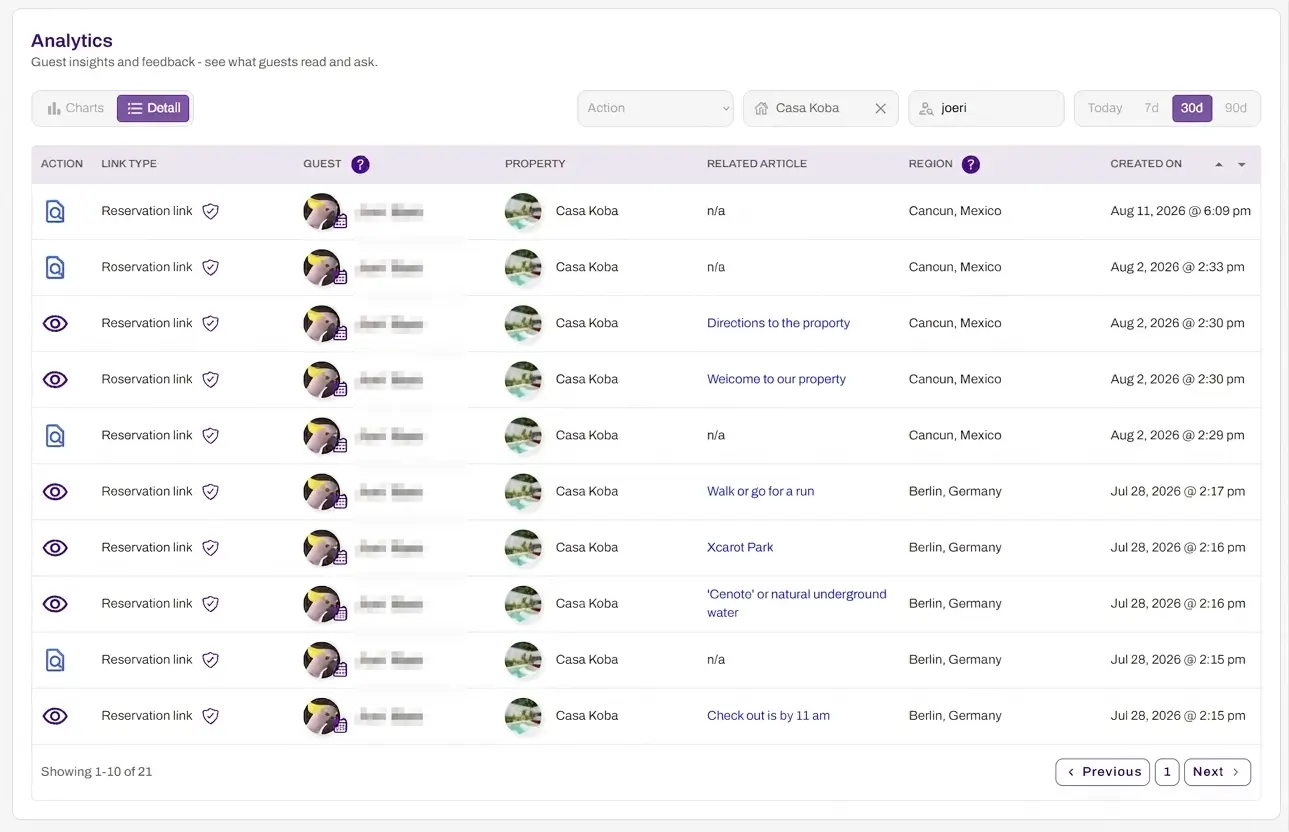
A single guest at one of our Riviera Maya properties produced 61 recorded events in the window. Ten of them landed inside seven minutes, in this order:
WiFi Code
Welcome to our property
Check in time starts at 4 pm
Arriving earlier? Please ask us
Policy use of our towels and linens
A friendly reminder of what you agreed
14-cup ground coffee maker
Gas stove and oven
Filtered water
Cenote, or natural underground water
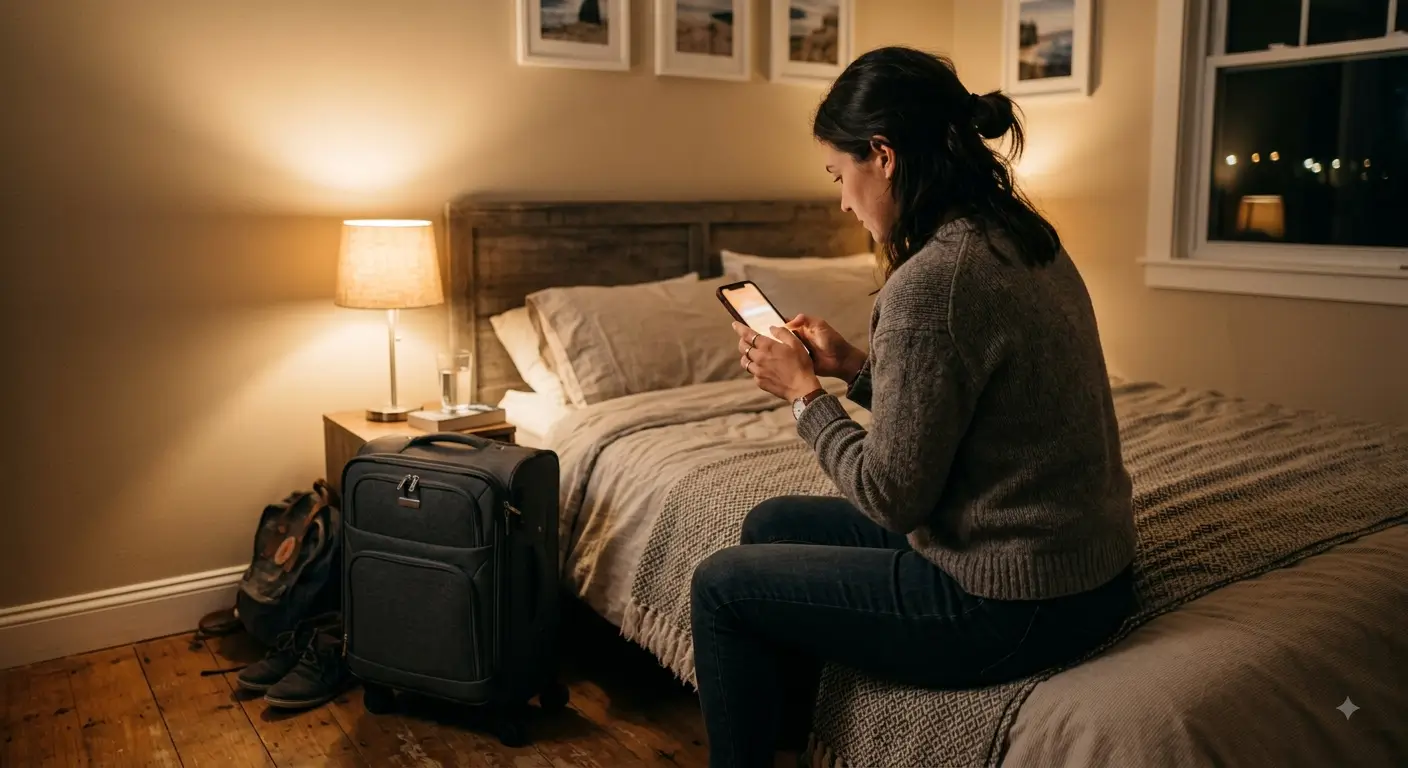
Ten articles in seven minutes is not close reading, even though these are short articles. And every one of those events resolved to a European city rather than to Mexico, so this was somebody working out what they were walking into from home, before the trip.
So there are two moments, not one. An early sweep, usually before arrival, and then the day-three question when somebody cannot work out the fan. The sweep is where your practical articles earn their place. The day-three question is the one that turns into a message, because nobody remembers on day three which article they skimmed on a sofa two weeks earlier.
Across our portfolio in the Riviera Maya, a few articles take most of the views
Over the same 90-day window, views concentrated far harder than we expected. These are exact counts, not estimates:
Article title | Views | Upvotes | Feedback |
|---|---|---|---|
Welcome to our property | 164 | 14 | 0 |
WiFi Code | 147 | 0 | 0 |
Directions to the property | 132 | 11 | 6 |
About your hosts | 112 | 22 | 0 |
Airport and private group transport | 18 | 0 | 1 |
Tap water is not safe in Mexico | 17 | 0 | 1 |
Each individual restaurant, bar or beach recommendation | ~ 1 per article | ~ 10% of articles | ~ 5% of articles |
Other articles | 60 | 3 | 2 |
The cliff is the part to look at. Four articles sit between 112 and 164 views. The next highest is 18. That tells you what belongs at the top.
It does not tell you what to delete. A view count measures how often a question comes up, not how much the answer is worth. The tap water article was opened 17 times, and if it settled the question for those 17 guests it did more for our inbox than its place in the table suggests. An article read once, by the one guest who needed it at the moment they needed it, has done its job. Most of a guidebook is articles like that, and the restaurant and beach entries are only the most visible part of the tail.
Two things to hold before leaning too hard on that. "Welcome to our property" is where guests land, so part of its lead is structural rather than appetite. And a guest tapping through to a restaurant's map registers as a link click rather than an article view, so views alone understate recommendations. Ninety days across four small properties in one region is one window, not a law.
What the numbers do settle is the ordering question. Local recommendations take the longest to write and averaged about one view each, while wifi, directions and the articles about how the property physically works absorbed most of the traffic. Roughly one in ten recommendations still collected an upvote, so they are landing with somebody. We have not stopped writing them. What we stopped doing is letting them set the structure.
The other surprise was "About your hosts." Fourth on views, first on upvotes by a distance: 22, against 14 for the welcome article and none at all for the wifi code. Nobody upvotes a wifi password, because it is a thing you needed rather than a thing you enjoyed. Views tell you what guests were looking for, and upvotes tell you which articles they actually liked.
Engagement is more than views
A view only tells you a page loaded. The useful signals are the ones where a guest did something deliberate.
Action | What it tells you |
|---|---|
Page view | The guidebook was opened at all, the crudest yes or no |
Article view | Which specific questions your property generates |
Article feedback | Whether that article answered the question, from the guest rather than your guess |
Upvoted | Which articles and recommendations guests actively liked |
AI Concierge session started | The structure did not answer them, so they asked instead |
AI Concierge negative feedback | A named content gap, with the guest's own reason attached |
External link click | Interest in something you recommended that never shows as an article view |
Link click | The guest went to maps or search instead of your write-up |
Contact registered | A guest chose to leave their own details, with their own consent |
The last two rows of that list are the ones that tell you what to write next. When a guest starts an AI Concierge session, the structure did not answer them. When they mark the answer unhelpful, they pick a reason: it did not answer the question, it was not detailed enough, or it was misleading. That is a triage queue with the diagnosis already attached.
A real one from our own guidebook: a guest asked whether there was cooking oil or olive oil on site. The AI Concierge confirmed the electric oven and toaster, said the guide does not mention cooking oils, and told the guest to contact us. That is the behaviour you want, because it is designed to answer from published guidebook content rather than filling gaps with assumptions. It is also a flag. Somebody wanted to know what was in the kitchen and we had not written it down.
Feedback and upvotes work from the other direction. Directions drew six feedback events, more than any other article, which is a signal to go and read that one properly rather than assume it is fine.
If your guidebook platform reports engagement, those signals are what tell you where to spend your next hour. Ours shows it as guest insights and analytics at the article level, per property.
Guests do not read entire guidebooks. They look things up.
Once you see the behaviour as lookup rather than reading, a lot of guidebook advice stops making sense. A beautifully designed 56-page PDF made in Canva is a bad reference document, not because it is badly written but because finding one fact inside it takes longer than sending you a text. The guest is not choosing between your guidebook and nothing. They are choosing between your guidebook and messaging you, and whichever is faster wins.
That is also why guests reach for their phone first. The research below is hotel-side and a few years old, but nothing since has pointed the other way.
"Nearly three-quarters (73%) of travelers want to use their mobile device to manage their hotel experience, including checking in and out, paying, ordering food, and more."
Oracle Hospitality and Skift, Hospitality in 2025, June 2022
How to build a guidebook people can look things up in
Write short articles, titled in the guest's words. One subject per article. "Wifi" beats "Connectivity and Entertainment." If your building calls it the mechanical room and every guest calls it the laundry, put both words in the title.
Put the practical set first, and keep the human one close behind. Entry, wifi and directions are what our numbers say people open. The article about who you are came fourth on views and first on upvotes, so it does not belong at the bottom.
Link to the article, not the front page. Sending a guest asking about the pool heater to the front page makes them hunt again. Send them to the one article that answers it. Keep a single version of it, too: the moment the same information lives in a binder, a card and a message template, two of them go stale.
Read your own gaps. Every AI Concierge question and every thumbs-down is a guest telling you which article is missing or too thin. Write that one next.
None of this requires the guest to be on Airbnb. A vacation rental guidebook you own works the same for a Vrbo booking, a direct booking or a returning guest, which is part of why it is a sensible place to put effort if you are also working on direct bookings. It does need an internet connection to load, so anything a guest needs before they are through the door belongs in a message too.
Put the QR code where the question happens
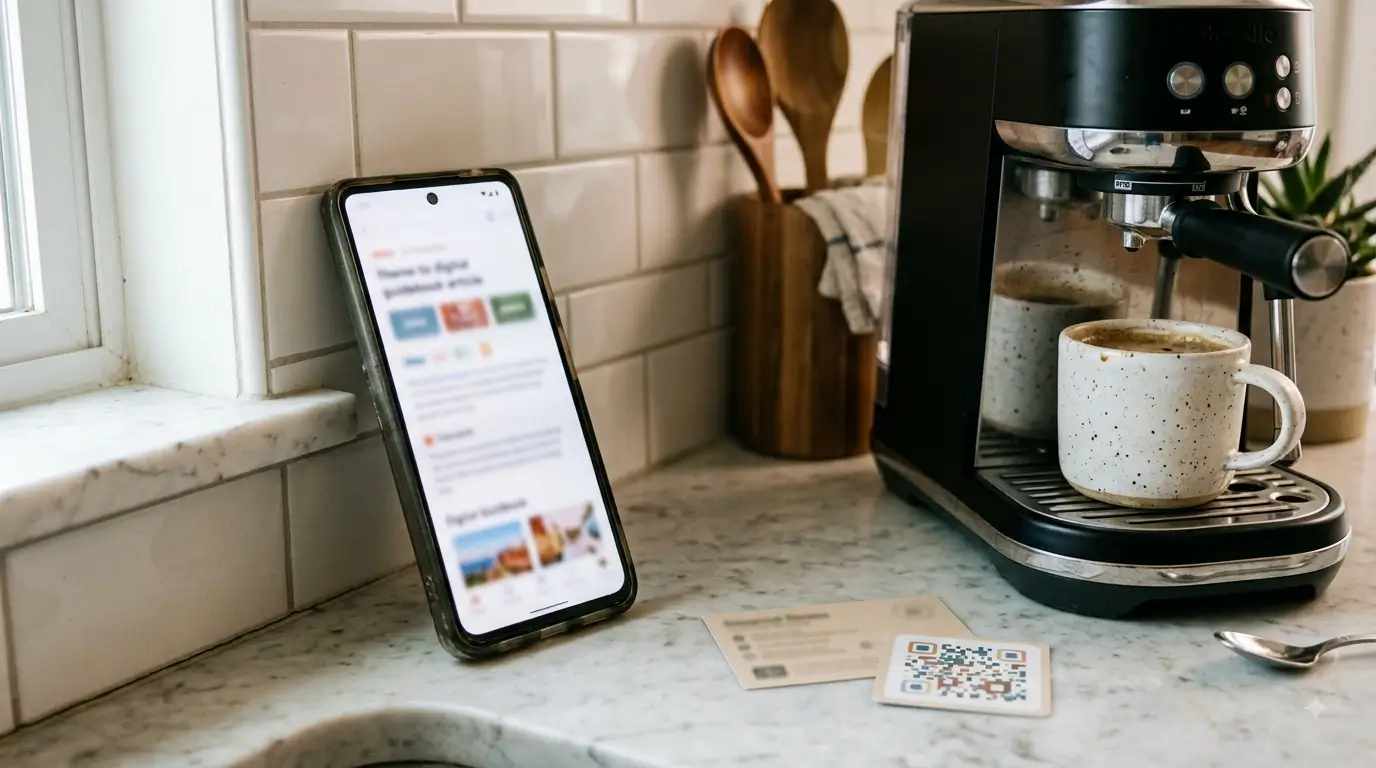
The change that moved our numbers most had nothing to do with writing. We started putting small QR codes next to the thing they explain, each one linked to a single article rather than the guidebook home page.
The example that convinced us was a water filter at one of our Mexico properties. A guest messaged to ask whether the filtered water was safe to drink. We had an article covering exactly that, and the article was fine. Getting to it took more effort than typing the question, so the guest typed the question. We printed a small code, stuck it next to the filter, and pointed it at that one article. We have not been asked about the water since.
We saw the same pattern with the outdoor fans at another property, where there is a wall switch and a separate remote and no obvious relationship between the two. After we added a small labelled code by the switch, those questions stopped appearing in our messages. What made the difference inside the article was a photograph of the remote.
That photograph is worth dwelling on, because a guidebook is a visual surface and many hosts write theirs like a legal document. Written instructions assume the reader can map your words onto the object in front of them, and with unfamiliar hardware that assumption fails often enough to matter, particularly for older guests. A photo of the actual remote, with the right button visible, does the job in a second. For a genuinely awkward sequence a short video does it better still, and a printed binder cannot show one at all.
The code works because it removes the search step, and it lands on exactly the day-three problem the early sweep cannot solve. The guest is already standing in front of the thing confusing them. A single code at the front door pointing at the whole guidebook does not do this, because the guest still has to navigate once they land.
Where we put them now:
Beside anything with a non-obvious control: water filters, fans, pool equipment, thermostats, coffee machines
Near the router for wifi, inside the front door for checkout, and on the bins, where collection rules change and a printed card goes stale
Keep the codes small and label them in plain words. And do not code every surface; four to six around a property covers most of the recurring questions. QR codes paired with deep links are what let a physical code open one article rather than the front page.
Where the printed version still earns its place
Some guests genuinely prefer paper. Older travellers often do, and so do parts of the luxury and boutique market where a printed welcome book for guests reads as care rather than clutter. Saying "guests do not touch paper" would be wrong, and it is the kind of overclaim that costs you credibility.
The honest position is narrower. Paper cannot be searched, cannot show a video, cannot be updated without reprinting, and cannot tell you whether anyone used it. It is a fine welcome object and a poor reference tool. A card by the door with a QR code and two lines of text is not competing with your digital guidebook, it is pointing at it. We compare the formats properly in paper versus digital guest guides.
What this changes for your operation
None of this guarantees fewer messages. Operators who put the practical set first and keep it accurate generally field fewer routine questions, and that is as strong a claim as the evidence supports. What measuring changes is where the effort goes: you stop rewriting articles that already work and start writing the ones guests keep asking about.
Across a portfolio it compounds, because one correction propagates instead of five. When the trash collection day changed at one of our co-hosted properties, the fix was an edit rather than a reprint. And "we could not work out how to use X" shows up in reviews more than most hosts expect, which is an information problem rather than a property one. We covered those tactics in how to reduce guest questions.
Building one from scratch? Start with what to include in an Airbnb digital guidebook, then revisit the ordering once you have real opens to look at.
FAQ
Do guests actually read the Airbnb house manual?
They open it and use it, but rarely end to end. If your house manual is one long block of text, expect low use, because it is hard to scan on a phone at the end of a travel day. Break it into short articles with titles a guest would actually search for.
When do guests open the guidebook?
Earlier than most hosts assume. In our own data the first substantial read is often days before arrival, from home: one guest opened ten articles in seven minutes from another continent. After that, opens are sporadic and tied to whatever the guest is trying to do at that moment.
How do I know whether my guidebook is working?
Look past views. The questions guests ask the AI Concierge tell you what is missing, a thumbs-down tells you which answer was too thin, article feedback and upvotes tell you what is landing, and link clicks tell you what guests followed up on. A view on its own only tells you a page loaded, and a low view count is not failure. It usually means the question comes up rarely, not that the answer was wasted.
Why do guests still message me about things that are in the guidebook?
Usually the information is buried, the article is titled in your words rather than theirs, or messaging you is simply faster than searching. The fix is structural rather than telling guests to read it. Shorten the articles, retitle them, and for anything attached to a physical object, put a small QR code next to the object that opens that single article.
Does Airbnb tell me whether guests opened my guidebook?
Airbnb's guidebook feature is built around local recommendations, while check-in and property details reach guests through separate guest-facing flows that Airbnb has renamed and reworked more than once. At the time of writing, neither gives hosts article-level engagement data. That is why most hosts who care about this run a separate vacation rental guidebook they control.
Should I still print a binder or an Airbnb welcome book?
Keep a small printed piece if you like the way it looks, but do not treat it as your reference. A card by the door with a QR code and the wifi network name covers the guest who has no signal. Everything that changes, from collection days to lockbox codes, belongs somewhere you can edit once.
If you would rather not format all of this yourself
You can have a digital guidebook running in minutes, with your own branding, QR codes, deep links to individual articles, and analytics that show the questions as well as the views. There is a free tier for a single property if you want to set one up without a card. Our write-up on building a guidebook guests actually use is a good next stop either way.
Latest articles

How to Automate Check-In Instructions for Short-Term Rental Guests
Automate check-in instructions for short-term rental guests: the four-send sequence, what goes in a message versus a guidebook, and a copy-ready sample.

Vrbo Premier Host in 2026: Every Listing Now Stands on Its Own Record
Vrbo Premier Host requirements changed in 2026: per-listing scoring, tighter thresholds, quarterly checks. What each one means, and how it compares to Superhost.
Booking.com Guest Messaging Rules: What Hosts Can Send, When, and Why Links Get Removed
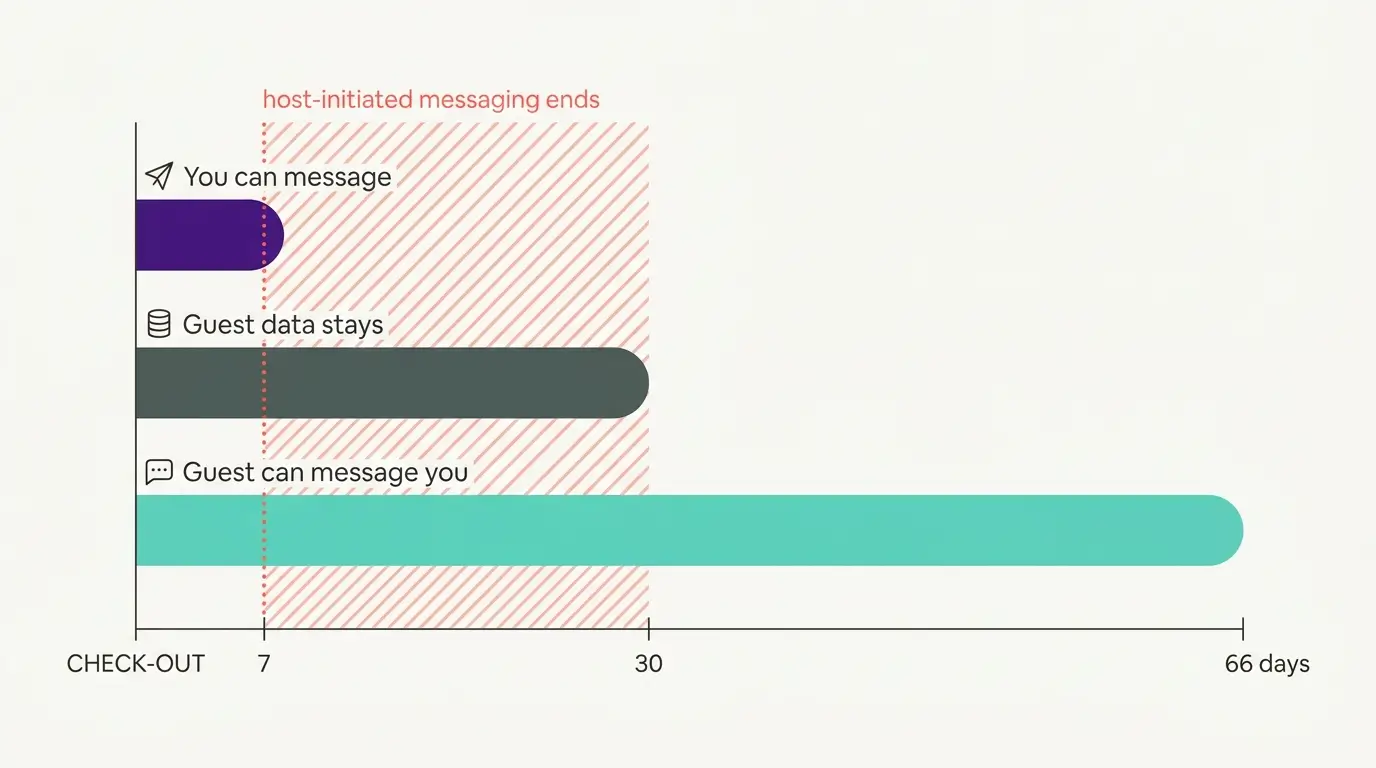
Booking.com guest messaging rules, verified at source: how long you can message a guest, why your links get removed, and what the partner terms say.
Vrbo's New Features for Fall 2026: What's Live, What's Gated, and What's US-Only
We sorted Vrbo's new features for fall 2026: what is live globally, what is gated behind eligibility, and what is US-only. Verified against Vrbo's own pages.