How to Get Direct Bookings for Your Vacation Rental (Without Risking Your Airbnb Account)

Published
Last updated
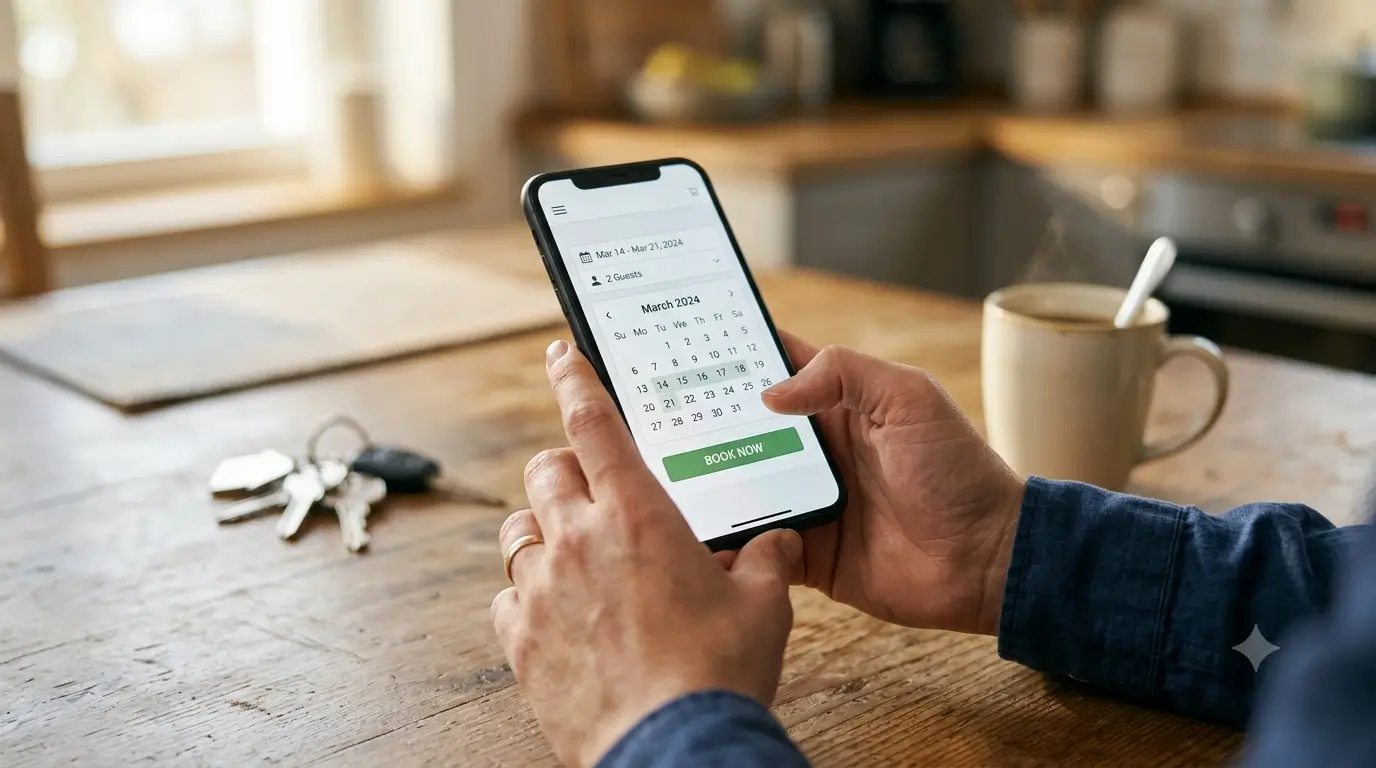
Direct bookings for vacation rentals require a two‑step approach: a booking site or engine to handle reservations and payments, and a consent‑based system to capture guest contact information after the booking. By avoiding prohibited email harvesting from Airbnb, using tools like Hospitable Direct for the booking layer, and building a compliant guest list, hosts can grow repeat business safely and reduce reliance on OTA platforms.
Every host has had the same thought watching a payout land lighter than what the guest actually paid: what if they had just booked with me?
That thought is where most direct-booking plans start, and it is also where most of them go wrong. The usual next step is some version of "I'll collect my Airbnb guests' emails and market to them later." That plan is against Airbnb's rules, and it does not work mechanically either. Airbnb does not give you the email.
Here is the version that actually works.
How do you get direct bookings for your vacation rental?
You need two things. First, somewhere for guests to book: a booking site or booking engine that holds your calendar, takes the reservation, and takes the payment. Second, a way to own the guest relationship after the booking: a contact list built with explicit consent, on channels whose terms allow it. Direct bookings then grow mostly from repeat guests and word of mouth, slowly at first. What you cannot do is harvest contact details from your Airbnb guests to seed that list.
That second half is the part nobody wants to hear, so let's get it out of the way first.
The myth: "I'll just collect my Airbnb guests' emails"
You cannot. Airbnb's Off-Platform and Fee Transparency Policy is unusually direct about this, and the list of prohibited behaviors is longer than most hosts realize:
Asking guests for contact information prior to booking; all guest communications prior to booking must be on Airbnb. Soliciting guests for their email, mailing address, or other communications channels using the Airbnb messaging system or email alias after a booking… Selling, sharing, or using guest contact information for marketing communications or signing guests up for contact list.
Read that last clause again. Signing guests up for a contact list is named specifically. It is not a grey area someone forgot to close.
The same policy prohibits "asking or encouraging users to move current, future, or repeat bookings (including reservation extensions) off of Airbnb," and it prohibits "including links that take people off of the Airbnb platform in listings or messages." That second one catches a lot of hosts who think they are being subtle. Your booking site URL in your listing description is a violation. A "find us at" line in your check-in message is a violation. A QR code in the kitchen that goes to your booking page is the same idea wearing a hat.
Airbnb enforces at its own discretion, and the policy says repeated or severe violations can mean suspension or permanent deactivation. You are risking the channel that pays your mortgage to build a list you are not allowed to have.
You don't get their email anyway
Even if the policy vanished tomorrow, the plumbing is not there. Airbnb retired the email alias feature, and since late 2023 hosts don't receive a guest email address at all, aliased or otherwise. What you get is in-app messaging, plus whatever contact details Airbnb chooses to share with you for the purpose of running that specific trip.
Those details are for the stay. Using them for anything else is the "using contact information provided by Airbnb for other purposes" clause of the same policy.
So the honest starting position is this: your Airbnb guests are Airbnb's guests. Host them beautifully, earn the review, and let the platform do what the platform does. Your direct business gets built somewhere else.
Why this matters more in 2026 than it did three years ago
Two things changed.
The first is fee structure. Airbnb has been moving hosts onto a single host-side service fee, where the entire fee comes out of your payout and the guest-facing fee disappears. Per Airbnb's own service fee page, most hosts on the single-fee structure pay 15.5%, and the split-fee structure is going away for a widening set of hosts. Whether that is good or bad for your specific listing depends on how you reprice. What is not debatable is that a single channel now visibly takes a sixth of the top line, and it shows up on your statement every month instead of being hidden in the guest's checkout.
The second is concentration risk. One algorithm change, one policy shift, one account issue you did not cause, and a business with one channel has zero channels. We have watched search placement move for reasons nobody explained.
Direct bookings are not a way to get rich. They are a way to not be a tenant on someone else's platform.
The honest path has two layers
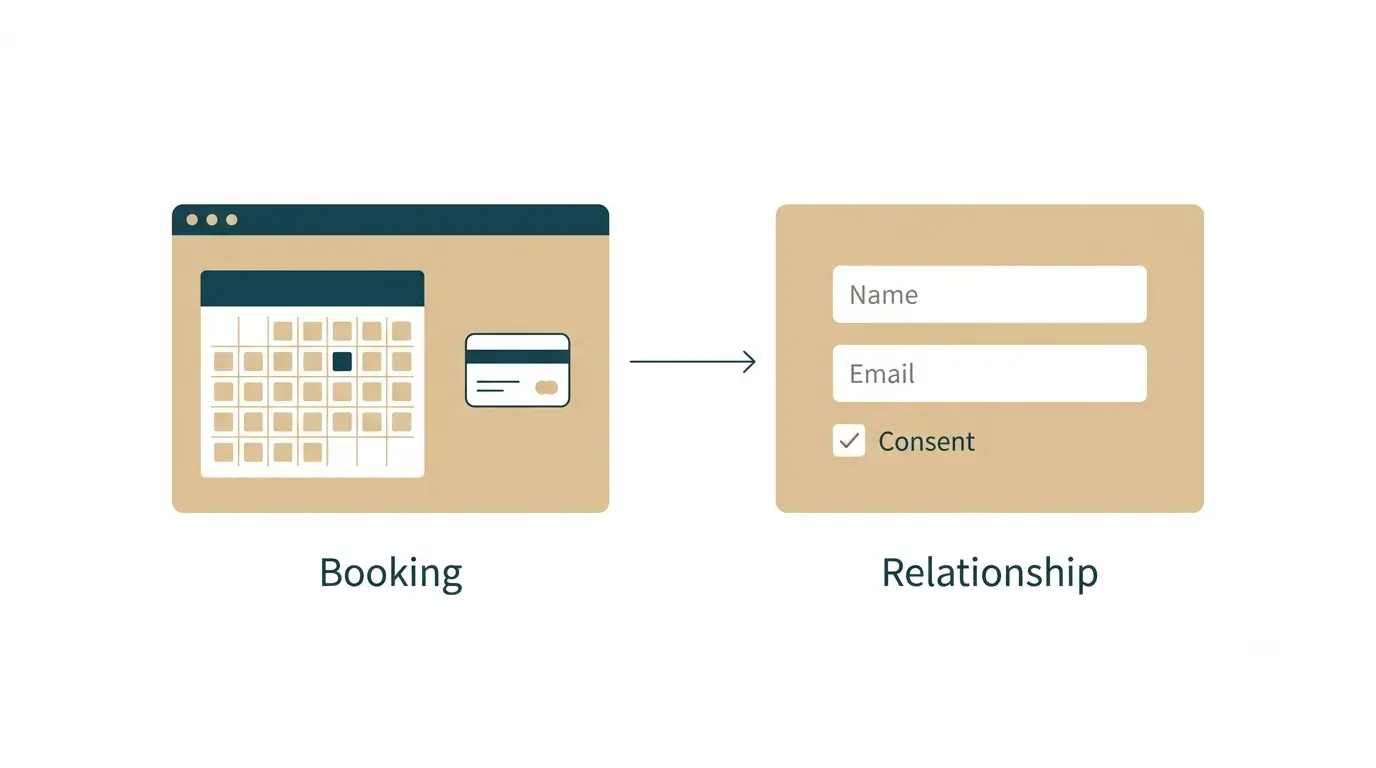
Most direct-booking advice mashes these together and it makes the whole thing sound harder than it is. They are separate jobs, and different tools do them.
Layer | The job | What handles it |
|---|---|---|
Booking | Show availability, take the reservation, take the money, sync the calendar so you don't double-book | A booking site or booking engine |
Relationship | Capture who the guest is, with consent, so you can invite them back next year | Your registration flow and contact list |
Trust | Screening, damage protection, chargeback protection | Your booking tool's screening layer, plus insurance |
You need the first before the second matters. A contact list with nowhere to send people is a spreadsheet.
Layer 1: the booking site
Today, we are using Hospitable Direct and we recommend it. One tool, not a shortlist, because a shortlist is how hosts spend four months evaluating and zero months booking.
Why it: it stands up a branded booking site on your own domain, takes payments, syncs reservations back against your Airbnb and Vrbo calendars so a direct booking blocks the OTA calendar automatically, offers guest screening and damage protection on the higher tier, and pushes your listings to Google Vacation Rentals so there is actually a demand source pointed at your site. The pricing is a small percentage of the booking rather than an OTA-sized take rate. Check their pricing for current numbers; percentages move.
Full disclosure, in both directions: we have no affiliate or partner deal with Hospitable and there are no tracking tags on that link. We recommend it because we run Hospitable as our own PMS across our properties and the direct product sits inside the thing we were already using. That is a real reason and also a limited one. If you run a different PMS, your PMS probably has a direct-booking product too, and the calendar-sync argument points you there instead.
And if you don't want a whole property management system like Hospitable, a booking widget is the simpler path. BNBForms is one worth a look. You paste a "Book Now" widget onto whatever site you've already got, whether that's WordPress, Squarespace, Wix, or a Framer page. It syncs your calendar to Airbnb over iCal so nothing double-books, and it handles the payment. Flat monthly fee, no cut of your bookings.
What matters more than the tool is that the booking lives somewhere that is not a Google Form and an emailed invoice. Guests can tell.
What belongs on a booking site
The bar is not "as good as Airbnb." The bar is "a normal person will put their card in."
Real photos and a real price. The nightly rate, the cleaning fee, and the total, before they have to enter anything.
Instant availability. A calendar that is actually current. Nothing kills a direct booking like "let me check and get back to you."
A cancellation policy in plain words. Guests booking direct are giving up Airbnb's safety net. Tell them what yours is.
Who you are. Names, faces, the fact that a human owns this. This is your entire advantage over a platform listing.
Payment that looks like payment. Card on a secure checkout, confirmation email, done.
A reason to book direct. Not a discount race. Better cancellation terms, a late checkout, the room you actually prefer, first pick of dates next season.
Your house rules and any registration requirements, visible before booking, not sprung afterward.
What does not belong: a login wall, a 14-field form, or a "request to book" button that goes to your personal inbox.
Layer 2: a contact list that is actually yours
Now the part you can build without looking over your shoulder.
Decide which channels feed the list, and write it down. Direct bookings: yes, unambiguously, they are your guests. Airbnb: never, for the reasons above. Vrbo shares a guest's email and phone with the host after a booking is accepted, but "we were given it" is not the same as "we may market to it." Read that channel's current terms, and remember consent and privacy law (GDPR, CCPA, and whatever applies where your property sits) apply on top of any platform's rules.
Ask at a moment that makes sense. The natural one is registration or check-in, on your own surface, after the booking exists. A guest filling in who is arriving expects to give you a name and an email. That is not marketing, that is hosting.
Ask for consent separately. An unticked box that says something like "Email me when we open next season's dates" is not decoration. It is the difference between a list and a liability. Never bundle it into the booking terms.
Store it somewhere you can export. If you cannot get a CSV out, you do not own it. You are renting it from a different vendor.
Give them a reason to say yes. "Join our mailing list" earns nothing. "Repeat guests get our dates two weeks early" earns something.
Then barely use it. Two or three emails a year. Dates opening, a genuine thank you, maybe one thing about the neighborhood that isn't a pitch. A list you email monthly is a list that unsubscribes.
How we handle it
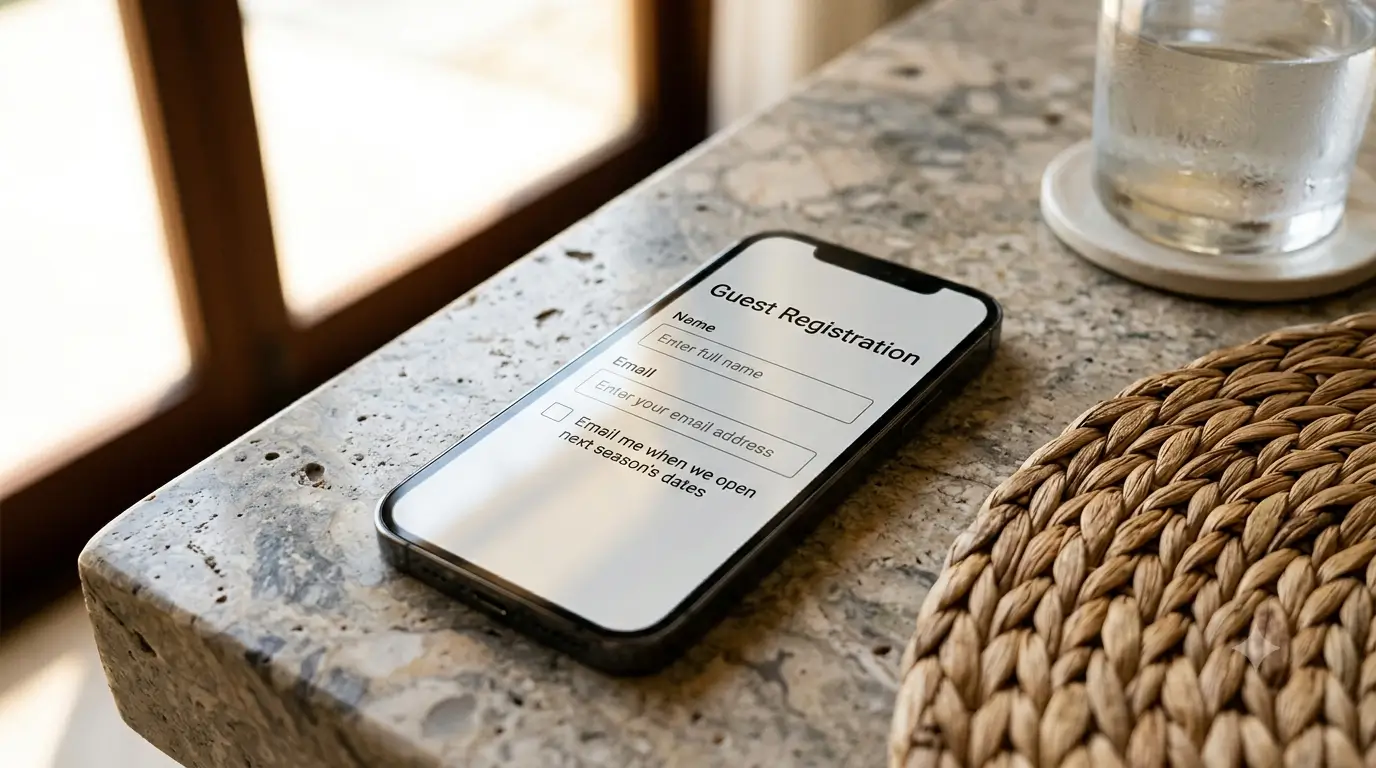
We built our Guest Registration widget for exactly this shape of problem: it captures name, email, phone, and marketing consent at the moment a guest registers, and the contact list exports to CSV whenever you want it.
The part that matters here is OTA Compliance Mode. It reads the booking source, and for Airbnb-sourced reservations the contact and consent fields simply do not render. Not hidden behind a warning, not left to your memory at 11pm. They are not there. Your Airbnb guests get the guidebook and the arrival information; your direct and eligible-channel guests get the registration flow that builds your list. One system, and the line stays where Airbnb draws it.
A clear division of labor, since it's the question we get asked: we are not the booking site, and we do not screen guests. Hospitable Direct takes the reservation and the payment and runs screening. We handle what the guest reads, asks, and consents to after the booking exists. Different jobs, and we would rather do ours well than half-do three.
A realistic timeline
Here is what nobody selling direct-booking courses will tell you: it is slow, and the first bookings are people who already stayed with you.
Stage | What's actually happening | What to expect |
|---|---|---|
Months 0–3 | Site is up, calendar syncs, registration flow is capturing consent on eligible bookings | Roughly zero direct bookings. This is normal. You are building inventory of a different kind. |
Months 3–12 | First repeat guests come back around. Word of mouth from people who loved the stay. | A handful. Every one of them is a guest you already earned. |
Year 2+ | The list has a season's worth of consenting guests. Google Vacation Rentals and search start contributing. | A meaningful minority of your calendar. Most hosts never get past this, and that's fine. |
The goal was never 100% direct. A business where one channel cannot end you is the whole prize. If direct is a fifth of your nights and your best guests come back on their own, you have won the actual game.
Which is why the fastest lever on direct bookings is not the booking site at all. It's whether people want to come back. That happens during the stay, not after it, and it's covered properly in how to get repeat guests for your vacation rental.
FAQ
Can I ask Airbnb guests for their email after checkout?
No. Airbnb's Off-Platform Policy prohibits soliciting guests for their email or other communications channels through Airbnb's messaging system after a booking, and separately prohibits signing guests up for contact lists. Checkout does not open a window.
Does Airbnb give hosts the guest's email address?
No. Airbnb retired the email alias feature, and hosts have not received guest email addresses since late 2023. You get in-app messaging and the contact details Airbnb shares for running that trip.
Can I put my direct booking website link in my Airbnb listing?
No. The policy explicitly prohibits including links that take people off the Airbnb platform in listings or messages. That covers your listing description, your messages, and anything functionally equivalent.
Can I email guests who booked through Vrbo?
Vrbo does share the guest's email and phone with the host after a booking is accepted, which is a real difference from Airbnb. Being given an address is not consent to market to it, though. Check Vrbo's current terms, get explicit opt-in, and comply with the privacy law that applies to you.
How many direct bookings will I get in the first year?
Realistically, very few depending on your market, and most of them repeat guests. Hosts who expect a filled calendar in month three quit in month four. Treat year one as building the asset.
Do I need a PMS to take direct bookings?
Not strictly, but you need calendar sync from day one or you will double-book. If you run one property on one channel, a booking engine alone can work. Two or more properties, or two or more channels, and a PMS stops being optional.
Getting the booking site up is a weekend. Getting guests who want to come back is the actual work, and it happens during the stay.
If you'd rather not hand-build the guidebook, the registration flow, and the marketing consent handling yourself, you can have all three running in minutes. Start your free 14-day trial, no card needed.
Latest articles

How to Automate Check-In Instructions for Short-Term Rental Guests
Automate check-in instructions for short-term rental guests: the four-send sequence, what goes in a message versus a guidebook, and a copy-ready sample.

Vrbo Premier Host in 2026: Every Listing Now Stands on Its Own Record
Vrbo Premier Host requirements changed in 2026: per-listing scoring, tighter thresholds, quarterly checks. What each one means, and how it compares to Superhost.
Booking.com Guest Messaging Rules: What Hosts Can Send, When, and Why Links Get Removed
Booking.com guest messaging rules, verified at source: how long you can message a guest, why your links get removed, and what the partner terms say.
Vrbo's New Features for Fall 2026: What's Live, What's Gated, and What's US-Only
We sorted Vrbo's new features for fall 2026: what is live globally, what is gated behind eligibility, and what is US-only. Verified against Vrbo's own pages.