
Airbnb is moving all hosts to a mandatory single‑service‑fee model, charging about 15.5% on the host side starting September 15 (Outside EEA) or October 13 (Inside EEA) 2026, which will reduce payouts unless listings are repriced. Hosts should adjust their nightly rates before the deadline and focus on building direct demand to protect margins and avoid reliance on a single platform.
You have a deadline. If you live outside the European Economic Area, it's September 15. Inside the EEA, October 13. Let it pass without touching your prices and every booking you take after that pays you roughly 13% less for the same night, in the same house, with the same guest.
That's the emergency. The rest of this is context.
What is Airbnb's single service fee?
Airbnb is replacing its split fee with one flat fee taken entirely from the host side. Under the split fee, you paid about 3% and your guest paid 14.1% to 16.5% on top of your price. Under the single fee, most hosts pay 15.5%, deducted from your price to calculate your payout, and the separate guest service fee disappears. The nightly price you set becomes the price the guest sees, before taxes.
Airbnb's total cut of the booking barely moves in most markets. Your payout does, if you don't reprice.
The deadlines
Airbnb has been moving hosts across in waves for almost a year. Hosts using property management or channel management software went first, some in late 2025 and the rest on April 13, 2026. Hosts in Peru and South Korea switched on May 25, Germany and the UK on June 22. Now it's everyone else, including hosts who run their listings by hand.
Where you live | Deadline to adjust your prices |
|---|---|
Outside the European Economic Area | September 15, 2026 |
Inside the European Economic Area | October 13, 2026 |
Those dates come straight from Airbnb's own "Simplifying service fees on Airbnb" update, posted July 7, 2026.
One caution before you file this as settled. Airbnb's help center still describes the single fee as mandatory for "certain hosts" and notes that exceptions may apply. Read the host press and you'll see it flattened to every host, everywhere, by the end of 2026, and that's probably where it lands. But your date is the one in your email and your host dashboard, not the one in a blog post. Ours included.
What happens if you do nothing
You adjust your price | You do nothing | |
|---|---|---|
Your listed price | $115 | $100 |
Guest pays | $115 | $100 |
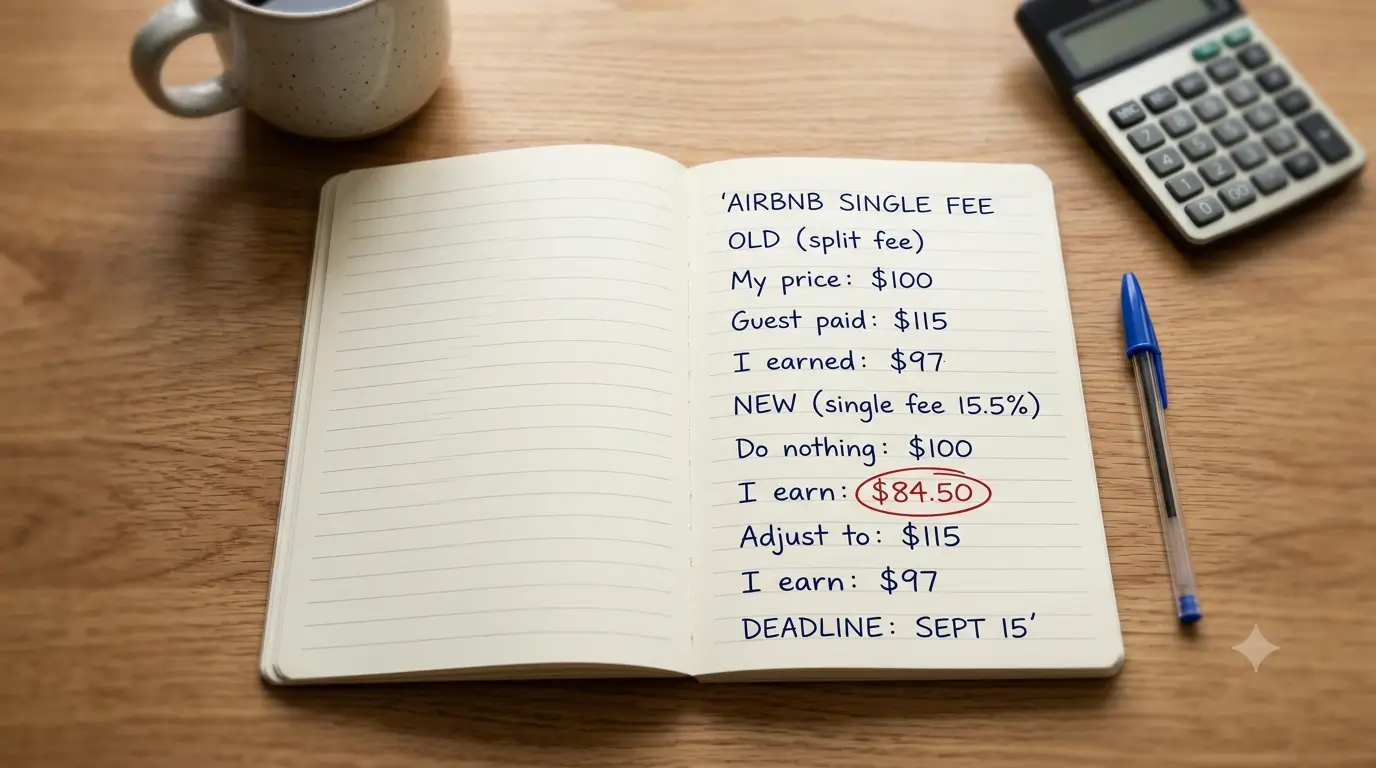
You earn | $97 | $84.50 |
That's Airbnb's own example, from their resource center. Same night, same guest, $12.50 gone. Across a 200-night year at $100 a night, it's $2,500 you handed back for no reason at all.
Airbnb built a price adjustment tool that runs the arithmetic across every active and inactive listing at once, including your cleaning fee, pet fee and extra guest fee, for the next two years of calendar. Two things worth knowing about it. It's one-way: once you use it to switch your fee structure, you can't go back to the split fee. And it adjusts your prices, not your judgment. It will happily push your nightly rate to a number your market won't pay in September.
Is this a fee increase?
Mostly, no. You're going to read a lot of posts this month telling you otherwise.
Run the math on Airbnb's own example. Split fee: guest pays $115, you keep $97, Airbnb takes $18, which is 15.7% of what the guest paid. Single fee: guest pays $115, you keep $97, Airbnb takes $17.83, or 15.5%. The old guest fee floated between 14.1% and 16.5% depending on the booking, so some of your reservations were already costing more than 15.5% and some less. Now it's flat.
One correction while we're here, because it's making the rounds: the single fee does not newly apply to your cleaning fee. It never didn't. The split-fee host service fee was already a percentage of your nightly price plus any fees you added. The base didn't change. Only the side it's collected from.
Where it genuinely costs more: Brazil pays 16%, and Mexico moved to 16% in June 2026. In most places VAT or GST is assessed on the service fee itself, which is why a UK host's effective rate lands north of 15.5%.
Why Airbnb is doing this
The official reason is pricing transparency, and it isn't a lie. Hosts have complained for years that they set $100 with no idea what the guest actually saw.
The unofficial reason is that regulators across Europe and the US have spent years pushing platforms toward all-in pricing, and a fee that materializes at checkout is precisely the thing they're pushing against. Moving it host-side makes the displayed price the real price. That's a bet on cleaner comparison shopping, better conversion and one less regulatory headache. Those are reasonable things for a company to want.
The part worth actually sitting with
Here's the change nobody is putting on a slide.
For years the fee was mostly invisible to you. Airbnb showed $115, you saw $100, and the 3% you paid felt like a rounding error. The other $14 was the guest's problem, or that's how it read on your statement.
Now your Airbnb listing says $115 and your payout says $97. The $18 isn't buried in the guest's checkout anymore. It's on your earnings statement, in your currency, every booking, forever. Airbnb just made the cost of the channel legible.
That's not a reason to rage-quit. Airbnb is the best top-of-funnel in this business and it isn't close, and $18 to put a stranger in your house is a fair price for the introduction. The question worth asking is narrower: is that the only way anyone will ever find you?
And there's a thing underneath the thing. This particular change is survivable: reprice, and your margin comes out where it started. But look at what actually happened. Airbnb restructured how you get paid, picked your deadline, and sent you an email. That's the entire transaction. You didn't get a vote, a vote was never on offer, and the only question anyone asked you was whether you'd do the paperwork in time.
That's fine when the change is neutral. The trouble is you have no way of knowing the next one will be. A channel that can rewrite your payout math and hand you a date is a channel worth having and a bad one to depend on entirely. Not because Airbnb is the villain here. Because one channel is a single point of failure, and this is the reminder.
The durable responses haven't changed, and none of them are exciting:
Price with the fee inside the number, not around it. Our pricing strategy post covers how we think about that.
Don't let one channel be the only place your guests can find you. This isn't the first Airbnb change this year to shift money or risk toward the host side, and the Extended Cancellation Option is worth reading alongside it.
Make the stay good enough that guests come back on purpose, and go earn an audience that finds you without a platform in the middle.
The third one is the slowest and the only one that compounds. It also has a rule attached that most of this month's advice is going to skip.
Before you sit down and build a direct-booking funnel, read the Airbnb rule
This is where a lot of the takes you'll read this month will quietly get you suspended.
Airbnb's Off-Platform and Fee Transparency Policy prohibits "asking or encouraging users to move current, future, or repeat bookings off of Airbnb." Repeat bookings are named, in writing. The same policy bans soliciting a guest's email or other channel through Airbnb messaging after a booking, and bans "selling, sharing, or using guest contact information for marketing communications or signing guests up for contact list." Airbnb says it may suspend or permanently deactivate listings or accounts for repeated or severe violations.
Read that again, because the popular version of the direct-booking pitch runs straight through it. The guest Airbnb introduced you to is not a lead you get to farm. Turning your Airbnb inbox into a mailing list isn't a clever growth hack, it's the thing accounts get deactivated for.
So be precise about what's actually yours:
Demand you generated. Your own website, your search traffic, your social following, word of mouth, guests who found you without a platform in the middle. Nobody can touch that.
Guests who come back on their own. You can't encourage an Airbnb-originated guest to make future bookings outside Airbnb, and you can't use Airbnb's messaging to nudge them there. A guest who looks you up next year without any of that is a guest you earned by hosting well.
Contact details collected on your own channel, with consent, under whatever privacy law applies where you operate. Airbnb does allow extra contact or identity collection where it's required for legal or compliance reasons, as long as it's disclosed in your listing description, and it puts the data-protection burden squarely on you. Read that narrowly: registering a guest because your city or your HOA requires it is compliance. It is not a mailing list with extra steps.
The distinction is boring and it's the entire game. Build a channel. Don't poach one.
What to do this week
Find your date. It's in the email Airbnb sent and in your host dashboard. Don't rely on ours.
Decide your new number before you touch the tool. Adjusting $100 to $115 keeps your payout at $97 and the guest's price identical. Whether $115 is still right for your market in September is a separate question, and a better one.
Check your fees, not just your nightly rate. Cleaning, pet, extra guest. The tool moves all of them.
Look at your discounts and promotions afterward. They calculate off the new prices.
If you're VAT or GST registered, read Airbnb's tax note before you assume the tool's number is your number.
Then go work on the demand you own: your own site, your own audience, the guests who find you with no platform in the middle. Within the rules in the next section, which are stricter than most people think.
Where we sit on this

We've already been through this one. Our listings in Washington, DC and across the Riviera Maya all run through Hospitable, so we moved to the single fee in the late-2025 wave, months before self-managed hosts started getting these emails.
Two things we took from it. The repricing was a few hours of work and then it was done, which is worth saying plainly if you're reading this with a knot in your stomach. And in June, Airbnb moved Mexico to 16%. Our Playa del Carmen and Tulum listings now pay a different rate than the DC row house, for reasons that have nothing to do with us, and we found out the same way you did.
Neither of those is a catastrophe. Both are reminders that the terms belong to somebody else.
Which is why the part we spend our own time on is the part that happens after someone books. That's the job we picked, and it's the one asset here nobody can reprice on you: a stay good enough that people remember who you are.
It's also why SmoothStay is built channel-aware instead of channel-blind. The guidebook, the AI Concierge that answers at 11pm so you don't have to, and guest registration all sit behind OTA Compliance Mode, which gates what a guest sees based on where their booking came from. Your Airbnb guests get the stay. Your direct guests get the rest. We built it that way because the alternative is handing hosts a very efficient way to lose their listing. Pricing, channel management and your booking engine are three other jobs with good tools behind them. Ours is the stay itself.
A fee you don't control is a decent week to go build the asset you do.
FAQ
When does Airbnb's single service fee take effect for me?
If you live outside the European Economic Area, September 15, 2026. Inside the EEA, October 13, 2026. Hosts using property management or channel management software were moved earlier, most on April 13, 2026. Check your host dashboard for your specific date.
How much is Airbnb's host service fee in 2026?
Most hosts pay 15.5% of the nightly price plus any fees they've added, like cleaning. Some pay 14% to 16%. Listings in Brazil and Mexico pay 16%. VAT or GST may be assessed on top of the fee depending on where you are.
Does the guest still pay an Airbnb service fee?
Not on a booking under the single fee. The guest pays the price shown on your listing before taxes, and the 15.5% comes out of your payout. Bookings still on the split fee, and any listing covered by an exception, work the old way.
What happens if I don't adjust my prices before the deadline?
Your prices stay where they are and your payout drops. On a $100 nightly price you'd earn $84.50 instead of $97, and your guest would pay $100 instead of $115.
Is the single service fee actually more expensive for hosts?
Not materially, if you reprice. Airbnb's cut lands in the same range it did under the split fee, because the old guest fee floated between 14.1% and 16.5%. The hosts who lose money here are the ones who miss the deadline.
Can I switch back to the split fee afterward?
No. Once you use the price adjustment tool to change your fee structure, the change is permanent.
Start with the part you own
Reprice before your date, then go spend an afternoon on the thing that outlasts the next policy email.
And if you'd rather not build a guest experience from scratch while you're busy repricing a whole calendar, you can have an Airbnb compliant guidebook running in minutes.
Sources, all reviewed July 16, 2026: Airbnb Help Center on service fees, the price adjustment tool and VAT; the Airbnb Resource Center on simplifying service fees and the country rollout; Airbnb's official Simplifying service fees on Airbnb update of July 7, 2026; and the Off-Platform and Fee Transparency Policy. Fees and dates change. Check your own dashboard before you act on any of this.
Latest articles

How to Automate Check-In Instructions for Short-Term Rental Guests
Automate check-in instructions for short-term rental guests: the four-send sequence, what goes in a message versus a guidebook, and a copy-ready sample.

Vrbo Premier Host in 2026: Every Listing Now Stands on Its Own Record
Vrbo Premier Host requirements changed in 2026: per-listing scoring, tighter thresholds, quarterly checks. What each one means, and how it compares to Superhost.
Booking.com Guest Messaging Rules: What Hosts Can Send, When, and Why Links Get Removed
Booking.com guest messaging rules, verified at source: how long you can message a guest, why your links get removed, and what the partner terms say.
Vrbo's New Features for Fall 2026: What's Live, What's Gated, and What's US-Only
We sorted Vrbo's new features for fall 2026: what is live globally, what is gated behind eligibility, and what is US-only. Verified against Vrbo's own pages.