
Clear, detailed check‑in instructions—covering address, entrance, parking, photos, access method, desk hours, and a contact—prevent late‑arrival frustration at small hotels. Providing these instructions before arrival and making them accessible on‑site via links, QR codes, or an AI concierge ensures guests can check in smoothly even when the front desk is closed.
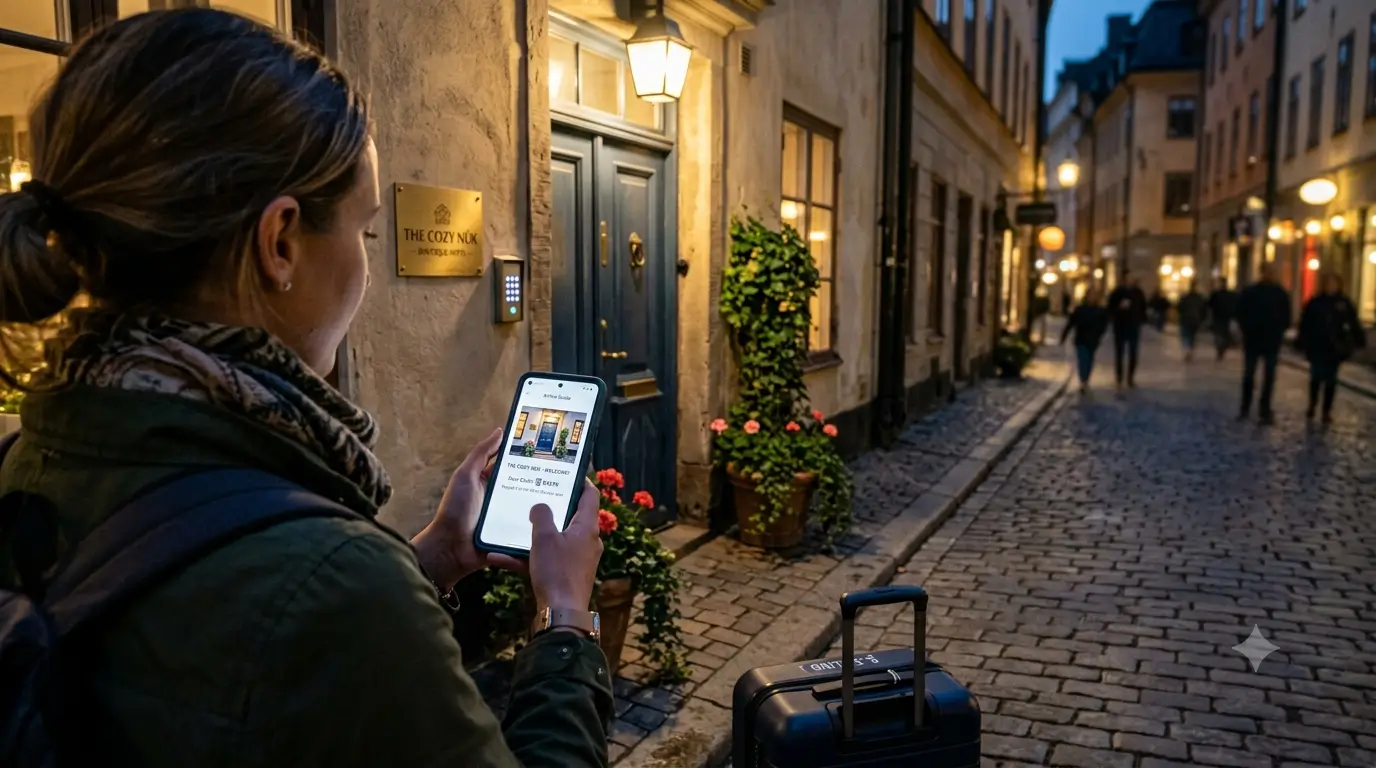
A guest lands at 11:40 pm in a city they have never driven in, hunting for a small hotel with no bright sign and a front desk that went dark at nine. How that arrival goes has almost nothing to do with how many people you have on staff. It comes down to one thing: did the instructions you sent survive contact with a tired traveler?
At a small or independent property, check-in friction is never spread evenly. It piles up in the edge cases: the late arrival after the desk closes, the guest who circles the block three times looking for parking, the annex room next door that nobody warned them about. You do not fix those with more front-desk hours. You fix them with arrival information good enough to stand in for a person who is not there.
We run short-term rentals in Washington, DC and the Riviera Maya, most of them remote, so guests let themselves in without us at the door. The lesson transfers straight to a small hotel: the arrival has to work on paper, because nobody is there to rescue it.
What should hotel check-in instructions include?
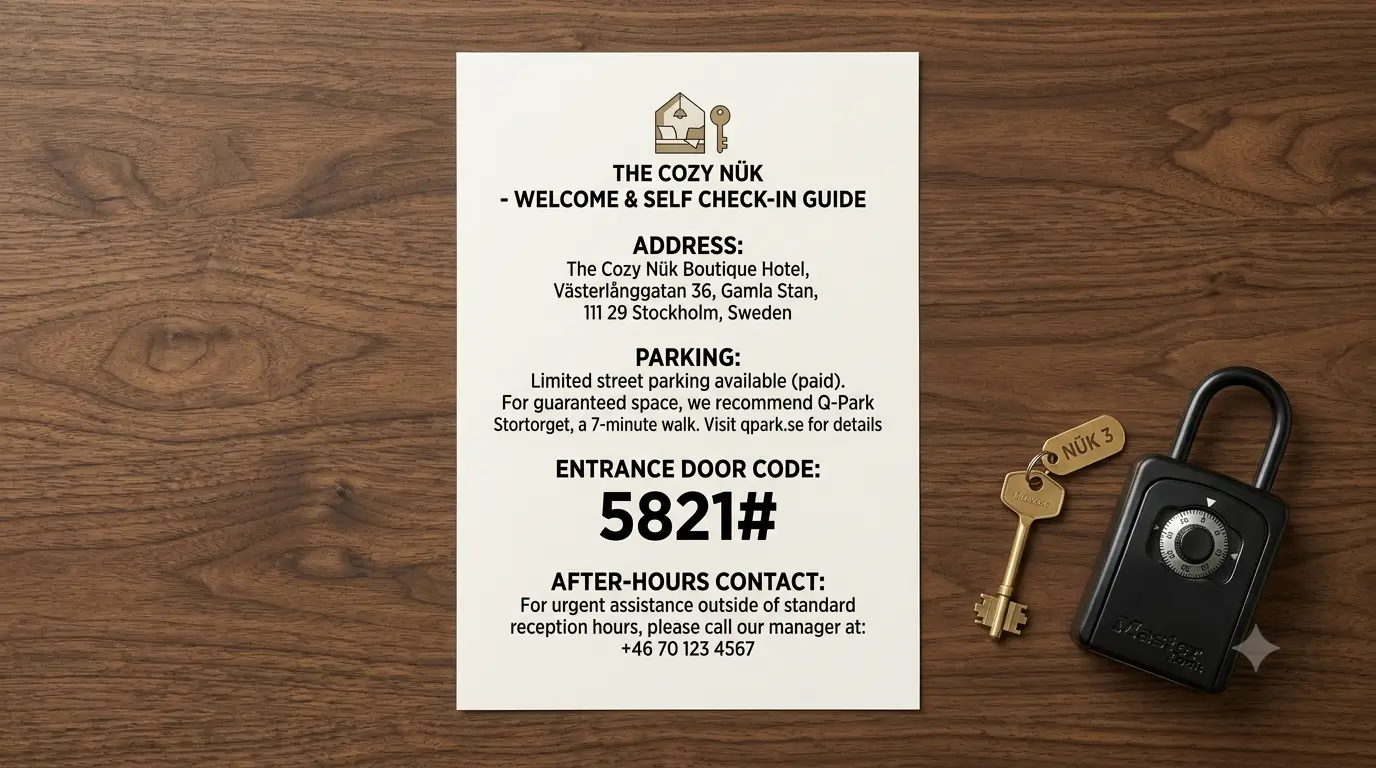
Complete hotel check-in instructions cover the exact address and the entrance guests actually use, parking, a photo of the door, the access method, front-desk hours, and a name and number to reach when something goes sideways. Send them before arrival, and make them findable again once the guest is standing outside in the dark. For a small property, that written detail quietly does the job a 24-hour desk does at a chain.
Copy the checklist below, fill in your own details, and you have a working arrival guide.
Full address, plus the entrance guests actually use. If the door is around the side or the lobby is on the second floor, say so. Map pins lie more often than people think.
Parking. Where to put the car, whether it costs anything, and what to do if the lot is full. "Street parking is fine after 6 pm" saves you a midnight text.
A photo of the entrance. One clear daytime photo of the exact door, so a guest can match what they see to what you sent.
The access method. Key code, lockbox, smart lock, or a key handed over at a set time. Spell out the steps: which button, which order, what happens if it beeps twice.
Front-desk or contact hours. When someone is physically there, and what happens outside those hours.
A name and a number. Who to call, and roughly how fast they will pick up. A number nobody answers is worse than no number at all.
What to do on arrival. Check-in time, where to go first, and whether anything is waiting for them (a welcome note, a key, a room number).
The complete instruction set, item by item
The address line is where most arrivals quietly go wrong. A guest pastes your address into maps, follows it to the front of the building, and finds a locked lobby because check-in is through a side gate. Write it the way you would tell a friend on the phone: the street number, then the detail that gets them to the right door.
In our first year as hosts, we discovered that nearly every midnight support call came from one of three issues: guests couldn't identify the entrance, couldn't find parking, or were reading outdated instructions. Fixing those reduced after-hours calls dramatically.
Depending on where you’re located, parking is the single most common arrival-hour question, and it is almost always answerable in advance. Guests do not want options. They want the one thing you would tell them to do: name the lot, the street, or the garage, note the cost, and give them a fallback for when it is full.
Access instructions should be numbered steps, in order, one action per line.
Find the keypad to the right of the main door.
Enter the four-digit code from your confirmation, then press the key symbol.
Wait for the green light and pull the handle firmly.
Your room is 2B, up the stairs and second on the left. The key is on the desk.
In our experience a numbered sequence is what stops the arrival-hour calls; the same information written as a paragraph does not. We break down the arrival section in more depth in our digital guidebook for hotels guide, the hub for how small hotels handle this without a binder.
Late arrivals and no front-desk hours
Late arrivals are where small properties tend to lose reviews, and they are worth planning for rather than avoiding. A guest checking in after hours is a normal event you can set up once and then stop thinking about.
Build a late-arrival protocol and send it automatically to anyone checking in after your desk closes:
Confirm the exact access method for after hours. If the door locks at 10 pm, tell them which code or entrance works at midnight.
Set the expectation on response time. "If you are stuck, text this number. Someone answers until 1 am, and by 8 am after that."
Leave the room ready and obvious. Room number in the instructions, key inside or in a lockbox, a light on a timer.
Give them a way to get help in their own words. A tired guest in a second language wants an answer, not to compose a careful text.
Guests generally do not mind that nobody is at the desk. What bothers them is not knowing what to do next. A property running limited hours with complete instructions handles arrivals better than one with a desk staffed by someone who does not know the answer. We made this case for the whole arrival experience in our piece on how small hotels out-host the chains.
Where the instructions actually live
Guests rarely reread confirmation emails. They search their inbox using your property name while standing outside. That's why your subject line matters almost as much as your instructions.
Instructions only work if the guest can find them at 11:40 pm. Put the same information in more than one place, each reachable with one thumb.
A link in the confirmation email. Not a PDF attachment they have to download and lose. A link that opens on a phone, so it is always the current version.
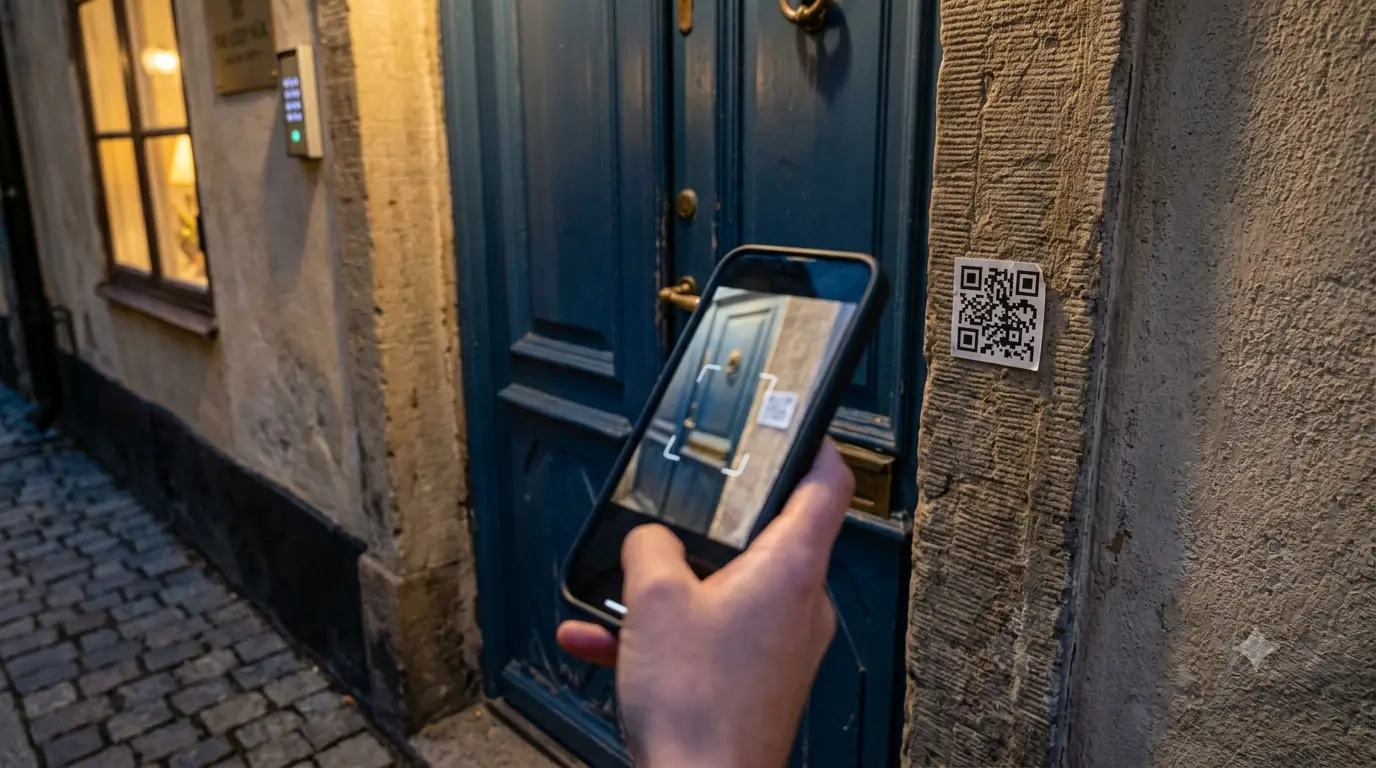
A QR code at the entrance. For the guest who is already standing at the door and cannot remember the code, a QR code taped to the frame that opens straight to the arrival instructions usually saves the phone call.
An answer to arrival-hour questions, in the guest's language. When the desk is closed, the questions still come. A digital guidebook with an AI concierge answers "where do I park" and "the code is not working" from the information you already wrote, in the language the guest is typing in. It is not a check-in system and it will not open a lock for them. It just makes sure the instructions you wrote are reachable at the exact moment they are needed.
That is the split we build SmoothStay around: most guests read the arrival section and get in, and the ones with a question get an answer instead of your voicemail. If local rules require you to collect guest details, our guest registration tool captures them at the same touchpoint, with consent.
The failure points to check before your next arrival
Most bad check-ins trace back to a handful of gaps. Walk your own instructions against this list.
The photo of the door was taken in daylight, but half your arrivals happen after dark.
The parking note assumes the guest knows the neighborhood.
The access steps were written for someone who already knows which door.
The contact number goes to a phone nobody checks after 9 pm.
The instructions live in one email, and that email is now unfindable.
There is no plan for the guest who does not speak your language.
None of these need staff to fix. They need someone to read the instructions cold, at night, a little frustrated, as if they had never seen the property. If you run more than one room type or a couple of buildings, this is where a guidebook that layers on top of whatever PMS you already use pays for itself. More on the software side in our breakdown of what small hotels actually need for contactless arrival.
FAQ
What are the most important hotel check-in instructions to get right?
The access method and the after-hours plan. A guest can forgive a missing parking note. They cannot forgive being locked out at midnight with no way in and no one answering. Nail the entry steps and the late-arrival contact first, then fill in the rest.
How do you handle check-in when there is no front desk?
Send the access method, the room details, and an after-hours contact before the guest arrives, and make that information reachable again on-site through a link or a QR code. The goal is that a guest can complete their own arrival without needing anyone to be physically present.
When should late-arrival instructions go out?
Before the day of arrival, and again as a reminder on the check-in day for anyone arriving after your desk closes. A guest planning a late arrival wants the plan while they are still packing, not while they are standing outside.
Is a self check-in the same as contactless check-in?
Not quite. Self check-in means the guest lets themselves in with a code or a key you left for them. "Contactless" usually implies kiosks or digital keys, which most small properties do not have and do not need. Clear written instructions plus a keypad or lockbox get you the same smooth arrival without the hardware.
How do I give check-in instructions to guests who speak another language?
Write them clearly once, then use a tool that translates them automatically so each guest reads the arrival steps in their own language. A guest who can read the entry steps in their first language is a guest who does not text you at midnight.
If you'd rather not build this yourself
You can have a digital arrival guide running in under an hour, behind a link and a QR code, answering the after-hours questions for you.
Latest articles
Vrbo's New Features for Fall 2026: What's Live, What's Gated, and What's US-Only
We sorted Vrbo's new features for fall 2026: what is live globally, what is gated behind eligibility, and what is US-only. Verified against Vrbo's own pages.
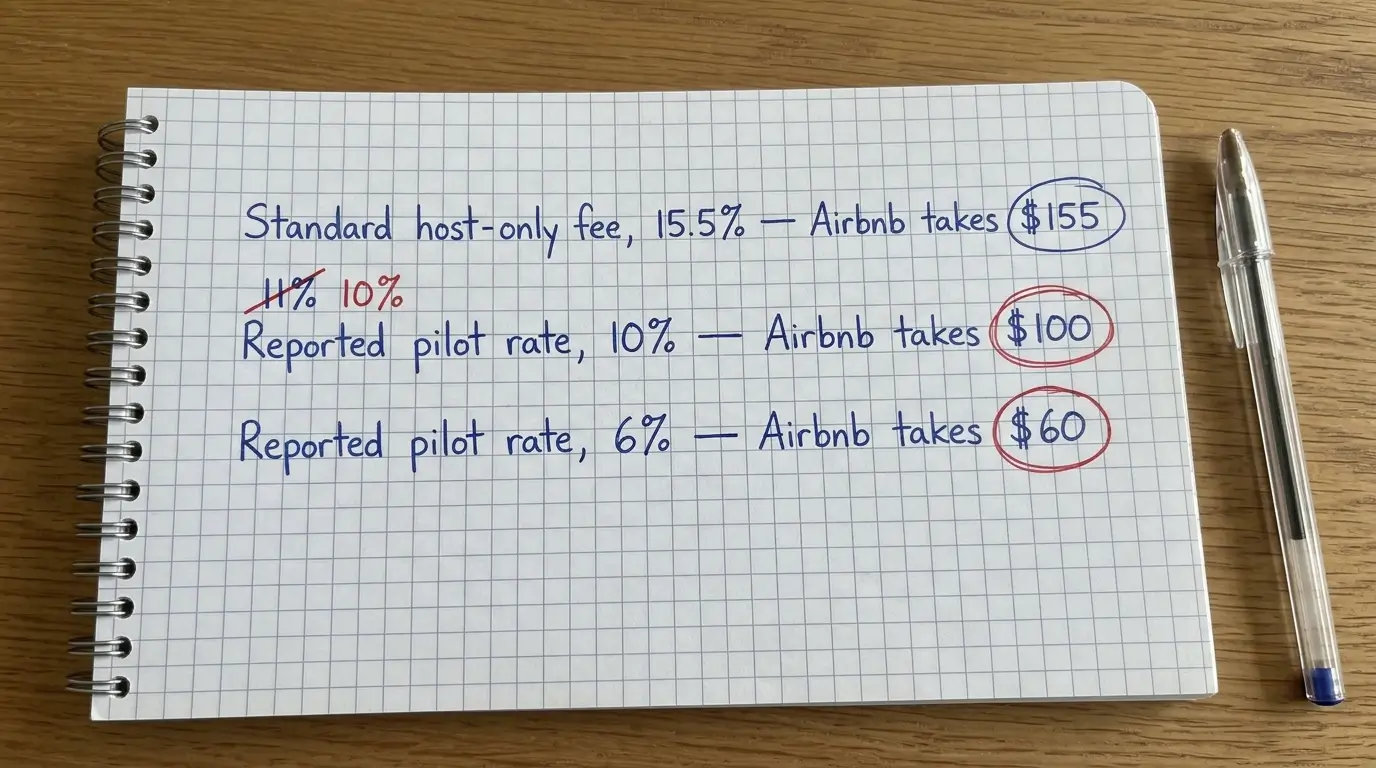
Airbnb Direct Booking Links: What the Reduced Fee Changes at 1 to 20 Listings
Airbnb direct booking links cut the host fee to a reported 6% or 10%. What they are, how they work at 1 to 20 listings, and what the lower fee still pays for.
The Booking.com Genius Program for Hosts: The Occupancy Rule That Decides It
The Booking.com Genius program for hosts is a discount you fund. Use the occupancy rule to work out whether it buys real nights or just cuts your rate.
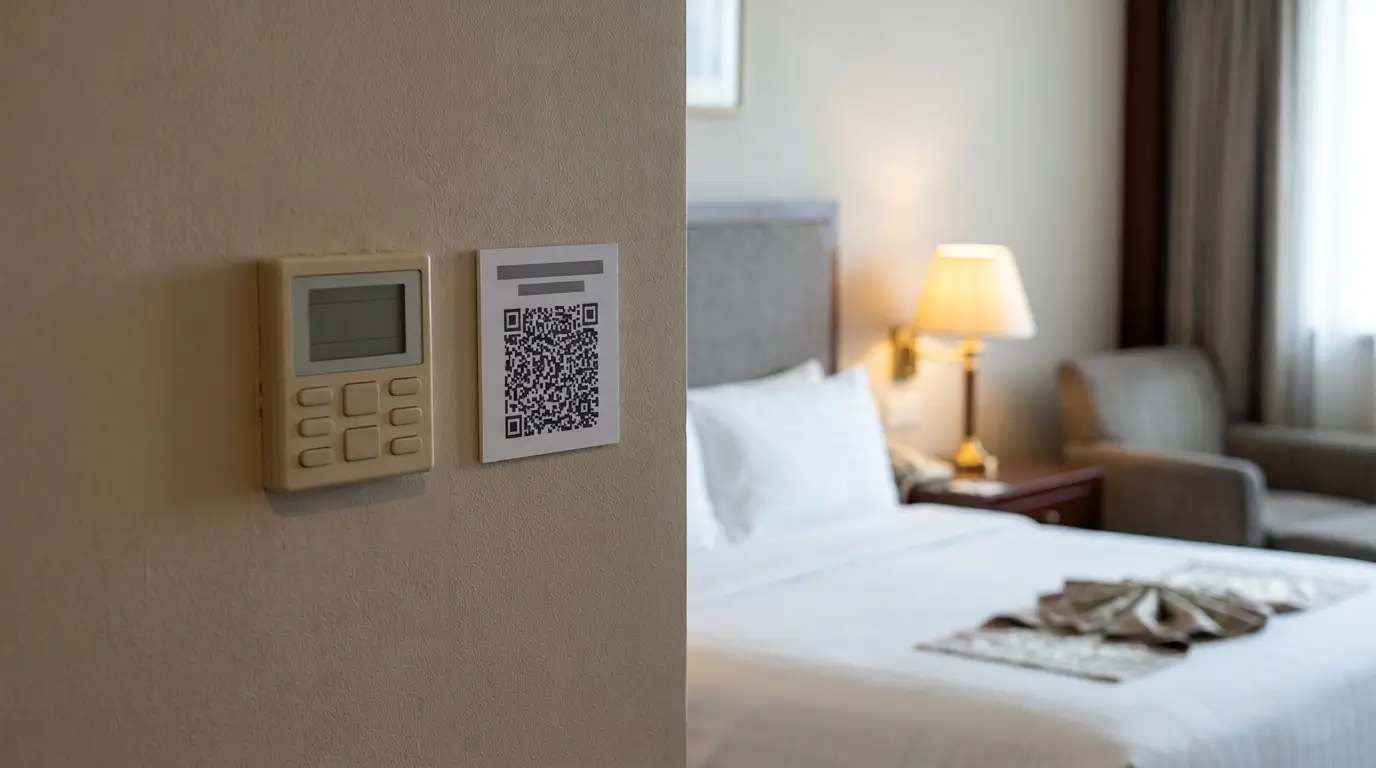
QR Codes for Hotel Rooms: Where to Put Them and What to Print Beside Them
Plan a QR code for hotel rooms that guests actually scan: what each code should open, where to place it, the print specs that work, and what it cannot replace.