
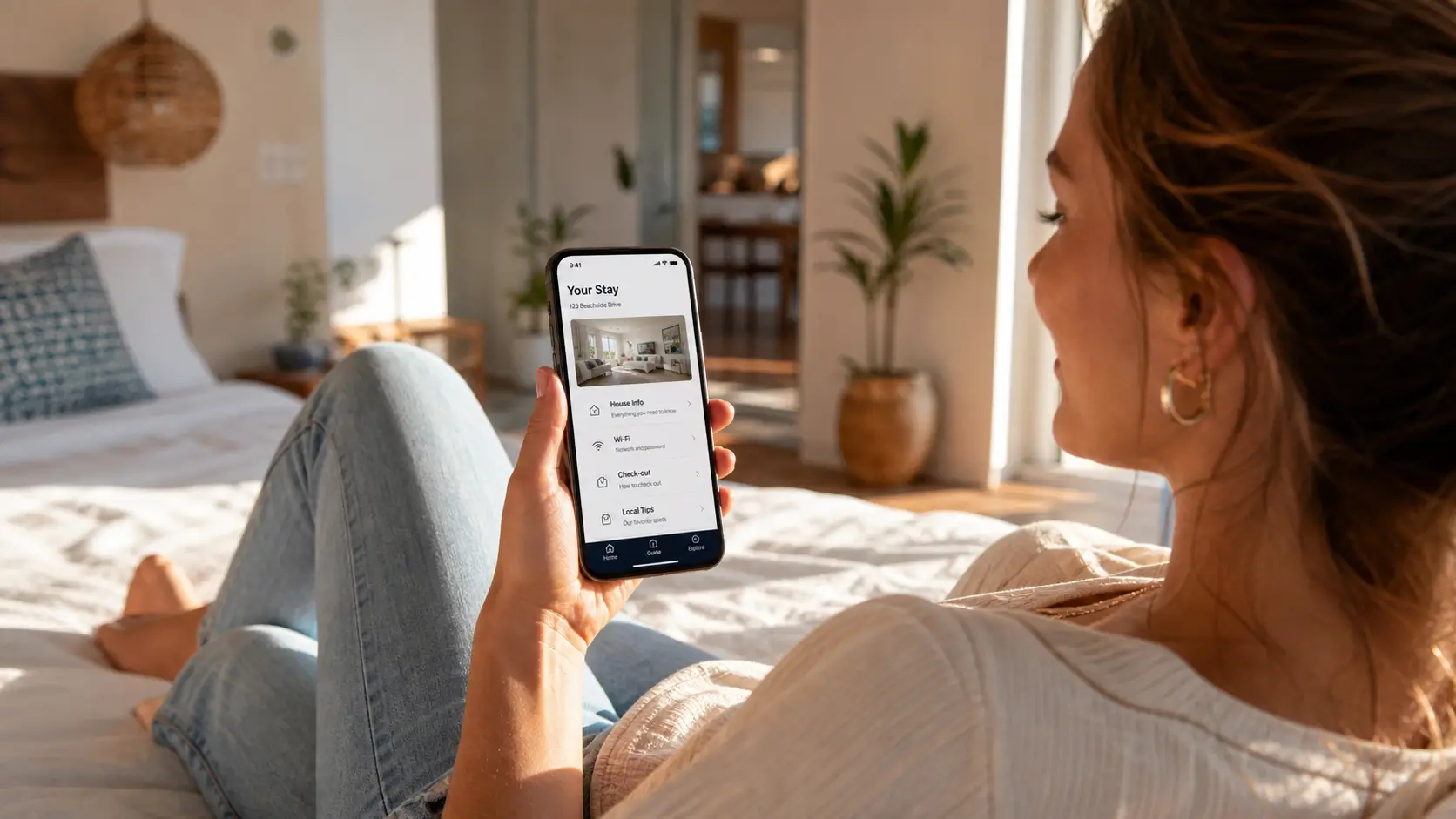
Great guidebooks get built one guest question at a time—and the best ones live outside any single platform so every guest, on every channel, sees the same, updated version. A simple, mobile-first, always-current guidebook (arrival, in-stay, local, departure, in multiple languages) turns confused four-star stays into confident five-star ones and saves you from answering the same questions hundreds of times.
We have been hosting short-term rentals for about ten years. The first place was our row house in Foggy Bottom, Washington DC, where we lived before we moved. We added a four-and-a-half-bedroom house in Playa del Carmen, built around being a vacation rental from day one. Then a studio in Tulum. Then two more properties in the Riviera Maya for owners who didn't want to manage them. Five very different homes. Five very different guidebooks.
At 11:42 pm on a Tuesday a few summers ago, a guest at the Playa del Carmen house messaged us asking which switch turned on the pool light. There are three switches by the back door. None of them are labeled. The guidebook had a beautiful photo of the pool. It didn't have a photo of the switch panel. After we answered, we added the photo and slept worse than I should have.
That's the job. You build a guidebook once, and then you finish building it one guest question at a time, usually after dinner. This post is what we wish someone had handed us when we started.
What is an Airbnb guidebook, and why does it matter for your reviews?
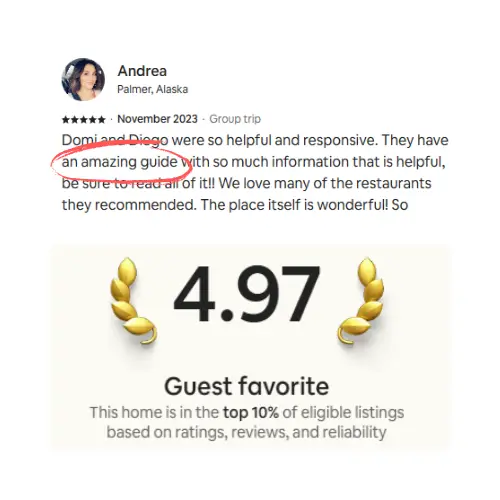
An Airbnb guidebook is the document a host gives a guest so the stay runs without five messages a day. It usually covers arrival, house operations, local recommendations, and departure. The reason it matters has very little to do with Airbnb the company. It matters because guests give better reviews when they feel like they know where they are and what they are doing. Confused guests leave four-star reviews. Confident guests leave five-star ones. Over a year, that gap is the difference between Superhost status and "good but not great" hosting.
There is a quieter reason too. Every question a guest asks you is a question the next guest will ask if you don't write it down. A guidebook is how you stop having the same conversation three hundred times.
Why a platform-agnostic guidebook beats Airbnb's built-in one
Airbnb has its own guidebook feature. It works. It also has two real problems. The content lives inside Airbnb, so if you ever take a booking from VRBO, Booking.com, or your own direct site, that guest sees none of it. And the editor is built for tourist recommendations, not the operational reality of your specific home. The tricky patio door instructions for our DC house don't fit in there. Neither does the three-photo walkthrough of how the Mexican washing machine works.
A platform-agnostic guidebook lives at its own link, not inside an OTA. You write it once. You share it with every guest, every channel, every time. The day you eventually open a direct-booking channel, the guidebook is already done. You don't rebuild it.
What to include, section by section
Most posts on this topic give you a thirty-item list with no opinion about what matters most. Here is our actual structure, ordered by how guests use it.
Arrival
The first ninety minutes of a stay are when guests are the most stressed and the most likely to message you. Arrival is the section that earns its keep.
What works: the exact address and directions with a Google Maps deep link, a photo of the entrance (not the front of the building, the actual door they're walking to), the lockbox or keypad procedure with a photo of the box itself, parking specifics with a photo of where the spot is, and the WiFi name and password in a large copyable block. What most hosts get wrong: assuming a guest from Berlin knows what "the alley behind CVS" means.
In-stay (house operations)
The section guests come back to over and over. AC and heat, with the actual button sequence to change the temperature. Washer and dryer, with photos of the buttons because every machine has different symbols. The dishwasher pod location. The kitchen quirks: the burner that runs hot, the drawer that sticks. Trash and recycling, with the day and the spot. Pool, hot tub, or grill instructions if you have them. What most hosts get wrong: writing in legalese. "Guests are responsible for adhering to..." Nobody is reading that. Write like a friend showing them around.
Local recommendations
The part guests brag about in the review when you do it well. Three to five restaurants, two for breakfast or lunch, two for dinner, one casual and walkable. One bar that is actually good. One coffee shop. One thing to do that isn't on the first page of TripAdvisor. Each one gets a sentence about why you'd send your sister there. What most hosts get wrong: listing twenty places. Curation is the value.
Departure
Short and clear. What time. What to do with the keys. What to do with the towels (we say "leave them, please don't try to be helpful"). Whether to start the dishwasher. Whether to take the trash out. What most hosts get wrong: leaving departure as a paragraph instead of a four-line checklist.
A long worked example with full content for each section sits in our writeup of seven Airbnb guidebook examples. Open it in another tab if you want to see real ones before you finish reading.
Physical binder vs. PDF vs. live digital guidebook
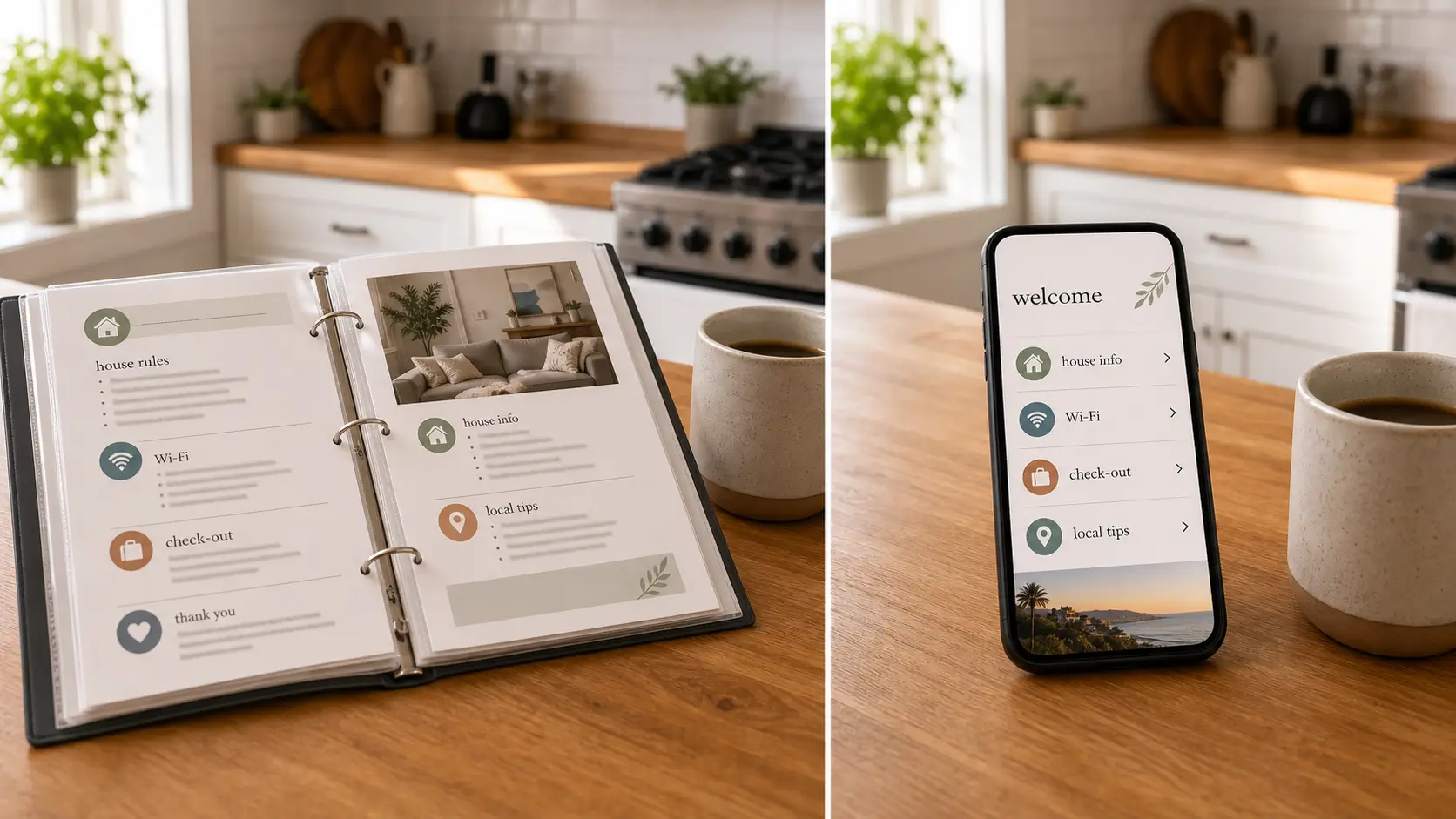
We have used all three. Here is the honest comparison.
Format | Always current | Works on phone | Cost over time | Best for |
|---|---|---|---|---|
Printed binder | No | No | Reprints every time something changes | Hosts who want one charming object on the counter |
PDF or Google Doc | Only if you remember to resend | Yes | Free | One property, slow rate of change |
Live digital guidebook | Yes, instantly | Yes | A small monthly or annual fee | Multi-property hosts, or anyone who edits often, and appreciates visual and smart communication |
Binders look great in listing photos. They also go out of date the moment you change a WiFi password, and nine times out of ten you don't laminate the new sheet. You just slide it loose into the front pocket. Within a year the binder has three loose pages and the WiFi page still says the old password.
PDFs are better than binders because guests have them on their phones. They are worse than digital guidebooks because every PDF you send is a frozen copy. If you change something, every guest who arrived before the change has the old version.
We had a blue-cover binder at the DC house for about two years before we switched. The WiFi network name on page three was wrong because a friend resetting the router never told us, and we never opened the binder. Nobody mentioned it. We assume they just messaged us, got the right one, and shrugged.
We ended up on a live digital guidebook for all five properties. You edit one place. Every guest, past and future, sees the latest version. The trade-off is paying for a tool. The good news is most of them have a free tier now.
The tools available right now, honestly
We tested most of these before we built SmoothStay. Here is the 2026 read, plainly.
Tool | Strength | Trade-off | Pricing model | Honest take |
|---|---|---|---|---|
TouchStay | Mature product, deep template library, well-known in the STR community | Per-guidebook pricing climbs as you scale | Tiered by features | A solid pick at one property, gets pricey at five-plus |
Hostfully native guidebook | Free if you're already paying for the PMS | Built around the reservation, not the guest experience | Bundled with the PMS subscription | Fine if you're locked into Hostfully PMS, not worth choosing on its own with an outdated UX |
Hospitable Knowledge Hub | Tight integration with Hospitable PMS, the AI feeds from the same content | Guest-facing polish isn't the priority, the content is mostly a feed for their AI replies | Bundled with Hospitable | Very useful for AI message generation (we use it), less useful as a guest-facing guide with visual content |
SmoothStay | OTA compliance built in, unlimited contacts on every plan, the same per-property price whether you run one listing or fifty | Newer entrant, still adding integrations | Single per-property price, free tier available | Worth a look if you care about scaling, contact ownership, platform compliance, or awesome UX |
We are an obviously biased source. So here is what is structurally true and easy to verify. TouchStay charges by how many guidebooks you have based on the feature plan you are on. Hostfully's native guidebook ships inside their PMS subscription. Hospitable's Knowledge Hub was built mainly to feed their AI message responder. SmoothStay charges the same per-property price whether you have one or fifty, and the contact collection sits on top of the platform's OTA-compliance layer.
If you're at one property, any of these works. At five, the pricing math changes a lot. Our full head-to-head with TouchStay walks the math out.
Three mistakes hosts keep making
We see the same handful of mistakes across guidebooks we audit for friends or co-hosted owners. Three of them come up most.
The first is treating the guidebook like a legal document. Long paragraphs about liability, "guests are required to," a wall of house rules at the top. The first thing a guest sees should make them feel welcome. The rules can sit further down without losing their force.
The second is hiding the WiFi password. We've seen WiFi credentials buried under twelve sections of local recommendations. It is the single most-searched item in any guidebook. Put it near the top, in a copyable block, with a photo of the router as a backup.
The third is never updating it. A guidebook decays. Restaurants close. Codes change. Once a month, open the guidebook on your own phone and walk it like a guest would. You will find at least one thing to fix every time.
One more thing: multilingual guests
More than half of our Riviera Maya guests do not have English as their first language. The DC house gets a steady mix of European travelers too. We used to write everything in English and hope.
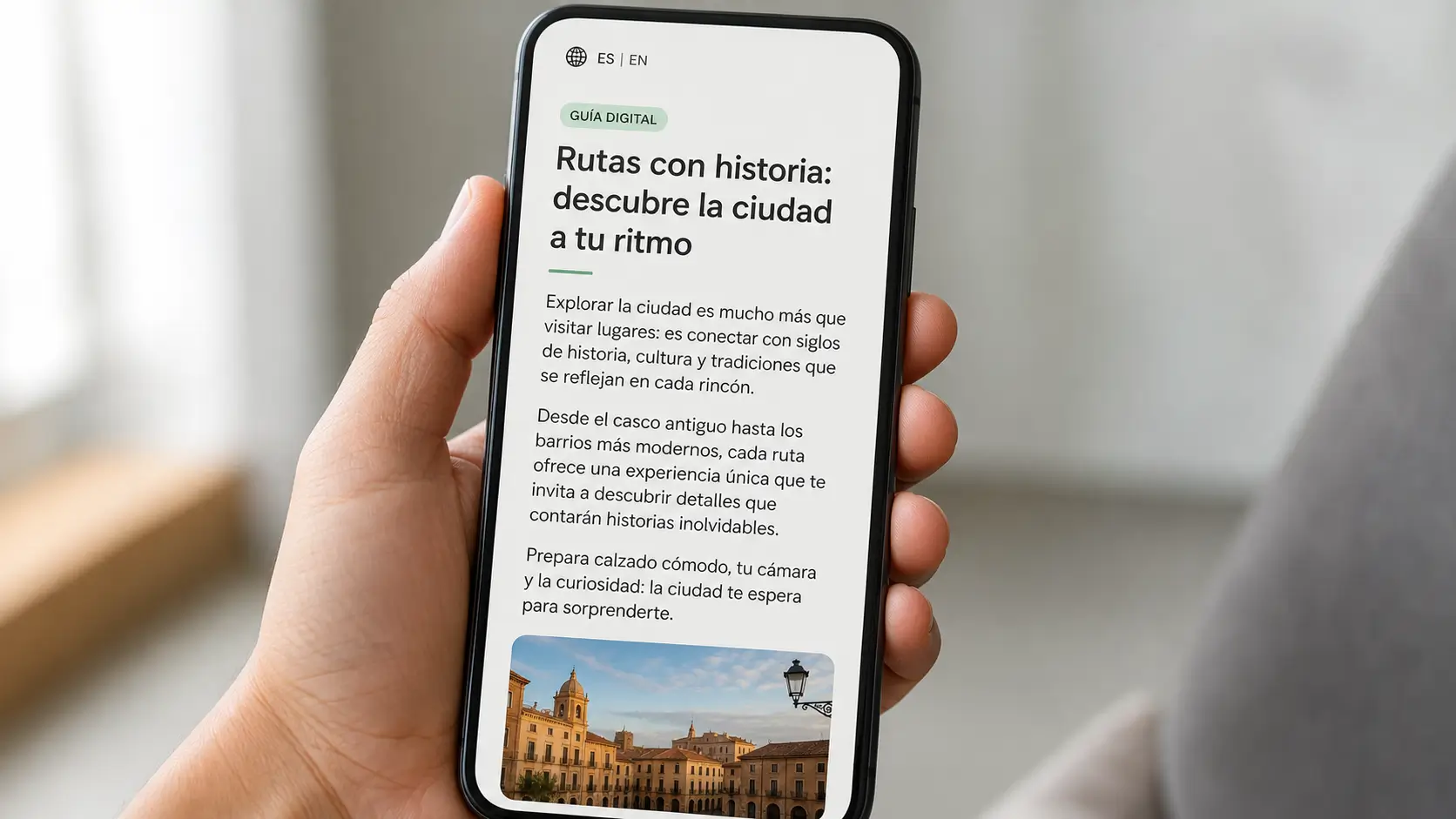
The fix isn't writing the guidebook three times. It is using a tool with built-in translation, so a guest opening the link sees it in Spanish, German, or French automatically. If the tool you pick doesn't do that, you can paste each article into DeepL or a similar translator and add the language as a duplicate article. Either way, take the language step seriously. The WiFi instructions are a lot less useful when your guest can't read them.
Where SmoothStay actually fits
We won't list a feature matrix. The honest pitch is three lines.
It was built by hosts who are still hosting. Dominique and I run our own listings every week. The design choices in the product come from problems we hit on our own properties, not from a customer interview document.
The platform handles OTA compliance for you. If you want to capture guest contact info or send marketing later, the rules around what Airbnb allows and what Booking.com allows are different. Getting it wrong can suspend your listing. SmoothStay helps you stay compliant with the right thing at the right time, at the link level, the article level, and the widget level.
Pricing is structurally simple. The same per-property price whether you run one Airbnb or fifty. Unlimited contacts on every plan. Growing your portfolio doesn't get punished by the tool. That's the second of two SmoothStay mentions in this post, so back to the work.
A free Airbnb guidebook you can use today
We’ve made the exact welcome book we used in our own rentals available as a free Canva template, matching the arrival, in‑stay, local, and departure structure above. You can customize the line items that matter, fill in the blanks for your property, and either export it to PDF, print it, or use it alongside whichever guidebook tool you choose—no email or credit card required. The download sits inside our free Airbnb welcome book template post.
If you'd rather not format all of it yourself, you can have a free digital guidebook running in under an hour. No credit card needed.
FAQ
How long should an Airbnb guidebook be?
Long enough to answer the questions guests actually ask, short enough that nobody scrolls past the local recommendations. Our properties land between 25 and 40 short articles each. If your guidebook is one giant document, it is too long. If it has fewer than ten sections, it is probably missing the operational content. Our Tulum studio runs leaner than the others. Around 22 articles, all short, because a smaller space has fewer questions to answer.
Do guests actually read the guidebook?
Not the way you'd read a book. They scan visually and use the search button. They tap the photo of the restaurant before they read the description. They search for "WiFi" the moment they walk in. Build the guidebook with big icons for scanning, not reading.
What should I include for emergency information?
A short section. The local emergency number, the nearest hospital, your phone for things only a host can fix. Keep it brief. Don't open a section with the phrase "in case of emergency."
What is the difference between a guidebook, a welcome book, and a house manual?
Overlapping terms used loosely. A welcome book tends to lead with hospitality: the warm intro, the local picks. A house manual tends to lead with operations: the appliances, the rules, the troubleshooting. A guidebook usually covers all of it. We treat them as one document with three sections. If you want a focused welcome book for Airbnb breakdown, that one is its own post.
Can I use Airbnb's built-in guidebook instead?
You can. We don't. The content is trapped inside Airbnb, and if you ever take a stay from another channel, including a returning guest who books direct, they don't see it. The cost of having a separate guidebook is a few dollars a month. The cost of not having one is the guests on other channels showing up unprepared.
How often should I update my guidebook?
Whenever something changes and whenever a guest asks a question you did not anticipate. In practice, once a month for an active property and once every couple of months once the property stabilizes.
Latest articles

How to Automate Check-In Instructions for Short-Term Rental Guests
Automate check-in instructions for short-term rental guests: the four-send sequence, what goes in a message versus a guidebook, and a copy-ready sample.

Vrbo Premier Host in 2026: Every Listing Now Stands on Its Own Record
Vrbo Premier Host requirements changed in 2026: per-listing scoring, tighter thresholds, quarterly checks. What each one means, and how it compares to Superhost.
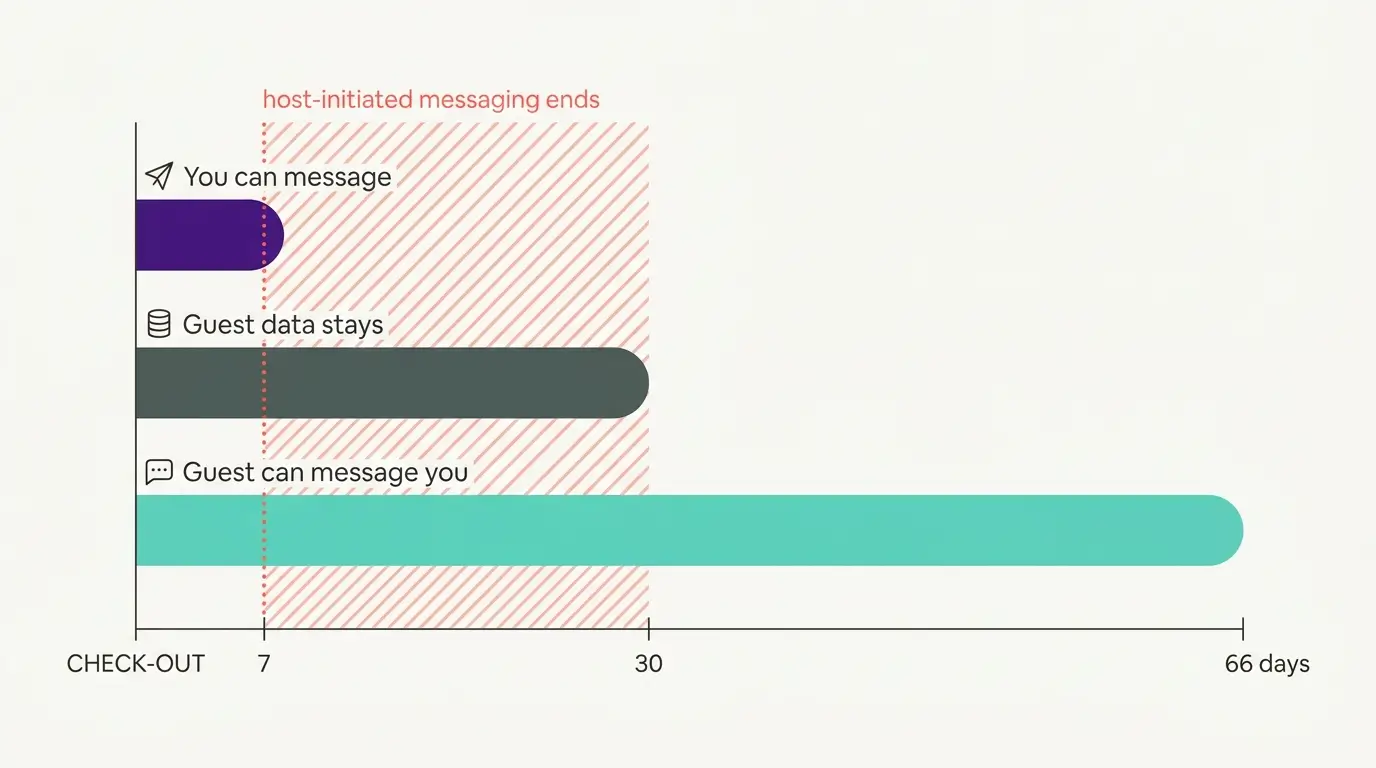
Booking.com Guest Messaging Rules: What Hosts Can Send, When, and Why Links Get Removed
Booking.com guest messaging rules, verified at source: how long you can message a guest, why your links get removed, and what the partner terms say.

Vrbo's New Features for Fall 2026: What's Live, What's Gated, and What's US-Only
We sorted Vrbo's new features for fall 2026: what is live globally, what is gated behind eligibility, and what is US-only. Verified against Vrbo's own pages.