

The post explains that the most effective way to cut down repetitive guest questions is to provide answers before guests ask them, using a visually appealing digital guidebook placed where guests look, complemented by an AI Concierge that handles the remaining queries. It outlines practical steps and examples for pre‑emptively addressing common questions like Wi‑Fi, check‑in, and local recommendations.
How do I reduce guest questions?
Answer the predictable ones before anyone has to ask. Most of the messages you get are the same short list every single stay: wifi password, check-in time, where to park, how the AC works, what to do at checkout. Put those answers somewhere guests will actually look, then set up a fallback that handles the rest on its own. You won't hit zero messages, and you shouldn't want to. But the repetitive ones can drop to almost nothing.
We've hosted in Washington, DC and the Riviera Maya for more than a decade, and for years we treated every question as a one-off. It isn't. Once we started paying attention to what people actually asked, the pattern was almost boring. Same questions, different guests, stay after stay.
The questions are more predictable than they feel
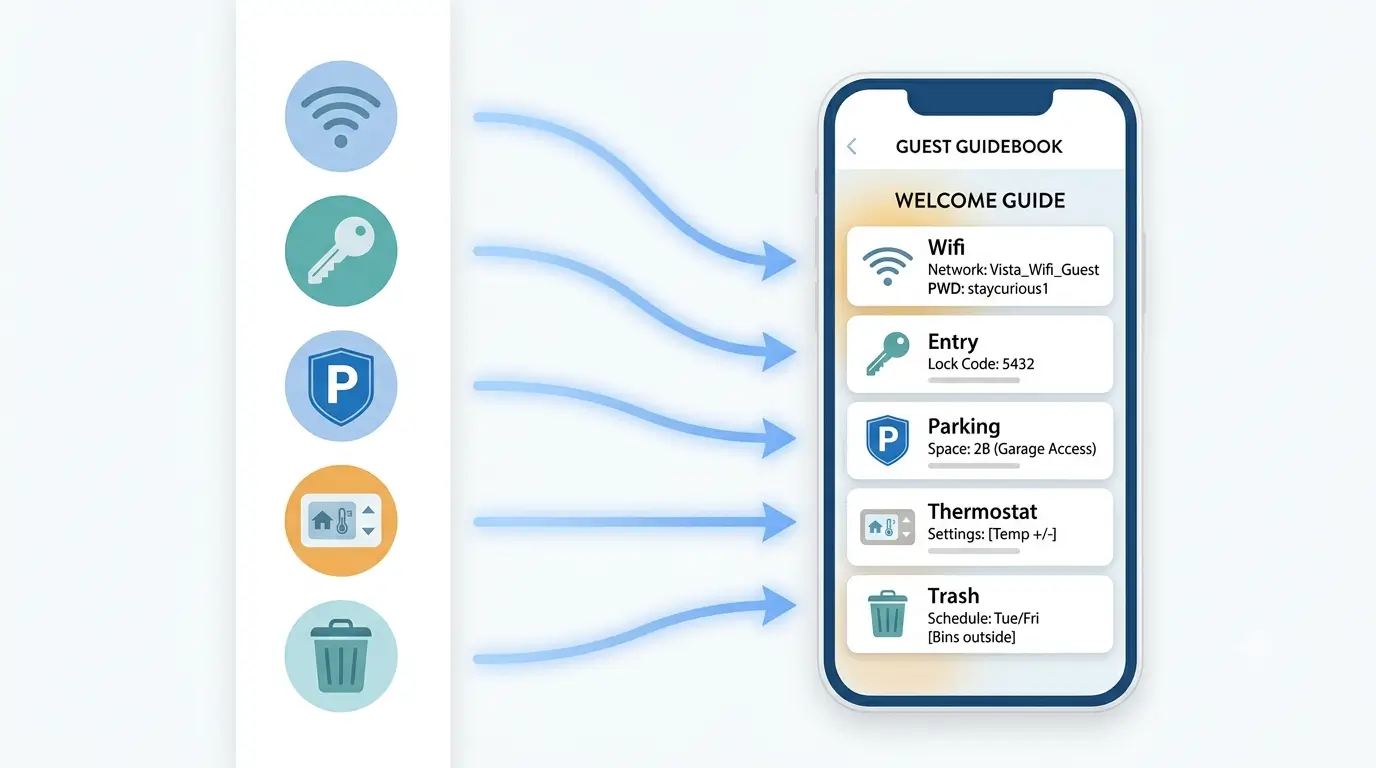
When you're answering them one at a time, each message feels unique. Zoom out across a few months and it's the same greatest hits. Wifi. Check-in. Parking. The thermostat. Checkout time. Trash day. A couple of "what's good to eat nearby" texts.
The wifi question came in at least once a stay, and more often than not it landed after 10pm when we were trying to sleep.
That predictability is the good news. A problem that repeats is a problem you can get ahead of. You're not fielding a thousand different questions; you're fielding maybe a dozen, over and over, from people who booked at different times and never talk to each other.
The mistake most hosts make is answering faster. A canned reply you paste in at 11pm is still you, awake, doing the work. The fix isn't a quicker response. It's making the response unnecessary.
Map every repeat question to a place it gets answered
Before you write anything, list the questions you actually get. Pull your last twenty or thirty guest threads and count. Then give each one a permanent home, so the answer lives somewhere a guest can reach on their own.
Common question | Where to answer it |
|---|---|
What's the wifi password? | Guidebook, on the check-in screen and its own labeled entry |
How do I get in / what's the code? | Check-in section, sent again the morning of arrival |
Where do I park? | Guidebook with a photo of the actual spot |
How does the AC/heating work? | A short "how the house works" entry with the real thermostat |
What time is checkout and what do I do? | Checkout section, plain steps, no fluff |
Which day is trash and recycling? | House-basics entry with the schedule |
Where should we eat? | A local recommendations list you actually stand behind |
The pattern here matters more than the exact rows. A guest asks because they can't find the answer, not because they enjoy texting a stranger. Give the answer a findable home and the question mostly stops coming.
Photos do a lot of quiet work in this table. "Park in the second spot on the left" is a sentence a guest still has to interpret at night in an unfamiliar place. A picture of the spot ends the conversation. Same with the thermostat, the coffee maker, the lockbox. If you've written the same clarifying reply twice, it should have been a photo the first time.
Put the answers where guests are already looking
You can write the best house manual in the world and it won't help if it's an outdated PDF buried in a confirmation email nobody reopens. The answer has to sit where the guest already is, on the phone in their hand.
That's the whole case for a digital guidebook. It's the thing guests actually open because it’s visual, and it front-loads the answers to the questions above so they're one tap away instead of one text away. A printed binder can't do this; it sits on the counter while the guest is standing in the driveway wondering where to park.
A few things make a guidebook actually get used instead of ignored:
A QR code at the door and on the fridge, so opening it is faster than typing a message to you.
Deep links straight to a specific answer, so when a guest does ask about wifi, you reply with a link that lands right on the wifi entry instead of retyping the password.
Structure a stressed person can scan. Someone hunting for the door code doesn't want a wall of text.
None of this eliminates questions. It answers most of them before they're asked, which is a different and more realistic goal. Our post on the questions guests ask most is a good starting checklist for what to preload.
Automate the long tail, honestly
Even a great guidebook won't cover everything. Someone will ask whether the water's safe to drink, or whether there's an iron, or how to work the beach-gear closet. These are the questions you can't fully predict, and they're the ones that still pull you back into your inbox.
This is where an AI concierge earns its place. It answers from your guidebook content, around the clock, in the guest's own language, so a question at 3am in Portuguese gets a useful reply without waking you. It's not making things up; it's pulling from what you already wrote and pointing the guest to the right entry.
One honest boundary, because it matters: this reduces the messages coming in. It's not automated messaging going out. We're not talking about scheduled texts or a marketing sequence. The guest asks, your own content answers. That's it. If you want the fuller version of front-loading communication across a stay, the guest welcome checklist walks through the touchpoints worth setting up.
What should still reach you
Cutting questions is the goal, but not all of them. A guest who can't get in, a broken AC in July, a plumbing problem — those need to hit you fast, and no self-serve system should swallow them. The point of preempting the predictable stuff is that when a message does come through, it's a real one worth your attention, not the fourth wifi request of the week.
Done right, you notice the shift within a few stays. Your phone goes quiet on the small things. Guests feel more independent, which most of them prefer anyway. And the messages you do get are the ones where being a responsive host actually counts.
FAQ
How do I stop getting the same guest questions every stay?
Track what people actually ask over your last twenty or thirty stays, then give each recurring question a permanent, findable home — a digital guidebook entry, a photo, a labeled section. Guests ask because they can't find the answer, so make it findable and most of the repeats stop.
Will a digital guidebook really cut down guest messages?
It cuts the predictable ones, which are the bulk of your volume. It won't get you to zero, and any tool promising that is overselling. What it does is answer the wifi/parking/checkout questions before they're asked, so the messages you get are the genuine exceptions.
What's the most common guest question, and how do I preempt it?
Wifi is usually the winner, and it tends to arrive late at night. Put the password on its own labeled guidebook entry and on the check-in screen, add a QR code by the router, and include it in your arrival message. That one answer, placed well, removes a surprising share of your late-night texts.
Does answering questions automatically make hosting feel impersonal?
Not if you write the content in your own voice. Guests read impersonal as slow or absent, not as automated. Fast, accurate answers at 2am usually feel more thoughtful than a delayed human reply. Keep the truly personal touches — recommendations you love, a note about the neighborhood — and let the routine stuff run itself.
Is this the same as automated guest messaging?
No. Reducing questions through a guidebook and an AI concierge means guests pull answers when they need them. Automated outbound messaging pushes scheduled texts at guests. This post is about the first kind — cutting inbound volume with self-serve content, not sending more messages.
How many questions can I realistically expect to eliminate?
Aim to remove the predictable ones, which for most hosts is the large majority of message volume. The unpredictable and the urgent will still come through, and that's the system working — you want those reaching you. If you're still answering wifi and parking questions daily, the answers just aren't where guests are looking yet.
One less thing to answer at 11pm
If you'd rather not build all of this by hand, you can have a digital guidebook running in under an hour, with the recurring answers loaded, a QR code ready for the door, and an AI concierge catching the rest in your guest's language. It's the closest thing we've found to hosting that doesn't follow you to bed.
Built by hosts who got tired of the 11pm wifi text. Dominique and Diego run properties in Washington, DC and the Riviera Maya.
Latest articles

How to Automate Check-In Instructions for Short-Term Rental Guests
Automate check-in instructions for short-term rental guests: the four-send sequence, what goes in a message versus a guidebook, and a copy-ready sample.

Vrbo Premier Host in 2026: Every Listing Now Stands on Its Own Record
Vrbo Premier Host requirements changed in 2026: per-listing scoring, tighter thresholds, quarterly checks. What each one means, and how it compares to Superhost.
Booking.com Guest Messaging Rules: What Hosts Can Send, When, and Why Links Get Removed
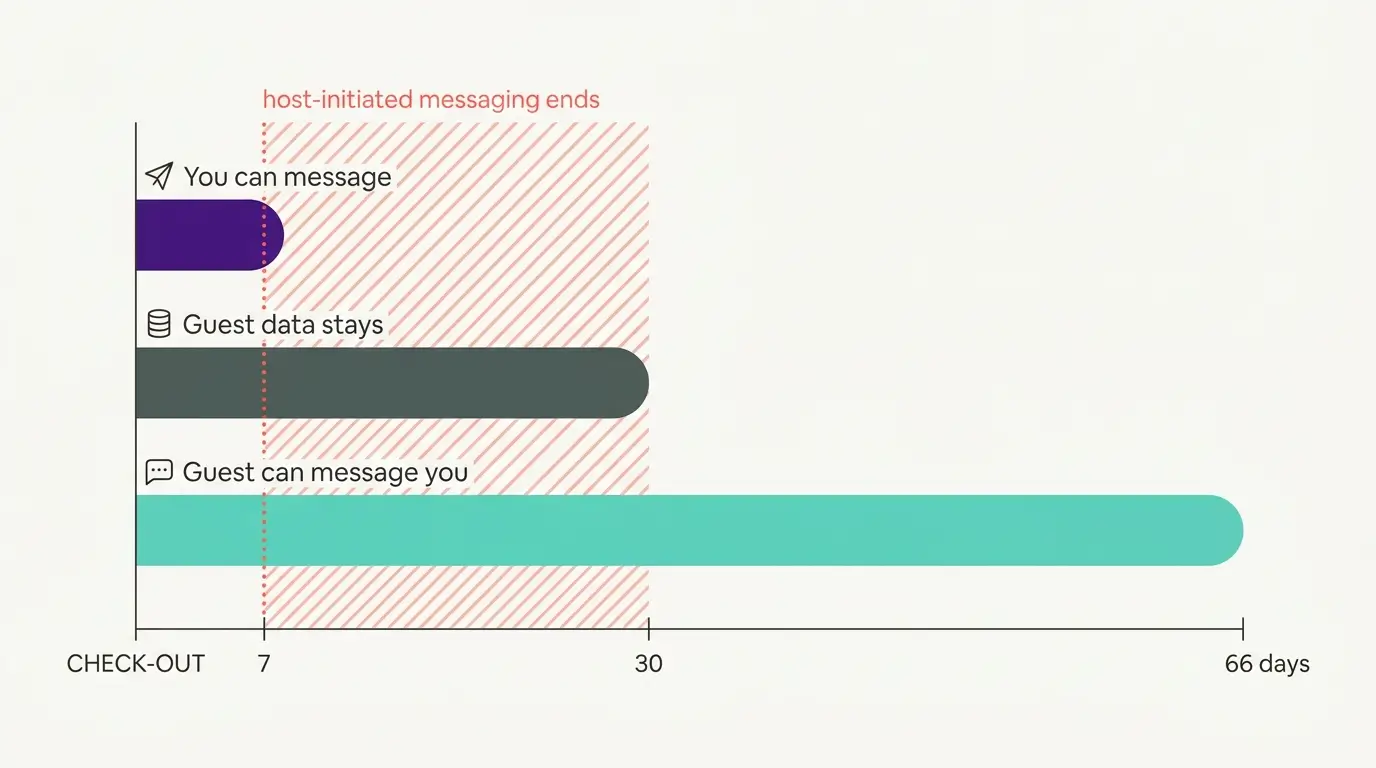
Booking.com guest messaging rules, verified at source: how long you can message a guest, why your links get removed, and what the partner terms say.
Vrbo's New Features for Fall 2026: What's Live, What's Gated, and What's US-Only
We sorted Vrbo's new features for fall 2026: what is live globally, what is gated behind eligibility, and what is US-only. Verified against Vrbo's own pages.