

A great glamping guest experience blends hotel‑grade comfort with off‑grid adventure by using a digital guidebook and AI concierge to handle check‑in, safety, and guest questions without a front desk. Providing clear pre‑arrival directions, on‑site QR codes, and reliable connectivity ensures guests feel cared for while enjoying the remote setting.
What makes a great glamping guest experience?
A great glamping guest experience delivers the comfort and service of a good hotel in a setting that feels miles from one. Guests booked the wilderness fantasy, but they still expect a made bed, hot water, clear directions, and a fast answer when something goes sideways. The operators who win get the unglamorous basics right, arrival, orientation, safety, comfort, without a front desk to fall back on.
We run short-term rentals in Washington, DC and the Riviera Maya, not a glamping site. But the problem glamping operators describe is the same one we work on every day: how do you make people feel looked after when there's no one at a desk to look after them? With glamping you're solving it in canvas and forest instead of drywall, usually with worse cell signal and a guest who's a little outside their comfort zone.
Glamping guests want two things that pull against each other
The whole job lives in one tension. Guests want to feel off-grid, and they want to feel taken care of. They want the dome under the stars, and they want the shower to be hot and the wifi to load. Lean too far rustic and it reads as unfinished. Lean too far toward hotel and you've sold a tent that may as well have been a room.
A strong glamping guest experience holds both at once. The setting does the wilderness work for you. Your systems do the hospitality work quietly in the background, so the guest only notices that everything they needed was already there.
The hardest moment is arrival
In a hotel, arrival is solved. There's a sign, a door, a person behind a desk. At a glamping site, arrival is where most stays wobble.
Look at what you're actually asking a guest to do. Drive to a spot their GPS probably gets wrong. Find an unmarked turn-off, maybe down a dirt road, maybe at dusk. Open a gate with a code. Pick out their specific unit among several that look identical. Work out how to get in. And do all of it on one bar of signal with a car full of tired people.
Glamping check-in works when you kill every one of those small panics before it happens. That means precise directions written for a human, not a map app: the real turn-off with a photo, a pinned location, the gate code, which unit is theirs, and how the door or zipper works. Get the first ten minutes right and the rest of the stay rides on that goodwill. Get it wrong and you spend the weekend fielding calls.
Your guest's phone is the front desk
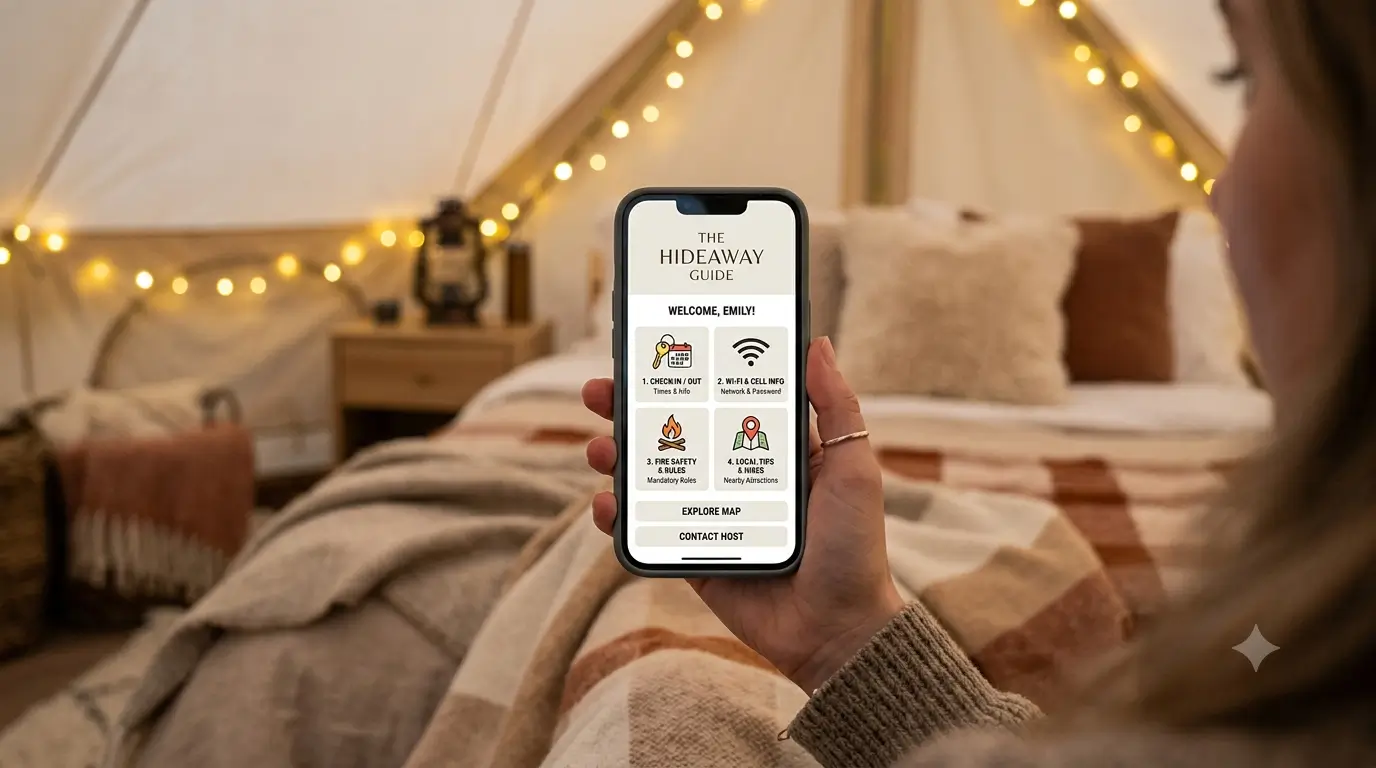
Since there's no desk, the phone has to be one. That isn't a slogan. It's the operating model for a site with no staff standing around.
A digital guidebook does that job. You put a QR code at the unit and drop a link into the booking confirmation and the pre-arrival message. The guest taps it and gets the things they'd otherwise call you about: a map pin to the real entrance, the gate code, which tent is theirs, how the lights and heat and water work, the wifi password if you have wifi, the fire rules, and where to find coffee in the morning.
For the questions the guide doesn't spell out, "is the tap water drinkable," "what was that noise," "can I have a fire tonight," an AI Concierge answers from your own guidebook content at the hour you're asleep. And because glamping pulls a lot of international travelers, a guidebook that translates automatically means a guest reads your fire policy in their own language instead of guessing at it.
This is the visual-first idea doing real work. The guidebook is what guests actually open. The AI is the fallback for the thing the guidebook didn't surface.
What about the signal?
Most glamping guests already expect their bars to drop. That's half the reason they booked, so you don't need to apologize for it, you need to plan around it. Send your guidebook link ahead of arrival so it opens while guests still have signal on the drive in, and leave a printed card in the unit with the essentials: gate code, your number, fire rules.
The bigger shift is that a lot of rural operators are closing the gap at the source. Satellite internet like Starlink now reaches sites that fiber and cell towers never will, and campground-grade kits can push guest wifi across a whole property from a single dish. More sites are installing it and treating reliable internet as a sellable amenity instead of something they apologize for. Go that route and your guidebook loads in a tap, and "we have wifi" turns into a line in your listing instead of a question in your inbox.
Safety and orientation aren't a nice-to-have
A guest in a hotel room can't really hurt themselves. A guest at a glamping site can. Different terrain at night, a wood stove, a generator, wildlife, a fire pit, water that may or may not be potable. Orientation is hospitality here, not paperwork.
Cover the real risks plainly and where the guest will see them: how the heat source works and what not to do with it, fire rules and current burn restrictions, what to do if they meet the local wildlife, where the first-aid kit and the fire extinguisher are, how to walk the site safely after dark, and a number that reaches a human in an actual emergency. Say it once, clearly, in the guide and on the printed card. A guest who feels safe relaxes, and a relaxed guest is the one who leaves five stars.
Where the experience breaks, and how to cover it
Map the stay to the moments a front desk would normally handle, then cover each one without staff:
Guest moment | What they need | How you deliver it without a front desk |
|---|---|---|
Booking to arrival | Directions GPS gets wrong, gate code, where to park | Pre-arrival link with a map pin, codes, and a photo of the turn-off |
First ten minutes on site | Which unit is theirs, how to get in, where the bathroom is | QR code at the unit opening a site map and a unit guide |
Settling in | Wifi if any, how the lights, heat, and water work | A short guide section per system, with photos |
After dark | Fire rules, what that noise was, who to call | A safety page plus an AI answer while you sleep |
The next morning | Trails, food, the good swimming spot, weather | Local recommendations built into the guide |
The pattern is the point. Every job a front desk does, a well-built guide and a phone can do, as long as you set it up before the guest arrives instead of after they've called.
The small touches that make glamping feel premium
Once the basics are handled, the experience is won on the things guests didn't expect. The trail you'd actually walk, not the one on every brochure. The swimming hole locals use. Which night the sky is clearest for stars. A heads-up about the cold snap coming Thursday so they pack the extra layer. These are the recommendations a good host gives in person, and they're exactly what carries a glamping stay from fine to memorable.
If you're also running tent pitches or an RV loop alongside the glamping units, the contents side of this lives in our guide to what to put in a campsite guide book and the RV park version. This post is about the experience around all of it.
FAQ
How do glamping guests check in without a front desk?
Self check-in handled by their phone. You send arrival directions, a map pin, the gate code, and unit details in the pre-arrival message and the booking confirmation, plus a QR code at the unit itself. The guest follows it step by step, no one needs to meet them, and you're reachable if something's off.
Do glamping sites need wifi?
Not always, and some guests come specifically to escape it. But you should be clear in your listing about what you offer. If you have wifi, put the password in the guide. If you don't, say so up front and lean into the digital-detox angle. And if weak signal has been costing you bookings, satellite internet like Starlink now lets even remote sites offer real wifi as a paid amenity.
What do glamping guests expect?
Hotel-grade comfort in a wilderness-grade setting. A real bed, hot water, clean everything, clear instructions, and the feeling that someone thought about their stay, all without the place feeling like a hotel. The gap between the rugged look and the polished service is the whole product.
How do you answer guest questions at a remote site with no staff?
Front-load the answers in a digital guidebook so most questions never get asked, then use an AI assistant that replies from your own content for the rest. For genuine emergencies, give one number that reaches a person. Most "questions" are really just guests not finding the answer fast enough.
What's the difference between camping and glamping for the guest?
Camping asks the guest to bring the comfort. Glamping promises the comfort is already there. That promise raises the bar on everything: the bedding, the bathroom, the welcome, and especially the service. A glamping guest who has to rough it feels misled in a way a camper never would.
How do you keep glamping guests safe on site?
Orient them before they need it. Spell out the fire rules, the heat source, the wildlife, the after-dark terrain, and where the first-aid kit and extinguisher are, in the guide and on a printed card. A guest who knows the site relaxes into it. A guest who doesn't calls you at midnight, or worse, doesn't.
If you'd rather not build all this by hand
The glamping guest experience comes down to handling everything a front desk would, with a phone and good preparation instead of staff. You can assemble that yourself. Or, if you'd rather not format all of it from scratch, you can have a digital guidebook and AI Concierge running for your site in about an hour and watch how guests use it before you spend a cent. Either way, the goal is the same: a guest who feels looked after, out in a place that feels like nobody's around for miles.
Latest articles

How to Automate Check-In Instructions for Short-Term Rental Guests
Automate check-in instructions for short-term rental guests: the four-send sequence, what goes in a message versus a guidebook, and a copy-ready sample.

Vrbo Premier Host in 2026: Every Listing Now Stands on Its Own Record
Vrbo Premier Host requirements changed in 2026: per-listing scoring, tighter thresholds, quarterly checks. What each one means, and how it compares to Superhost.
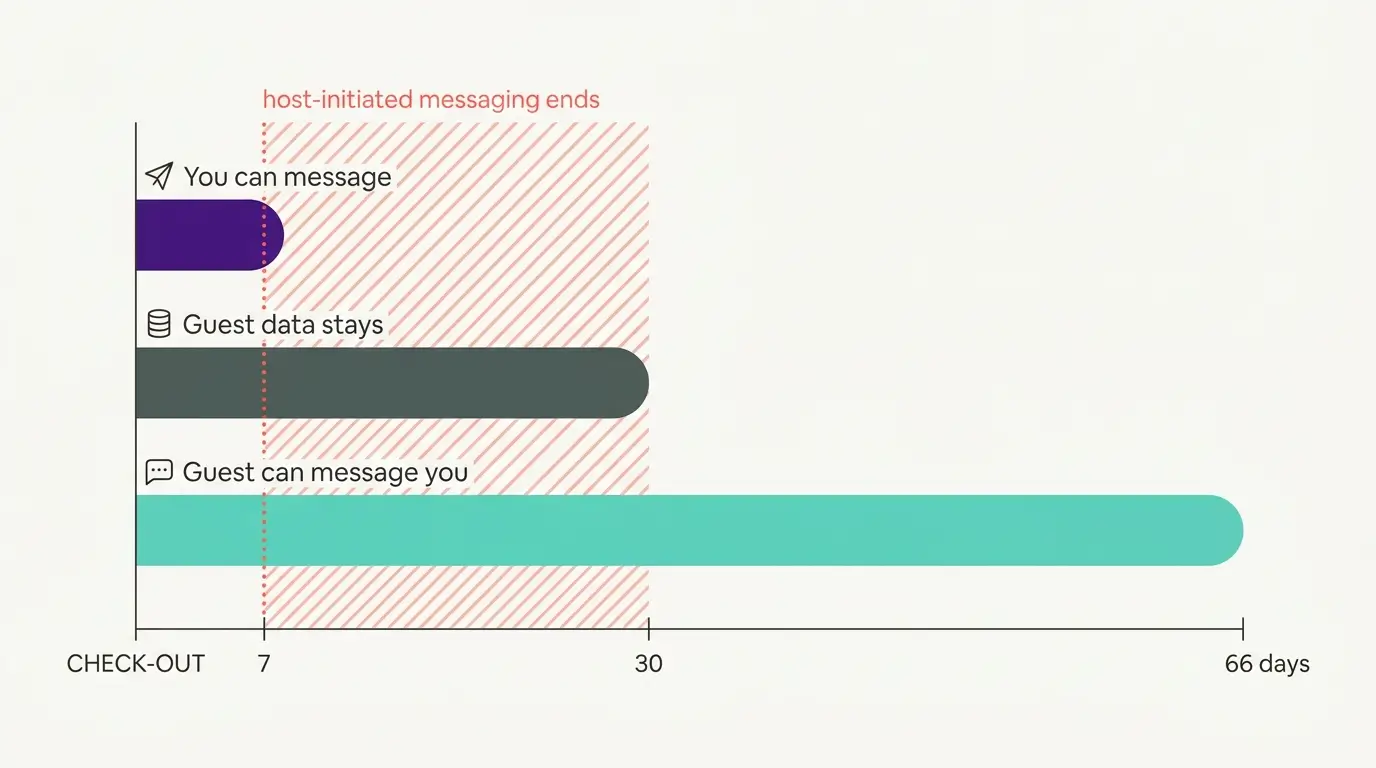
Booking.com Guest Messaging Rules: What Hosts Can Send, When, and Why Links Get Removed
Booking.com guest messaging rules, verified at source: how long you can message a guest, why your links get removed, and what the partner terms say.
Vrbo's New Features for Fall 2026: What's Live, What's Gated, and What's US-Only
We sorted Vrbo's new features for fall 2026: what is live globally, what is gated behind eligibility, and what is US-only. Verified against Vrbo's own pages.