
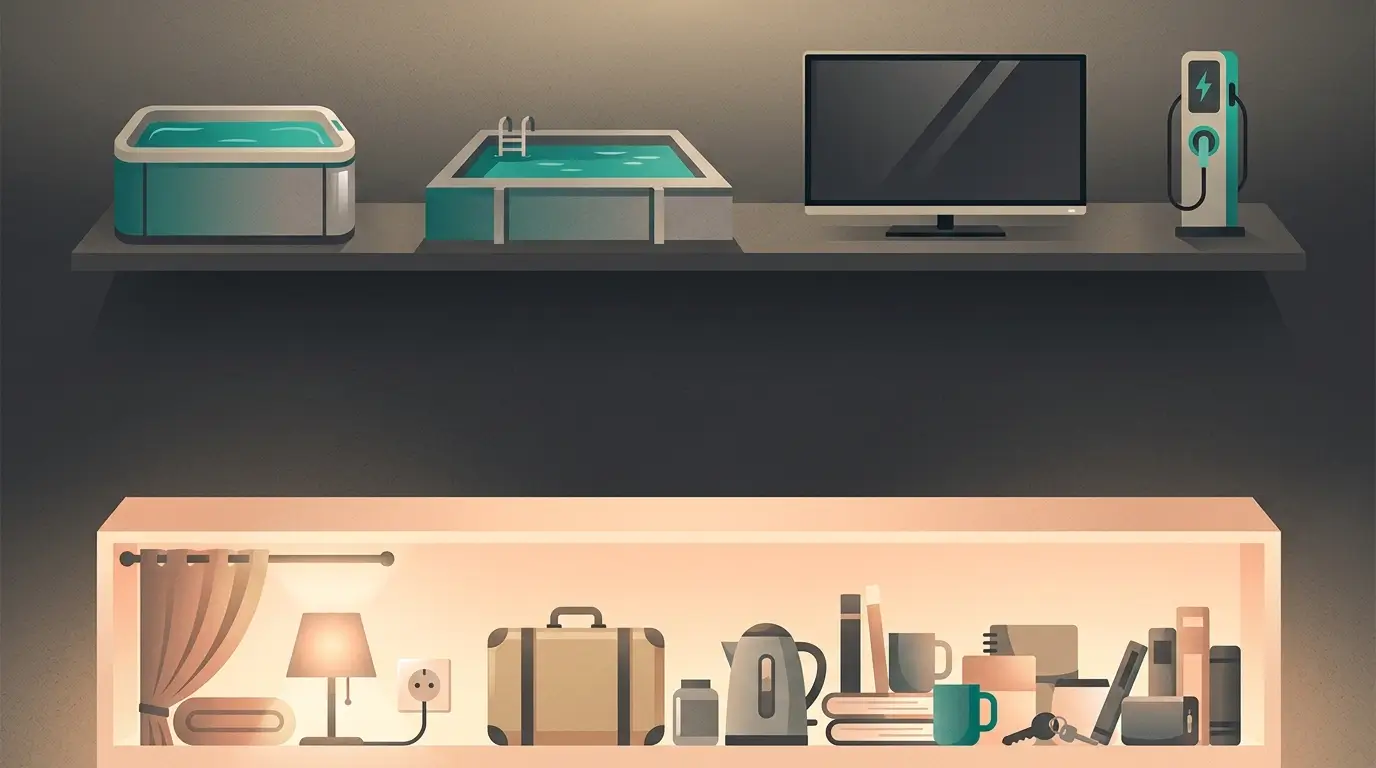
Which amenities pay depends almost entirely on your local market and who you are competing against. AirDNA's data shows a pool lifting nightly rates around 16% in mid-size cities and 4% in mountain destinations, because the premium comes from being different to the listings beside you. Underneath that, the list guests actually mention barely moves: hot water, a dark room, a reachable socket and clear instructions.
Go back through a year of your own reviews and highlight the concrete nouns. Not the star rating, the nouns. Ours keep landing on the same short list: the bed, the shower, the wifi, the parking, the light. The line items we spent the most on barely come up.
What do guests actually want in an Airbnb?
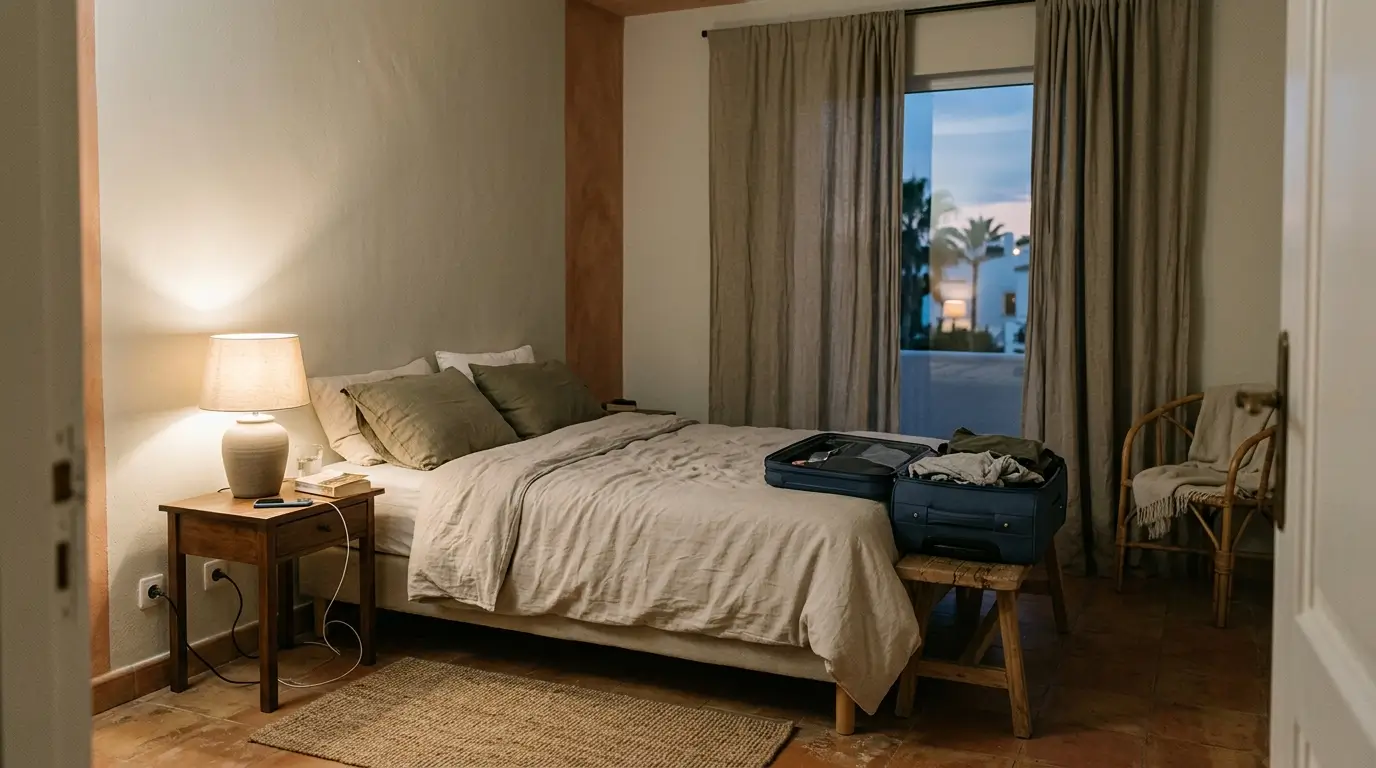
In our experience guests want a place that is easy to live in for a few days. In practice that means hot water that lasts through several showers, good water pressure, a bed they sleep well in, and a room they can make dark. Then the small things: somewhere to set a suitcase, an outlet within reach of the bed, enough light to read by, and clear information about how everything works. Premium amenities help win the booking. Practical comfort is what shows up in the review.
Most hosts fund the amenities budget properly and assume the comfort list takes care of itself, because the comfort list does not photograph.
The complaints guests mention constantly if you don’t fix them
We run five properties: a row house in Washington DC that used to be our home, a house in Playa del Carmen we built to rent, a studio in Tulum, and two Riviera Maya properties we co-host. Two countries, very different guest profiles, and a stubbornly similar list of complaints.
Hot water that lasts, and pressure behind it. A four-guest booking often means four showers back to back, and a heater sized for the couple who viewed the listing is not sized for that.
A room you can make dark. Blackout curtains cost less than almost anything else here and get named in reviews more often than anything else we have bought. People on holiday tend to sleep later than they do at home.
Somewhere to put a suitcase. A bench, a cleared shelf, a low table. Without one the case usually lives open on the floor all week.
An outlet within reach of the bed. Most guests use their phone as an alarm clock, so a dresser blocking the only free socket gets noticed on the first night.
Light you can read by. One ceiling fixture on a single switch makes an evening feel like a waiting room, at least to us.
Somewhere to sit that is not the bed. In our Tulum studio this was the comfort decision that mattered most, and it is what stops a studio feeling like a room you only sleep in.
A kitchen with the few things people cook with. One sharp knife, a pot big enough for pasta, a colander, a decent pan and an obvious way to make coffee. Most guests want breakfast without hunting, not a fully equipped chef's kitchen.
Clear information about how the place works. Where to park, how the shower mixer behaves, which switch is the water heater, what to do with the trash. This one costs time rather than money.
In our Tulum studio the only bedside outlet sat on the far side of the bed, and a guest mentioned charging a phone from across the room. We moved a lamp and added a socket on the near side.
Our post on running a successful Airbnb covers the operational side, and our decorating notes cover where comfort and photographs have to agree with each other.
Do expensive amenities still earn their money?
They do, but how much depends almost entirely on your local market and who you are competing against. The best evidence we've found beyond our own experience is AirDNA's amenity study, which analysed thousands of active US listings and ran a regression controlling for bedroom count, property type, location, occupancy and review score. That control is the part that matters, because it separates the amenity's own effect from the fact that houses with hot tubs tend to be nicer anyway.
Their first finding is one you cannot act on. Several of the strongest national performers, including ski-in/ski-out access, waterfront and an ocean or lake view, come with the property and cannot be added later (AirDNA, best Airbnb amenities, October 2025 data). Of the things you can actually buy, hot tubs lead nationally at 14.3%.
After that the national average stops being much use, and AirDNA's own chart titles say so: pools add a premium where they are more uncommon, hot tubs add the most value in small cities and rural markets, and saunas fail to stand out where pools and hot tubs already reign. A pool lifts nightly rate around 16% in mid-size cities and around 4% in mountain and lake destinations. The same hot tub runs from roughly 20% in small city and rural markets down to about 9% on the coast.
Their coastal cut shows both halves at once. A pool appears in 55.3% of coastal listings and lifts rate 5.9%. A hot tub appears in 20.4% of them and lifts it 9.4%. Same market, same guests, and the scarcer amenity carries the bigger premium. That makes it a question about your comp set rather than your property, which is why a number from someone else's market is often less useful than hosts assume.
What is ours rather than AirDNA's is the comparison with the comfort list. Our experience suggests it does not decay the same way, because guests judge blackout curtains and a comfortable bed from inside the stay rather than against competing listings. That is an inference from our own reviews, not something anyone's data proves.
The same logic rescues a very unglamorous item: in mountain and lake destinations AirDNA puts internet at about a 15% lift, level with ski-in/ski-out access, because where connectivity is not assumed it stops being furniture and starts being a feature.
Our Playa del Carmen house is the worked example, and the miss is ours. We built it from the ground up as a rental with a small pool, which in the Riviera Maya, and especially at the luxury end, is a must-have rather than an upgrade. On AirDNA's coastal numbers that is the 55.3% amenity: it gets you considered rather than earning you a premium. What we did not build is the 20.4% one. The reason is the part a percentage cannot show you. Our terrace is too small for a hot tub, so fitting one would have meant adding a rooftop level to stand it on.
Three cautions, all ours rather than AirDNA's. Their sample is US listings, so we read the coastal figures as a pattern rather than a price for Quintana Roo, Mexico. ADR is what you can charge, not what you keep, and the model does not price the rooftop or the pump. And AirDNA sells market data, so we take the regression as the useful part and the market-filtering advice as a sales argument.
All of that is pre-booking data. ADR measures what a guest will pay before they arrive, which makes it the wrong instrument for the second list entirely, and the only numbers we have from inside the stay are our own. Across the four Riviera Maya properties over ninety days, and our Washington, DC house is not in that sample, the wifi article was opened 147 times and collected zero upvotes. "About your hosts" came fourth on opens and first on upvotes. Those measure different things: how often guests needed something, and whether they felt anything about it. Wifi tops the first and bottoms the second, and it is the same item AirDNA prices at a 15% lift where it is scarce. Guests will pay for it and look it up constantly without ever thinking to mention it.
The article about us runs the other way, which we read as a warning against tuning a property for the practical list alone. Treat opens as an ordering signal and nothing more: a low count usually means the question is rare, not that the answer was wasted. Full numbers in what our guidebook analytics actually show.
Why the gap exists
Two reasons, both from our own experience. A property can photograph beautifully and still be irritating to live in for four days, and guests only find that out after they have paid. The second is one we fell into ourselves: you know which switch is the water heater, and you brought your own pillow last time you stayed, so every one of those is a private workaround your guests never got.
How to find the gap in your own property
Read a year of reviews for nouns, not stars. Ignore the rating and count the concrete things guests named. The repeats are your list, in priority order, for an hour of reading.
Write down every question you have answered twice. That is either a missing piece of information or a confusing object. Our guest welcome checklist works as a starting inventory.
Stay in the property properly. Leave the owner's cupboard locked and your own pillow at home. Arrive at 11pm the way a guest does, and fix nothing until morning.
Look up what your comp set already has before buying a big amenity. The premium lives in the difference between you and the listings a guest sees beside yours, so the same pool can be worth three or four times more in one market than another.
Write the information somewhere that is not tied to one booking site or channel. If your check-in steps only exist in Airbnb's arrival guide, a Vrbo guest or a direct booking never sees them, and you end up writing the same thing two or three times. Keep one copy you can point any guest at, whichever site they came through.
What changes by property type
Only the first row comes from properties we run. We do not operate a hotel, a B&B or a campsite, so the rest is the same reasoning applied to those formats rather than something we have lived, and none of it is survey data. Treat it as a checklist to test against your own reviews. The order moves around less than you would expect.
Property type | What we would check first | What tends to get over-weighted |
|---|---|---|
Airbnb or vacation rental | Hot water, blackout, kitchen basics, parking clarity | Amenity count; in our reviews guests name a handful, not the list |
Small hotel room | Bed quality, sound between rooms, power at the bedside, a desk surface | Printed in-room collateral as the main reference, though some guests still prefer paper |
B&B | Breakfast timing stated clearly, bathroom arrangements stated clearly, privacy in shared space | Decorative styling, when the practical answers are missing |
Glamping unit or campsite pitch | Power and charging, water, how the bathroom works, what to bring, what mobile signal to expect | Luxury finishes, if the basics are ambiguous |
With no front desk for some of these properties, information is close to the only thing standing in for one, which we went into in the glamping guest experience.
The cheapest item on the list is the one you write down
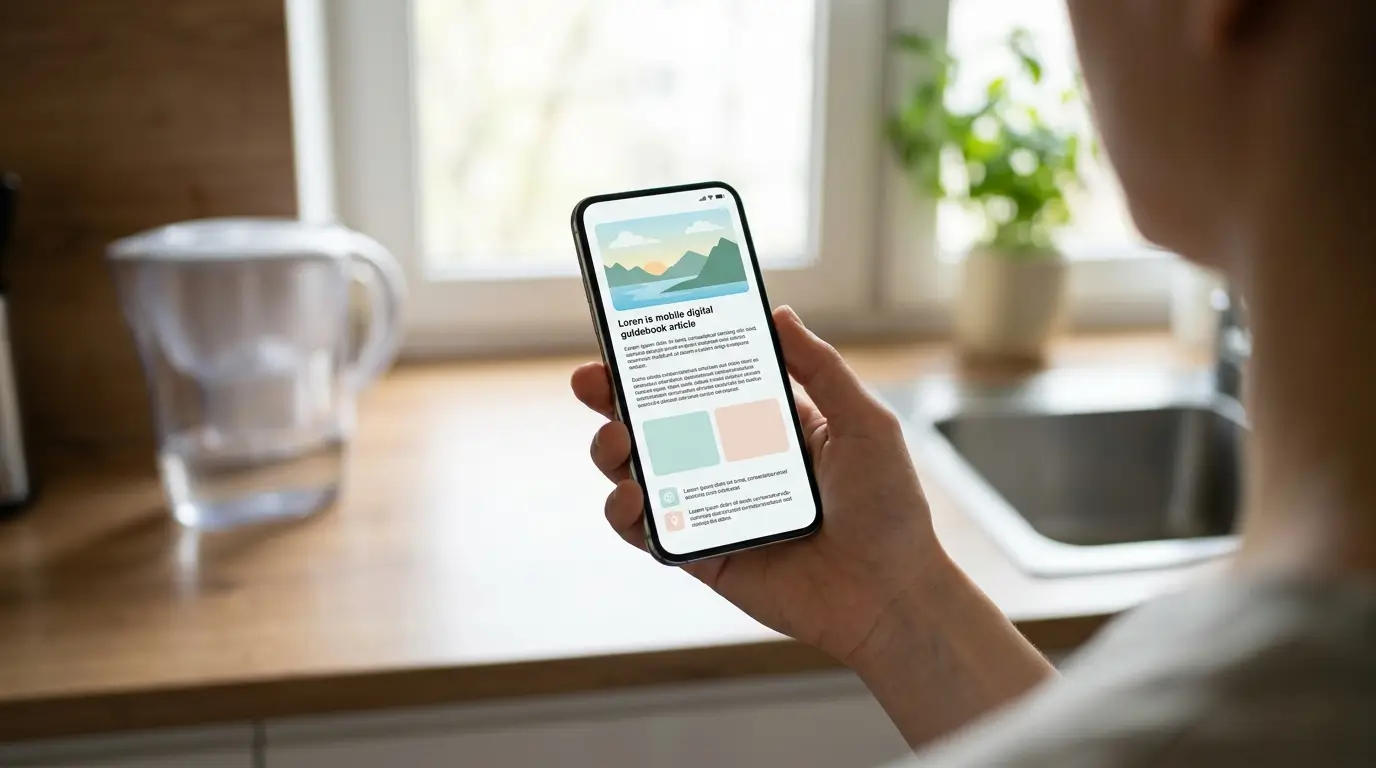
Almost everything on that list costs money. Writing the information down costs time instead, and in our data it is the item guests reach for most often. It also does not need a rooftop built for it. Our guidebook build guide covers the mechanics.
Two things we learned the hard way: put the answer where the question happens, since a code stuck next to our water filter ended a question an existing article had not, and use a photograph of the actual object rather than a paragraph describing it.
Keep that information outside the OTAs, too. Airbnb's platform-wide numbers can be strong in a quarter when your own market is soft, as we covered in Airbnb's Q2 2026 results, so a single channel is not a plan. This is not about moving guests off Airbnb, which their policy prohibits and which we would not advise anyway. It is about a second source of demand, and one set of guest information that serves every channel equally.
FAQ
What is the most requested amenity in an Airbnb?
Based on our own guidebook analytics, reliable wifi is one of the highest-demand items: the wifi article is the most-opened practical article across our Riviera Maya properties. That measures what guests look up rather than what they ask for, so read it as a strong signal rather than a ranking. In AirDNA's US data internet also lifts nightly rate by about 15% in mountain and lake markets, level with ski-in/ski-out access. After that the requests cluster around comfort rather than features.
Which amenities add the most value to an Airbnb?
It depends on your market more than on the amenity. In AirDNA's US data hot tubs lead nationally at 14.3%, but the same hot tub is worth roughly 20% in small city and rural markets and about 9% on the coast, and a pool swings from around 16% in mid-size cities to around 4% in mountain and lake destinations. Look at what the listings you compete with already offer before you spend.
What makes a good Airbnb from a guest's point of view?
In our view, one where nothing needs explaining twice. The guest gets in without a phone call, finds the bathroom and the wifi without hunting, works out the lights and the temperature without help, and does not have to message you before bed.
Is a welcome basket worth it?
It is a low-cost gesture guests do notice, and it is not a substitute for the practical list above. If you only have budget for one, we would buy the blackout curtains first.
What it comes down to
Which amenities pay depends on your market and your competition, and that question deserves real research before you spend. The pattern underneath it does not move nearly as much. Guests rarely thank you for what you spent, they thank you for the friction you removed. Hot water, a dark room, a reachable outlet, clear instructions and a bed that suits them will never make a dramatic listing photo, and they turn up in our reviews again and again.
Want the information half handled?
You can build the guest information layer with a printed folder, a shared document, or a digital guidebook. If you would rather not format it yourself, SmoothStay gives you a guidebook you can put behind a QR code, plus an AI Concierge that answers follow-ups from what you have published and nothing else. The free tier covers one property with no card needed, so you can see whether guests open it before paying. AI features sit on the paid plans.
Latest articles

How to Automate Check-In Instructions for Short-Term Rental Guests
Automate check-in instructions for short-term rental guests: the four-send sequence, what goes in a message versus a guidebook, and a copy-ready sample.

Vrbo Premier Host in 2026: Every Listing Now Stands on Its Own Record
Vrbo Premier Host requirements changed in 2026: per-listing scoring, tighter thresholds, quarterly checks. What each one means, and how it compares to Superhost.
Booking.com Guest Messaging Rules: What Hosts Can Send, When, and Why Links Get Removed
Booking.com guest messaging rules, verified at source: how long you can message a guest, why your links get removed, and what the partner terms say.
Vrbo's New Features for Fall 2026: What's Live, What's Gated, and What's US-Only
We sorted Vrbo's new features for fall 2026: what is live globally, what is gated behind eligibility, and what is US-only. Verified against Vrbo's own pages.