

Airbnb’s Q2 2026 results show strong demand, with nights booked up 10% and guidance raised, while the company’s AI support assistant cut support‑cost per booking by about 16% by resolving roughly 45% of issues without human agents. For hosts, the takeaway is that leveraging self‑serve guidebooks and multilingual AI tools can reduce routine guest questions and improve efficiency, especially as Latin America’s growth drives more non‑English‑speaking bookings.
Airbnb published its second-quarter 2026 results on August 6, and the financial coverage wrote itself: revenue up, guidance raised, stock story intact. We read the shareholder letter looking for something a host can act on. It was not in the revenue line. It was in a paragraph about customer support.
What did Airbnb's Q2 2026 results mean for hosts?
Demand grew and Airbnb raised its full-year outlook, so the booking environment for the rest of 2026 looks healthy on paper. Nights and Seats Booked reached 148.3 million, up 10% year over year and accelerating from Q1 2026. The line worth reading twice sits further down the letter: Airbnb reported that its customer support cost per booking fell approximately 16% year over year, driven in part by an AI support assistant that now resolves nearly 45% of the issues it handles without a human agent.
The headline numbers, in host terms
Metric (Q2 2026) | Reported figure | What it signals for a host |
|---|---|---|
Nights and Seats Booked | 148.3M, up 10% year over year | Demand grew, and the growth rate picked up from Q1 |
Gross Booking Value | $27.2B, up 16% year over year | Volume and rate both contributed, not just rate |
Average Daily Rate | $184, up 5% year over year | Moderate rate growth, no sign of a pricing spike |
Full-year 2026 outlook | Raised; revenue growth now expected at least mid-teens | Airbnb expects the second half to hold up |
Revenue was $3.6 billion, up 17%, net income $816 million, diluted earnings per share $1.37, and Adjusted EBITDA margin expanded to 35%. The letter also reports that 64% of nights booked came through the Airbnb app, up from 59% a year earlier, which tells you where your guests are when they need something.
None of that decides what your calendar does. It describes a backdrop, and we will come back to how far that backdrop sits from some markets.
The line the coverage skipped: Airbnb's support costs fell because people stopped needing a human

Here is the paragraph, in Airbnb's own words:
In Q2, our customer support related cost per booking declined approximately 16 percent year-over-year, driven in part by improvements to our AI assistant.
And a few lines above it, the mechanism:
Our AI assistant, now available in more than 50 languages, has been rated the best AI support assistant in travel. Nearly 45 percent of issues that begin with our AI assistant are now resolved without a human agent, up from Q1, while delivering much faster resolution times.
Those are Airbnb's numbers about Airbnb's own support organization, not a claim about your property. What makes them worth reading is the source: the largest company in the category, publishing in a document its lawyers reviewed, on what happens when the person with the question can get the answer instead of waiting in a queue. Airbnb says an AI voice assistant is coming later this year too.
Why the same logic scales down to one host with an inbox
Airbnb runs support for millions of hosts and a global guest base. You run support for four bedrooms and a phone that buzzes at 11pm. The scale is nothing alike, but the questions are the same kind: someone needs a fact and cannot find it.
Most of what lands in a host inbox is not a complaint. It is a lookup. The wifi password, the trash day, the gate code, whether the beach chairs are in the closet or the shed. Cheap one at a time, expensive in aggregate, and every one arrives at a moment you did not choose. Hosts have been solving this for years with a sheet on the counter and a guidebook link in the check-in message, and almost none of us ever measured it.
Our own version: guests at the Playa del Carmen house kept asking how to set the temperature on the electric grill. We put a QR code next to the grill that deep-links straight to the guidebook article about it. The question still comes up now and then, just far less than it used to.
So our position: the direction is right, and hosts got there first without the instrumentation to prove it. What Airbnb's letter adds is one of the clearest public disclosures we have seen from a major OTA about the operational impact of AI-assisted support. Treat that as a reason to spend an afternoon writing things down, not as a result to expect. Nobody outside Airbnb has data on what one property's inbox does after a guidebook goes live, and any vendor telling you otherwise is guessing.
The practical version is in how to reduce guest questions without ignoring anyone. For the wider pattern of every major booking platform rebuilding around AI, here is the host playbook.
What Airbnb's Latin America growth means at your front door
Across Airbnb's four reporting regions, Latin America posted the strongest growth in Nights and Seats Booked in Q2 2026, at approximately 20%. Asia Pacific came in at high teens, North America and EMEA at high single digits. Inside that number, Brazil origin net nights booked accelerated to over 30% year-over-year growth and the number of first-time bookers from Brazil rose 40%. Airbnb also flagged continued strength from bookers in Mexico, helped in part by installment payments introduced in June. All of those figures sit in the regional breakdown of the Q2 2026 shareholder letter, which the shorter newsroom summary leaves out.
Two things follow, both operational rather than strategic.
First, a 40% jump in first-time bookers from Brazil means more guests who have never used Airbnb before. Airbnb says nothing about what those guests ask, so take the next part as our own experience rather than theirs: first-time users need more guidance, because they do not yet know which things the platform handles and which things you do.
Second, more of those guests read Spanish or Portuguese. If your arrival instructions, wifi details, and house rules only exist in English, a guest translating your check-in message in a browser tab at midnight is a phone call waiting to happen.
We learned that one the hard way. An older French couple called us about the pool gate because they read neither English nor Spanish, and the sign by the gate was in both. Those instructions now live in the guidebook, which translates into 100+ languages on its own, so the next guest in that spot picks their language and reads it without calling anyone. More on that in how to communicate with non-English-speaking guests.
Airbnb's Latin America grew. Our corner of it did not.

Worth saying plainly, since we host here. For the week of July 4 to 10, average hotel occupancy across Quintana Roo's main destinations was 59.6%, according to the state tourism information system Situr, reported by EFE. Riviera Maya sat at 54.1% and Tulum at 41.5%, in what should be peak summer. Sargassum, expensive flights, and a wave of new supply all get blamed. The World Cup, which everyone here expected to fill rooms, did not.
Platform-wide demand up 10%, our stretch of coast down, both true at once. That gap is the argument for not letting one channel own your pipeline. Build a direct booking channel alongside the OTAs, and pick tools that work across every channel instead of ones that only live inside a single platform's product. It is a slow build, and it is not about moving guests off Airbnb, which their Off-Platform Policy prohibits and we do not do. It is about having a second place demand can come from when your market has a quarter like ours. The compliant version is in how to get direct bookings without risking your Airbnb account.
What we would actually do with this
Pull your last 30 guest messages and split them into questions and conversations. The questions are the ones a written answer can absorb.
Write the top five answers down once, somewhere a guest can reach without messaging you. Wifi and checkout go first, because those are what guests hunt for.
Check that your arrival information exists in the languages your guests read, not just the one you write in.
Keep that information outside any single platform's tools. Anything that only lives in Airbnb's product does not travel to a Vrbo guest or a direct booking.
Leave the conversations alone. A guest asking for a dinner recommendation is not a support ticket, and answering that one yourself is the part of hosting worth protecting.
On the SmoothStay side, this is the job the guidebook does: your information, published once, in whatever language the guest picks, sitting outside the OTAs so it serves an Airbnb guest and a direct booking equally, with the AI Concierge answering follow-ups strictly from what you have published rather than inventing anything. An assistant that only draws on your own content cannot tell a guest the pool is heated when it is not.
FAQ
When did Airbnb report Q2 2026 results?
Airbnb posted its Q2 2026 shareholder letter on August 6, 2026, followed by an earnings webcast the same afternoon. You can read the full shareholder letter, with a shorter summary on the Airbnb newsroom.
Did Airbnb raise its guidance for 2026?
Yes. Airbnb raised its full-year 2026 outlook for both revenue growth and Adjusted EBITDA margin, now expecting revenue growth of at least mid-teens and a full-year Adjusted EBITDA margin of at least 35.5%. For Q3 2026 it guided to revenue of $4.69 billion to $4.77 billion.
What is Airbnb's AI support assistant, and does it replace host support?
It is Airbnb's own customer support tool, available in more than 50 languages, which Airbnb says now resolves nearly 45% of the issues that begin with it without a human agent. It handles platform and booking issues. It does not answer property-specific questions like your door code or your parking spot, so those still come to you.
Which region grew fastest for Airbnb in Q2 2026?
Latin America, with approximately 20% growth in Nights and Seats Booked year over year, ahead of Asia Pacific in the high teens and North America and EMEA in the high single digits. Brazil and Mexico were the standouts.
Do these results mean my bookings will go up?
Not on their own. Airbnb's numbers describe platform-wide demand, and plenty of individual markets are moving the other way right now. Quintana Roo is one. Read the guidance raise as a sign that overall travel demand held up in the first half of 2026, then check your own booking pace before you change anything.
Should hosts be worried about Airbnb automating support?
Worry less about the automation and more about where the answer lives. Guests increasingly try to find information before they ask for it, and the questions still reaching you are usually the ones nobody wrote down anywhere they could get to.
Answer the repeat questions once
If most of your inbox is the same handful of lookups, replying faster only gets you so far. Put the answers somewhere your guests can reach at 11pm, in the language they read, and somewhere that works no matter which channel booked them. If you would rather not format all of that yourself, you can have a digital guidebook running in minutes, starting free for one property.
Dominique and Diego host in Washington, DC and the Riviera Maya. Airbnb figures come from its Q2 2026 shareholder letter and newsroom release, both published August 6, 2026. Quintana Roo occupancy figures are from Situr via EFE, July 14, 2026.
Latest articles

How to Automate Check-In Instructions for Short-Term Rental Guests
Automate check-in instructions for short-term rental guests: the four-send sequence, what goes in a message versus a guidebook, and a copy-ready sample.

Vrbo Premier Host in 2026: Every Listing Now Stands on Its Own Record
Vrbo Premier Host requirements changed in 2026: per-listing scoring, tighter thresholds, quarterly checks. What each one means, and how it compares to Superhost.
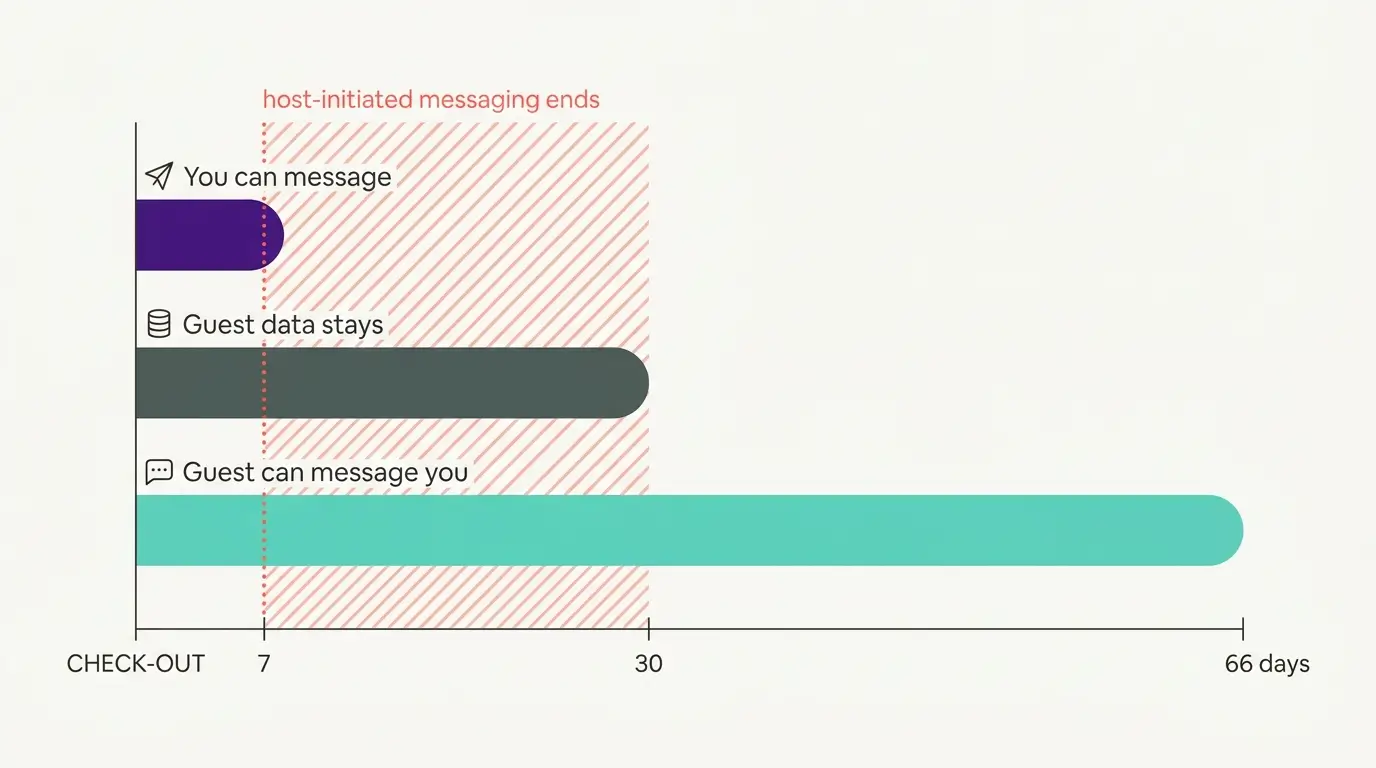
Booking.com Guest Messaging Rules: What Hosts Can Send, When, and Why Links Get Removed
Booking.com guest messaging rules, verified at source: how long you can message a guest, why your links get removed, and what the partner terms say.

Vrbo's New Features for Fall 2026: What's Live, What's Gated, and What's US-Only
We sorted Vrbo's new features for fall 2026: what is live globally, what is gated behind eligibility, and what is US-only. Verified against Vrbo's own pages.