
A concise RV park guidebook should cover essential details such as site location, arrival procedures, hookup instructions, dump station use, site rules, pet policies, amenities, local attractions, and emergency contacts, while also explaining how guests can access the guide via QR codes or confirmation links even with weak cellular signals. This focused content helps RV park operators provide a seamless, informative experience tailored to their specific audience.
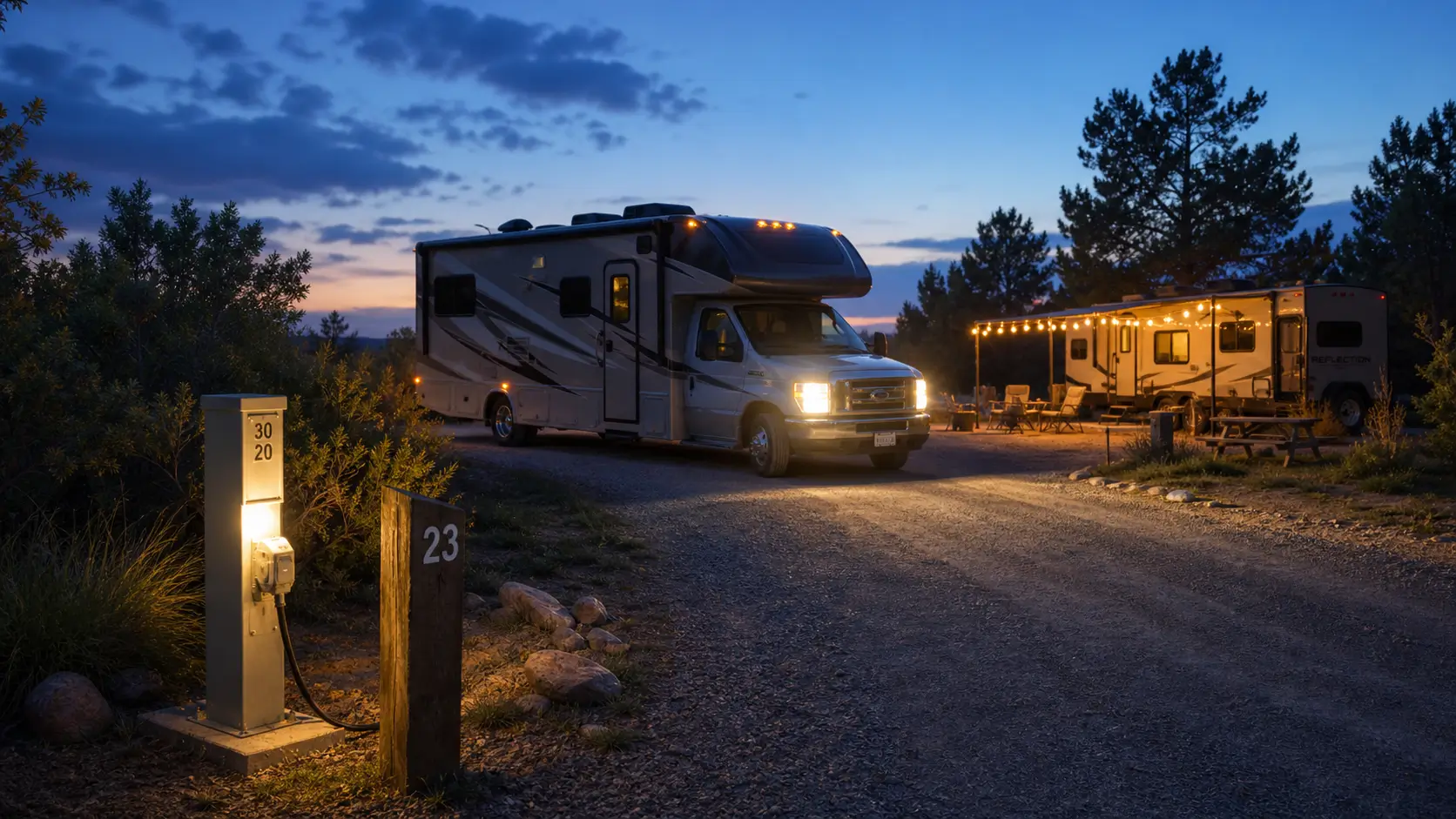
A rig pulls into the park at 8:40 on a Friday night, more than an hour after the office light went off. The driver has a confirmation email buried in his inbox, a site number he can't quite remember, and one bar of signal that dies every time the map tries to load. He's backing thirty-two feet of travel trailer down a gravel loop in the dark, hunting for the 30-amp pedestal on site 14, hoping he doesn't clip the water riser on the way in.
That arrival is the entire reason an RV park guidebook exists. Not to look polished on a welcome table. To get a tired driver onto the right pad, hooked up, and settled before they wake the whole loop.
What should an RV park guidebook include?
An RV park guidebook should cover seven things, in this order: how to find and pull into the assigned site, the hookup guide for electric, water, and sewer, dump station rules, the site rules guests actually break, an amenities map, local attractions, and emergency contacts. Arrival and hookups go first because those are the two sections a guest reads in the dark with the engine still running. The rest can wait for coffee.
Keep each section short and answer the question a guest is actually asking at that moment. The sections below are in the order guests reach for them.
Finding the site and pulling in
This is the only part of the guidebook guests read before they've stopped moving, so it has to be exact. Give the site number's location relative to a landmark they'll actually see in headlights, not a map grid. "Site 14 is the third pull-through on the right after the shower block" beats a coordinate every time.
Tell them which way the loop runs. One-way gravel loops are a small disaster in reverse with a trailer. Flag the low branch by site 9, the tight turn at the top of the hill, and whether 14 is pull-through or back-in. If it's back-in, say which side the hookups are on so they set up on the correct approach. And tell them where to leave the tow vehicle once they're parked.
For after-hours arrivals, spell out the routine: where the late-check-in envelope or board is, whether the gate code changes, and what to do if the assigned site already has someone on it. That last one happens more than anyone wants to admit.
The hookup guide: electric, water, sewer

The section guests come back to twice a night. Be specific about amperage. Say whether each site is 30-amp, 50-amp, or 20-amp, and where the pedestal sits relative to the pad. Note the breaker on the pedestal and ask guests to switch it off before they plug in and on after, which saves your pedestals and their converter.
For water, point to the spigot, say whether it's potable, and remind guests to use their own pressure regulator. Parks with high line pressure burn out a hose connection now and then, and the guest always assumes it was the park's fault. For sewer, give the connection location, mention the seal or donut, and say plainly: the black tank stays closed until it's time to dump, gray can flow if your sites allow it, and nobody dumps gray water onto the gravel.
Dump station
Short and firm. Where it is, the hours, which way the one-way lane runs, and the rinse-and-glove etiquette. Spell out what does not go down it: wipes, grease, anything that isn't what the tank is for. One blocked dump station ruins a Sunday checkout for thirty rigs.
The site rules guests actually break
Skip the legal wall. List the handful of rules that cause real friction and say why each one matters.
Quiet hours and generator hours, with the actual times
Pets on a leash, picked up after, and never tied to the park's trees or hookups
Campfires: in the ring only, and whether a burn ban is currently on
Slide-outs and awnings kept inside the site lines so the rig next door can still open theirs
Speed limit on the loops, because kids and dogs dart out between rigs
A rule framed as "here's why" gets followed. A rule framed as a citation gets ignored.
The amenities map
A simple labeled map does more than three paragraphs. Mark the restrooms and showers, the laundry, the potable water fill, propane, the Wi-Fi zone if coverage is patchy, the office and its hours, the playground, and the dog run. If your Wi-Fi only reaches the clubhouse, say so in the guidebook instead of letting guests discover it at their site at 11 p.m.
Local attractions worth the drive
Keep it to your real shortlist, the places you'd point a neighbor toward. The nearest grocery with a decent lot for a truck and trailer. The closest hardware or RV-parts store, because someone always needs a fuse or a sewer fitting. One trailhead or lake worth the morning. One diner that won't mind muddy boots. Five good picks beat a directory.
Emergency and after-hours contacts
Keep it to four lines so it doesn't read like a place where things go wrong. The after-hours number that actually reaches a human. What to do in a power outage or water issue. The nearest hospital and, for this crowd, the nearest emergency vet. The local non-emergency line for noise or trespass after dark.
Getting the guidebook into the guest's hands when signal is weak

A guidebook nobody can open is just a document. Cellular signal at campgrounds is famously thin, so plan for it.
Put a small weatherproof card with a QR code at the check-in board and on the site post, so guests can scan wherever they have the most signal. A digital guidebook needs at least a weak connection to open, so the goal is to get it onto the phone before the bars run thin. Drop the same link in the booking confirmation and the pre-arrival message so guests read it on the drive in, and point them to the park Wi-Fi near the office. For back-loop sites where coverage drops to nothing, keep a printed one-pager with the essentials (a site map, hookup basics, the gate code, and your number) in the late-arrival envelope and/or invest in a satellite internet service if you haven’t already so that you can offer Wi-Fi. That's the backup that always works.
Where a tool like SmoothStay fits
We built SmoothStay running our own rentals in Washington DC and the Riviera Maya, not an RV park. We believe a digital guidebook tool works for non-standard formats just as well as for a house: each site or site type gets its own arrival and hookup details, and you update the dump-station hours once instead of reprinting a board.
If your park also lists sites on Airbnb or Hipcamp, the OTA compliance layer matters. It's channel-aware: for a guest who booked through a channel that bans direct-booking nudges, it hides your contact-capture and book-direct-next-time content, and it shows that same content to guests who came to you directly. The decision rides on where the booking came from, not when the guest shows up. Pricing stays the same simple per-site rate whether you run six pads or sixty.
If you'd rather not format all of this yourself in a PDF, you can have a free digital guidebook for your park running in under an hour. No card needed.
FAQ
What's the difference between an RV park guidebook and a campground welcome packet?
Not much, except a guidebook updates instantly and a printed packet doesn't. Both cover arrival, hookups, rules, and local tips. The guidebook wins the moment your dump-station hours or your gate code changes, because every guest sees the new version without you reprinting anything.
How do guests open the guidebook if there's no signal at the site?
A digital guidebook needs a connection to open, so have guests load it where signal is best. Send the link in the booking confirmation so they read it on the way in, put a QR code at the entrance or check-in board where bars are strongest, and point them to the park Wi-Fi. For sites with no coverage at all, a printed one-pager with the essentials in the late-arrival envelope is the reliable fallback. It would also be a good idea to invest in a satellite internet service to provide Wi-Fi.
What should actually go on the site post itself?
The site number, the QR code to the guidebook, and the amperage of that pedestal. That's it. The post is a pointer, not the manual. Everything else lives one scan away.
Do I need a guidebook if my park is small?
If guests have ever called the office asking where the dump station is or what the Wi-Fi password is, yes. A six-site park gets the same questions a sixty-site park does, just from fewer people. Writing the answers down once is cheaper than answering them all season.
How often should I update an RV park guidebook?
Whenever something changes, and a quick read-through at the start of each season. Burn bans, rate changes, a new laundry machine, updated quiet hours. Open it on your own phone, walk it like a first-night guest, and fix the one thing you spot.
Latest articles

How to Automate Check-In Instructions for Short-Term Rental Guests
Automate check-in instructions for short-term rental guests: the four-send sequence, what goes in a message versus a guidebook, and a copy-ready sample.

Vrbo Premier Host in 2026: Every Listing Now Stands on Its Own Record
Vrbo Premier Host requirements changed in 2026: per-listing scoring, tighter thresholds, quarterly checks. What each one means, and how it compares to Superhost.
Booking.com Guest Messaging Rules: What Hosts Can Send, When, and Why Links Get Removed
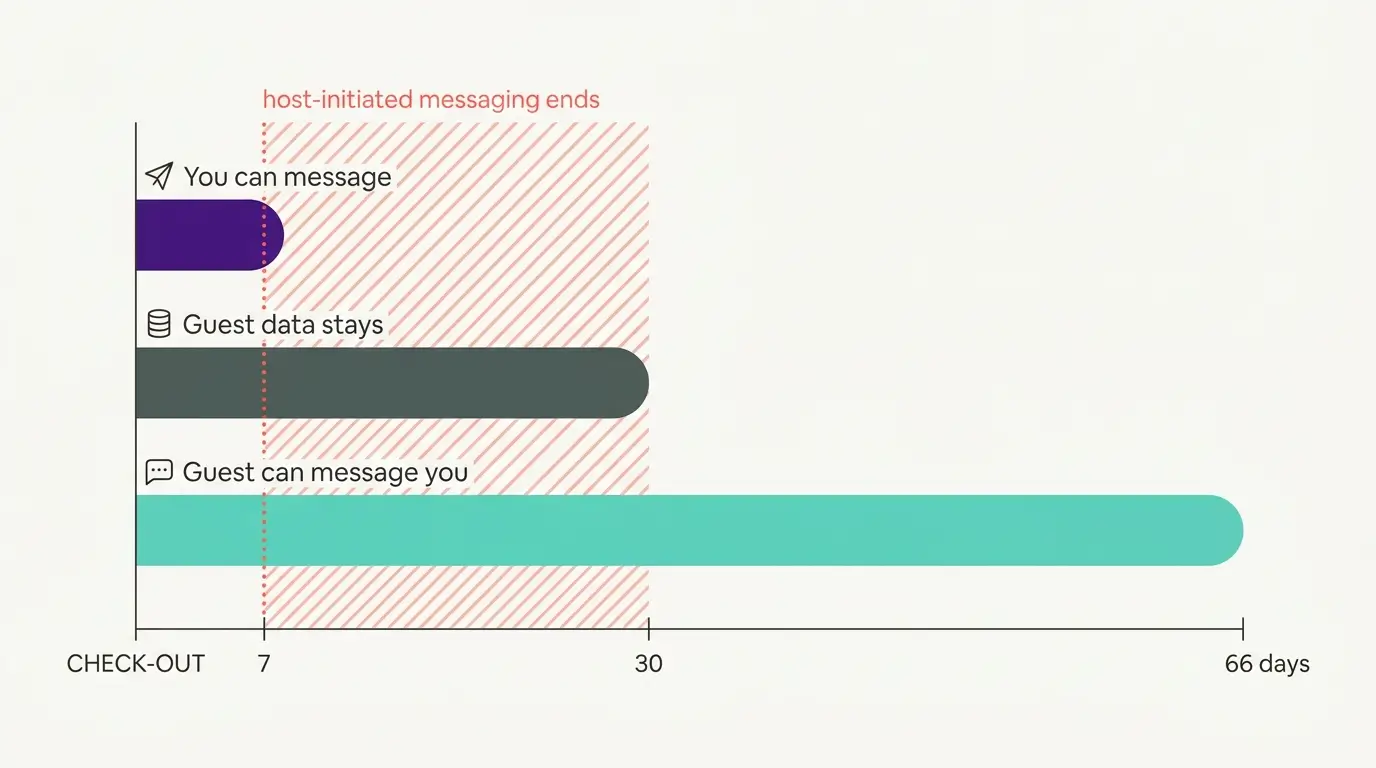
Booking.com guest messaging rules, verified at source: how long you can message a guest, why your links get removed, and what the partner terms say.
Vrbo's New Features for Fall 2026: What's Live, What's Gated, and What's US-Only
We sorted Vrbo's new features for fall 2026: what is live globally, what is gated behind eligibility, and what is US-only. Verified against Vrbo's own pages.