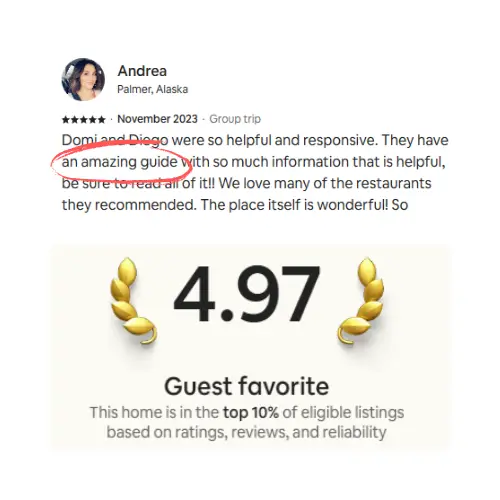

A trusted Airbnb local guide focuses on everyday essentials—coffee, food, groceries, pharmacies, and quick‑access spots—organized by the moments guests need them, with each recommendation paired with a brief why and a practical detail. Curating a short, property‑specific list and keeping it updated twice a year ensures guests receive reliable, actionable advice that reduces questions and enhances their stay.
Most local guides read like the first page of Google. Five restaurants with 4.5 stars, the beach everyone already knows, a coffee shop that closed two years ago. Guests skim it once, decide it tells them nothing they couldn't find themselves, and go back to searching.
The guides guests keep open are shorter and more opinionated. They answer the question the guest has right now: where do I get coffee before eight, where is the nearest pharmacy, is the closest grocery store any good. Then they add the line of context Google's listing can't give them.
What should an Airbnb local guide for guests include?
A local guide should cover the everyday essentials within walking or short driving distance of your property: coffee and breakfast, two or three restaurants at different price points, the grocery store you'd actually shop at, a pharmacy, an ATM, the nearest beach or park or trail, one or two bad-weather options, and the basics of getting around. Each entry needs a one-line reason you picked it plus one practical detail: walking distance, cash only, best time to go, or what to skip.
Fifteen to twenty-five places, each with two sentences in your own words, will serve guests better than a hundred pins with imported descriptions.
Why the top-ten list doesn't work
A ranked list of the ten best restaurants in town is a list your guest can generate in four seconds on their phone, with more reviews attached. Reproducing it adds nothing, and it quietly tells the guest that you don't know the neighborhood any better than an algorithm does.
There's a second problem. A top-ten list is organized around superlatives, and guests aren't shopping for superlatives. They're solving a problem at a specific hour: it's 9pm on arrival night and they haven't eaten, or it's raining on day three and the kids are climbing the walls.
A 2026 Hotelbeds trend piece, citing Oxford Economics research presented at HBX Group's MarketHub Asia, reported that 72% of travellers prefer spending money on local activities over traditional sightseeing. Hotelbeds is a B2B travel distributor with an interest in the experiences market, so read the framing accordingly. The direction matches what most hosts see: guests want the neighborhood, and they'd rather get it from someone who lives there.
Organize by the moment of the stay, not by category name
Categories like "Restaurants" and "Attractions" are how you file information. Moments are how guests need it. The fastest fix to any local guide is to look at each entry and ask which point in the stay it belongs to.
Moment | What the guest is solving | What to have ready |
|---|---|---|
Arrival night, often late | Food, and something to drink | One or two places open past 9pm, plus whether delivery actually reaches you |
First morning | Coffee, breakfast, a first grocery run | Nearest good coffee on foot, the grocery store you'd use |
Mid-stay | Real meals, a beach or park, a market | Two or three restaurants at different prices, your outdoor default |
Bad weather | Anything indoors | A museum, a long-lunch spot, a cinema, a covered market |
Something went wrong | Pharmacy, clinic, ATM, hardware store | Address, hours, and whether staff speak English |
Last morning | Fast breakfast, fuel, the route out | Where to eat before checkout, realistic drive time to the airport |
Guests don’t often read a guide front to back. They open it when something specific comes up, which is why the arrival-night and something-went-wrong rows earn their place near the top.
What a recommendation guests trust actually looks like
The difference between a listing and a recommendation is roughly two sentences. One says why you picked it. The other is the practical detail that saves the guest a wasted trip.
Weak entry | Entry guests trust |
|---|---|
"Great local taqueria, highly rated." | "Six-minute walk, on the corner past the pharmacy. Al pastor is the one to order. Cash only, busiest between 8 and 10pm, and the sign is small — look for the orange awning." |
"Nice beach nearby." | "Twelve minutes by car. Go before 10am for parking. There's a beach club at the north end if you want chairs and a bathroom; the south end is quieter and has neither." |
"Well-stocked supermarket." | "The big one is a ten-minute drive and has everything. The small one across the street is fine for coffee, eggs and beer, and open until 11pm." |
Four details do most of the work: how long it takes to get there, what to order or do, when to go, and the thing that would otherwise annoy them. A useful fifth is the honest negative. "Skip the seafood, stick to the grill" buys more credibility than another round of praise, because guests can tell a curator from a brochure.
Write the entries in your own voice. If one could have been pasted from anywhere, it reads that way. One of our personal recommendations for our Washington, DC home says:
Jaleo is one of our go-to restaurants in DC for Spanish tapas. The patatas bravas are the best we've tried! Everything feels fresh and full of flavor. The atmosphere is lively and the service is almost always great, so it's an easy choice for a relaxed lunch or dinner with friends and family.
Curate down, then stop
Twenty places guests trust beats two hundred they'll ignore. If you wouldn't send a friend there, it doesn't go in, and everything past your genuine shortlist dilutes the entries doing the work.
Three restaurants you know well, with an order recommendation for each, make a better local guide than twelve with star ratings attached.
Keeping it current without rewriting it every season
Local guides go stale in a specific way: restaurants close, hours change seasonally, and the tip that was true in high season is wrong in September. A printed sheet or a PDF locks those errors in until you reprint. Digital doesn't fix the drift on its own, but it makes correcting it a two-minute job instead of a print run.
A short seasonal pass is usually enough. Twice a year, check hours on anything you called "open late," delete anything that closed, and adjust the entries where the season changes the advice.
If you run more than one property
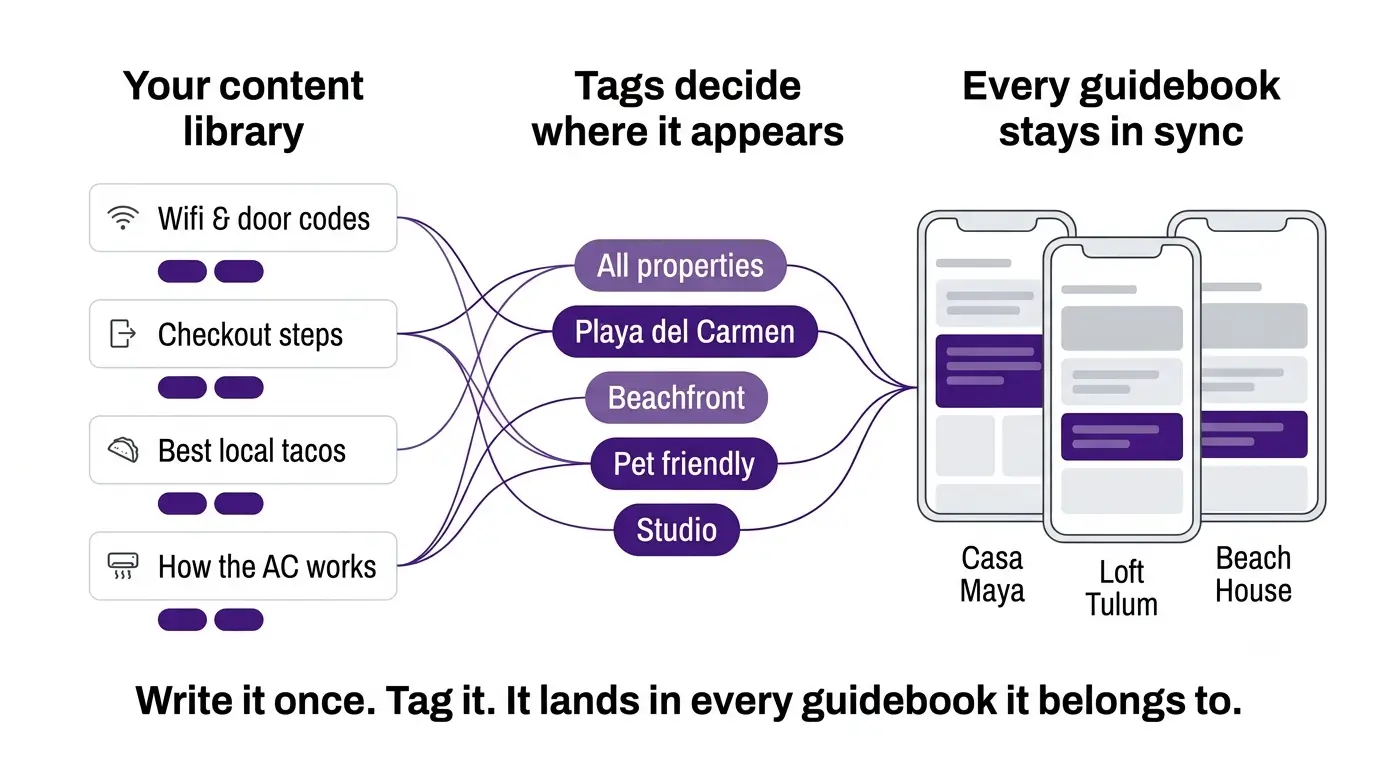
Properties in the same neighborhood share most of their local list, and if every guidebook holds its own copy, the same taqueria ends up described three different ways. Then the hours change and only one of the three gets fixed.
The way out is to store each recommendation once and point it at the properties it belongs to. In SmoothStay that's what tags do: write the entry or article once, tag it for the guidebooks it applies to, and it appears in each of them. Edit it later and they all update together. Picks that are genuinely property-specific, like the coffee place that's only walkable from one unit, can stay restricted to that guidebook.
Where the guide lives decides whether it gets read
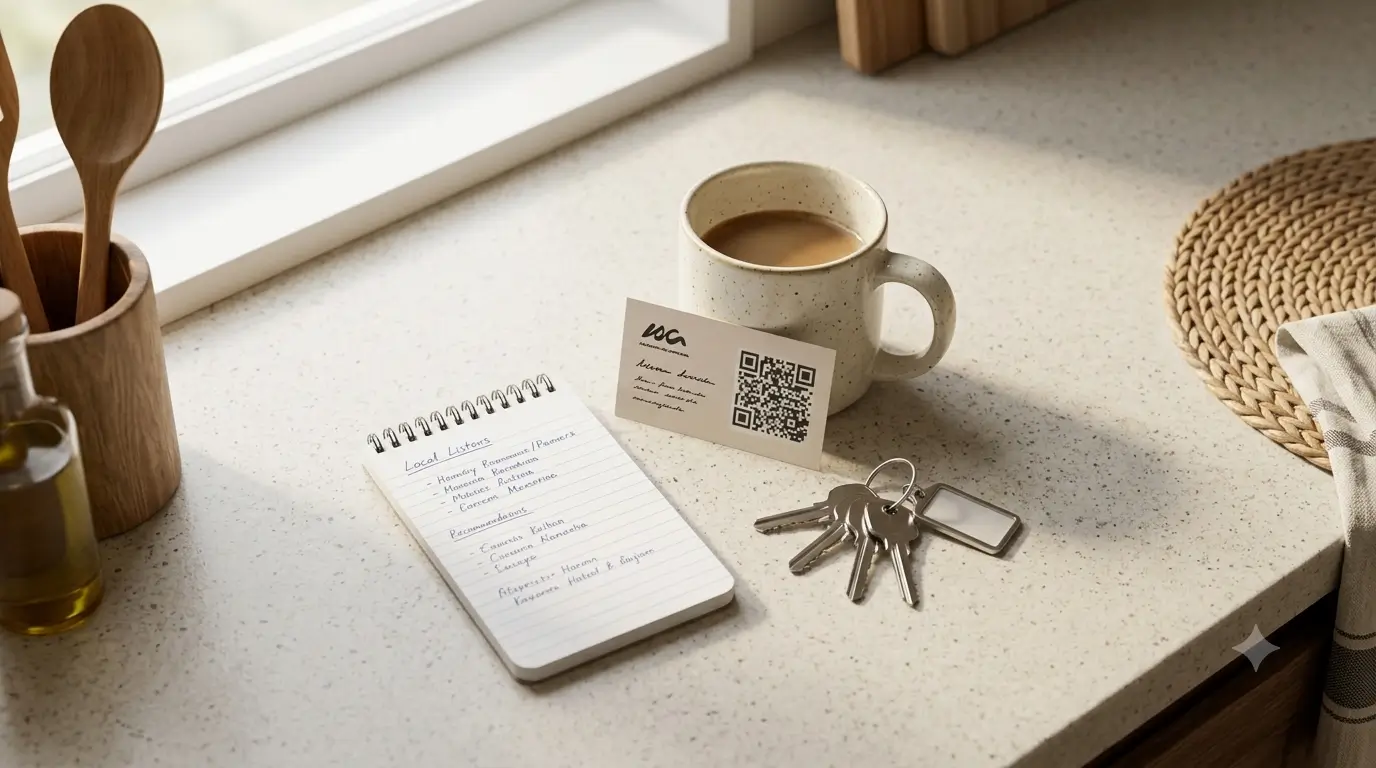
Most guests reach for their phone first, so the guide has to work there. That's the argument for digital over a folder on the counter, though a printed card still helps guests who prefer paper and gives the QR code somewhere to live.
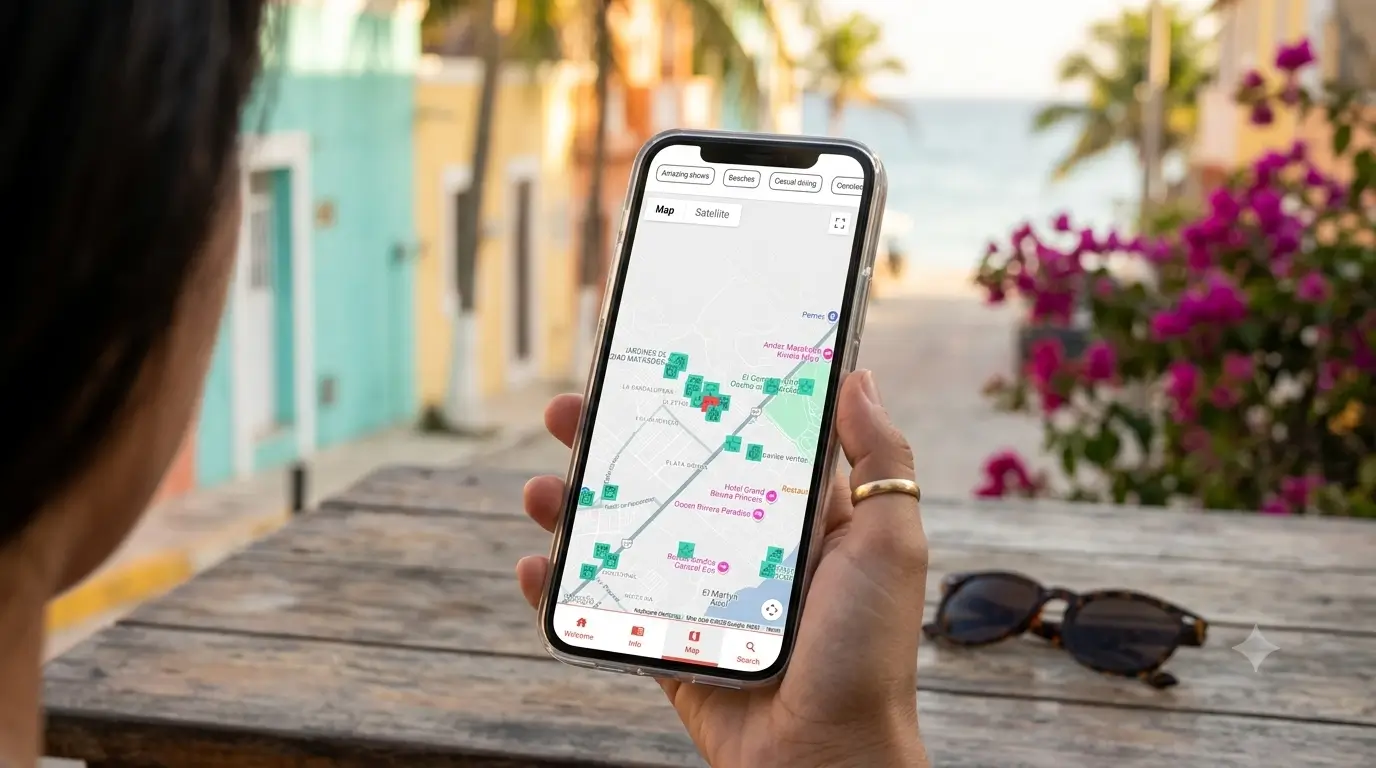
This is the part SmoothStay was built for. In the guidebook's local recommendations section you search a place by name, import the address, hours, phone and map location from Google, then add the tip that makes it yours. Guests see the whole set on one filterable map instead of a dozen links pasted into a welcome message. The AI Concierge, which answers only from what you've published in the guidebook and the reservation data, picks up the follow-ups: "somewhere open late near the house," "is the grocery store walkable."
Having it in one place changes two things. Many operators find guests stop asking the same handful of questions by message, the same effect a good guidebook has on routine questions generally. And the recommendations show up in reviews; the coffee place you sent them to gets written up more often than the mattress does.
One boundary worth keeping: this section is everyday essentials. Activities, tours and day trips are a different job, and mixing them makes both harder to scan. Keep them in separate categories inside your guidebook.
FAQ
How many local recommendations should an Airbnb guidebook have?
Fifteen to twenty is a good working range for most properties. Enough to cover the essentials in the table above, few enough that every entry is one you'd genuinely defend. Hosts who add everything nearby tend to hear less about the guide from guests than hosts who curate.
Isn't Airbnb's built-in guidebook enough?
It's a reasonable start and it costs nothing, but it's built around one channel. Your Airbnb guidebook lives on your Airbnb listing and in that guest's Trips tab, and it's scoped to local recommendations, with wifi, appliances and checkout sitting in other fields or in your messages. A guest who books through Vrbo, Booking or your own site doesn't get handed it with their trip. Keeping the guide in a platform-agnostic tool means one link covers every guest whatever channel they came from, and the work stays yours if your channel mix changes later (as it should to reduce platform dependency). We went further into this in our post on the alternative to Airbnb's guidebook limitations.
Should I include chain restaurants and big supermarkets?
Yes, when they're the practical answer. Guests need to know where the reliable big supermarket is, and a familiar chain at 11pm on arrival night is a real solution. Just don't let the chains crowd out the picks only you could have made.
What's the difference between a local guide and a things-to-do list?
The local guide covers everyday essentials: food, coffee, groceries, pharmacy, the nearest beach or park, getting around. A things-to-do list covers activities, tours and day trips. Guests reach for them at different moments, so they work better as separate sections.
How often should I update my local guide?
Twice a year covers most properties, plus a quick fix whenever a guest tells you something closed or changed hours. Seasonal destinations are worth checking at the start of each season.
Can I just link my guests to Google Maps lists?
You can, and it beats nothing. The trade-off is that a Maps list carries pins and ratings but not your reasoning, and guests still have to jump apps for the wifi password or the checkout time.
Put your local picks where guests will find them
If you'd rather not format all of this yourself, you can have a digital guidebook running in minutes, with your recommendations on a filterable map and one QR code that gets guests to it. Dominique and Diego built SmoothStay while hosting in Washington, DC and the Riviera Maya, largely because keeping local recommendations current across several properties by hand stopped being reasonable.
Start free with one guidebook, or read the full guide to building an Airbnb guidebook first.
Latest articles

Vrbo Premier Host in 2026: Every Listing Now Stands on Its Own Record
Vrbo Premier Host requirements changed in 2026: per-listing scoring, tighter thresholds, quarterly checks. What each one means, and how it compares to Superhost.
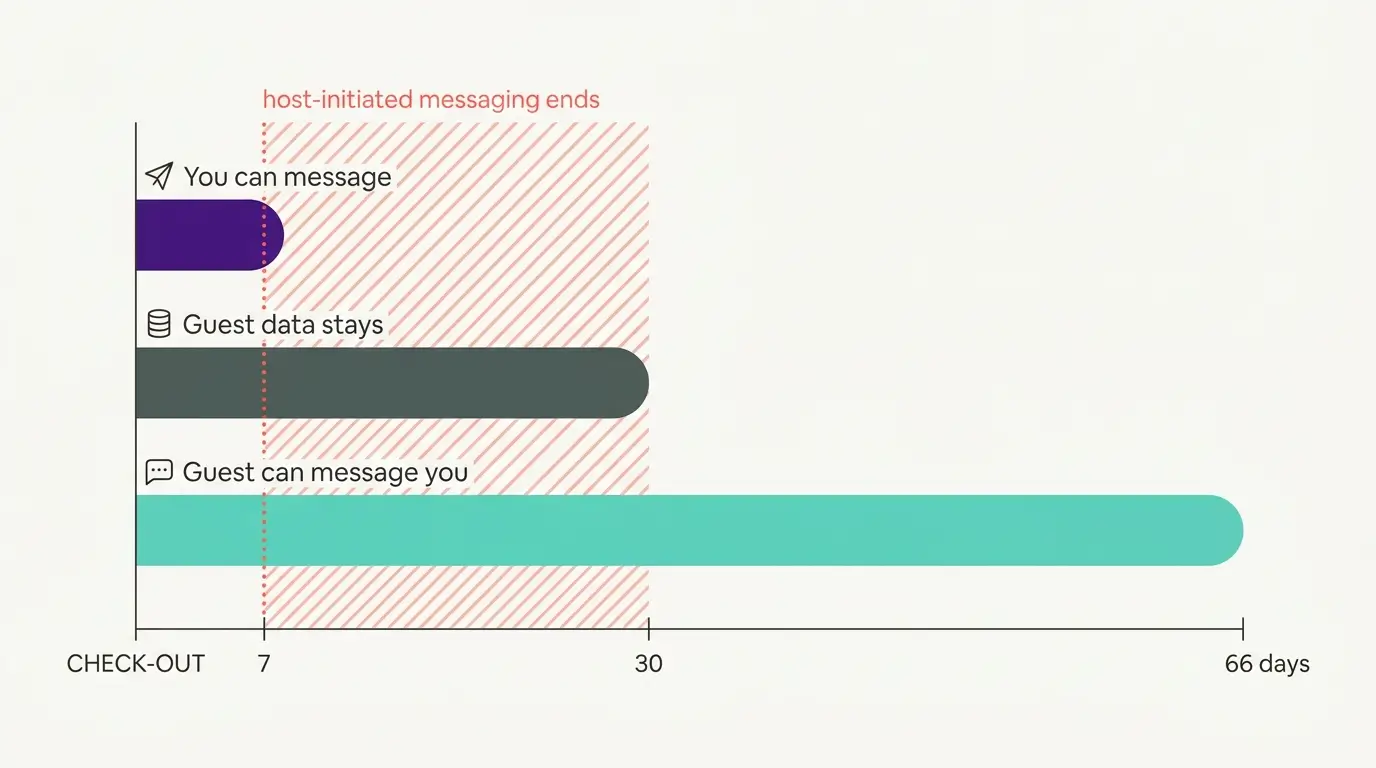
Booking.com Guest Messaging Rules: What Hosts Can Send, When, and Why Links Get Removed
Booking.com guest messaging rules, verified at source: how long you can message a guest, why your links get removed, and what the partner terms say.
Vrbo's New Features for Fall 2026: What's Live, What's Gated, and What's US-Only
We sorted Vrbo's new features for fall 2026: what is live globally, what is gated behind eligibility, and what is US-only. Verified against Vrbo's own pages.
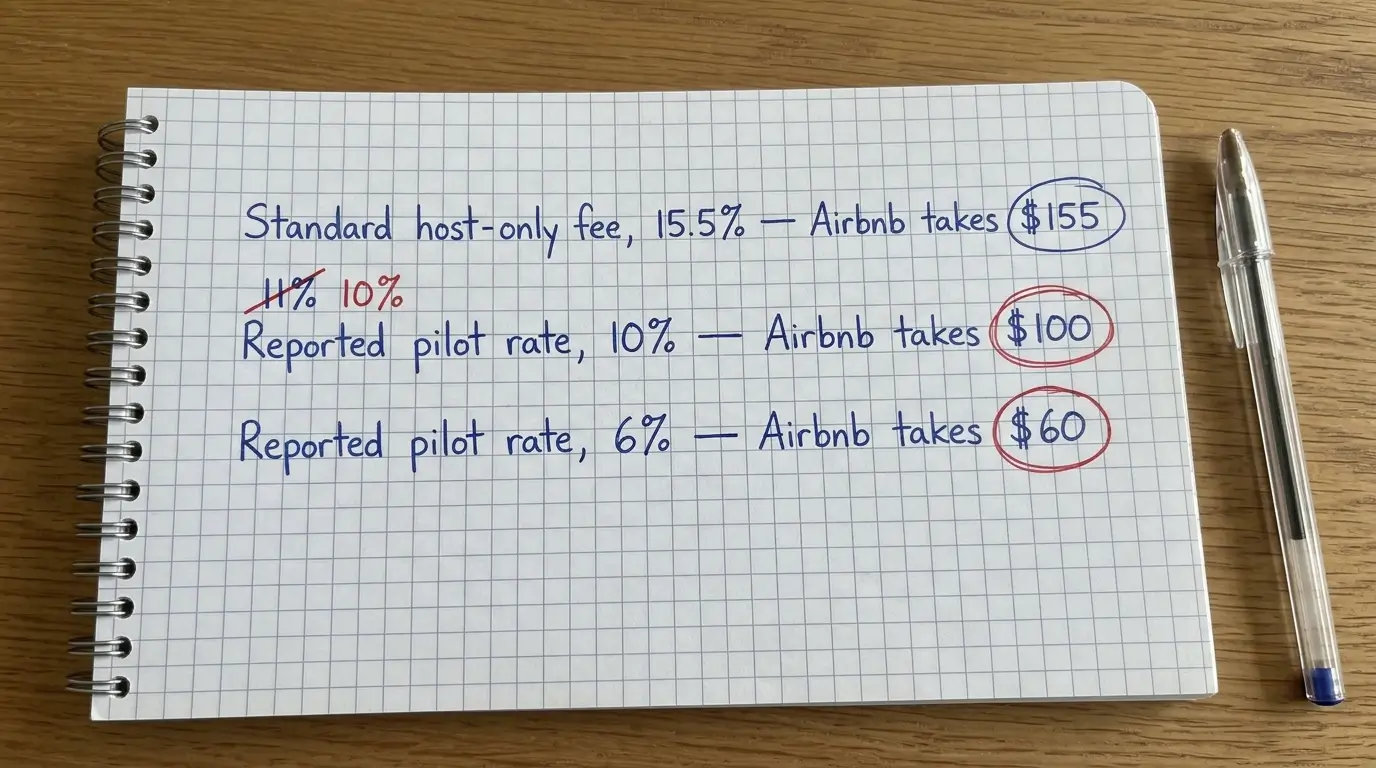
Airbnb Direct Booking Links: What the Reduced Fee Changes at 1 to 20 Listings
Airbnb direct booking links cut the host fee to a reported 6% or 10%. What they are, how they work at 1 to 20 listings, and what the lower fee still pays for.