
A guest who pushes the thermostat to its lowest number is not being unreasonable. They are working a machine nobody explained. Manufacturers suggest not setting it more than about twenty degrees below the outside temperature, and going lower does not get there faster anyway. Sometimes the panel defeats a guest before temperature enters into it. Name the device, give the honest range, and ask for the two things a guest can change, with the reason attached rather than a fine.
A guest lands at two in the afternoon in August, finds the thermostat and pushes it to the lowest number on the display. Two hours later you get a message saying the AC is broken. It isn't. The house is doing about what the equipment can do, and the guest has no way of knowing that.
Below is the air conditioning article we use for this, and how to word it so a hot, tired person reads it as help rather than a telling-off.
What should your Airbnb AC rules for guests actually say?
Five things, in this order: where the thermostat is and what it looks like, what temperature the property holds in that season, and roughly how long it takes to get there. Then the ask to keep doors and windows closed while it runs, with the reason attached, what to do if it stops cooling, and who to contact. No fines, no capital letters, no exclamation marks.
Why the AC argument happens in the first place
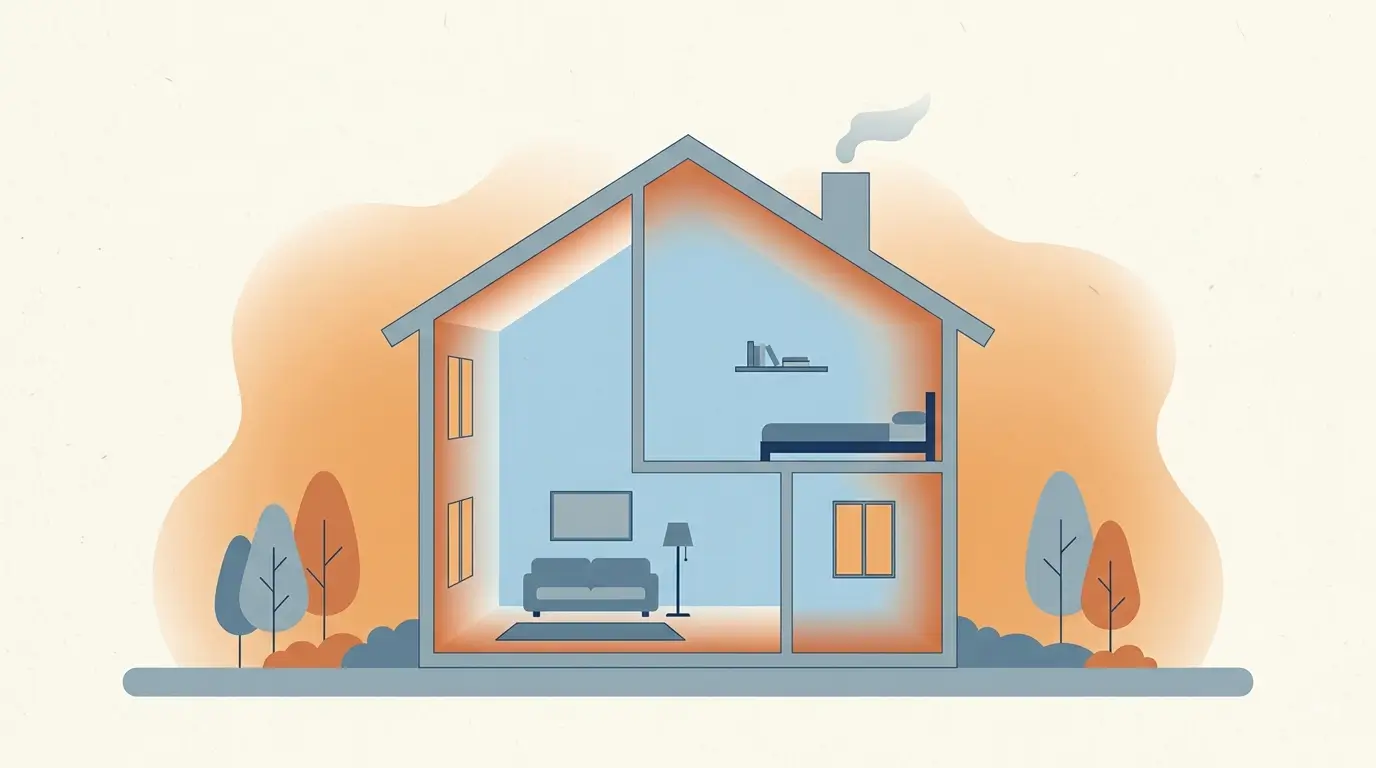
Guests turn the dial all the way down because that is what you do with a dial when you want more of something. Two bits of physics work against them, and neither is obvious from inside a hot room.
One caveat before the numbers, and it applies to both. How a given property performs depends on its climate, insulation, unit size, humidity and how well the system has been serviced. What follows are industry rules of thumb, not promises about your house.
The first: a lower setting does not cool the room faster. American Standard, which makes the equipment, says it plainly. A system cools at the rate it cools. A lower setting just runs it longer.
The second: capacity. The same guide names a 20-degree rule of thumb, that your cooling set temperature should not sit more than 20°F, or 11°C, below the outside temperature, and works its example at 98°F outdoors with the thermostat at 78°F. Read that as advice on what to set rather than a hard ceiling on what the equipment can do. How close a given house gets depends on all the things above, and some houses do considerably better. What holds either way is the direction: on a hot Playa del Carmen afternoon, a guest who sets it to 64°F is not going to see 64°F.
A third thing turns a warm room into no cooling at all, and it belongs to you rather than the guest. Dirty filter, blocked return, sofa pushed over a vent: running non-stop is when a marginal system shows it. The Department of Energy's maintenance guidance is largely about airflow for that reason, since a clogged filter chokes the air crossing the evaporator coil and cuts how much heat it can absorb. Carrier names that same restricted airflow as a common cause of a frozen coil, and a frozen coil presents as the thing the guest is already complaining about. Carrier's advice is to switch the system off and let it thaw rather than keep running it, which takes a few hours or overnight. Not every loss of cooling is ice, but the guest's move is the same whatever the cause: off, wait, tell the host. Nothing beyond that should ever land on them.
Our Playa del Carmen house shows the setup problem plainly. Every room has its own mini-split, which is what we see across the Riviera Maya, so nothing holds the house at a temperature in the background. A guest walking in at two in the afternoon starts from a hot room and a unit that is switched off.
How that lands depends a great deal on where the guest is from, and this is the part most AC advice skips. Air conditioning is close to standard in American homes and still reaches only a minority of European ones, on IEA figures. An American guest is used to cooling that runs whether anyone is home or not, so a room that takes an hour reads as a fault. A European guest is more likely to expect to switch a unit on themselves. Same house, two different reactions. Worth knowing which assumption your guests arrive with before you write for one of them by default.
Doors and windows, and how to ask without scolding

In our experience a door propped open to a terrace is the most common reason a room will not reach its set temperature, and it is almost never deliberate. People go in and out of a pool. A window gets opened at six in the morning when it is pleasant and forgotten by noon.
The wording most of us reach for first is a rule with a threat bolted on: "DOORS AND WINDOWS MUST REMAIN CLOSED WHEN THE A/C IS ON. GUESTS WILL BE CHARGED FOR EXCESS ENERGY USE." On a nightstand, that reads as an accusation to the large majority of guests who were never going to do it.
The version that gets followed is the same instruction with the reason attached:
Keep the terrace door and the windows closed while the AC is running. It's cooling the whole house, so an open door means it never quite catches up and the bedrooms stay warm.
Hosts are not being petty here. We put solar on the Playa house and the mini-splits are still the biggest single line in the electricity bill, and a terrace door open all afternoon is real money. The concern is legitimate. What needed changing was the wording.
Our house rules examples post covers the wider set. This one goes deep on a single rule, because at our properties AC generates more guest messages than any issue except wifi.
Say it before they arrive, not on day one
Anything about the air conditioning that would surprise a guest belongs in the listing and the pre-arrival message:
Mini-splits or window units rather than central air. Say which rooms have them and where the remotes live.
A minimum thermostat setting. If the system is locked at a floor, put the number in the listing.
A genuinely hot climate. "The house holds about 76 to 78°F through August" gives a guest something to book against. Air conditioning as a checkbox amenity does not.
An older system, or more than one panel. Say which panel controls which rooms, and say plainly if a room runs warm in the worst weeks of summer. Our third-floor bedroom in DC stays warm at 68°F on the hottest days, which is thirty degrees of differential and well past the rule of thumb above.
When the thermostat itself is the problem
Some of this has nothing to do with temperature. The DC row house runs an Infinity Carrier system, and its two main touchscreen panels do not work the way a Nest does. There is no obvious up and down; you go through the screen to reach a setting. Guests have put up with a warm room for days rather than work it out, and it comes up more often with older guests. We looked at fitting something simpler and could not. The control is proprietary to the system.
When you cannot change the hardware, the article carries it. Write the sequence in plain words: which button wakes the screen, what to press to reach the temperature, how to confirm it, how to tell it took. A photograph of the panel beats any description. Say which panel controls which rooms, too, because a guest on the third floor adjusting the ground-floor zone will decide the AC is broken. Ours mixes two complicated main panels with two simpler secondary ones, so the article has to sort out which is which before it gets anywhere near a temperature.
Tulum is that problem in a smaller package. The wall unit needs the ON button pressed and held for a few seconds, and if it has been off it can take twenty minutes to respond. Neither is guessable from looking at it. Each is one line in the article.
What the air conditioning article in your guidebook has to answer
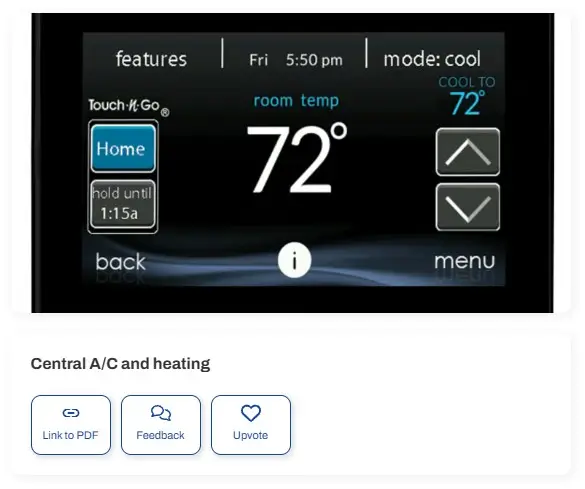
Where the thermostat is, and how to work it. "The thermostat" means nothing to someone who has never been in the house. "The white panel on the hallway wall, left of the bathroom door" does.
What the property holds, by season, as a range rather than a number.
How long it takes, so the message does not arrive at minute forty.
Doors and windows, with the reason attached.
What to do if it stops, and what is there meanwhile. Off at the thermostat, left off for a few hours, then message you. If ice has formed inside, that gives it time to thaw. Say where the fans are. A failure at night is the one nobody can fix before morning.
Who to contact, and when it is worth waking someone up.
The pattern under all six: facts stay bare, and anything asking a guest to change what they are doing carries one short clause of reason. Where the thermostat lives needs no justification. Closing the terrace door does. Our house manual template applies that shape to every other system.
The copy-paste template
Fill in the brackets. Only the lines that ask something of the guest carry a reason.
Air conditioning
The thermostat is [location and description, for example: the white panel on the hallway wall, left of the bathroom door]. [If the panel is not self-explanatory: describe the sequence to change the temperature, step by step, and add a photo of it.]
In [season], the house sits comfortably at [range, for example 75 to 78°F / 24 to 26°C]. Set it there and give it [an hour or two] after a hot afternoon. Going lower won't cool the house faster, it only runs the unit longer.
Keep [the terrace door / the windows] closed while the AC is running, because it's cooling the whole [house / room] and an open door means it never quite catches up.
[If the property has mini-splits: each room has its own unit and its own remote, kept in the pocket on the wall beside it. Each unit only cools the room it is in, so keep that room's door closed while it runs. They start from cold, so give a room time to come down after you switch it on, and please switch a unit off when you leave that room for the day.]
[If it applies: the ceiling fans make a real difference and cost almost nothing to run.]
If the air stops feeling cold, switch it off at the thermostat and leave it off for a few hours before turning it back on, because ice sometimes forms inside and needs that time to thaw. If it's still not cooling, message us. Please don't open the unit or anything behind a panel, since that part is a technician's job. There are portable fans in [location] if you need one overnight while we sort it out.
We're on [channel] and usually reply within [time]. For anything urgent overnight, call [number].
The short version for a card near the unit
Three or four lines is the ceiling for anything stuck on a wall.
[Property name] air conditioning
Set it to [range]. It won't cool faster if you set it lower.
Keep [the terrace door] closed while it's running, or the bedrooms stay warm.
Not cooling? Switch it off for a few hours, then message us, since ice sometimes forms inside and needs time to thaw.
Our parking instructions post pairs a full article with a short card too.
Put a QR code where the question happens
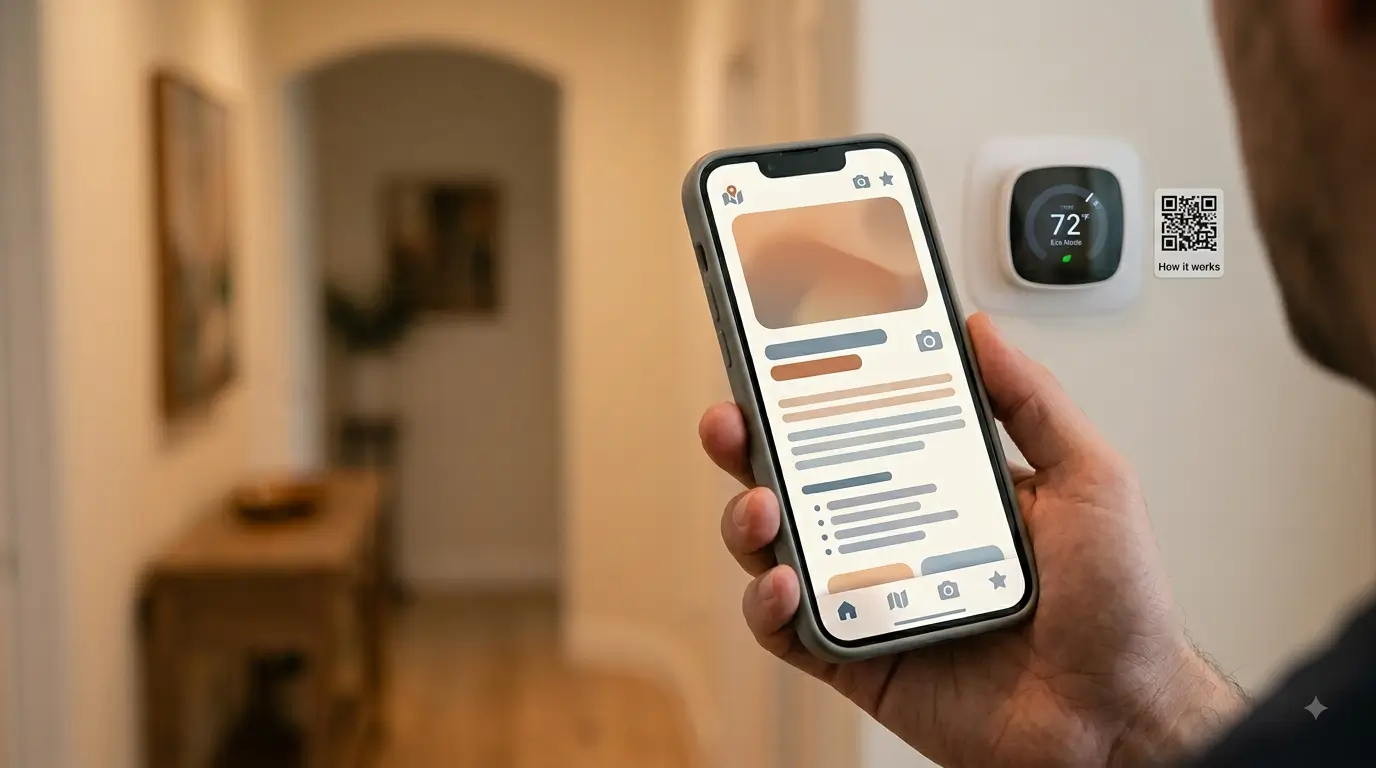
A wall card tells a guest three things. A small QR code next to the thermostat, deep-linked to the AC article rather than to the guidebook home page, hands them the whole article at the moment they are standing in front of the panel. On a mini-split property, put one beside each unit.
Timing is what makes this work. Most guests skim the practical articles once, usually before they arrive, and by day three nobody remembers which one covered the thermostat. The code serves that second moment.
Keep the codes small, label them in plain words, and stop at four to six per property or guests stop noticing any of them. One caveat worth stating: a digital guidebook needs a signal to load, so anything a guest needs before they are through the door still belongs in a message.
Heating: everything above, pointed the other way
All of it holds in reverse for a winter property. A guest arriving into a cold house pushes the thermostat to 78°F for the same reason they push it to 64°F in August, and it does not warm up faster for it. The heating article needs all six parts above plus two: which rooms run cold and what is provided for it, and what to do with the thermostat when they are out for the day, which matters if your pipes can freeze.
The same article at three properties, three different versions
We run this article at three properties and no two of them share a sentence.
Playa del Carmen is the short one, because the equipment is simple. Each room has its own mini-split and the living room has two. The instruction that matters is about interior doors: keep the room doors closed, since each unit only cools the room it is in. We also ask guests to switch a unit off when they leave that room and put the remote back in its wall pocket, which is there because remotes go missing.
Washington DC is the long one. An Infinity Carrier dual-zone system with four thermostats: a main panel in the dining room for the first floor, a main panel in the master bedroom for the second and third, and two simpler secondary panels on the second level. The article says which panel governs which floor, states the defaults we have set, and links the manufacturer's manual rather than trying to rewrite it. We can usually troubleshoot that system remotely. It is buggy, and it does nothing when the fault is in the unit itself.
Tulum is the one we underestimated. One central unit, one wall control, and a city with frequent power cuts, so the article has to cover what a guest does after one.
What carries across all three is the shape: where the control is, what to expect from it, the one behaviour we ask for and why, what to do when it stops, who to contact. None of the content does.
Where the article should live
Keep it in one place per property. If the AC information sits on a laminated card, a line of the listing and a paragraph of your check-in message, you are maintaining three copies and they drift apart.
Put it where guests already look, and link straight to it. When a guest messages at four that the house is warm, a link beats retyping. Our guide to building an Airbnb guidebook covers the structure if you are starting from nothing.
Keep it outside any single platform's tools. An article that only lives inside one OTA's product does not travel to a Vrbo guest or to someone who booked direct. That logic also argues for building a second source of demand over time. That is not about moving Airbnb guests off Airbnb, which their off-platform policy prohibits. It is about not depending on one channel, and we covered the compliant version in how to get direct bookings without risking your Airbnb account.
Let the follow-ups answer themselves. SmoothStay's AI Concierge is designed to answer from the guidebook content you have published rather than filling gaps with assumptions, so "how do I turn on the unit in the second bedroom" gets answered from what you already wrote.
FAQ
What temperature should I tell guests to set the AC to?
Give a range for your property and your season rather than one number, and check that range against a full summer before you publish it. Humidity, afternoon sun on the walls, ceiling height and the age of the unit all move it. A house that holds 75°F in June may only manage 79°F in the worst week of August. Publish the range you actually hit, not the one you would like to.
Can I charge a guest for leaving the doors open with the AC on?
Whether a fee is collectible depends on your platform's policies and your local rules, and both vary, so check them rather than taking wording from a blog post. From our own properties: a sentence with a reason attached has done more than any fee wording.
When should a guest contact me overnight about the AC?
Give them the threshold rather than leaving it to judgment. At our properties that means the unit stopping entirely, or water appearing where it should not be. Everything else waits until morning. Keep portable fans in the property and say where they are, so a guest whose unit failed at midnight has something while they wait.
Do the AC rules go in my house rules or my guidebook?
The one behavioural line, doors and windows closed while it runs, is fine in house rules. The rest of your air conditioning instructions are not rules at all, and they belong where a guest looks when they have a question, not in a list they agreed to at booking.
Do mini-splits need different instructions from central air?
Yes, and it is often the missing section. A mini-split cools the room it is in and starts from cold rather than running in the background, so say which rooms have units and where the remote lives. The door instruction inverts too: with central air you want the exterior doors closed, and with a mini-split you want that room's own door closed.
If you'd rather not format all this yourself
Copy the template above into whatever you already use, a Word document, a printed folder or a Notion page. If you would rather not maintain the same wording in three places, you can have a digital guidebook running in minutes, with the AC article and everything else in one place that updates once. There is a free tier for a single property.
Latest articles
Do Guests Read Airbnb Guidebooks? What Our Own Analytics Show
Do guests read Airbnb guidebooks? Ours show a few articles take most views, but a low count is not failure. See what 90 days of our own data actually changed.
Airbnb Host Burnout: The Workload Was Never the Problem for Us
Airbnb host burnout is rarely about the hours for us. It's about being on call. What ten years of hosting taught us about the systems that reduce the load.
Book Direct With a Hotel: What Guests Want When They Call
Guests who book direct with a hotel want more than a discount. What small operators need to catch the enquiry, and what to send once the booking is theirs.

The Airbnb Extra Guest Policy: How Strict Do You Actually Need to Be?
An Airbnb extra guest policy that fits the booking, not a blanket rule: why we charge no extra guest fee, how guest reviews change it, and wording to copy.