
Clear, specific Airbnb parking instructions prevent last‑minute guest texts by detailing the exact spot, permit needs, time limits, vehicle size, EV charging, overflow options, and what not to do, plus ready‑to‑copy templates for various property types. Including photos, map links, and placing the guide in both the listing amenity and the pre‑arrival guide ensures guests know where and how to park before they arrive.
Parking is the thing guests ask about before they ask about the door code. They are circling the block with a rental car full of luggage, the map pin dropped them at the wrong end of the street, and the listing says "free parking on premises." Free where, exactly?
Most parking messages are not really about parking. They are about one detail the host assumed was obvious: which side of the driveway, whether the pass goes on the dashboard, what to do when the spot out front is taken.
What should Airbnb parking instructions include?
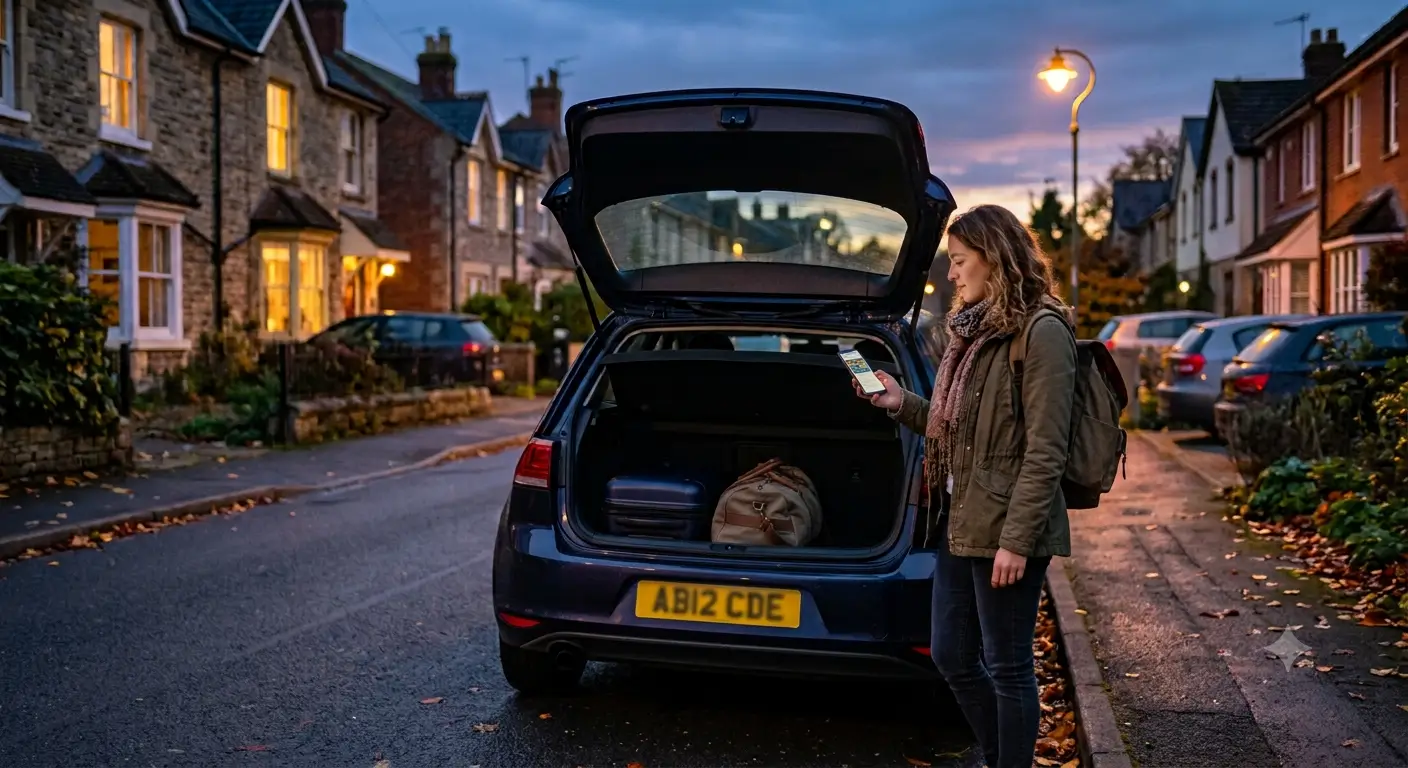
Good Airbnb parking instructions name the exact spot, say whether a permit is needed and how the guest gets one, state any time limit or street-cleaning day, and give a specific backup for when the spot is taken. Add a photo of the space from the direction guests approach it, and a link that opens the parking entrance in their map app, since a street address and a parking entrance are often not the same place.
Eight things belong in every version:
The exact location. Street and block, or which bay in the driveway. "Out front" is not a location.
How to get in. Gate code, fob, remote, ramp entrance, and where the guest picks it up.
Permit rules. Whether they need one, who arranges it, what you need from them.
Time limits and street cleaning. Day, hours, side of the street. This is the detail that turns into a tow.
Cost. Free, or the amount and how it is paid, said before the stay rather than at the door.
Vehicle size, if it is constrained. Door opening height and width, and the usable depth. This is the question that arrives weeks before check-in, not on arrival day.
EV charging. Connector type, whether it is shared, what it costs.
Overflow and what not to do. Where a second car goes, and which driveway, alley, or numbered space is off limits.
Where parking instructions need to live
The listing amenity sets the expectation at booking. Airbnb's amenity list separates parking on the premises from street parking and paid parking (Airbnb Help Center), and guests read "free parking on premises" as a dedicated spot held for them. If yours is shared, first come, or on the street, pick the label that matches.
The Arrival Guide carries the operational detail, but Airbnb only releases it 48 hours before check-in (Airbnb Help Center). That works for a door code and less well for parking, since a guest booking a rental car wants to know two weeks out whether they will have somewhere to put it. Your own guidebook, separate from Airbnb's, is where the long version lives, with photos, and where a guest can pull it up at the curb. Our Airbnb self check-in guide covers the whole arrival package; this is the parking part in detail.
Copy-paste parking templates
Swap the bracketed parts for your property and keep the tone plain. Guests skim these on a phone.
City street with a residential permit zone
Parking: street parking with a visitor permit
Park on [STREET] between [CROSS STREET] and [CROSS STREET]. The block is a residential permit zone, so a visitor permit is required to stay longer than [TWO] hours on weekdays.
Send us your license plate number and registration state as soon as you know which car you are bringing, and we will register the permit for your dates. Nothing goes on the dashboard; enforcement reads the plate.
Street cleaning is [DAY], [TIME] to [TIME], on the [odd/even] side. Move the car the night before or it will be ticketed.
If the block is full, [OVERFLOW STREET] one block [DIRECTION] is the same zone. The nearest garage is [GARAGE, ADDRESS], about [$X] per day. Please do not park in the alley or across the driveway at number [X].
A note on permits: they have quietly gone digital in a lot of cities in the U.S., which changes what you need from the guest. For example, Washington DC moved its visitor parking permits to a plate-based system on August 1, 2025: nothing is printed for the dash, and the plate on the permit has to match the car (DC DMV).
Private driveway
Parking: private driveway
The driveway is yours for the stay. It is the [COLOR] gate at [ADDRESS], on the [left/right] as you come [DIRECTION] on [STREET].
Pull all the way forward to the [wall/fence] so a second car fits behind you. The gate opens with the code in your check-in instructions: hold [BUTTON] until it beeps and it swings on its own.
The driveway fits [X] cars nose to tail. For anything more, [STREET] outside the gate is free and unrestricted. Please do not stop in the gate opening, even briefly. [The neighbor / the unit next door] shares this access.
Assigned garage space
Parking: garage, space [NUMBER]
Enter the garage from [STREET], not through the main lobby entrance. The ramp is [LANDMARK]. The gate opens with [remote / fob / keypad code], which you will find [WHERE].
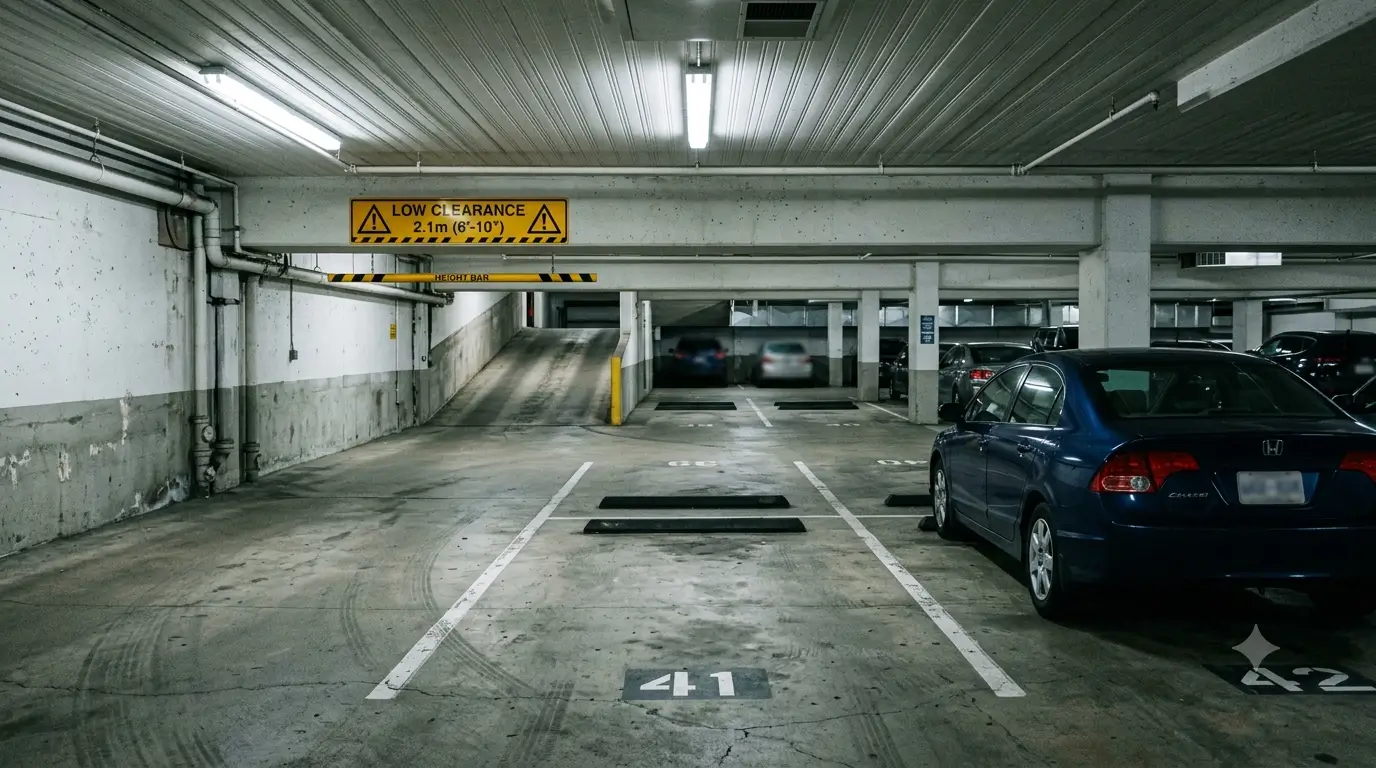
Your space is number [X] on level [X], marked [DETAIL]. Every other numbered space belongs to a resident and gets towed at the driver's cost. Clearance is [X FT X IN], so if you are in a van, a lifted truck, or anything with a roof box, park at [ALTERNATIVE] instead.
Garage with a vehicle-size limit
Our Washington, DC row house has this issue. It is a historic row house with a tandem garage off an alley, and across years of hosting, one of the most common pre-arrival questions was some version of "will my car fit?" Suburbans do not. Passenger vans definitely do not. So we stopped waiting to be asked and answered it with measurements:
Parking: tandem garage, please check your vehicle size
Our tandem garage fits up to two small-to-medium vehicles, or one large SUV. The garage door opening is approximately 72 inches tall and 98 inches wide (6 ft by 8 ft 2 in), and the maximum depth available is approximately 376 inches (31 ft 4 in). Please check your vehicle's dimensions to make sure it fits. Passenger vans will certainly not fit.
Please note there is no actual driveway to park in outside the garage. It is an alley, and parking there is strictly controlled by the city.
Alternative parking for larger or additional vehicles is close by. The nearest public garage with the tallest clearance (8 ft 2 in) and 24/7 access is three blocks away, next to Whole Foods. SpotHero is another good way to find and book a space nearby.
Swap the measurements for your own and keep the shape: what fits, the exact opening, what definitely does not fit, and where an oversized vehicle goes instead. Measure the opening rather than estimating it, because the guests who ask this question are the ones who get stuck if the number is wrong.
HOA or condo with visitor spaces
Parking: visitor spaces
Guest parking is in the row marked VISITOR at the [north] end of the lot. The spaces are first come, first served and are not reserved for this unit.
The HOA requires a visitor pass on the dashboard. The laminated pass hangs [WHERE] and goes face up on the dash whenever the car is on the property. Cars without one are ticketed by the management company.
A pass covers [X] days; if you are staying longer, message us. If visitor parking is full, [STREET or PUBLIC LOT] is [X] minutes on foot and costs [free / $X per day].
A photo does the work of a paragraph
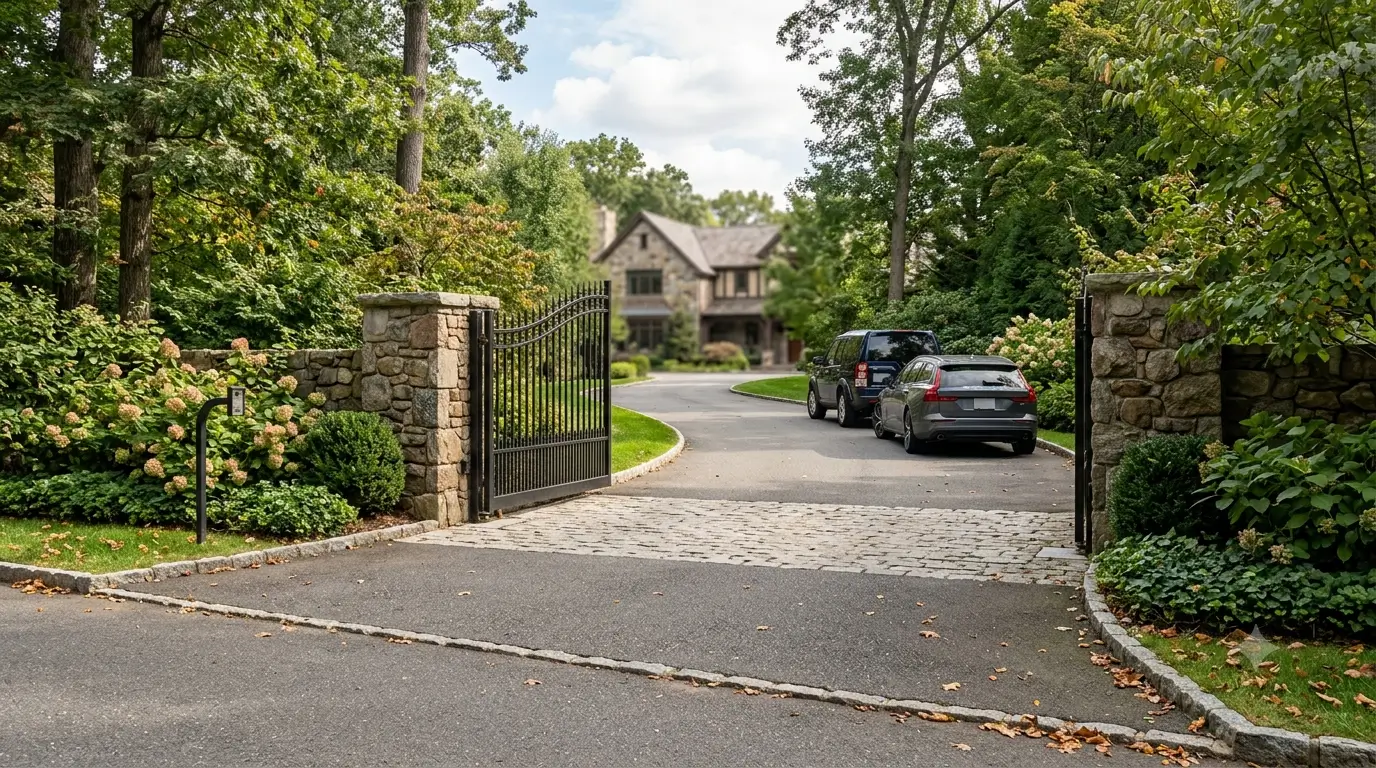
The templates above are the words. For a complicated approach, the words are the backup.
Shoot the spot from the direction guests actually arrive, from roughly where a driver's eyes would be, and shoot it again after dark if most of your arrivals are at night. A photo of the gate settles "which gate" faster than three sentences describing it. For anything with a sequence, like an unmarked turn, a two-level garage, or a gate that has to be held, a 20-second clip filmed walking or driving the route replaces most of the paragraph.
Both need somewhere to live, and this is where hosts get tripped up, because Airbnb has two surfaces with similar names that do different jobs.
Airbnb surface | Photos? | What it is for |
|---|---|---|
Check-in instructions (Arrival Guide) | Yes, one per step | Your property: the door, the gate, the parking spot. Released to the guest 48 hours before check-in |
Guidebook | Yes, one per place you recommend | Local restaurants, shops, hikes. No field for your driveway (Airbnb Resource Center) |
So arrival photos do have a native home, and it is a decent one. The catch is when it opens. A guest asking whether their van clears your garage door is asking three weeks out, while booking the rental car. That is the gap a guidebook you control fills: the same photos, reachable from the moment they book.
What not to write
A vague line is worse than no line, because the guest stops reading and messages you instead.
Vague version | What to write instead |
|---|---|
"Free parking available" | "One dedicated spot in the driveway, plus free street parking on [STREET] for a second car" |
"Street parking out front" | "Street parking on the [800] block of [STREET]. Permit zone: send us your plate and we will register a visitor permit" |
"Use the garage" | "Garage entrance on [STREET], space [42] on level [2], clearance [6 ft 8 in]" |
"Please don't block the neighbors" | "Please do not park across the driveway at number [806]. It is in use every morning around 6am" |
Replace the category with the specific, every time.
Why this is worth twenty minutes
Parking questions arrive at the worst hour, when the guest is tired and driving, and they arrive over and over because every guest hits the same gap. Many operators find the routine arrival messages drop off once the answers are written down properly.
There is a review angle too. A tow or a ticket during a stay tends to show up in writing afterward, and it is usually traceable to information the guest never got. Parking also sits next to your house rules, since "do not block the neighbor's driveway" is a rule as much as a direction. For the wider version, we wrote about reducing guest questions across the whole stay.
Put parking where guests look before they call
We host in Washington, DC and the Riviera Maya, and what works for us is a short parking article inside the arrival section of the digital guidebook: two photos of the actual spot, the instructions above, and a link that opens the parking entrance in the guest's map app rather than the front door. The guidebook link goes in the pre-arrival message so it is there while they book the car, and a QR code at the entrance covers the guest who is already standing there.
For the follow-ups, SmoothStay's AI Concierge answers only from what you have published in the guidebook, in the guest's language, at whatever hour they pull in. It repeats your parking article back to someone who did not want to wake you at 1am to ask.
FAQ
When do guests see my Airbnb check-in and parking instructions?
Airbnb releases detailed check-in instructions 48 hours before check-in (Airbnb Help Center). Guests see the check-in method at booking but not the specifics. If your parking needs advance planning, like a plate registration or a size limit, put it somewhere they can reach earlier.
What does "free parking on premises" mean to a guest?
Most guests read it as a dedicated space on the property, held for them, at no cost. If yours is shared with other units, first come, or actually street parking, choose the amenity that matches and spell out the arrangement in the description.
Do I need to mention EV charging?
If you have a charger, be specific: connector type, whether it is shared, the speed, and the cost. If you do not have one, name the nearest public charger. EV guests plan their day around this.
Where can I put parking photos on Airbnb?
In your check-in instructions, which take a photo per step and are built for exactly this. The catch is timing: Airbnb releases them 48 hours before check-in, so they cannot answer a question a guest has while booking a rental car. Airbnb's guidebook is a separate feature, built around places you recommend with a photo attached to each place, so there is no field there for your garage entrance. For photos a guest needs weeks ahead, keep a copy in a guidebook you control alongside the Airbnb fields.
What if the parking spot is taken when a guest arrives?
Give them the answer before it happens. Every parking section should end with a named backup: a specific overflow street, a garage with an address and a rough price, or a message-us instruction. A guest with a plan B does not call.
Get parking off your phone
Parking instructions are boring to write and they pay for themselves the first time a guest finds the spot without messaging you. Write the version for your property once, get it to the guest before arrival day, and keep it somewhere they can pull up at the curb. If you would rather not format all of that yourself, you can have a digital guidebook with your arrival section, photos, and QR codes running in an afternoon.
Latest articles

How to Automate Check-In Instructions for Short-Term Rental Guests
Automate check-in instructions for short-term rental guests: the four-send sequence, what goes in a message versus a guidebook, and a copy-ready sample.

Vrbo Premier Host in 2026: Every Listing Now Stands on Its Own Record
Vrbo Premier Host requirements changed in 2026: per-listing scoring, tighter thresholds, quarterly checks. What each one means, and how it compares to Superhost.
Booking.com Guest Messaging Rules: What Hosts Can Send, When, and Why Links Get Removed
Booking.com guest messaging rules, verified at source: how long you can message a guest, why your links get removed, and what the partner terms say.
Vrbo's New Features for Fall 2026: What's Live, What's Gated, and What's US-Only
We sorted Vrbo's new features for fall 2026: what is live globally, what is gated behind eligibility, and what is US-only. Verified against Vrbo's own pages.