

The latest Hostfully Vacation Rental Tech Stack Report reveals that while operators have widely automated back‑office functions, guest‑communication and AI tools remain the most under‑adopted category, with adoption rates only 9%‑39% across property sizes. This post highlights that gap, and points out how SmoothStay’s digital guidebook and AI Concierge directly address the unmet guest‑experience needs.
Hostfully just put out the largest study of vacation rental tech stacks anyone has published. They pulled active integration data from 2,248 growing operators and mapped 31,474 of their integrations across eight tool categories. It's a useful snapshot of what running a short-term rental looks like under the hood right now.
But the number nobody is repeating is the small one. The category hosts have automated the least is the one guests actually feel.
What is a vacation rental tech stack?
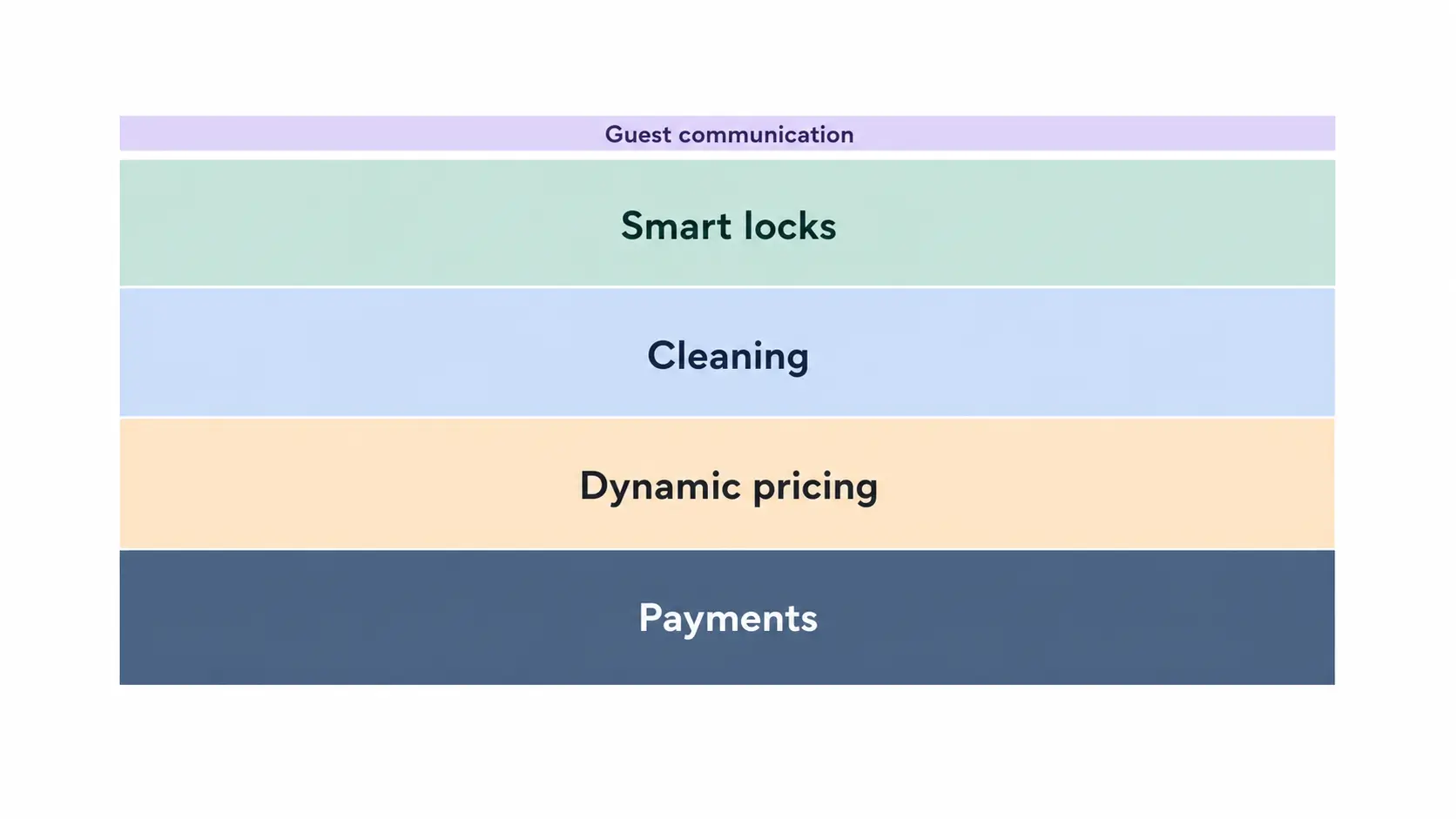
A vacation rental tech stack is the full set of software a host runs to operate a property: the property management system (PMS) at the center, plus the tools that plug into it for dynamic pricing, cleaning and turnover, payments, smart locks, accounting, marketing, and guest communication. Hostfully splits it into two layers, the distribution channels where guests book (Airbnb, Booking.com, Vrbo) and the operational software that runs the day-to-day. The average operator in their study runs 13 operational integrations on top of 6 to 10 listing channels. (Source: Hostfully Vacation Rental Tech Stack Report, June 2026.)
That's a lot of moving parts for a job people still picture as renting out the spare room.
Hosts have automated the property, not the stay
Here's the pattern across the whole dataset. The tools that keep the business running are everywhere. The tools that shape what the guest experiences barely register.
Tool category | 1–5 props | 6–15 | 16–50 | 51–100 | 100+ |
|---|---|---|---|---|---|
Payment processing | 91% | 92% | 94% | 91% | 82% |
Dynamic pricing | 77% | 76% | 75% | 82% | 85% |
Cleaning & turnover | 52% | 58% | 70% | 74% | 88% |
Smart home & IoT | 37% | 32% | 32% | 35% | 36% |
Insurance & screening | 29% | 28% | 34% | 34% | 33% |
Marketing & analytics | 23% | 39% | 51% | 62% | 67% |
Accounting | 20% | 25% | 33% | 35% | 42% |
Guest communication & AI | 9% | 19% | 26% | 39% | 27% |
Adoption by portfolio size. Source: Hostfully Vacation Rental Tech Stack Report, June 2026.
Payments are basically universal, 91% from the very first property. Dynamic pricing sits between 75% and 85% at every size, which means hosts install it on day one and never look back. Cleaning software climbs from 52% to 88% as portfolios grow, the steepest curve in the study.
Now find guest communication. It starts at 9% for hosts with one to five properties. It peaks at 39% for the 51-to-100 crowd, then actually drops to 27% at the biggest operators. It never cracks 40%. It is the lowest-adopted category in the entire report.
Read those two facts together. A host will automate their pricing before they've automated a single guest-facing thing. The stay itself, the part the review is actually about, is running on memory, copy-pasted message templates, and a binder by the coffee maker.
A quick word on whose data this is
One thing to keep in mind as you read these numbers: they come from Hostfully's own platform. It's behavioral data from 2,248 of their accounts, which is exactly what makes it so detailed, and it also means it reflects operators who already run a PMS. Solo Airbnb hosts who don't use one aren't in the sample, and they're a meaningful slice of the market. A few of the named category leaders, like PriceLabs, Breezeway, and Turno, are also Hostfully integration partners, so the specific tool rankings lean toward what plugs into their platform, which is fair game.
None of that takes away from the trends. The adoption curves are consistent and they line up with what we see running our own properties. The fair way to read it: treat the specific tool rankings as "what Hostfully customers use," and trust the broad patterns, which hold up well. And the guest-communication gap is one of those broad patterns. It's the lowest-adopted category in the set no matter how you slice it.
Why the guest communication gap is the interesting one
Operators aren't lazy. They automate the things that visibly cost them money. A mispriced weekend, a missed turnover, a failed payout, those have an obvious dollar figure attached. So pricing and cleaning get solved first.
Guest experience doesn't bill you directly. It bills you later, in a four-star review that mentions "we couldn't figure out the parking," or a 9pm text asking how the thermostat works, or the third guest this month who didn't know which day the trash goes out. The cost is real. It's just diffuse, so it loses the priority fight to the tool with the obvious ROI.
It's the same short list of questions on every property, too, which is exactly why it's so fixable. We wrote up the questions guests ask over and over and the pattern barely changes from a studio in Tulum to a row house in DC.
That's the gap. Hosts have spent a decade automating how the property runs. They've barely started on how the guest experiences it.
What we automated, and what we left alone
We run a handful of properties in Washington, DC and the Riviera Maya, and our own stack looks a lot like the study. Pricing runs through our PMS's built-in tool and we mostly leave it alone (we used Beyond Pricing in the past and still recommend it) Payments, automated. Cleaning coordination, mostly handled. If you're earlier in that process, our guide to vacation rental automation walks through what's worth automating first.
The guest-facing layer is where we actually put the work in, because that's where some of the complaints came from. For years it was a printed binder and a wall of saved message templates. Both go stale the second anything changes, and neither helps the guest standing in the kitchen at 11pm with a question. Moving all of it into a digital guidebook the guest can pull up on their phone, with an AI concierge that answers from it when they'd rather just ask, killed most of those late-night texts. That's the slice of the guest-communication category that's easy to fix and almost nobody has.
Why cleaning software adoption climbs fastest
The most dramatic line in the report is the cleaning one. Turnover software jumps from 52% adoption at one-to-five properties to 88% at 100-plus, the steepest climb of any category. That curve makes sense the moment you've run a few back-to-back checkouts. A missed or sloppy turnover is the quickest path to a one-star review and a same-day scramble to fix it, and the math gets unforgiving as you add properties. One cleaner juggling fifteen Saturday checkouts can't run on text threads and memory, so scheduling, checklists, and photo verification stop being optional. Tools like Breezeway and Turno, the category leaders in the study, exist because the manual version breaks somewhere around your fifth or sixth property.
That's a different job from the guest experience, but it points at the same lesson. Hosts move on the problems with an obvious price tag first. The guest-facing side costs you just as much in slower-burning ways, and it's the one still waiting its turn.
FAQ
What is a vacation rental tech stack?
It's the complete set of software an operator uses to run a short-term rental: a PMS at the core, connected to tools for pricing, cleaning, payments, smart locks, accounting, marketing, and guest communication, plus the listing channels like Airbnb and Vrbo. Hostfully's 2026 study found the average operator runs about 13 operational integrations.
What software do most vacation rental hosts use?
By adoption, the most common categories are payment processing (91%), dynamic pricing (77–85%), and cleaning and turnover software (52–88% depending on size). This study in particular named automated payments, dynamic pricing, and cleaning/turnover software.
How many tools does a typical operator run?
About 13 operational integrations on average, ranging from roughly 11 at the smallest tier to 18 at the 51-to-100 tier, per Hostfully's June 2026 report. That's on top of another 6 to 10 listing channels.
What's the least-adopted category in the vacation rental tech stack?
Guest communication and AI. It runs from 9% adoption at the smallest operators to a peak of 39% at the 51-to-100 tier, then falls to 27% at 100-plus. It's the lowest category in the study, which is striking given that guest communication is what most reviews end up being about.
Do I need a full tech stack to run one or two properties?
No. At one or two properties you can run pricing, payments, and a guest guidebook and skip most of the rest until the manual work actually hurts. The study's own data shows smaller operators run leaner stacks. The one piece worth setting up early is the guest-facing layer, because it's cheap to do and it's where small operators are weakest.
Is the Hostfully study reliable?
It's the largest dataset of its kind and genuinely useful for spotting trends. Just know it's drawn from Hostfully's own accounts, so it skews toward operators who run a PMS, and some of the leading tools it names are also Hostfully integration partners. Trust the broad adoption patterns; read the specific tool rankings as "what Hostfully customers use."
If you want to close the gap
The tech stack data is a mirror. Most of us have automated the back office and left the guest experience running on templates and a binder. If you'd rather not format all of that by hand, you can stand up a digital guidebook with an AI concierge in under an hour and hand guests something they'll actually open. Start with the guidebook your guests will actually use, and let the late-night texts taper off.
Latest articles

How to Automate Check-In Instructions for Short-Term Rental Guests
Automate check-in instructions for short-term rental guests: the four-send sequence, what goes in a message versus a guidebook, and a copy-ready sample.

Vrbo Premier Host in 2026: Every Listing Now Stands on Its Own Record
Vrbo Premier Host requirements changed in 2026: per-listing scoring, tighter thresholds, quarterly checks. What each one means, and how it compares to Superhost.
Booking.com Guest Messaging Rules: What Hosts Can Send, When, and Why Links Get Removed
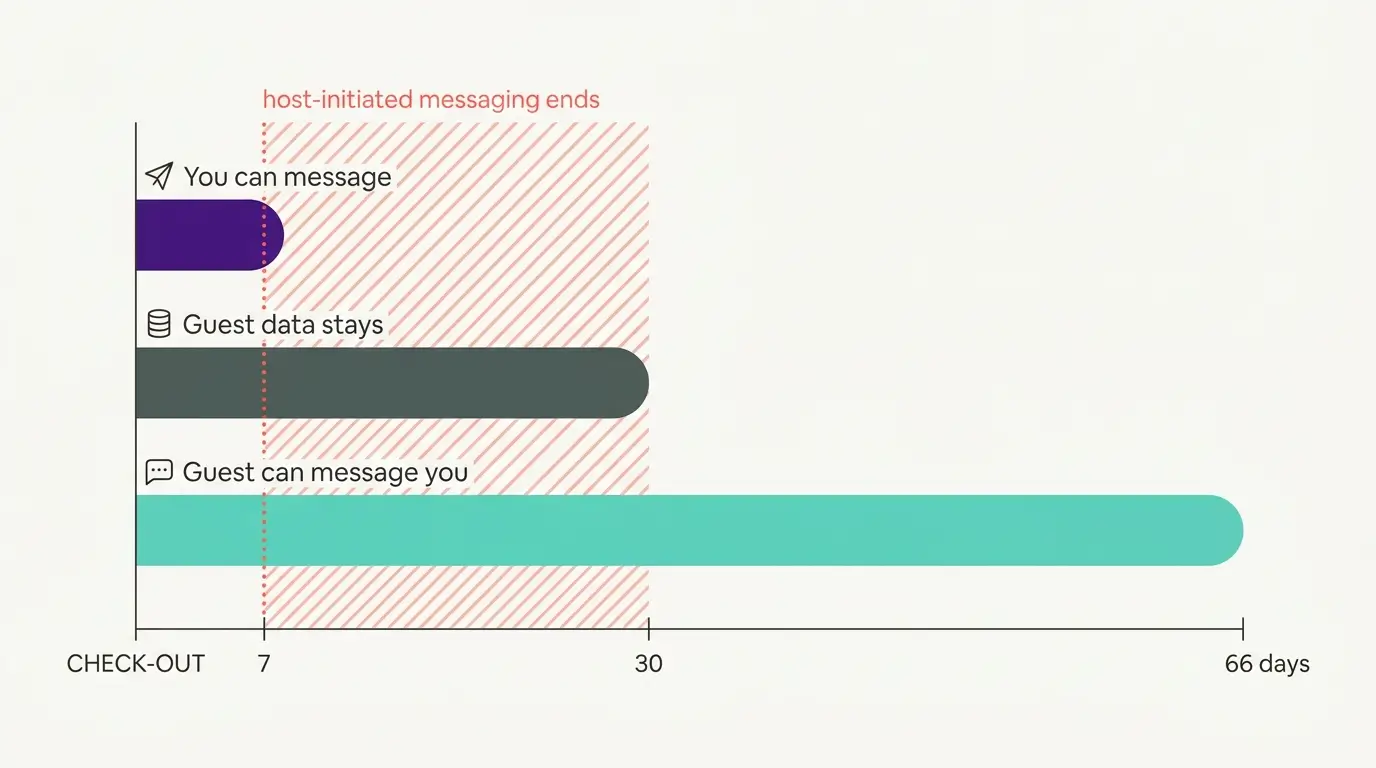
Booking.com guest messaging rules, verified at source: how long you can message a guest, why your links get removed, and what the partner terms say.

Vrbo's New Features for Fall 2026: What's Live, What's Gated, and What's US-Only
We sorted Vrbo's new features for fall 2026: what is live globally, what is gated behind eligibility, and what is US-only. Verified against Vrbo's own pages.