

Airbnb hosts should create a clear extra‑guest policy that combines the listing’s occupancy limit, any optional extra‑guest fee, and specific house‑rules for overnight and daytime visitors, while tailoring wording and reminders to each property and guest type. When extra guests appear, hosts are advised to document the situation, use Airbnb’s trip‑change tool for adjustments, and communicate politely, recognizing that outcomes can vary.
We've hosted for over ten years and have never charged an extra guest fee. Our Playa del Carmen house sleeps eight, and when a guest asks whether one more person can come, the answer is almost always yes.
That isn't the advice most posts on this topic give. They treat every extra head as a policy failure to be fixed with tougher wording. Some are. Most are a group that grew by one and wasn't sure it was allowed to ask.
What is an Airbnb extra guest policy?
An Airbnb extra guest policy is three things working together: the maximum number of guests you set on your listing, an optional extra guest fee if you use one, and the house rules text explaining who may stay and who may only visit. Airbnb handles the first two as listing settings. The third is yours to write, and how hard you hold it should depend on the property and the booking, not on one rule applied to everyone.
The three places your policy already lives
The guest maximum on your listing. Set it to the number the property genuinely sleeps, not the number you could squeeze in. This does most of the work.
The extra guest fee. Airbnb lets you add a per-night fee above a threshold you choose. We don't use one anywhere, but if you do: the fee only applies to future reservations, and adding it to a confirmed booking means sending a trip change.
Your house rules text. The part a guest actually agrees to. Rules disclosed before booking are generally the easiest to reference if Airbnb support ends up reviewing a dispute. Our post on Airbnb house rules examples covers the full set.
The variable most posts leave out: who booked
Ten years in, the thing that tells us how much attention a headcount needs isn't our wording. It's the guest's review history.
In our experience, guests with a long history of positive reviews are less likely to create occupancy problems. They message and ask before adding anyone, and when they ask, we say yes. A guest with no reviews at all is a different call. Not a bad guest, just an unknown one, and that's where we're clearer up front and repeat the number before arrival.
Two caveats. It's a judgment you develop over time rather than a rule with a number attached, and it will occasionally be wrong in both directions. And it's only a read of the public review record. Airbnb doesn't verify who physically enters your property, so hosts fall back on guest communication and, where it's permitted and properly disclosed, their own monitoring, which tells you about noise or comings and goings rather than a headcount.
Your property sets the floor
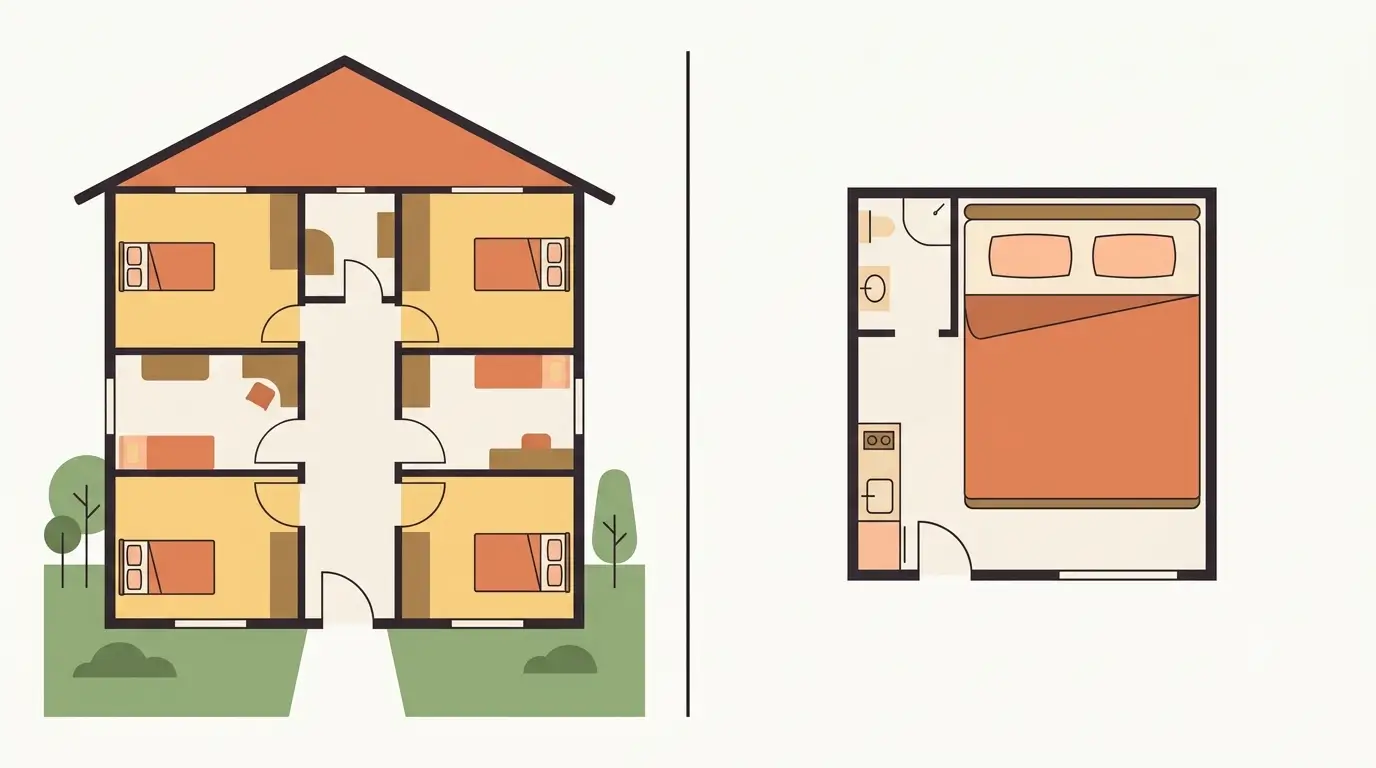
The other half of the equation is physical. A policy that's relaxed at one property is strict at another, for reasons that have nothing to do with trust.
Property | Limit | Why the number is what it is |
|---|---|---|
Playa del Carmen whole house | 8 | Enough bedrooms that one extra guest changes very little. We say yes most of the time. |
Tulum studio | 2 | 32 square metres and one king bed. Nowhere for a third adult to sleep, and the building has its own rules on top of ours. |
Washington DC row house | 8 | An occupancy cap we don't get to negotiate, so the number is the number. |
The Tulum logic isn't about rule-breaking. If a third adult shows up at a studio, nobody sleeps well, and that lands in the review as a complaint about comfort. Saying no there protects the guest as much as the property.
At the whole house our answer is usually "sure, just so you know there are four bedrooms and we'd rather nobody ends up on the sofa." That sets the expectation without opening a negotiation.
Say the reason out loud, whatever yours is. An unexplained limit reads as suspicion; a guest who knows the number comes from the beds or the building tends to work with you instead. Beyond beds, the usual reasons are your insurance and rental agreement, both written around a stated occupancy, and local or building occupancy caps. Those are specific to you, so check your own policies and local rules rather than guessing.
Overnight guests and daytime visitors are two different rules
This is the gap that causes most of the arguments, and almost no listing closes it.
The guest count describes who is staying. It says nothing about the friend who drives over for dinner or the six people who turn up for a barbecue and leave at midnight. Airbnb's ground rules for guests tell guests to respect the approved number and to ask their Host if they're unsure about the rules for visitors. Airbnb is pointing the guest back at you, so if you never wrote a visitor rule, there isn't one.
The complaint we get from neighbors in DC has never been about people sleeping over. It's about four cars parking in the back alley without a permit.
Airbnb's Community Disturbance Policy prohibits open-invite parties and disruptive gatherings of any size regardless. That belongs in every set of house rules, and it's a separate rule from a headcount.
How much to repeat it, and when
Most advice tells you to restate the rule at every touchpoint: listing, booking confirmation, pre-arrival message, guidebook, a sign on the wall. Our experience across four properties has been that this creates friction rather than compliance. Stacking the same restriction across five messages reads as distrust to a guest who has done nothing, and it starts the stay on the wrong foot.
For us, the number in the listing and the house rules is enough, and guests simply ask when their plans change. Hosts in higher-risk situations, a party-prone market or a building that fines you for it, may reasonably want more reminders than we use.
The exception is the booking that gives you a reason: a guest with no reviews, a group already at your maximum, or a property where the cap isn't yours to bend. Those earn a second mention before arrival. Everyone else gets it once, where they agreed to it.
Wording options for the bookings that need it only
Adapt the numbers and keep only the reasons that are true for you.
In the listing house rules, where it has to be precise:
Maximum 8 guests, children included. Please tell us in advance if you're travelling with an infant. Overnight visitors who aren't on the reservation aren't permitted. Daytime visitors are welcome, up to 4 people, until 10pm. If your group changes, message us before arrival and we'll send a trip change to add them.
In a pre-arrival message, only when the booking warrants it:
Looking forward to hosting you on the 14th. If the group is still 8, you're all set. If it's grown, send me a message today and we’ll see what we can do about it.
In the guidebook, where a guest checks mid-stay:
Who can be here. The house sleeps 8 and the reservation is for 8. Friends are welcome for the day until 10pm, up to 4 visitors. If someone needs to stay over, message us first so we can add them to the booking.
Firm or warm: match the register to the booking
Firm. "The reservation is for 8 guests. Anyone not on the reservation cannot stay overnight. Please add guests through the reservation before arrival."
Warm. "We've set the house up for 8, mostly because of the bedrooms and our neighbors' patience with parking. If your group grows a little, message us please."
Warm is our default. Firm is for the small unit where the number is physical, or the booking you know nothing about.
When eight people show up anyway instead of six
Don't confront in the moment. A doorstep argument rarely changes the headcount, and it tends to show up in the review. Message the guest through Airbnb so the conversation is on the record.
Document rather than accuse. Airbnb asks hosts to document the issue through the Airbnb message thread, photos, or a neighbor's emailed complaint.
Use the change reservation tool, not the Resolution Center. This is the correction most hosts need. Airbnb states that you can't use the Resolution Center to collect payment for additional costs or provide refunds for nights, guest counts, or pet counts. To charge for extra guests you send a trip change, and the guest has to accept it.
Contact Airbnb if it isn't resolving. Ground-rule violations go to Airbnb support, which may warn the guest and, for repeated or severe violations, suspend or remove accounts.
Leave an honest review. It's what lets the next host make the same judgment call you just made.
Be realistic about the ceiling. What you can do rests on what you disclosed before booking, what you can evidence, and whether the guest accepts a trip change. Outcomes vary, so don't plan around Airbnb siding with you.
Where the rule should live during the stay

A rule that only exists in the listing is one the guest read once, weeks ago. That's the case for putting house rules in your digital guidebook as an article: it sits next to the wifi password and the checkout steps, and you can send one link instead of retyping the rule.
Across several properties you update it once rather than editing five listings by hand, and it isn't tied to one channel, so the same article serves Airbnb guests, Vrbo guests, and anyone who books directly. That's about keeping your own information consistent, not moving guests off Airbnb; bookings, messages, and payments stay where the platform requires them.
If your groups are genuinely large rather than undeclared, that's a different job, covered in our post on hosting large groups.
FAQ
Should I charge an extra guest fee on Airbnb?
You don't have to, and we don't. At a house with enough bedrooms, one extra guest costs very little, and charging for it creates friction over a small sum. It makes more sense where each extra person carries a cost you can point to, like linens or utilities at a small unit.
Can I charge a guest for bringing extra people to my Airbnb?
You can, but only through the right channel. Airbnb's extra guest fee applies to future reservations, and to charge on a booking that's already confirmed you send a trip change, which the guest must accept. The Resolution Center is not available for collecting payment tied to guest counts.
What counts as an extra guest on Airbnb?
Anyone staying who isn't in the guest count on the reservation. How children and infants count varies, so state your own rule rather than assuming guests share it. Daytime visitors are separate, and Airbnb leaves them to the host's house rules.
Can I cancel a reservation because guests brought extra people?
Don't cancel unilaterally; host cancellations carry consequences. Airbnb's own guidance, if you can't accommodate the larger group, is to let the guest know your place isn't the right fit and ask them to cancel, in which case they're refunded according to your cancellation policy. If it's a safety issue, contact Airbnb support rather than deciding alone.
Put the number where a guest can find it
Whatever number you land on, it has to sit somewhere a guest can reach mid-stay without messaging you first.
If you'd rather not maintain the same paragraph across five listings, you can have a digital guidebook running in minutes, with your house rules, wifi, and checkout steps in one link guests open in their own language.
Latest articles
Airbnb Host Burnout: The Workload Was Never the Problem for Us
Airbnb host burnout is rarely about the hours for us. It's about being on call. What ten years of hosting taught us about the systems that reduce the load.
Book Direct With a Hotel: What Guests Want When They Call
Guests who book direct with a hotel want more than a discount. What small operators need to catch the enquiry, and what to send once the booking is theirs.
Guests Not Using the Airbnb App to Check In: Why Your Instructions Never Landed
Guests not using the Airbnb app to check in often never see your instructions. Here's how Airbnb delivers them, and the sequence that gets them through.

Airbnb's Q2 2026 Results: The One Number That Lands on a Host's Desk
Airbnb's Q2 2026 results raised guidance, but the number hosts should read is the 16% drop in support cost per booking. Plus why one channel is not a plan.