
Campground operators can boost rule compliance by presenting concise, reason‑linked guidelines both digitally (via QR‑code cards that load once) and at key physical points, ensuring guests see the rules exactly when they need them. A ready‑to‑copy template provides clear, actionable lines for arrival, quiet hours, fires, pets, waste, utilities, Wi‑Fi, visitors, emergencies and checkout, complete with explanations and enforcement steps.
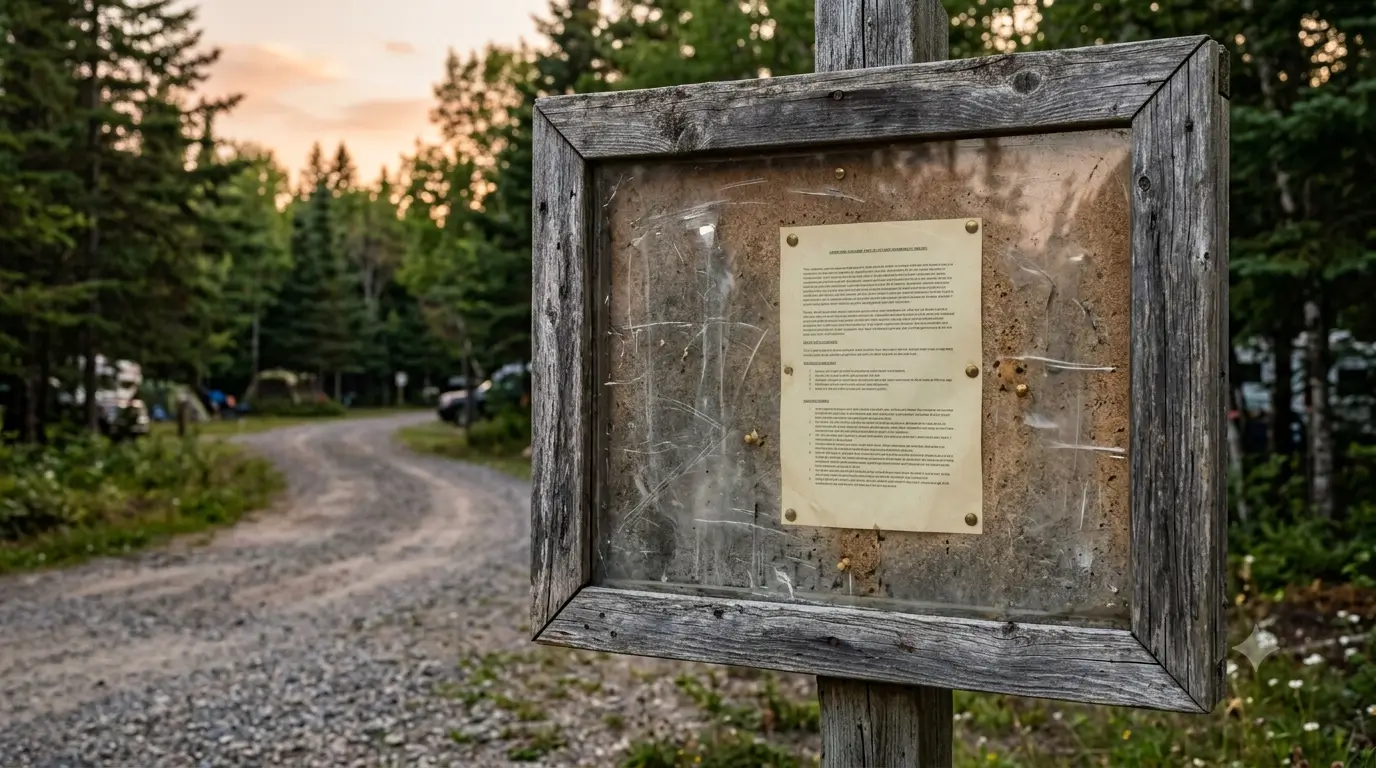
The rules board at the gate is usually the least-read sign on a campground. A guest passes it once, at four in the afternoon, squinting past it toward the office window. By the time the same guest is deciding whether half past ten is too late for a Bluetooth speaker, that board is a quarter-mile back down a dark gravel loop.
So the question is not whether you have rules. Every site does. It is whether they are written in a way a guest can find and act on at the moment the rule applies. Below is how to word them, the ones operators most often leave out, and a template you can copy into your own guide.
What rules should a campground have for guests?
Campground rules for guests should cover ten areas: arrival and site use, quiet hours and generators, fires and BBQs, pets, wildlife and food storage, waste and disposal, water and power, wifi and signal, visitors, and emergency contacts. Each rule should be one line a guest can act on, with the reason sitting next to it. Anything that needs a paragraph is not a rule, it is guide-book content, and it belongs in your campsite guide book instead.
Twelve to fifteen lines is about the ceiling. Past that, guests skim, and the rules that matter most get lost among the ones that never caused a problem.
Write the rule, the reason, and what happens next
Most campground rules are written the way a lawyer would write them, and they read like a citation waiting to happen. The version guests follow has three parts: what to do, why it exists, and what happens if it is ignored. The reason does most of the work; a camper who knows why outside firewood is banned tends not to bring it.
How the rule usually reads | How to write it so it gets followed |
|---|---|
Quiet hours are strictly enforced. | Quiet hours are 10pm to 6am. Tents have no walls, so a normal conversation carries three pitches. A camp host will knock once; after that we will ask you to pack up. |
No outside firewood permitted. | Buy firewood at the shop or within 10 miles. Outside wood moves tree pests between forests and we can be fined for it. |
Dogs must be under control at all times. | Dogs stay on a short lead anywhere outside your own pitch, and please don't leave them alone at the site. Ours is a walk-through loop and a dog on its own barks at every passing guest. |
Please dispose of waste responsibly. | Gray water goes to the disposal point by the shower block, never onto the grass. It kills the pitch and brings wasps within a day. |
In our experience a rule with a one-clause reason attached gets argued with far less at the office window than the same rule stated flat. The extra words are worth the space.
As an example, our pool rule used to read "no glass by the pool." Guests brought glass anyway. Adding the reason (bare feet, and the pool has to be drained if something breaks) is what actually stopped it.
The campground rules template you can copy
Fill in the brackets, delete anything that does not apply to your site, and keep the reasons attached. Two notes before you copy it. This is written for a mixed tent and touring site, so trim the hookup lines if you only take tents. And it is deliberately longer than the twelve to fifteen lines above, because it covers all ten areas for every site type: pick the lines that match problems you actually have for the posted version and the confirmation email, and let the rest sit in the guide where guests can look them up.
The lines below that read as plain information (wifi password, bin days, the emergency number) do not need a reason attached. The ones that ask a guest to change their behavior do.
Arrival and your site
Check-in from [3pm]. Check-out by [11am].
Arriving after [9pm]? [The gate code is in your confirmation email / the late-arrival board is on the shed door]. Please keep headlights low on the loop; canvas does not block light and the beams sweep straight through the tents.
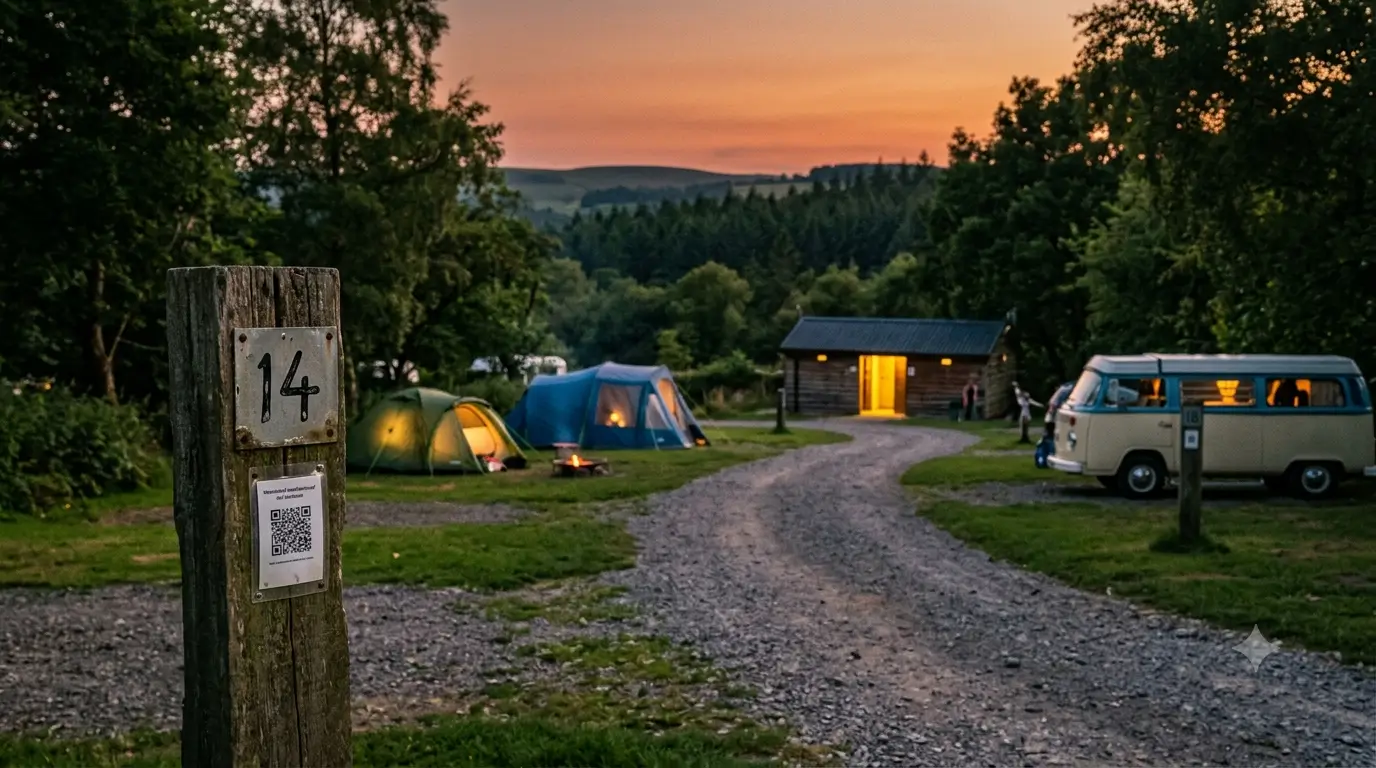
Your pitch is marked by the numbered post. Keep tents, awnings, guy ropes and vehicles inside the marked lines so your neighbor can open theirs.
[One vehicle per pitch. Extra cars go in the overflow lot by the entrance, [amount] per night, because a second car on the grass blocks the loop for the trash truck and the next arrival.]
Speed limit on the loops is [5 mph]. Kids and dogs come out from between the units without looking.
Quiet hours and generators
Quiet hours are [10pm to 6am]. Music off, generators off, voices down. Canvas does not block sound.
Generators may run [8am to 10am and 5pm to 7pm] only. Generator noise carries further than voices and it runs for hours, not minutes.
Point flashlights and headlamps down after dark. [The tents on pitches 8 to 14 face the loop.]
Fires, BBQs and firewood
Fires are allowed [only in the metal ring on your pitch / only in the communal ring]. Never under a tree, tarp or awning. Embers travel further than people expect and a tarp goes up in seconds.
Firewood: buy it [at the shop / within 10 miles]. Outside wood is not allowed because it moves tree pests between forests.
[Charcoal and gas BBQs are fine on your pitch, on a stand and off the grass. A BBQ set down on the turf scorches a bare patch that takes a season to grow back.]
Cold ash goes in [the metal ash bin by the shower block], never in the general waste. Ash can stay hot for a day and will burn through a bin bag.
During a burn ban, all open fires are off, [including charcoal]. Current status is posted [at the gate and in the digital guide].
Never leave a fire unattended, and douse it fully before bed. Water buckets are [at the fire point by the shop]. A fire that looks out can restart in a breeze.
Pets
Dogs are welcome on pitches [1 to 20], [maximum two per pitch].
Short lead anywhere outside your own pitch. Not every guest is comfortable around a loose dog, however friendly.
Pick up straight away. Bags and a dedicated bin are [at the shower block]. Tent pitches get walked barefoot.
Please don't leave a dog alone at the pitch or in a van. A dog on its own barks, and we have no way to reach you.
Dogs are not allowed in [the shower block, the play area or the shop]. Those are the shared indoor spaces and some guests have allergies.
Wildlife and food storage
[We are in bear country.] Food, coolers, trash, toiletries and anything scented go [in the bear box on your pitch / in your vehicle with the windows up / inside a hard-sided camper], never in a tent. Bears work by smell, and a cooler left in a tent is what brings one onto a pitch.
Cook and wash up [at least 100 feet from where you sleep], and keep nothing scented in the tent overnight, including toothpaste, sunscreen and dog food.
Trash goes in [the wildlife-resistant bins by the gate]. Please close the latch behind you; a bin propped open teaches every animal here where dinner is.
Please don't feed any wildlife, [including the chipmunks and the deer]. An animal that learns to associate people with food becomes a problem for the guest after you, and it is usually the animal that pays for it.
[If you see a bear, do not run and do not approach it for a photo. Back away the way you came and tell us at [number] so we can warn the pitches nearby.]
Encounter advice differs between black bears and grizzlies, and between bears and whatever you actually have on your land, so put your local wildlife agency's wording in that last line rather than something generic.
Waste, recycling and toilet disposal
We sort [general waste / recycling / glass]. Bins are [at the gate], emptied [Monday and Thursday].
Chemical toilet contents go to [the disposal point behind the shower block], not the toilets or the drains. The chemicals kill [our septic system]. Rinse the point after use.
Gray water goes to [the gray-water point], never on the grass or into the hedge. It kills the pitch and brings wasps within a day.
Don't leave food waste or bags outside overnight. [Raccoons] will find it and the mess lands on your neighbor.
Water, power and hookups
Drinking water taps are [the blue-marked ones by the shower block]. The tap at [the washing-up area] is not potable.
Hookups are [30-amp]. A kettle plus a heater plus an air conditioner will trip the post.
Use your own [pressure regulator and surge protector]. Line pressure here can be high enough to burst a hose fitting, and the flood lands on your own pitch.
If a post trips, reset it once at the pedestal. If it trips again, call [number] rather than resetting it repeatedly. A post that trips twice usually has a fault, and repeated resets can damage what you have plugged in.
Wifi and signal
Network [NAME], password [PASSWORD]. It reaches [reception and the shop], not the back field.
[Carrier] has the best coverage here. [Carrier] drops to nothing past pitch [20].
Load the guide on your phone while you are at [reception], where the signal is strongest.
Visitors
Day visitors are welcome [10am to 8pm], [amount] a head, signed in at [the office].
Visitors park in [the overflow lot] and cannot stay overnight. [Our site license caps how many people can be on site after dark.]
Emergencies and after hours
After-hours number: [NUMBER]. This reaches [a person, not a voicemail].
Emergency services: [911]. Our address for them is [FULL ADDRESS], what3words [///word.word.word].
Fire points are [at the shower block and by the shop]. Nearest hospital: [NAME, ADDRESS, distance].
First aid kit and defibrillator: [location].
Checkout
Out by [11am]. Changeover is [two hours] and the pitch has to be cleared and cut before the next arrival. [Late checkout is [amount] if the pitch is free that night; ask at the office.]
Everything goes to the bins on your way out, including [bottles, pegs and ash]. Pegs left in the grass puncture the mower and the next tent's groundsheet.
Leave the fire ring cold and empty, so the next guest is not clearing up before they can use it.
Return [the gate fob] to [the box on the shed door]. A fob that goes home in a pocket still opens the gate.
If a rule gets broken
[We will come and ask once, politely. If it carries on we will ask you to leave, and [state your refund position here].]
[Damage to the pitch, the hookup post or the facilities is charged at cost.]
This last section is the part worth having a local attorney read before you publish it. See the FAQ below.
The rules people break that nobody wrote down
These are the ones that generate neighbor complaints, and they are usually missing from the board because they feel too obvious to write down.
Day visitors. Guests assume friends can drop by and park on the pitch. Say what is allowed, what it costs, and where visitors park.
Pitch lines and guy ropes. An awning three feet over the line is the single most common source of "can you have a word with them."
Dogs left alone. Owners genuinely believe their dog is quiet when they leave. Almost none of them are.
Washing up in the bathroom sinks. Point people at the washing-up area explicitly or they will use whatever sink is closest.
Driving the loop during quiet hours. Headlights swung across a tent at midnight wakes more people than the engine does.
Where the rules need to live
The gate board still earns its place as a reminder, but it is the last place a guest looks for an answer. Rules land in three places, each doing a different job.
The booking confirmation. Dogs, fires, generators and visitor policy belong here, because these are the ones guests plan around before they pack.
The arrival point. A weatherproof QR code card at the check-in shed and on the site post, so the rules are one scan from where the guest is standing.
The guest's phone during the stay. This is the version that gets consulted at 10pm, and the only one that can be corrected the same day.
Worth being straight about the signal problem: a digital guide needs a connection to open. It does not download and sit on the phone. So the job is to get it loaded while the guest still has bars: link in the confirmation, QR card where coverage is strongest, and a printed one-pager in the late-arrival envelope carrying the gate code, fire rules, quiet hours and your number, for pitches with no coverage. The full contents question is covered in our campsite guide book breakdown and, for hookup sites, the RV park guidebook post.
Keeping the rules current when the season changes them
Burn bans arrive with hours of notice, not weeks. Quiet hours shift for a holiday weekend. A disposal point closes for repair. Whichever version of the rules your guests are actually reading has to be the one that changed, and a printed board is the slowest thing on the site to update.
Read the whole set once at the start of each season too. Open it on your own phone, walk the loop the way a first-night guest would, and fix the line that is now wrong.
Where SmoothStay fits
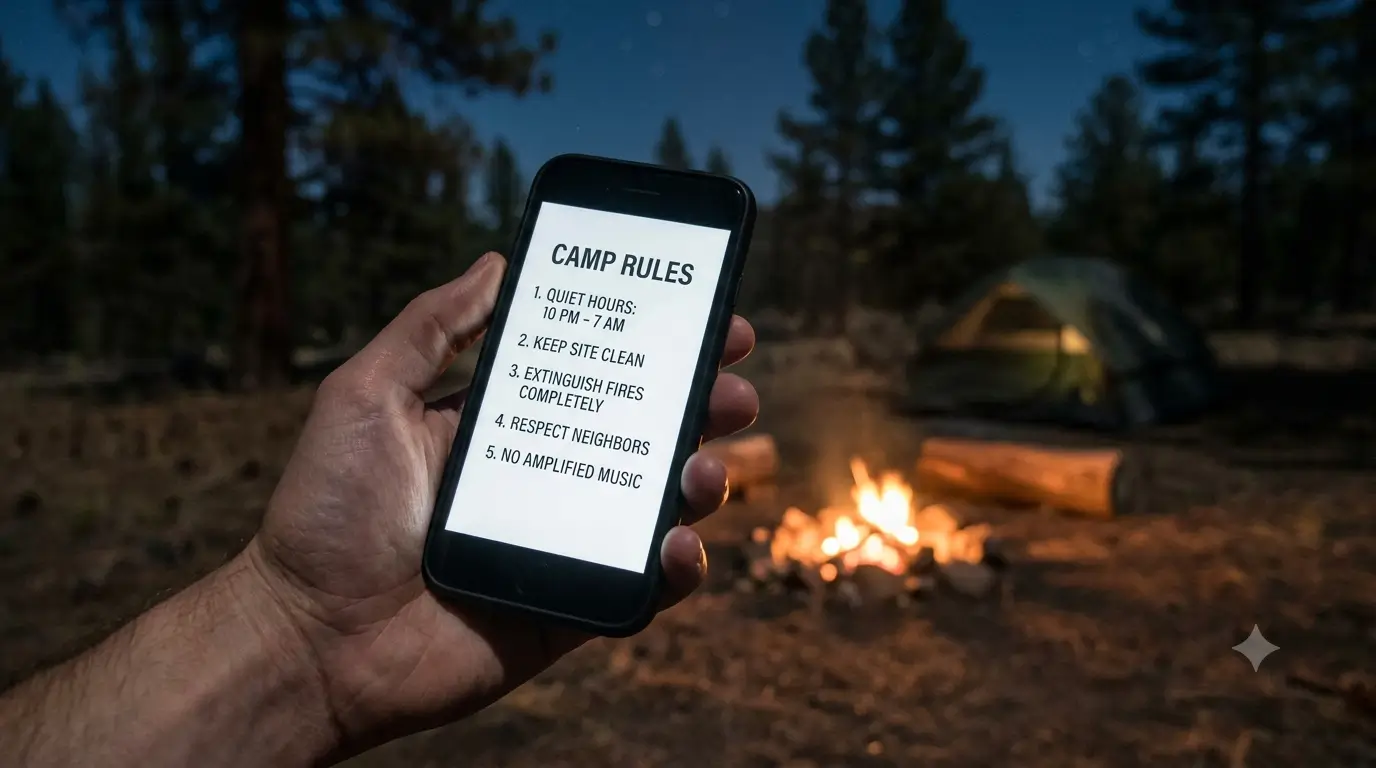
Updating a printed board mid-season is the part of this that software genuinely solves. A burn ban that lands on a Friday afternoon means reprinting the gate board, the shed notice and whatever is pinned up in the shower block, and the copy already in a guest's pocket stays wrong regardless. Change one line in a digital guide and everyone who opens it after that sees the current rule.
We built SmoothStay running our own rentals in Washington DC and the Riviera Maya, not a campground. The information problem is the same shape. Rules for a tent field, a glamping unit and a hookup pitch can each be their own version, so tent guests are not reading past hookup lines that do not apply to them.
The AI Concierge, working only from what you have published in the guide, handles the follow-up questions the rules themselves create: whether the shop is still open, where the ash bin is, which tap is potable. Those are the questions that otherwise arrive on your phone after dark, and many operators find they field fewer of them once guests can look the answer up.
FAQ
What are typical campground quiet hours?
10pm to 6am is the common range. The National Park Service notes that posted quiet hours in most campgrounds run a range of that kind. Plenty of private sites extend it to 7am or 8am on weekends. The specific times matter less than publishing them; "please be considerate" is not a rule anyone can follow.
How many rules is too many?
If the list does not fit on one phone screen, guests will skim it and miss the important ones. Twelve to fifteen lines covering the ten areas above is a workable target. Anything longer is guide-book material.
What is the difference between campground rules and a campground guide book?
Rules are the short list of things guests must and must not do, written to be scanned. The guide book is everything else: the facilities map, hookup instructions, trails, local shops, checkout detail. The rules usually live inside the guide book as one section, and they are also the part worth repeating in the confirmation email and on the site post.
Can I remove a guest for breaking the rules?
It depends where you are. Campgrounds are governed by different rules state to state and country to country, and in some places a guest who has stayed beyond a certain length of time gains tenancy-style protections. Write your escalation into the rules (a warning, then removal), state your refund position plainly, and have a local attorney look at the wording before you rely on it. Nothing here is legal advice.
Do tent sites and RV sites need different rules?
The core set is the same. RV and touring sites add hookup amperage, dump station etiquette, and slide-out and awning boundaries. Glamping units add appliance instructions, which are guide-book content rather than rules. If you run both, write one shared set and a short per-type addition rather than two separate documents that drift apart.
Where should the rules go if guests book through an OTA?
Put the short version in the confirmation and the listing description, and keep the full set in the guide. The house-rules wording principles that work for a rental listing work for a pitch too: specific, reasoned, and short enough to read on a phone.
Put your campground rules where guests will actually read them
If you would rather not lay all this out in a PDF and reprint the board every time a burn ban lands, you can have a digital guide for your site running in about an hour, then change one line whenever a rule changes. The free tier covers one property, no card needed.
Latest articles
The Airbnb Extra Guest Policy: How Strict Do You Actually Need to Be?
An Airbnb extra guest policy that fits the booking, not a blanket rule: why we charge no extra guest fee, how guest reviews change it, and wording to copy.
Guests Not Using the Airbnb App to Check In: Why Your Instructions Never Landed
Guests not using the Airbnb app to check in often never see your instructions. Here's how Airbnb delivers them, and the sequence that gets them through.

Airbnb's Q2 2026 Results: The One Number That Lands on a Host's Desk
Airbnb's Q2 2026 results raised guidance, but the number hosts should read is the 16% drop in support cost per booking. Plus why one channel is not a plan.
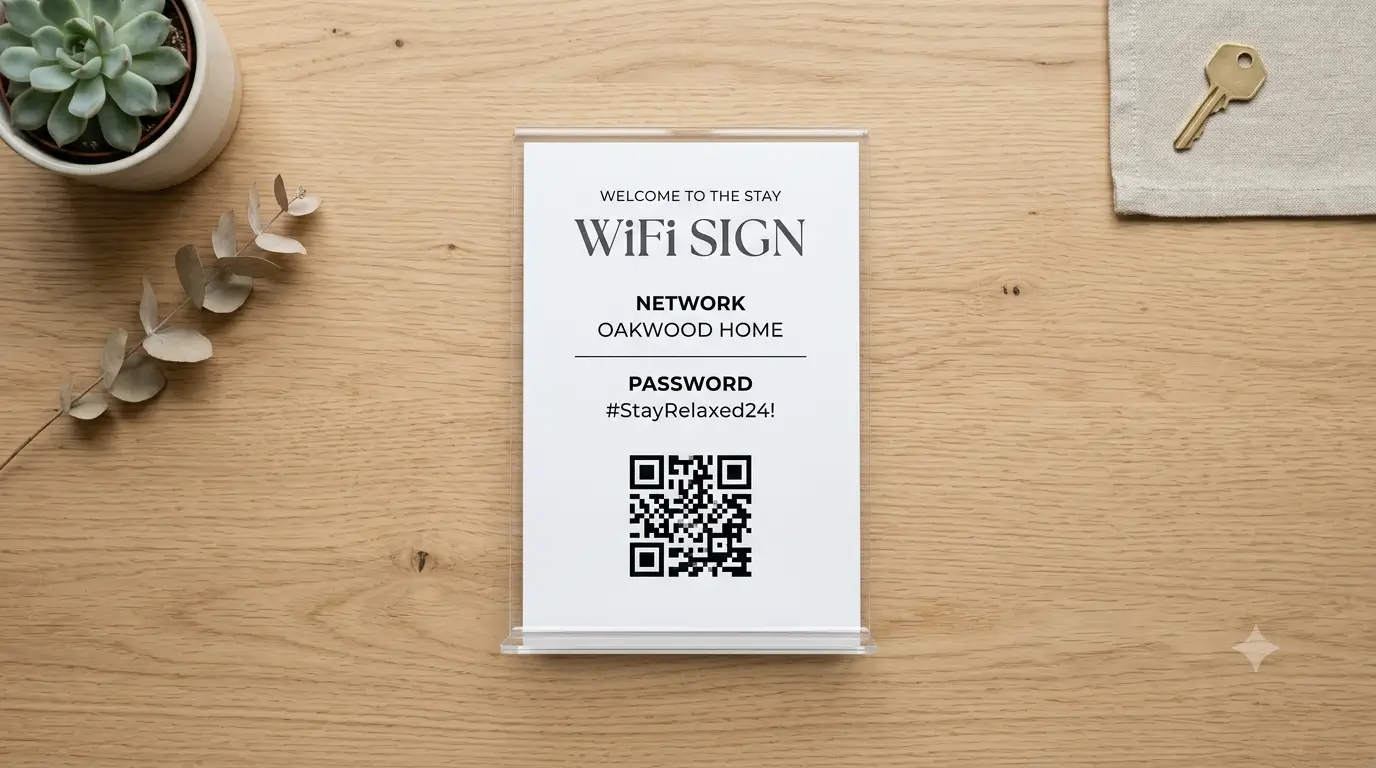
The WiFi Sign for Your Airbnb: What to Put on It (With a Copy-Paste Template)
Build a WiFi sign for your Airbnb guests actually use: exactly what to include, where to place it, an auto-connect QR trick, and a free copy-paste template.