
Trash generates more guest messages and neighbor complaints than its size suggests, and most house manuals give it one line. This post walks the six things guests need, in the order they hit them, and argues that collection day is where instructions usually stop short. It covers apartments, houses, campsites and small hotels, notes what you cannot charge a guest for, and hands you a copy-paste template with brackets to fill in.
A guest who cannot find the bins leaves a bag by the back door. A guest trying to be helpful drags your bins to the curb on the wrong night. Trash is a small section of the house manual that produces guest messages and neighbor complaints out of all proportion to its size, and most manuals give it one line.
What should Airbnb trash instructions say?
Airbnb trash instructions should tell guests six things: where the bins are, which bin takes what, whether anything needs rinsing or separating, what happens on garbage day if the stay covers it, what to do when a bin is already full, and what must never go in. Write them for your address rather than in general. Collection schedules, recycling categories and banned items vary a lot between municipalities, so a paragraph borrowed from another host's manual is a poor starting point for yours.
The six things, in the order a guest meets them
A guest usually reaches this information mid-task, standing in the kitchen holding a bag, so we order it the way the moment unfolds.
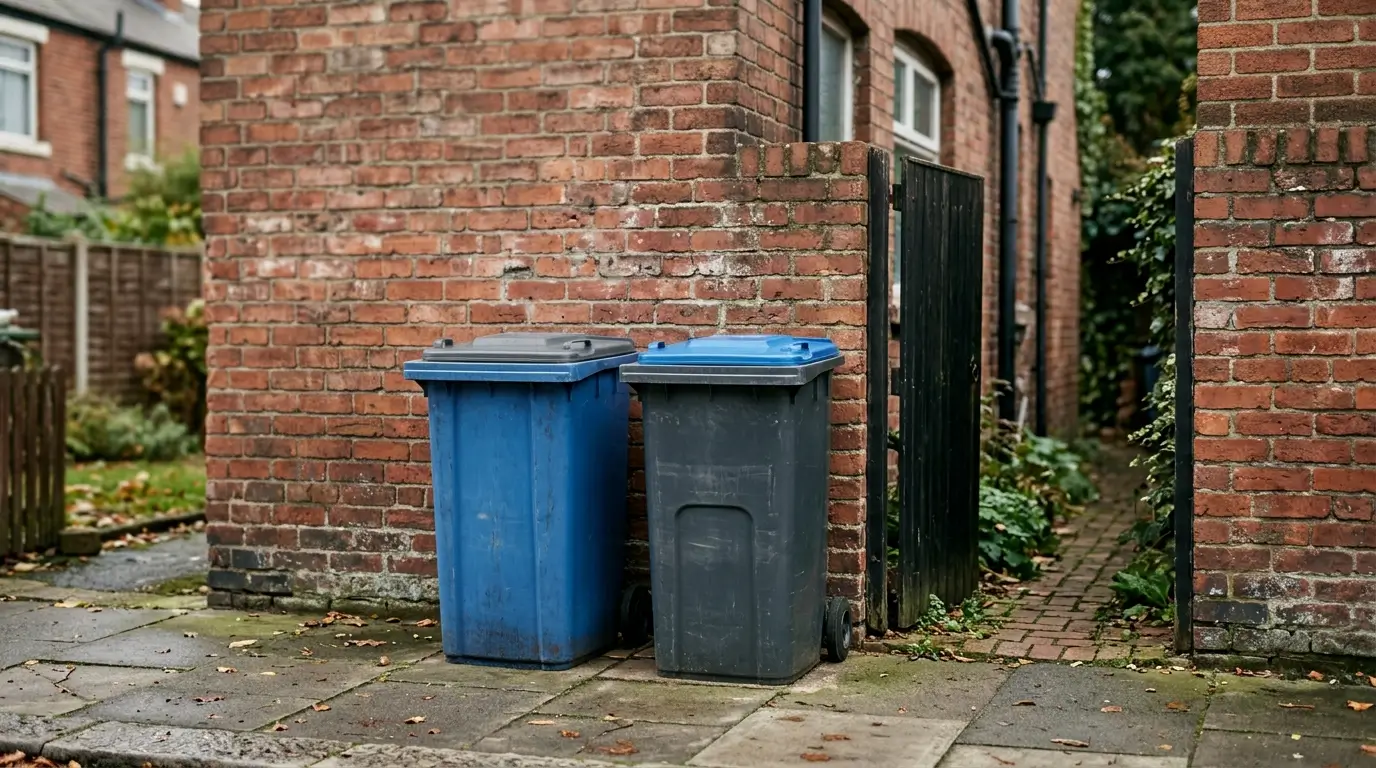
Where the bins are. Not "outside." Which door, which side, whether there is a gate or a code, and whether the bin store is shared. We have found a photo does more work here than a paragraph.
Which bin takes what. Lid color, or a label the guest can see from where they are standing.
Whether anything needs rinsing or separating. The EPA's guidance is to empty containers of food residue by rinsing or scraping, and that "spatula-clean" is generally enough. Plenty of programs go further and ask for empty, clean and dry, so write the version yours actually asks for.
What happens on garbage day. The next section.
What to do when a bin is full. Where the overflow goes, or whether you would rather the extra bag stayed inside. We have found guests improvise here more than anywhere else in the list.
What never goes in. Batteries are the common one. The EPA advises that most batteries, including lithium-ion, lithium metal, lead-acid and other rechargeable types, go to a designated drop-off or a household hazardous waste collection rather than into household garbage or recycling bins. Plastic bags and film are another, and many programs take those at a store drop-off instead. Past that it is local. Your own state and city rules are the ones that govern.
Garbage day is where we see many guidebooks stop
In practice there are two honest versions of this instruction, and most of the value is in picking one and writing it down.
One version asks the guest to help. If you go that way, say which night, which bins, where exactly they go, and whether to bring them back in. "Bins go out Tuesday" is not enough for someone who has never seen your curb line.
The other version is just as good: tell guests plainly that you handle the bins yourself. That is the one we use at most of our properties. A well-meaning guest who sees the neighbors' bins lined up at dusk will often assume they are meant to join in, and put the recycling out on a general waste night.
Either way, the instruction has to survive the conditions. At our DC row house the winter cold gets into the bin lids and they stick shut, which is enough to defeat a guest carrying a bag out after dark.
Our Mexico properties run on a different system entirely, different enough that a guest arriving from the US will not guess it correctly.
What changes by property type
Property type | What the guest needs to know | The line that usually gets missed |
|---|---|---|
Apartment with a chute or shared bin room | Which floor, which door, whether the chute takes recycling, and the building's own rules | That the chute takes bagged trash only, and cardboard has to be carried down |
House with curbside or alley collection | Bin location, sorting, garbage day, and whether the guest should move the bins at all | Whether to bring the bins back in, and where "back in" is |
Campsite or glamping site | The central disposal point, its hours, and any wildlife rules on your site | That food wrappers may need storing the same way food does |
Small hotel or B&B | Where the in-room bin is, and that staff handle the rest | Where a guest can put a recyclable item if they want to |
The campsite row is the one we would spend the most time on. Food-storage rules differ from park to park in the US, and the National Park Service tells visitors to treat food wrappers and other garbage the same as food, which can mean a bear-resistant container, a food locker, or hanging, depending on where you are. If anything like that applies to your site, put it in the arrival information. Our campsite guide book post covers the rest of what a site guide needs.
Composting, recycling and the garbage disposal
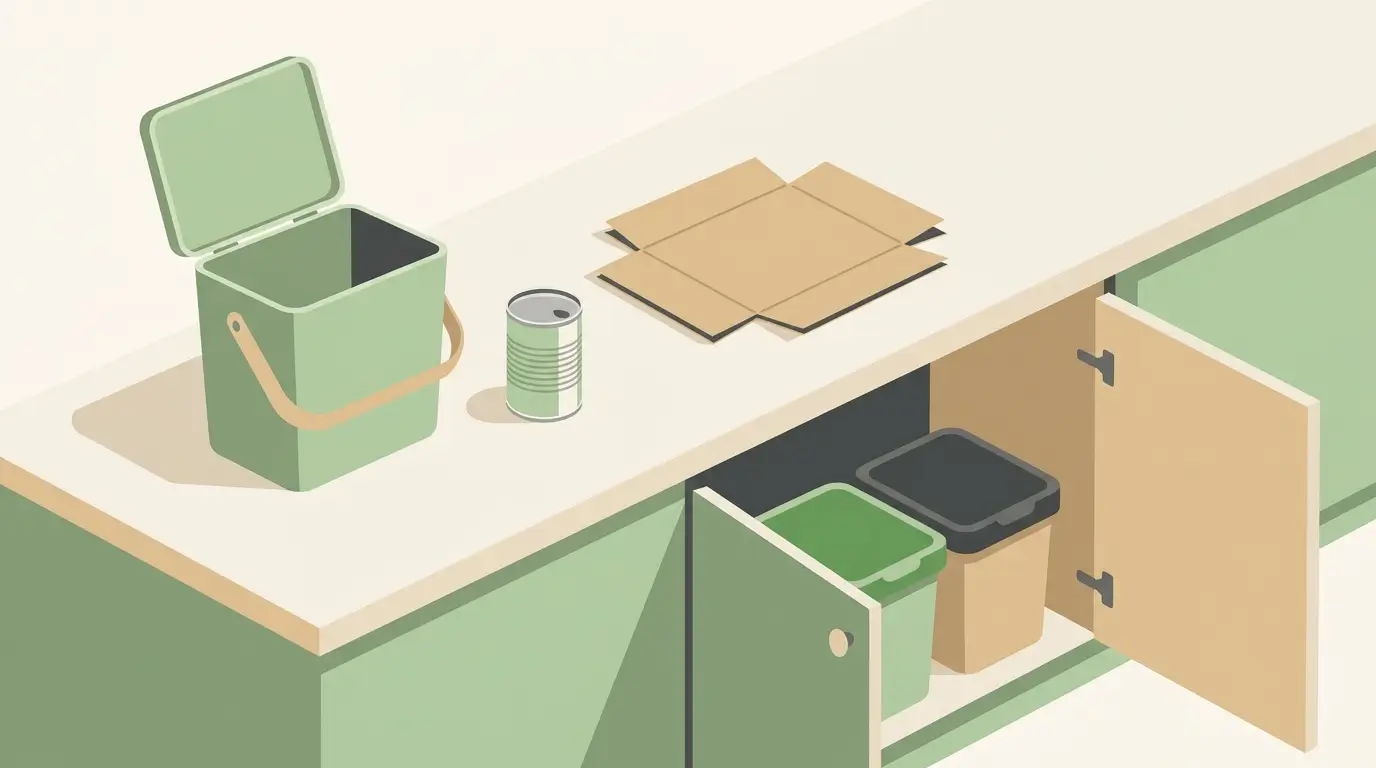
If you compost, we've found the instruction only works as a list of items. Name what goes in the caddy, and name the three or four things that do not.
Two recycling details are worth a line because guests get them wrong in good faith. The resin number stamped in a triangle on a plastic container is an identification code, and the EPA notes it does not necessarily mean the item can be collected for recycling in your community. And compostable plastics are not intended for recycling; the EPA says they can contaminate the recycling stream if they are mixed in with non-compostable plastics. A guest who bought compostable cups on the way in will assume the opposite.
The garbage disposal needs its own line, listing what does not go down the one in your kitchen. Models differ on what they can handle, so we would check the manual for yours before copying a general list.
What belongs on a bin label
Our view is that properties tend to over-sign, and that a bin gets two lines at most.
A label on or above a bin should say what goes in that bin and nothing else. Garbage day, sorting rules, the disposal list and the overflow instruction belong in the written guide, because they change and because a laminated paragraph is a poor place to read anything while holding a bag.
Copy-paste trash instructions template
Swap the bracketed parts for your property and keep the tone plain. This is the same shape as our parking instructions templates, which is the sibling article to this one.
Trash and recycling
[PHOTO OF THE BINS IN PLACE]
The bins are [LOCATION, e.g. through the kitchen door, left side of the house, behind the gate]. [GATE CODE OR ACCESS NOTE, or delete this line].
[COLOR] lid is general waste. [COLOR] lid is recycling: [WHAT YOUR PROGRAM TAKES, e.g. paper, cardboard, cans, glass bottles, plastic bottles]. [YOUR LOCAL RINSING RULE, in one short sentence].
[ITEMS YOUR PROGRAM BANS FROM RECYCLING] go in [WHERE THEY DO GO] instead. Batteries and [ANY OTHER SPECIAL-HANDLING ITEMS] should not go in either bin: leave them on [SURFACE] and we will take care of it.
Garbage day is [DAY]. [We put the bins out ourselves, so please leave them where they are. / If you are here on [DAY], please put the [WHICH] bin at [EXACT SPOT] after [TIME], and bring it back in the next evening.]
If a bin is full, [OVERFLOW INSTRUCTION, e.g. spare bags are under the sink and the tied bag can go beside the bin / please leave the extra bag inside by the back door].
[COMPOST LINE, if applicable: The caddy on the counter takes [LIST]. Please keep [LIST] out of it.]
[GARBAGE DISPOSAL LINE, if applicable: The disposal handles [LIST]. Please keep [LIST] out of it.]
The two-line bin label
[COLOR]lid: recycling.
[WHAT YOUR PROGRAM TAKES].
What you get back
Fewer messages is the obvious return, and in our experience it is the smallest one.
The bigger benefit is usually avoiding neighbor complaints. A missed pickup or an overflowing bin is visible to everyone on the street, and that friction can outlast the guest who caused it by a long way. Most hosts we know would rather field a guest question than a neighbor's second complaint.
And it is a write-once job. The answer barely changes between guests, which makes it a good candidate for writing down properly instead of answering by text at 9pm.
FAQ
Can I charge a guest for leaving trash behind?
Not as a separate fee for skipped chores. Airbnb's ground rules for guests say hosts may not charge guest fees for failing to perform specific cleaning or checkout tasks, and that cleaning fees are meant to cover standard cleaning between reservations. Documented damage or genuinely unexpected cleaning costs are a different matter, and the same page routes those through Airbnb's own reimbursement process rather than a charge you set yourself. It also says hosts may leave ratings and reviews based on cleanliness, asks guests to use designated receptacles, and treats excessive trash as something you can report. For our properties the better lever is writing the instruction well.
Should Airbnb guests take out the trash?
Into the bins, yes. Out to the curb on collection night, that depends on the length of the stay and how visible your bins are. For a two-night stay we would not ask. For a week that crosses collection night, asking is reasonable as long as the instruction names the night, the bin and the exact spot. Leaving it unstated is the version we would avoid.
What should I include in Airbnb recycling instructions?
Which bin, what your program actually takes, and how clean it needs to be. Then the two things guests get wrong in good faith, the resin code and compostable packaging, both covered above. Keep the list to the items your property actually generates. Twenty categories reads as a policy, and we've found guests skim policies.
Can I put trash instructions in Airbnb's own tools?
Only a short version. Airbnb's checkout instructions include a "Throw trash away" preset, and at the time of writing, in August 2026, the help page describes adding up to 140 characters of optional detail. That is room for a sentence, not a set of instructions, and platform limits like this move without notice. House details go in the house manual instead, which Airbnb describes as the place for day-to-day things like how to turn on the hot water heater, and which only guests with a confirmed reservation can open. In our experience it is a single plain-text field, so anything longer than a few lines arrives as a block with no photo of the bins to go with it. Worth knowing too that checkout instructions are visible before booking while detailed check-in instructions do not release until 48 hours before arrival, so the two sit on different timelines.
Where should trash instructions sit in the house manual?
Not at the top. Wifi, entry and checkout are what we see guests hunt for first, and trash belongs in the same tier as appliances and heating: needed by day two, not in the first ten minutes. Our house manual template puts it mid-document for that reason.
What if my guests do not speak English?
Keep the sentences short and the structure numbered, which we have found holds up under machine translation better than prose does. Lid colors and a photo of the bins carry a lot on their own. If your guidebook translates automatically, read the translated version of this section, because waste vocabulary is where we see translation go vague.
Put the bin answer where a guest will look for it
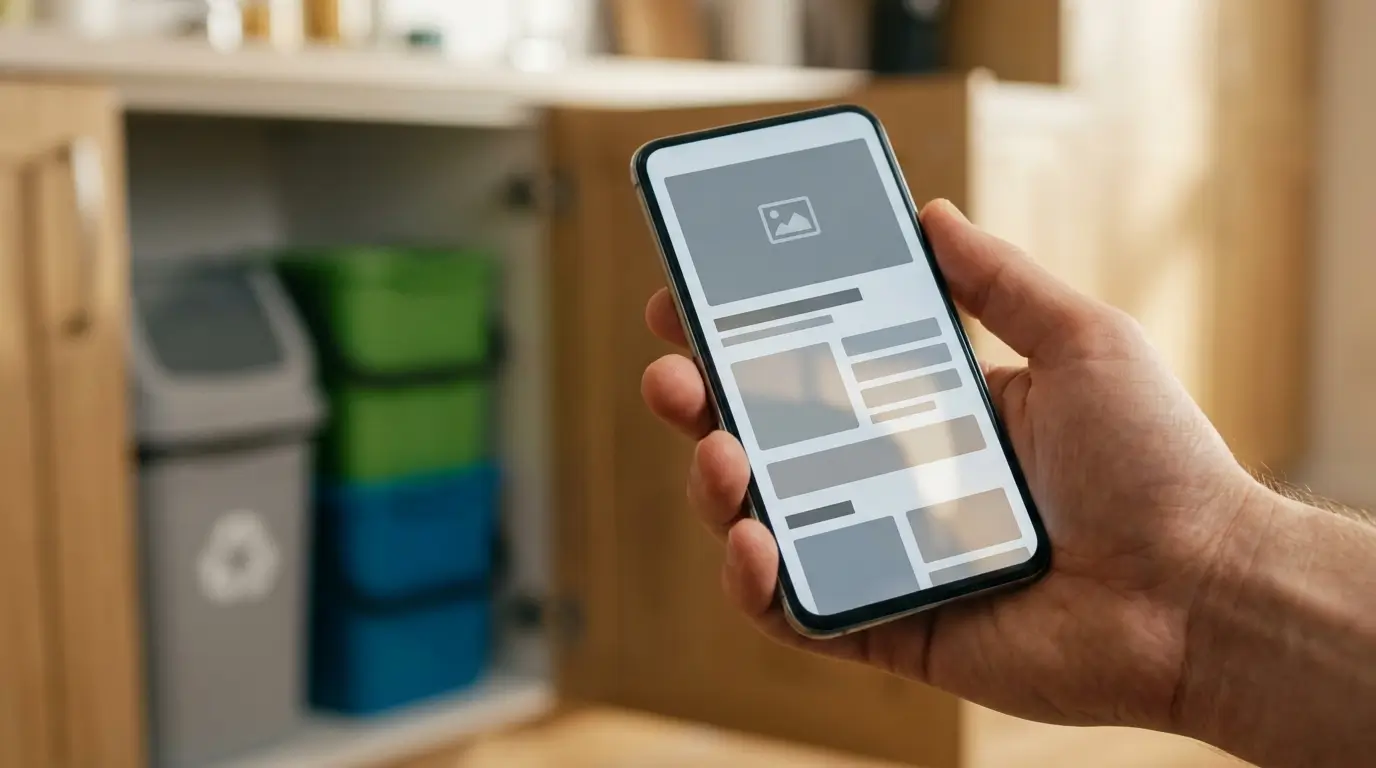
Garbage days move and municipalities change what they accept. If your trash instructions live in a printed binder or a laminated card, every one of those changes means a reprint, and in our experience the reprint runs months behind the change.
We keep ours as one article in the digital guidebook, with a QR code inside the cabinet door where the bins live, so a guest scanning it lands on the trash article and not the home screen. Across a portfolio, shared content means the general recycling language updates everywhere at once while the garbage-day line stays specific to each address, and the AI Concierge is built to answer follow-ups from what you have published and nothing else.
It is also an asset you maintain once and own outright, whatever channel the booking came through. On links tied to an OTA reservation, OTA Compliance Mode holds back the parts a platform restricts, so one trash article can serve an Airbnb guest, a Vrbo guest and a direct booking without you keeping three versions of it.
If you would rather not format all of this yourself, you can start on the free plan and have your trash, parking and arrival articles running in an afternoon, then edit them once whenever the collection day moves. Built by hosts who run properties in Washington, DC and the Riviera Maya.
Latest articles
Glamping Amenities: What Guests Expect, and What to Say About Each One
Which glamping amenities guests actually expect, and what to say about each one so nobody discovers the shared bathroom on arrival. Plus two lists to publish.
Hotel Guest Data Privacy: The Process We Made for Our Own Properties
Hotel guest data privacy from the operator's side: the list we made for our own properties, what travelers say about consent, and a statement you can copy.
How to Word Airbnb Fees and Fines for Guests
How to word Airbnb fees and fines for guests so they inform instead of accuse: what Airbnb counts as a fee, where each number goes, and 7 examples to copy.
What Many Guests Do First When They Arrive
What guests do first when they arrive: the sequence we keep seeing, what goes wrong at each step, and why a QR code at the object beats another page.