A hotel welcome letter should be a warm, 100‑150 word greeting that introduces the property’s personality and directs guests to a digital guidebook for practical details. The post explains what to include, what to omit, offers tone‑specific samples, and shows how a QR‑linked guidebook keeps logistics accessible without cluttering the letter.
What should a hotel welcome letter say?
A good hotel welcome letter greets the guest by name, thanks them for choosing you, shares the one or two things that make a stay here feel different, and points them to where the practical details live. Keep it to 100 to 150 words. The warmth and the personality belong in the letter. The logistics (wifi, breakfast times, checkout, parking) belong somewhere a guest can pull them up again at 10pm, which a printed card on the desk is not.
That last part is where most welcome letters go wrong. The instinct is to make the letter "useful" by cramming in the wifi password, the breakfast window, the parking map, and three house rules. What you end up with is a wall of admin that nobody reads and a first impression that feels like a terms-of-service page. The letter is a moment. Treat it like one.
We run short-term rentals, not a hotel, but the craft is the same: we write a welcome note for every guest across our properties in Washington, DC and the Riviera Maya, and the version that works is always the short, human one. Here's how to write yours, plus three samples you can adapt in about five minutes.
What a welcome letter is for (and what it isn't)
The welcome letter is the warmest 150 words in hospitality. It's the first thing a tired traveler reads after a flight, a rental car, and a wrong turn or two. Its whole job is to make someone feel like they picked the right place and there's a real person behind the door.
What it is not is a reference document. A guest who wants the wifi password at midnight is not going to walk to the desk to find the letter you left there at 3pm. Information needs to live where guests can search it and pull it back up whenever they need it. A letter can't do that, and asking it to try is what makes so many of them so long and so cold.
So the split is simple. Identity and warmth go in the letter. Everything a guest might need to look up twice goes somewhere findable. Get that division right and both jobs get easier.
What to include, and what to cut
Put in the letter | Leave out of the letter |
|---|---|
The guest's name and a genuine thank-you | The full wifi network name and password |
One or two lines of real personality or history | Every house rule |
A warm pointer to where the details live | Breakfast, checkout, and parking specifics |
A sign-off with a name and a way to reach a person | Anything that changes by season, room, or rate |
The test for any line is this: would a guest ever need to read it a second time? If yes, it's information, and it belongs in your guide, not your letter. If it's something they read once and feel good about, it stays.
Match the tone to the property
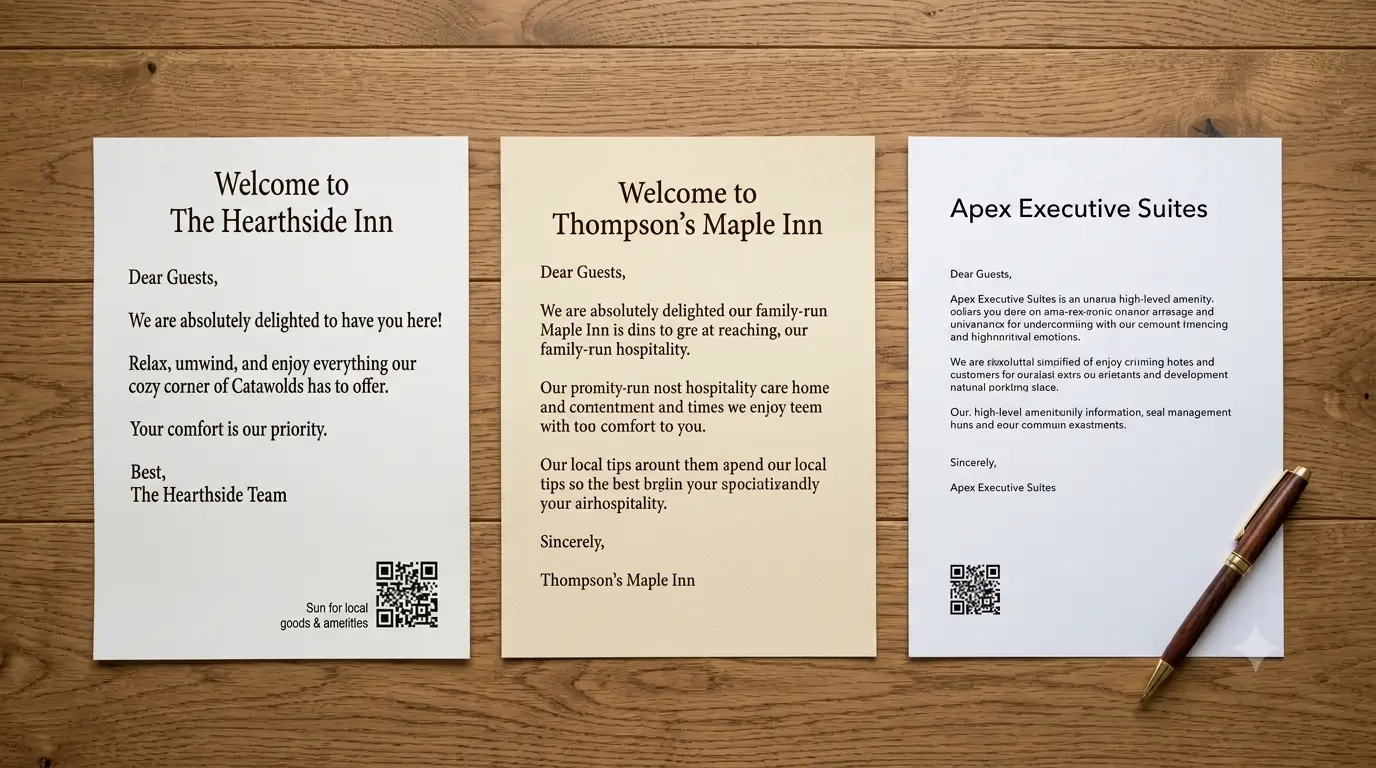
A welcome letter should sound like your property, not like a template someone downloaded. A restored boutique hotel and a five-room family inn are not trying to make the same guest feel the same way, so their letters shouldn't read the same either.
Three tones cover most small and independent properties: the polished-but-personal boutique voice, the come-in-the-kitchen family voice, and the get-out-of-my-way efficiency of a business stay. Pick the one that matches how guests actually experience you, then write like a person, not a brand.
Three welcome letters you can copy and adapt
Fill in the brackets, cut anything that isn't true for you, and read it out loud once before you print it. If it sounds like something you'd actually say, it's ready.
Sample 1: Classic boutique hotel
Dear [Guest name],
Welcome to [Hotel name]. We're glad you chose us for your time in [city].
Your room, [room name or number], is one of our favorites for [one specific detail: the morning light, the view over the square, the deep reading chair]. Settle in, and if anything would make your stay better, [staff name] at the front desk would genuinely like to help.
A few of our regulars swear by [one local pick: the café two doors down, the river walk at dusk]. We'd start there.
Everything else you might need during your stay is in the guide linked below. Scan it once and it's yours for the whole trip.
Rest well. We're happy you're here.
Warmly, [Your name] and the team at [Hotel name]
Sample 2: Family-run inn or guesthouse
Hi [Guest name],
Welcome. We're [Owner names], and we've run this inn for [X years]. You're staying in what used to be [a real detail: the old library, my grandmother's room].
We put you in [room], which gets the [morning sun, garden view]. There's a kettle and tea on the shelf, so help yourself whenever.
Breakfast is the part we love most. The when and where is in the guide below, along with anything you might wonder about at an odd hour.
If you need us, we're usually [nearby, just through the blue door]. Don't be shy about knocking.
Make yourself at home. That's the whole idea.
[Owner names]
Sample 3: Business or extended stay
Dear [Guest name],
Welcome to [Hotel name]. A work trip runs on small things going right, so we've tried to make those easy.
Fast wifi, a proper desk, and quiet floors after 10pm are the details that matter when you have an early call. Your room, [number], has [a real detail: blackout curtains, a second monitor on request].
Need a late checkout, a laundry pickup, or a quiet spot to take a call? Message us and we'll sort it.
The guide linked below has everything from the wifi login to the closest place for a real breakfast at 6am.
Have a good stay, and good luck with [the week, the meeting].
[Your name], [Hotel name]
Where the logistics actually go
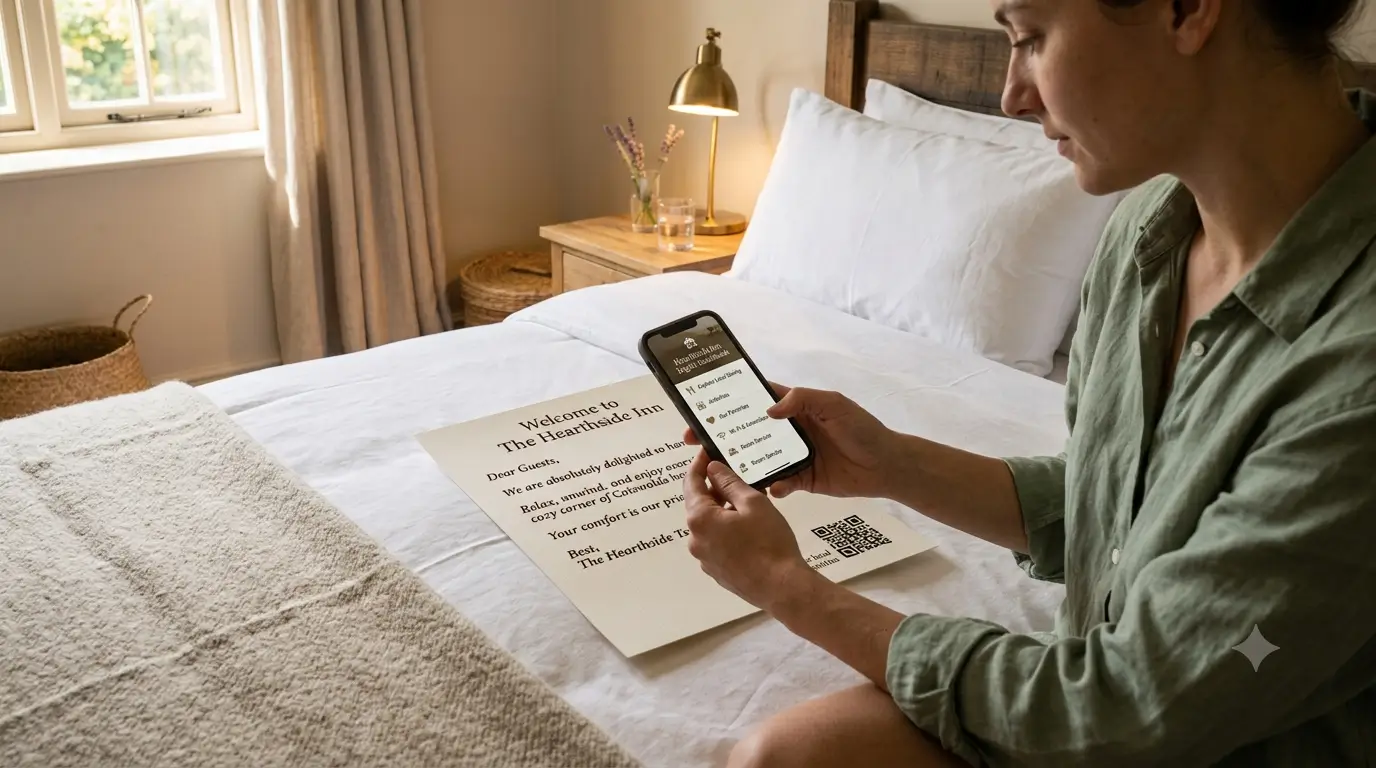
The letter opens the relationship. Something else has to carry the stay. For us, that's a digital guidebook: one link, sent in the confirmation and printed as a QR code at the bottom of the welcome letter, that holds the wifi, the breakfast hours, the checkout steps, the parking, and the local recommendations. A guest scans it once on arrival and pulls it back up whenever they need it, no walk to the desk required.
Two things make this worth doing over a laminated info sheet. It translates, so a guest reading in Spanish or German gets the details in their own language without you keeping five versions in sync. And when someone asks a question the guide didn't cover, an AI concierge can answer from your content at 1am, when the desk is dark. If you run on a PMS, this sits on top of it rather than replacing it, so nothing about your booking flow changes.
If you want the longer version of this thinking, our guide to what a hotel digital guidebook should include breaks it down, and we've made the case for why most small hotels don't need a separate guest app to do any of this. The welcome letter is the front door to all of it.
The shortest welcome note we ever wrote, three lines and a QR code, got more engagement from guests than the long one it replaced.
A starting point
If you'd rather not build the logistics layer from scratch, we put together a free welcome book template you can adapt for your property. Use it as a paper starting point or as the outline for a digital version. And if you'd rather not format all of it yourself, you can have a digital guidebook running in under an hour, one that carries everything the letter shouldn't, in the guest's language, findable at any hour.
FAQ
How long should a hotel welcome letter be?
Aim for 100 to 150 words, or about four short paragraphs. Long enough to feel warm and personal, short enough that a tired guest reads all of it. If it runs past half a page, you're probably storing information that belongs in a guidebook instead.
Should a hotel welcome letter be handwritten or printed?
Printed on nice stock is fine, and a handwritten signature or a single handwritten line makes it feel personal without slowing down your turnover. Fully handwritten letters are lovely but don't scale past a few rooms. The signature is where the human touch pays off most.
What's the difference between a welcome letter and a welcome book?
The welcome letter is the short, warm greeting a guest reads first. The welcome book (or digital guidebook) is the reference: wifi, breakfast, checkout, house rules, local tips. The letter sets the tone and points to the book. Keeping them separate is what lets each one do its job well.
Where should you put the welcome letter in the room?
Somewhere a guest sees it in the first minute: the desk, the bed, or propped against the kettle. Pair it with a QR code linking to your guidebook so the moment they finish reading, everything practical is one scan away.
Can you use the same welcome letter for every guest?
You can use the same template, but swap the guest's name and one specific detail every time. That single personalized line is the difference between a form letter and a note that feels written for them. Most property software can merge the name automatically.
Should the welcome letter include the wifi password?
Skip it. Wifi details change, guests need them more than once, and a password buried in a letter is a support call waiting to happen. Put the network and password in your guidebook and let the letter point there.
Latest articles

How to Automate Check-In Instructions for Short-Term Rental Guests
Automate check-in instructions for short-term rental guests: the four-send sequence, what goes in a message versus a guidebook, and a copy-ready sample.

Vrbo Premier Host in 2026: Every Listing Now Stands on Its Own Record
Vrbo Premier Host requirements changed in 2026: per-listing scoring, tighter thresholds, quarterly checks. What each one means, and how it compares to Superhost.
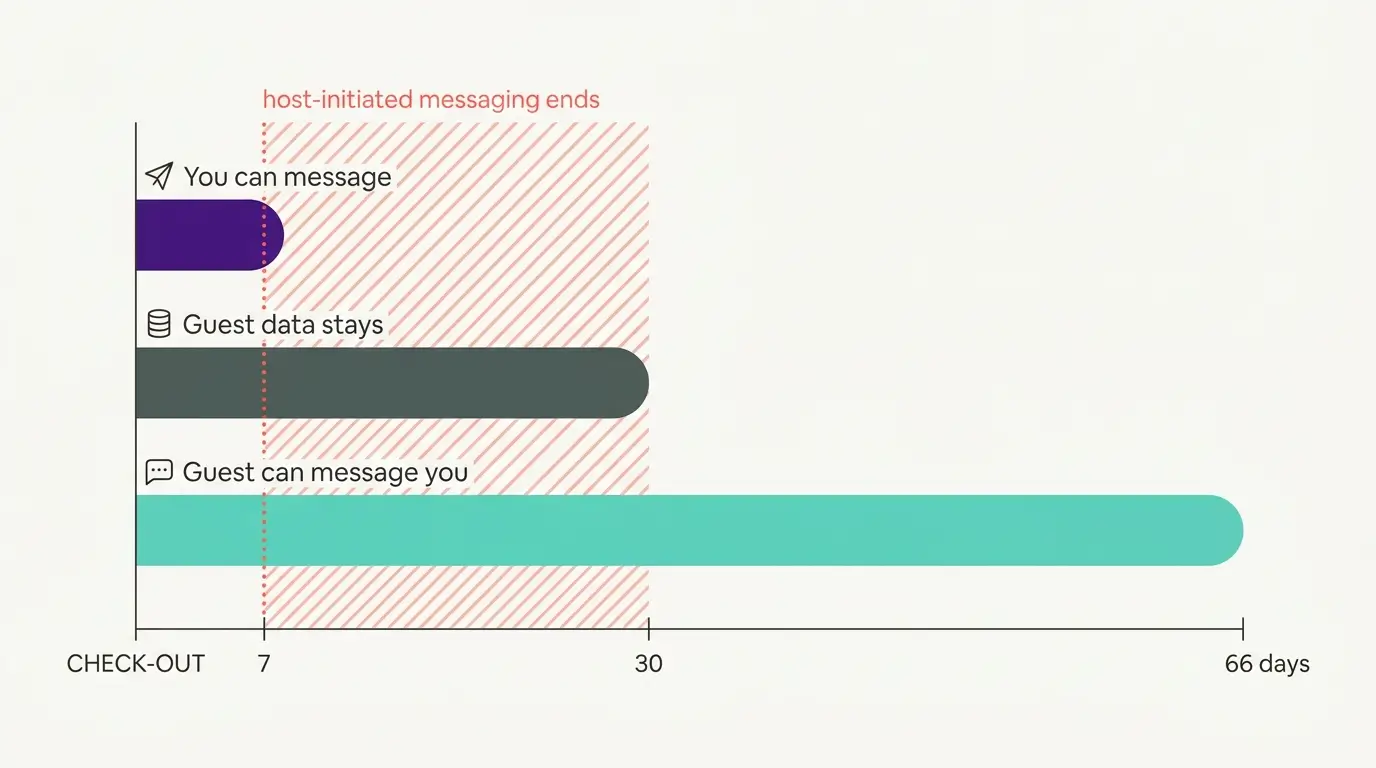
Booking.com Guest Messaging Rules: What Hosts Can Send, When, and Why Links Get Removed
Booking.com guest messaging rules, verified at source: how long you can message a guest, why your links get removed, and what the partner terms say.
Vrbo's New Features for Fall 2026: What's Live, What's Gated, and What's US-Only
We sorted Vrbo's new features for fall 2026: what is live globally, what is gated behind eligibility, and what is US-only. Verified against Vrbo's own pages.