
International short‑term‑rental demand in the U.S. is shifting, with Latin‑American source markets surging while Canada and parts of Western Europe decline, creating a growing share of Spanish‑speaking guests for hosts. Providing multilingual digital guidebooks, AI concierges and clear, language‑specific arrival instructions helps hosts serve this changing guest mix effectively.
Where are international guests coming from in 2026?
The short version: the international guest mix is shifting, not shrinking evenly. In its 2026 Midyear Outlook, AirDNA reports that international short-term rental demand in the US ran about 12% below last spring, but the drop is concentrated, not across the board. Canada is down 32% from 2024. Parts of Western Europe are soft. At the same time, arrivals from Latin America keep climbing, led by Argentina and Brazil, with Mexico close behind.
So the practical read for a US host is this: if your area draws a meaningful share of international guests in the first place, and plenty of STR markets barely do, you'll probably see fewer Canadian and Western European bookings this year and more Spanish-speaking ones, especially in gateway cities, coastal markets, and the towns hosting 2026 World Cup matches. The volume story is a headwind. The composition story is an opportunity, if you're set up to welcome a guest who doesn't speak English as a first language.
One caveat before we go further. AirDNA's figures here are US-only: inbound demand to US rentals, sorted by where the traveler comes from. This is not a global travel forecast. AirDNA also sells STR data and analytics, so their outlook is a well-sourced read from a company that benefits when hosts feel bullish. Take the numbers as directional and attributed, not gospel. The origin shift lines up with what we've seen on our own booking calendars in Mexico, though that's our anecdotal experience across a handful of properties, not a representative sample.
What the numbers actually say
The headline everyone repeats is "international demand is down." True, but incomplete. The more useful version is that a few large source markets fell hard while a whole cluster of others grew. Averaged together, you get a modest decline that hides a real reshuffling underneath.
Here's how AirDNA's named source markets stack up against 2024, ranked from the biggest gain to the steepest decline:
Source market | Demand vs 2024 (per AirDNA) |
|---|---|
Argentina | +85% |
Brazil | +22% |
Mexico | +16% |
UK and Netherlands | Slightly positive |
France | -12% |
Belgium | -16% |
Spain | -18% |
Germany | -23% |
Canada | -32% |
Two things stand out. First, the Latin American growth is broad, not one lucky market. Second, the declines are led by Canada, which has historically been one of the biggest feeders into US rentals, so a 32% drop there drags the whole average down even while other regions climb. AirDNA ties the Canadian slide to a weaker Canadian dollar and softer cross-border travel sentiment.
If you want the primary source, AirDNA published the 2026 Midyear Outlook here. Read it as their data, clearly labeled, rather than as a neutral referee.
Why this lands harder in some markets than others
International guests aren't spread evenly across the country. They concentrate in gateway metros, big coastal cities, and destinations with an international brand. If you host in Miami, Los Angeles, New York, or a well-known beach town, international demand is a bigger slice of your bookings than it is for a cabin market three hours from the nearest airport. When the mix of that slice changes, you feel it first.
The 2026 FIFA World Cup is pushing the same direction right now. It's underway across 16 host cities in the US, Canada, and Mexico and runs through July 19, and AirDNA reports it's lifting demand and pricing in and around host markets. A tournament co-hosted with Mexico pulls in exactly the Latin American travelers whose numbers are already climbing. If you're near a host city, you may see a higher share of guests arriving from Latin America, more of them reading your listing in Spanish or Portuguese. The bigger point outlasts the final whistle: the guest mix was already tilting this way before kickoff, and it won't snap back when the tournament ends.
You can't control where your guests come from. What you can control is whether the ones who show up feel like you were ready for them.
How to host international guests well
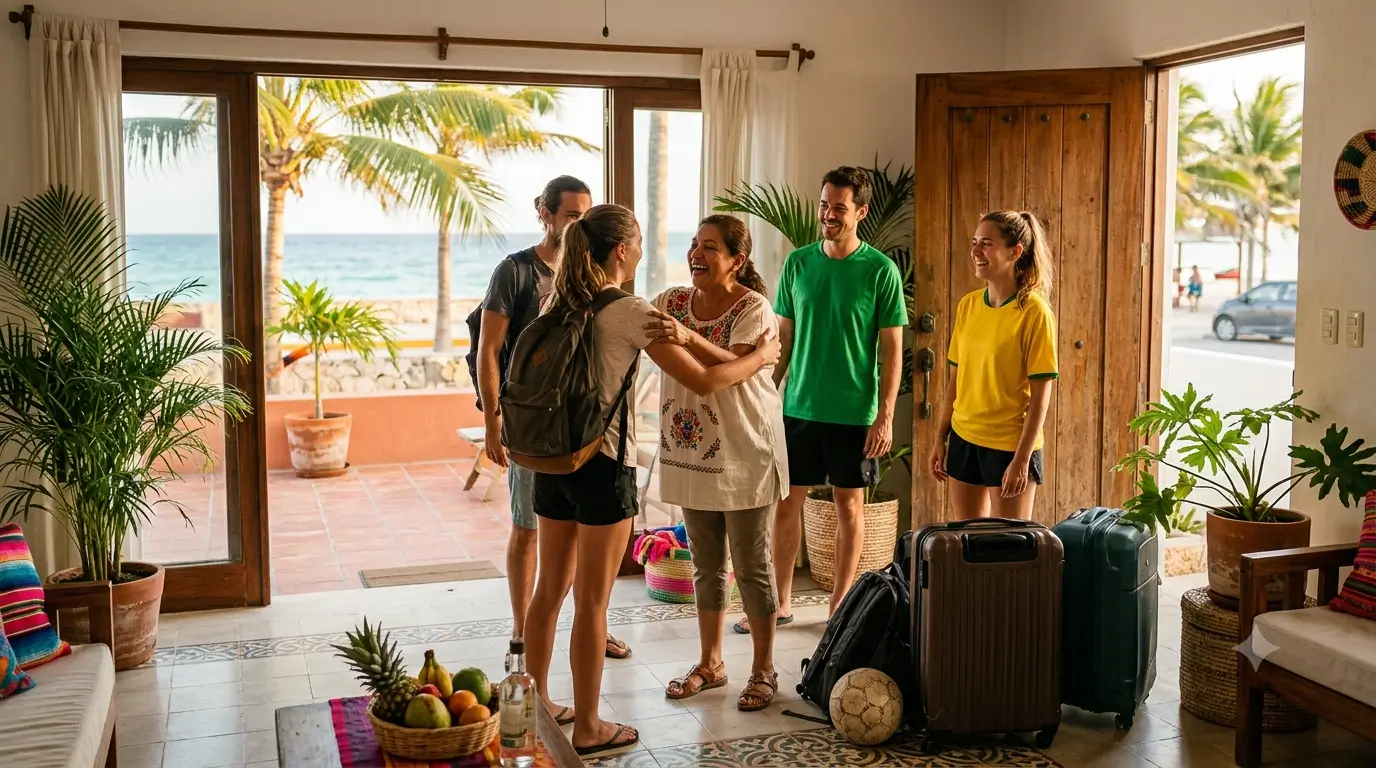
Hosting international guests is not a marketing problem. It's a guest-experience problem, and it shows up in the same four places every time: language, arrival, expectations, and orientation. Get those right and a guest who was nervous about a foreign country relaxes within an hour of walking in.
Close the language gap without pretending to be fluent
You don't need to speak your guest's language. You need your information to. The single biggest favor you can do a non-English-speaking guest is to make everything they'll need, the wifi, the door code, the checkout steps, the "why is the AC doing that" answers, readable in their own language without them fighting a translation app.
We run properties in Washington, DC, Playa del Carmen, Tulum, and co-host two more in the Riviera Maya, and we grew up speaking Spanish, so this one is personal for us. Most of our guests in Mexico don't have Spanish as a first language, and the DC house draws a steady mix of European travelers. A printed binder in English helps none of them. A digital guidebook that flips to the guest's language on one tap helps all of them. That's why our own guidebooks lean on built-in translation across 100+ languages, including neutral Latin American Spanish, so a family from Monterrey and a couple from São Paulo each read the same instructions in language that sounds natural to them.
If you want the fuller rundown of options here, we compared the best multi-language tools for rental hosts in a separate post. The short version: translate the content guests actually use, not just the listing.
Make arrival foolproof across a time zone and a language barrier
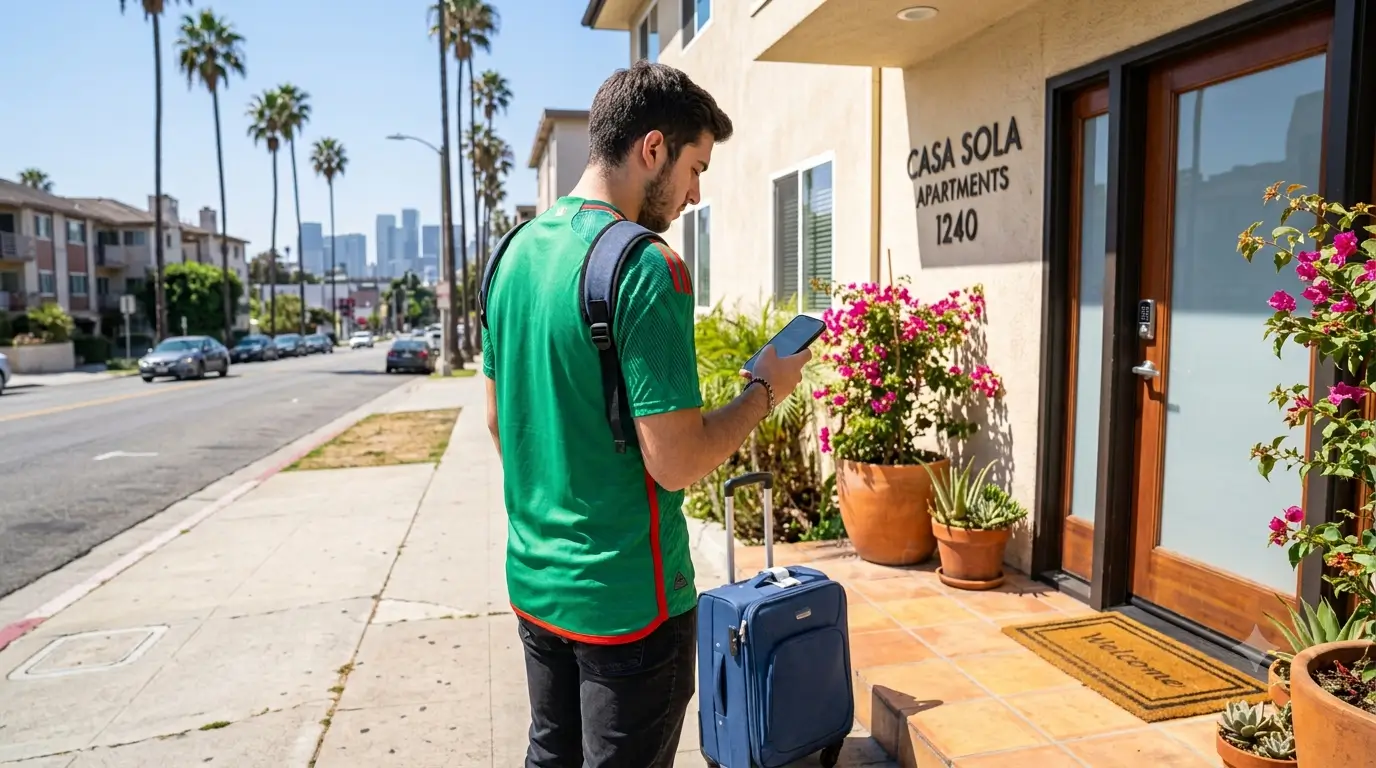
International guests arrive tired, often at odd hours, sometimes after a customs line and a two-hour drive. They're the most likely to hit a problem and the least able to call you about it, because it's 3am for you and they may not want to write a paragraph in English to a stranger.
So write the arrival section for the worst-case version of that guest:
Confirm the exact address and a landmark, with a photo of the building or gate.
Explain parking before they need it, including what to do if the obvious spot is taken.
Show the entrance and the lock with pictures, step by step, not just words.
State the access method and a backup, so a dead phone or a bad code isn't a crisis.
Give one clear way to reach a human, and say when you actually answer.
Then put a fallback behind all of it. When a guest asks something the guidebook didn't spell out, an AI concierge can answer from your own content, in their language, at the hour nobody's awake to text back. It isn't a smart lock and it doesn't check anyone in. It answers the arrival-hour question that would otherwise sit unread until morning.
A family from Monterrey messaged near midnight on their first night asking where to park their Suburban (our Washington, DC garage’s height is limited). The guidebook had already answered it in Spanish where the nearest public parking option was, and they found it before we ever saw the message.
Set expectations that travel across cultures
Small assumptions don't survive a border. Checkout time, tipping norms, whether tap water is fine to drink, how recycling works, whether shoes come off at the door: all of it is obvious to a local and genuinely unclear to someone from another country. Spell out the things you'd never think to mention to a domestic guest. It reads as thoughtful, not patronizing, when it's framed as "here's how things work here" rather than a list of rules.
The same goes for the practical stuff a traveler can't guess: which plug adapter they'll need, whether the neighborhood is walkable at night, how to get a local SIM. These are the details that turn a stressful first day into an easy one.
Orient them to the place, not just the property
A guest who flew across a hemisphere didn't come for your throw pillows. They came for the city. The hosts who earn the five-star review from an international guest are the ones who make the neighborhood legible: the coffee place that opens early, the market that's worth the walk, the dish to order and how to order it, the one scam to ignore. Local orientation is where a guidebook stops being an instruction manual and starts being the reason someone books you again next trip.
This is also the honest edge for a small operator. You can't out-spend a hotel chain on marketing. You can absolutely out-host them on knowing your own street, and a guidebook is where that knowledge lives so every guest gets it, not just the ones who happen to catch you in the driveway.
Where SmoothStay fits, and where it doesn't
We build the guest-experience layer, not the booking engine. We don't drive international demand to your listing and we won't pretend to. What we do is help you serve the guests you already get: a digital guidebook that translates itself, an AI concierge that answers in the guest's language around the clock, and QR codes and deep links so any of it is one scan away at the front door. If you run on a PMS, this sits on top of it rather than replacing it.
If you'd rather not format all of this by hand in five languages, you can have a translated digital guidebook running in about an hour, ready before your next international check-in.
FAQ
How do I host guests who don't speak English?
Put the information they need in their own language rather than relying on them to translate yours. A digital guidebook with automatic translation covers the wifi, the door code, checkout, and house details in 100+ languages, and an AI concierge can answer follow-up questions in the guest's language when you're asleep. You don't have to be fluent; your content does.
Where are international Airbnb guests coming from in 2026?
Per AirDNA's 2026 Midyear Outlook, US inbound international demand is down about 12% versus last spring overall, but the mix is shifting toward Latin America. Argentina, Brazil, and Mexico are up against 2024, with Brazil and Argentina leading, while Canada (down about 32%) and parts of Western Europe have fallen. The numbers are US-only and come from AirDNA, which sells STR analytics.
Is the 2026 World Cup bringing more international guests?
In host markets, yes. The tournament is underway through July 19, 2026, across 16 cities in the US, Canada, and Mexico, and AirDNA reports it's lifting demand and pricing near host cities. Because it's co-hosted with Mexico, expect a heavier Latin American share of those arrivals, an effect that started before the tournament and won't disappear when it ends.
Do I need to translate my whole listing?
Translate what guests actually use during the stay first: arrival instructions, house details, and local tips. Airbnb and Vrbo handle some listing translation automatically, but the operational content, the part that prevents late-night messages, is usually where the gap is. That's the content worth getting right in every language your guests speak.
How do I handle check-in with a big time-zone difference?
Write arrival instructions that don't need you online: address with a photo, parking, entrance and lock shown step by step, an access method plus a backup, and one clear contact with your real response hours. Then add a fallback that answers questions automatically, so a guest arriving at 3am your time isn't stuck waiting for you to wake up.
Is international demand actually recovering?
It's uneven. AirDNA's data shows total US inbound international demand still below last year, dragged down mainly by Canada and Western Europe, while Latin American and several Asian markets are growing. So "recovery" depends entirely on which source markets feed your area. Treat it as a shift in composition, not a simple rebound.
Last updated: July 1, 2026. Market figures are from AirDNA's 2026 Midyear Outlook, which measures US inbound short-term rental demand by traveler origin. AirDNA is a short-term rental data provider; figures are theirs and reflect their methodology.
Latest articles

How to Automate Check-In Instructions for Short-Term Rental Guests
Automate check-in instructions for short-term rental guests: the four-send sequence, what goes in a message versus a guidebook, and a copy-ready sample.

Vrbo Premier Host in 2026: Every Listing Now Stands on Its Own Record
Vrbo Premier Host requirements changed in 2026: per-listing scoring, tighter thresholds, quarterly checks. What each one means, and how it compares to Superhost.
Booking.com Guest Messaging Rules: What Hosts Can Send, When, and Why Links Get Removed
Booking.com guest messaging rules, verified at source: how long you can message a guest, why your links get removed, and what the partner terms say.

Vrbo's New Features for Fall 2026: What's Live, What's Gated, and What's US-Only
We sorted Vrbo's new features for fall 2026: what is live globally, what is gated behind eligibility, and what is US-only. Verified against Vrbo's own pages.