How to Handle Last-Minute Bookings Without Turning Every Arrival Into a Scramble

Published
Last updated

Booking windows and stays are shrinking in the U.S., so hosts must rely on automated systems—especially a platform‑agnostic digital guidebook and AI concierge—to deliver all guest information instantly at booking. Implementing these tools eliminates the scramble of last‑minute arrivals and ensures smooth turnovers without manual effort.
How do you handle last-minute bookings?
You handle last-minute bookings by having systems that make a guest ready to arrive the moment they book, instead of onboarding each one by hand. When someone books two days out instead of six weeks out, there's no runway for a slow, manual welcome. The access details, wifi, directions, and house rules have to deliver themselves the second the reservation confirms. A digital guidebook and an AI concierge do that front-loading for you, so a short timeline doesn't turn into a rushed or half-finished stay.
That's the whole shift in one line: less time before arrival means your systems, not your evenings, carry the load.
Why last-minute bookings are becoming the norm
This isn't a hunch. AirDNA, the analytics company that tracks short-term rental performance, put numbers on it in its 2026 Midyear Outlook (published July 7, 2026). Guests are booking closer to arrival and taking shorter trips, and the compression shows up across nearly every kind of market. In cities it's sharpest: AirDNA found urban booking windows tightening to roughly two to three weeks, the shortest stretch since the pandemic.
One caveat worth stating plainly. AirDNA's data here is US-only, and AirDNA sells market analytics for a living, so a report telling hosts to watch the market closely is partly a report telling hosts to watch AirDNA. The trend still matches what any host has felt in their own inbox, but read the specific figures as US numbers, not a global law.
For a host, the takeaway is simple. The calendar fills later than it used to, and the gap between "you have a booking" and "they're at the door" keeps shrinking.
The real problem isn't the short notice. It's doing everything by hand.
A last-minute booking only hurts when your process depends on you being available. If getting a guest ready means you personally writing out the door code, texting the wifi, explaining where to park, and fielding three follow-up questions, then a two-day window is a genuine problem. You might be at work, asleep, or three time zones away when it lands.
In the early days, a booking once came in for our Tulum studio the night before arrival, while we were out to dinner, and we spent the meal texting check-in details one message at a time between courses.
The fix isn't to move faster. It's to stop being the bottleneck. When the information a guest needs already sits somewhere they can reach it, the booking window barely matters. Six weeks or six hours, the guest gets the same complete welcome, because the welcome doesn't wait on you.
Systems beat speed: what to put in place before the next one lands
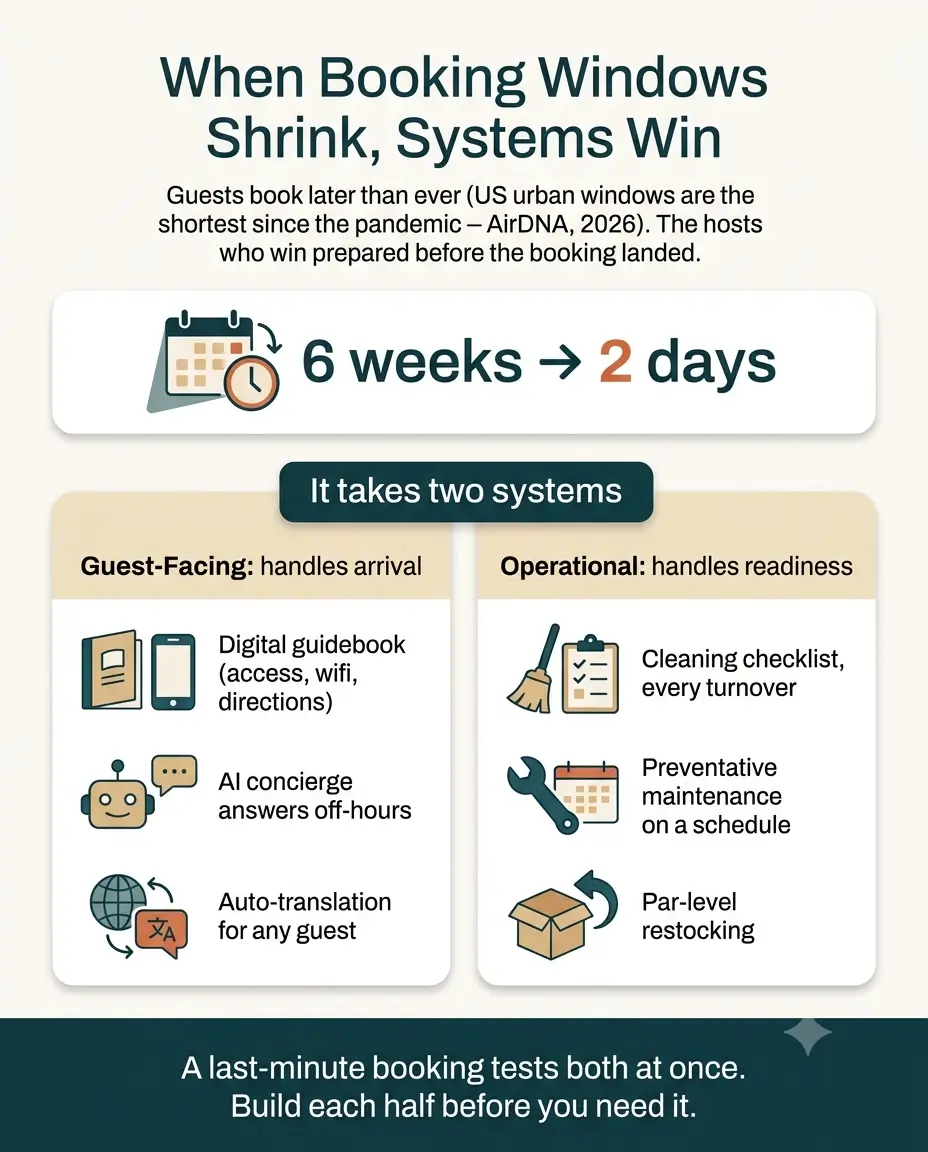
Guest-readiness is a stack, not a single tool. Pricing software sets the rate. Your PMS or channel manager handles the reservation. A cleaner keeps the turnaround tight. And a guidebook carries the guest's actual arrival. No one piece does the whole job, and the guidebook part is the one many hosts still do manually, one text at a time.
Here's what matters about a guidebook in this context: it's platform-agnostic. It doesn't care whether the booking came through Airbnb, Vrbo, or your own site, and it works whether or not you run a PMS. That counts double for last-minute bookings, because the ones that surprise you often come through a channel you check less often.
Map the friction points and solve each one before it happens, not after the guest texts:
Last-minute friction | What the guest needs | How a system handles it |
|---|---|---|
Booking confirms at 9pm | Access and arrival info, now | A guidebook link in the confirmation, ready the instant they book |
Guest lands before you've messaged | Door code, parking, wifi | Self-serve content they open on their own phone |
A question at midnight | A fast, correct answer | An AI concierge that replies from your guidebook |
Guest reads another language | The same info, readable | Automatic translation, no second version to write |
Back-to-back turnovers | No time for a custom welcome | One guidebook that serves every guest the same way |
The pattern is the point. Every one of those is a job you'd otherwise do live, under time pressure, and every one can be set up once and left to run.
The turnover is the other half of the job
Shorter stays don't just mean more bookings. They mean more turnovers, stacked closer together. AirDNA's finding on shrinking length of stay is really a story about cleaning crews and maintenance windows getting squeezed, and that pressure has nothing to do with the guest's phone. It's the operational half of a last-minute booking, and it breaks quietly if you leave it to chance.
Three things carry it:
A cleaning checklist your cleaner runs the same way every time. When turnovers are tight, quality can't ride on who showed up or how rushed they were. A written checklist, ideally with photos of how a finished room should look, holds the standard when the clock is against you.
Preventative maintenance on a schedule, not a crisis. The things that fail at the worst moment, the AC in July, the water heater, the lock battery, the wifi router, are the ones worth checking on a routine before they strand a guest you had no time to prep for.
Par-level restocking so supplies are staged, not counted mid-turnover. Coffee, paper, linens, toiletries: know the number, keep the number, and a fast turnaround doesn't become a supply run.
This is a different lane from the guidebook. The guest-facing systems handle arrival; the operational systems handle readiness. A last-minute booking tests both at once, which is why the hosts who run smoothest are the ones who built each half before they needed it.
Where a guidebook earns its place on a tight timeline
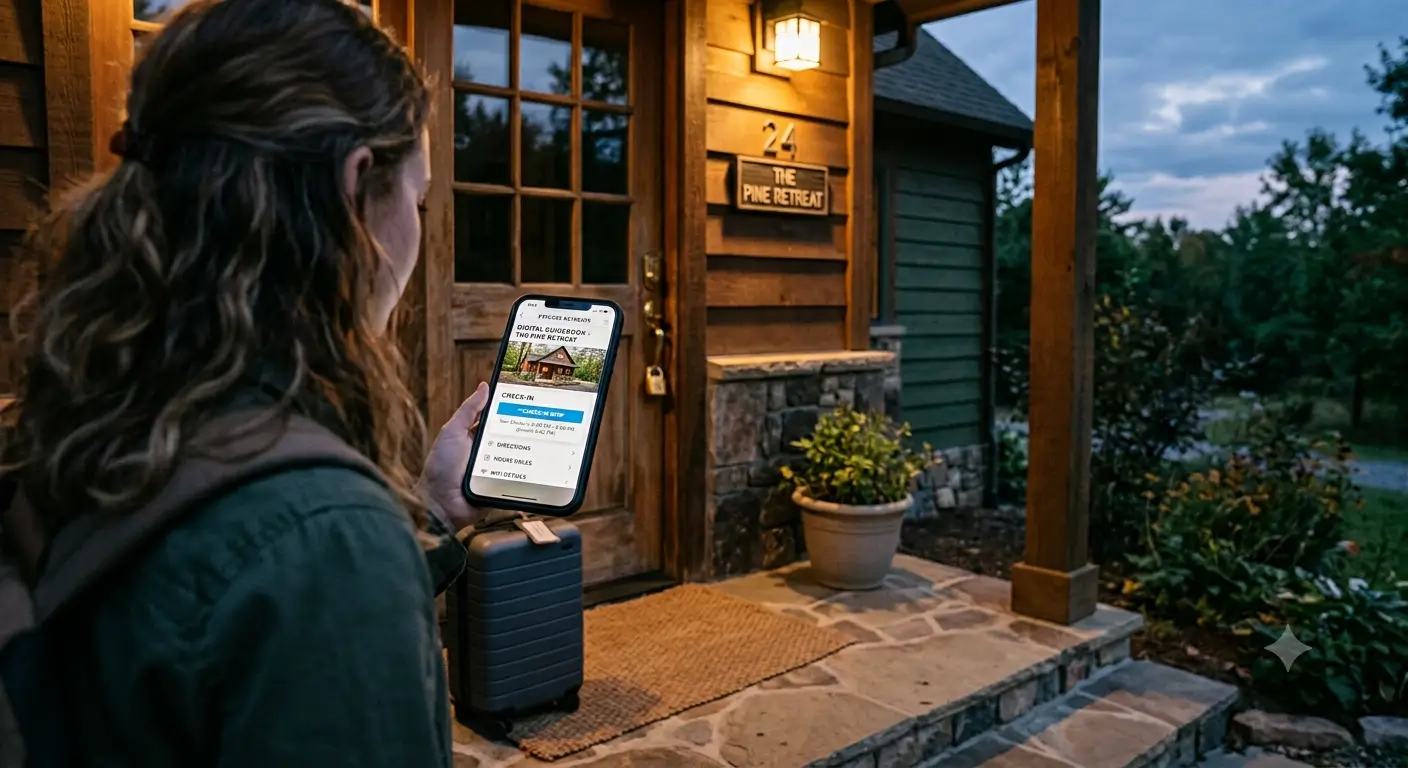
A digital guidebook is the piece that turns a compressed booking window into a non-event. You drop the link into your booking confirmation and your listing, and the guest has everything the moment they're confirmed: directions, the access method, wifi, house rules, checkout, and the local picks they'll want on a short trip. Deep links help too. You can send a guest straight to the check-in page instead of making them hunt for it while they're standing at the door.
For the questions the guidebook doesn't spell out, an AI concierge answers from your own content at whatever hour the guest asks. It only ever says what you put in the guidebook, so a 1am "which parking spot is mine" gets handled without waking you. If you want fewer of those questions in the first place, we went deep on that in how to reduce guest questions, and the same logic pays off harder when the timeline is short.
Two more pieces pull their weight on last-minute stays. Time-based reservation access lets the guidebook open to a guest around their actual dates, which keeps sensitive details from sitting exposed between bookings. And automatic translation means a guest who booked from abroad this morning reads your arrival instructions tonight in their own language, without you keeping a second copy. For the wider picture on getting guest communication right when there's no time to spare, our post on common guest questions and how to answer them covers the ground.
What doesn't fix this, and what to be honest about
You might expect the answer to be "just automate your messages." Scheduled pre-arrival texts are one approach, and plenty of tools send them. That's a real category, and not what we're describing here. Our approach is to make the information self-serve so the guest finds it, and to let the AI answer from your content when they'd rather ask.
Whatever route you pick, on a two-day timeline anything that depends on you being awake and available eventually lets you down. Build the parts that don't.
FAQ
How far in advance are guests booking short-term rentals in 2026?
Later than they used to. AirDNA's 2026 Midyear Outlook found booking windows shrinking across location types, with US urban markets tightening to roughly two to three weeks, the shortest since the pandemic. Resort and rural markets still run longer, but the direction is the same everywhere: closer to arrival.
Should I stop accepting last-minute bookings?
Usually not as long as you have systems in place. Last-minute demand is real revenue, and turning it away to dodge the scramble solves the wrong problem. The better move is to set up self-serve arrival info so a short window costs you nothing extra. Then a short-notice booking is just another booking.
How do I get a guest ready to arrive when I only have a day's notice?
Have the essentials deliver automatically the moment they book: a guidebook link in the confirmation with access, wifi, directions, and checkout, plus a way to answer off-hours questions. If that's in place, one day's notice is plenty, because you're not building anything, just pointing them to what's ready.
Do I need automated messaging to handle short booking windows?
Not necessarily. Automated messaging is one option, but self-serve content plus an AI concierge covers the same need differently: the guest pulls the information visually when they want it instead of waiting for a scheduled send. Plenty of hosts run both. Neither should depend on you being at your phone.
Does this work if my booking came through a channel I don't check often?
Yes, and that's the point of a platform-agnostic guidebook. It works the same whether the reservation came from Airbnb, Vrbo, a direct booking, or a channel you barely watch, and whether or not you run a PMS. The guest gets the same welcome regardless of where they came from.
If you'd rather not build this under pressure
Shorter booking windows aren't a crisis. They just punish hosts who onboard every guest by hand and reward the ones whose systems do it for them. You can assemble that yourself: a solid guidebook, a way to answer questions off-hours, translation for the guests who need it. If you'd rather not format all of it from scratch, SmoothStay can have a digital guidebook and AI concierge running for your place in minutes, ready to greet the next short-notice booking whether you're around for it or not.
Latest articles

How to Automate Check-In Instructions for Short-Term Rental Guests
Automate check-in instructions for short-term rental guests: the four-send sequence, what goes in a message versus a guidebook, and a copy-ready sample.

Vrbo Premier Host in 2026: Every Listing Now Stands on Its Own Record
Vrbo Premier Host requirements changed in 2026: per-listing scoring, tighter thresholds, quarterly checks. What each one means, and how it compares to Superhost.
Booking.com Guest Messaging Rules: What Hosts Can Send, When, and Why Links Get Removed
Booking.com guest messaging rules, verified at source: how long you can message a guest, why your links get removed, and what the partner terms say.
Vrbo's New Features for Fall 2026: What's Live, What's Gated, and What's US-Only
We sorted Vrbo's new features for fall 2026: what is live globally, what is gated behind eligibility, and what is US-only. Verified against Vrbo's own pages.