Glamping guests expect a real bed, hot water, light and a bathroom they understood before booking. Past that, what shapes the stay is often an amenity you already provide but never fully explain. Power that runs on hours, a tap that is not drinkable, a shared bathroom block forty metres away. This post gives you a table of the questions each amenity raises, and where the answer belongs: the listing before booking, the guidebook during the stay.
Most glamping amenity lists we read are accurate and still leave the guest guessing. The tent has power. The site has water. There is a bathroom. None of those sentences tells somebody whether they can run a hair dryer at seven in the morning, drink from the tap, or walk sixty metres in the dark in a towel.
What amenities do glamping guests actually expect?
Glamping guests expect a proper bed with linen on it, hot water they can reach without planning their day around it, light they can read by, somewhere to charge a phone, a way to make coffee, and a bathroom whose location and privacy they already understand. Past that, their expectations come mostly from your listing photos and description. In our experience the amenity that shapes the stay is often one you already provide but never fully explain.
Where we are standing: we run short-term rentals in Washington, DC and the Riviera Maya. What we bring is a decade of watching guests arrive somewhere with no reception desk and observations from our glamping users at SmoothStay. The list below comes from that angle, and your site will need rows we probably have not thought of.
What the camping data says before you spend on amenities
KOA's 2026 Camping and Outdoor Hospitality Report found that 77% of campers say "just being in nature is enough" without structured programming or additional amenities. Read it carefully before acting on it. The figure covers campers as a whole, glampers are only one part of that group, and it describes why people go camping, not a verdict on the fittings in your unit.
Worth knowing who ran it. KOA operates more than 500 franchised and owned campgrounds and owns Terramor, a glamping brand, which makes this an operator's research and worth reading alongside other industry data. We would still use the number: the fieldwork was 4,088 online surveys of US and Canadian households, run with Cairn Consulting Group and drawn from a randomly selected cross-section, not restricted to KOA camper databases.
Our read is that it reorders the amenity question instead of answering it. It suggests the fittings are less about winning the booking and more about not getting in the way of what people came for. KOA also describes glamping as the gateway for first-time campers, with 31% of new campers choosing it, and puts glamping at 29% of all camping experiences in 2025. That does not tell you what share of your bookings are first-timers, but it is a reason to stop assuming they arrive with a baseline.
Every glamping amenity comes with a question attached to it
In a hotel an amenity explains itself, because the guest has seen a hundred of them. On a site the same word can mean five different things.
Amenity | What a first-timer may assume | What is worth stating plainly |
|---|---|---|
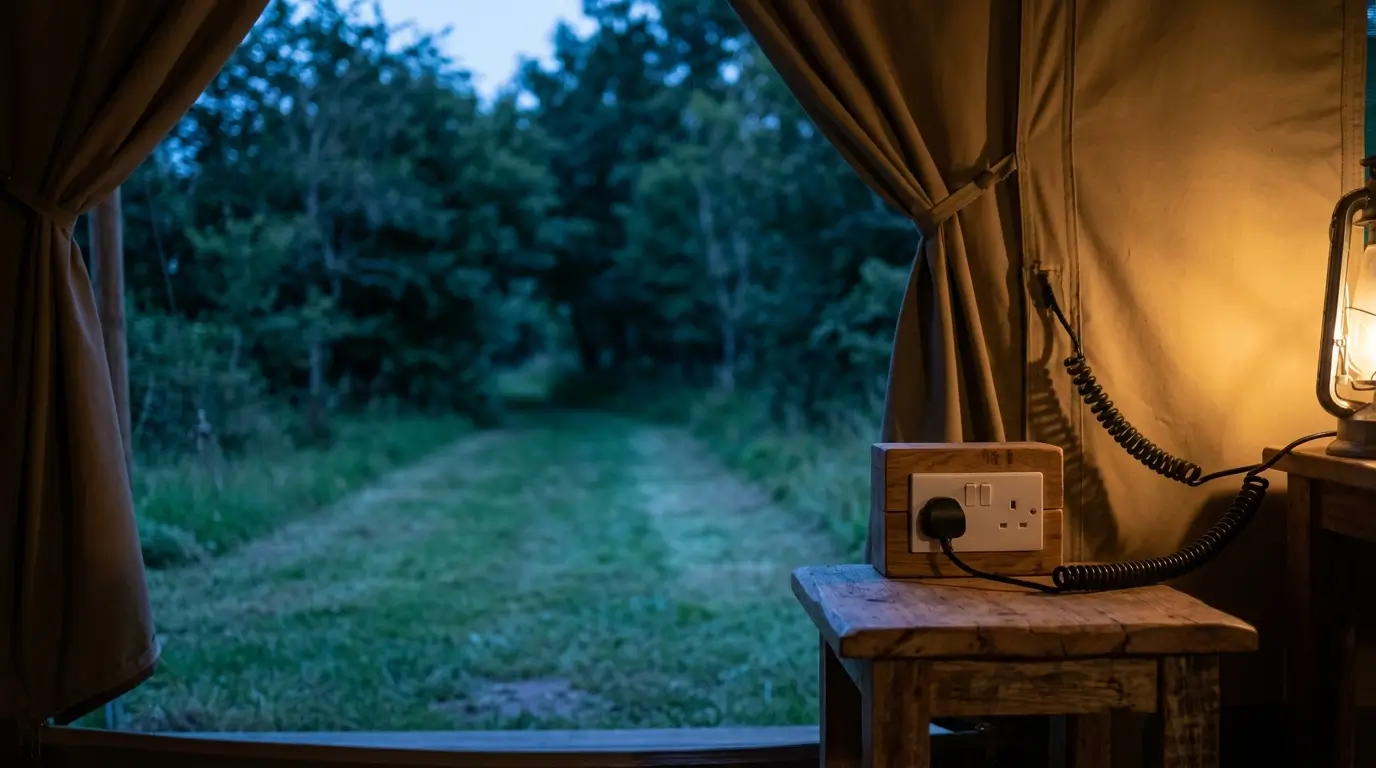
Power | A socket by the bed, live all night | What supplies it, what hours it runs, what it will not carry |
Drinking water | The tap is drinkable | Whether it is potable, and where drinking water is if not |
Heating or cooling | A thermostat on the wall | What heats or cools the unit, how to work it, what it will not reach on a cold night |
Bathroom | Private, attached, a few steps away | In the unit or shared, how far, and whether the path is lit |
Hot water | It does not run out | How it is heated, and how long it takes to recover between showers |
Kitchen and coffee | A kettle and a hob at minimum | What is in the unit, what is shared, and whether you supply coffee |
Lighting | Switches on the wall | Mains, solar or lantern, and whether they need a torch for the path |
Signal and wifi | A couple of bars at least | Which carriers work, where on the site, and whether there is wifi at all |
Bedding and towels | Made up the way a hotel does it | Made up or bagged, towels included or not, where the spare blankets are |
Every row is something you already own. Filling in the third column costs an afternoon and no money.
Air conditioning is the word we watch on our own listings. At our Playa del Carmen house it means mini-splits a guest sets room by room. At our Washington, DC row house it means two ageing central zones that behave nothing like that. Two identical words on two listings, two completely different sets of instructions, and the guest finds out which one they have after they arrive. A glamping unit has that problem across most of the table, where a house has it in one row.
Fire rules, wildlife and after-dark terrain belong in the same habit, covered in the glamping guest experience. Whether a bigger purchase pays is a separate question that turns on your local market, which we worked through in what guests want and which amenities they notice.
The listing sets the expectation. The guidebook runs the stay.
The listing is read before money changes hands, which is why it carries what exists, what does not, the distances and the honest limits. A guest who books knowing the bathroom is a shared block forty metres away has agreed to that, and a guest who finds out on arrival has not. That kind of surprise is the sort of thing that ends up in a review.
The guidebook is read during the stay, so it carries how each thing works, at what hours, and who to call, plus the answers that would otherwise arrive as a text message at ten at night.
One caution on the listing half, from our own experience. Before a stay at our Playa del Carmen house, a guest told us they had a dust allergy. We had described the setup in the listing, but a disclosure sitting in a listing is not the same as the guest having read it, and we heard nothing back either way, which we should not have taken as confirmation. We now assume the important limits need saying twice, once where guests book and once where they arrive.
Keep that information somewhere you own, outside any single booking channel. Glamping units get listed in several places at once, and three descriptions drift apart faster than one you maintain and link each channel to.
Write a "what we provide, what to bring" list
This is the section we would write first, and it takes about an hour. Two short lists, published in both places.
What we provide. Bed linen and towels, or a plain line saying guests bring their own. Pillows and blankets, with the count and where the spares live. Lighting and what kind. Power, with the hours. Water, and whether it is drinkable. Cooking equipment, down to whether there is a pan and a sharp knife. Coffee and how it gets made. Heating or cooling. The bathroom and its arrangement. Anything you leave as a welcome touch, which reads as a gift once it is named.
What to bring. A torch or head torch. Warm layers for the temperature after dark, with the actual number. Any toiletries you do not stock. Food and drinking water if there is no shop nearby. A power bank if the electricity runs on hours. Footwear for the ground guests will actually walk on.
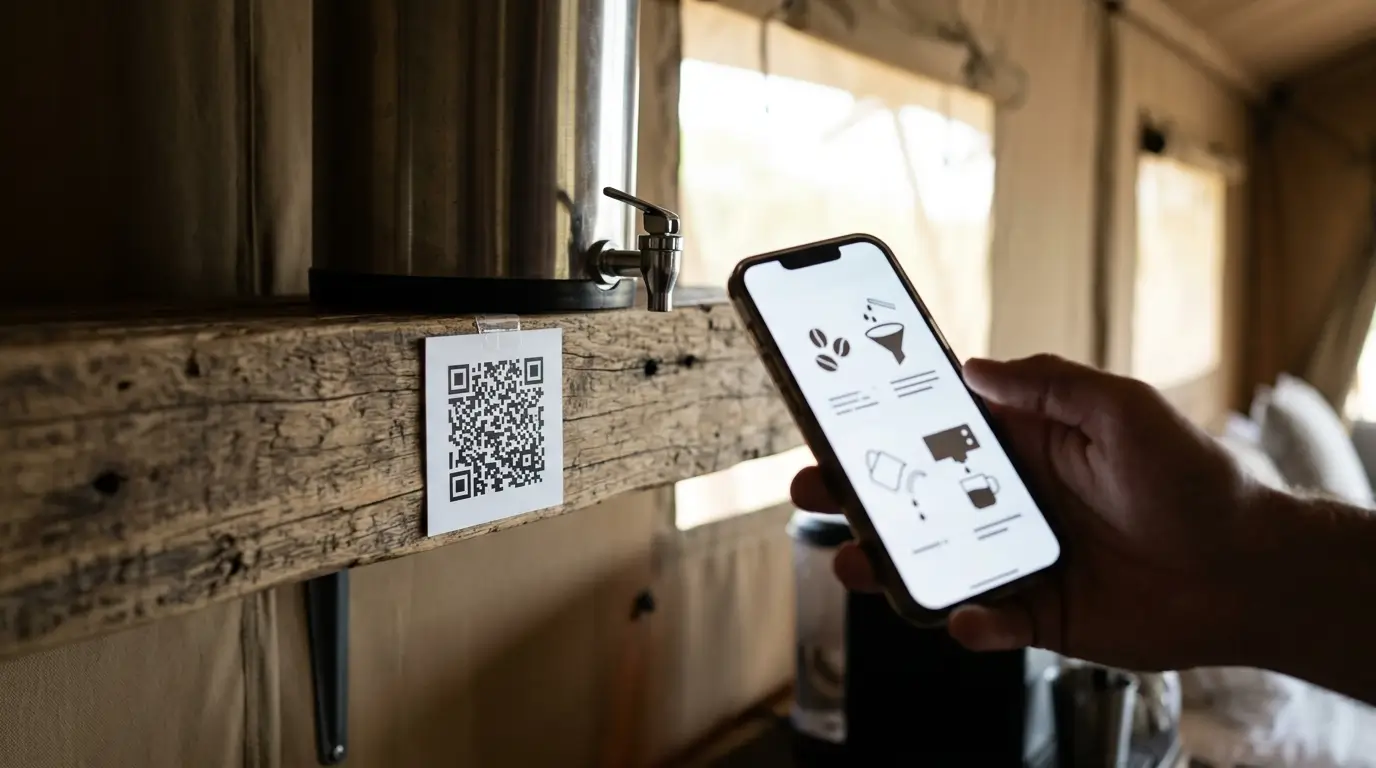
Then put each answer at the spot where its question comes up, as well as in the contents list. A code stuck beside the water filter at one of our properties settled a question a whole article about the filter had not, because the guest was standing in front of the object when they wondered. Printed labels at the stove, the water point and the bathroom path do the same job.
Our guide to what belongs in a campsite guide book covers the contents in full, and campground rules that guests actually follow covers the wording for quiet hours and fire.
FAQ
What do first-time glampers get wrong most often?
They assume the unit works the way a hotel room does: power live all night, a drinkable tap, hot water that does not run out, a bathroom a few steps away with a lit path to it. Each is a safe assumption in a hotel and much less predictable on a glamping site. Answer those four in writing before anybody has to ask.
How do I describe a shared bathroom without losing bookings?
State it early, give the distance in metres, and say what the path is like at night. Guests who do not want a shared block will rule themselves out early, and the ones who book arrive knowing what they agreed to.
Should we provide bedding and towels?
If you are selling glamping rather than camping, yes, and made up on the bed. If you cannot, say so in the listing in plain words instead of leaving it off the amenity list.
What do we tell guests to bring?
A short, specific list: a torch, warm layers with the real overnight temperature attached, footwear for your actual ground, a power bank if your electricity runs on hours, and food or water if the nearest shop is a drive away. Naming five things is what gets them packed.
Is it better to over-promise on amenities or under-promise?
Describe accurately and let the site sell itself. In our experience the complaints that stick are about the gap between what was described and what was there, and a modest setup described honestly rarely draws one.
Where to put the two lists
A printed card, a shared document or a digital guidebook will all do this job. If you would rather not type the amenity list out again, SmoothStay builds a starter guidebook from an existing listing URL and pulls the property details, photos and public amenities across with it, which leaves you the second and third columns to write. Connecting a Hospitable account brings your amenities across too, and every confirmed reservation gets its own guidebook. Put a QR code on the unit, with deep links that let a code at the stove open the stove article. The builder, the guidebook, the QR codes and the deep links are all on the free tier, one unit, no card needed. The AI Concierge, which answers follow-ups from what you have published and only from that, sits on the paid plans alongside the Hospitable connection. The guidebook needs a live connection to open, so send the link ahead of arrival while guests still have signal, and leave a printed card in the unit for the essentials.
Latest articles
Hotel Guest Data Privacy: The Process We Made for Our Own Properties
Hotel guest data privacy from the operator's side: the list we made for our own properties, what travelers say about consent, and a statement you can copy.
How to Word Airbnb Fees and Fines for Guests
How to word Airbnb fees and fines for guests so they inform instead of accuse: what Airbnb counts as a fee, where each number goes, and 7 examples to copy.
What Many Guests Do First When They Arrive
What guests do first when they arrive: the sequence we keep seeing, what goes wrong at each step, and why a QR code at the object beats another page.

Airbnb Hotels and Hosts: What the First Numbers Show, and What They Don't
Airbnb says a third of first-time hotel guests come back to book a home. What that data shows for hosts, what it doesn't, and why it is too early to act on it.