
Airbnb is piloting host-shareable booking links that cut the service fee to a reported 6% or 10%, with nothing official published about it. The link sits in your Listing editor, you share it, the guest books on Airbnb as normal. So far as anyone outside the pilot can see, the fee is the difference. You stop paying for demand and keep paying for the checkout and the protection. What you can do with that guest afterward does not change.
Some hosts opened an email from Airbnb last week offering a lower service fee on bookings they bring in themselves. The coverage since has been sharp and all of it written for an operator running fifty units or more. We run five listings between us, we have not been offered one, and the arithmetic at our scale comes out differently.
What are Airbnb's direct booking links?
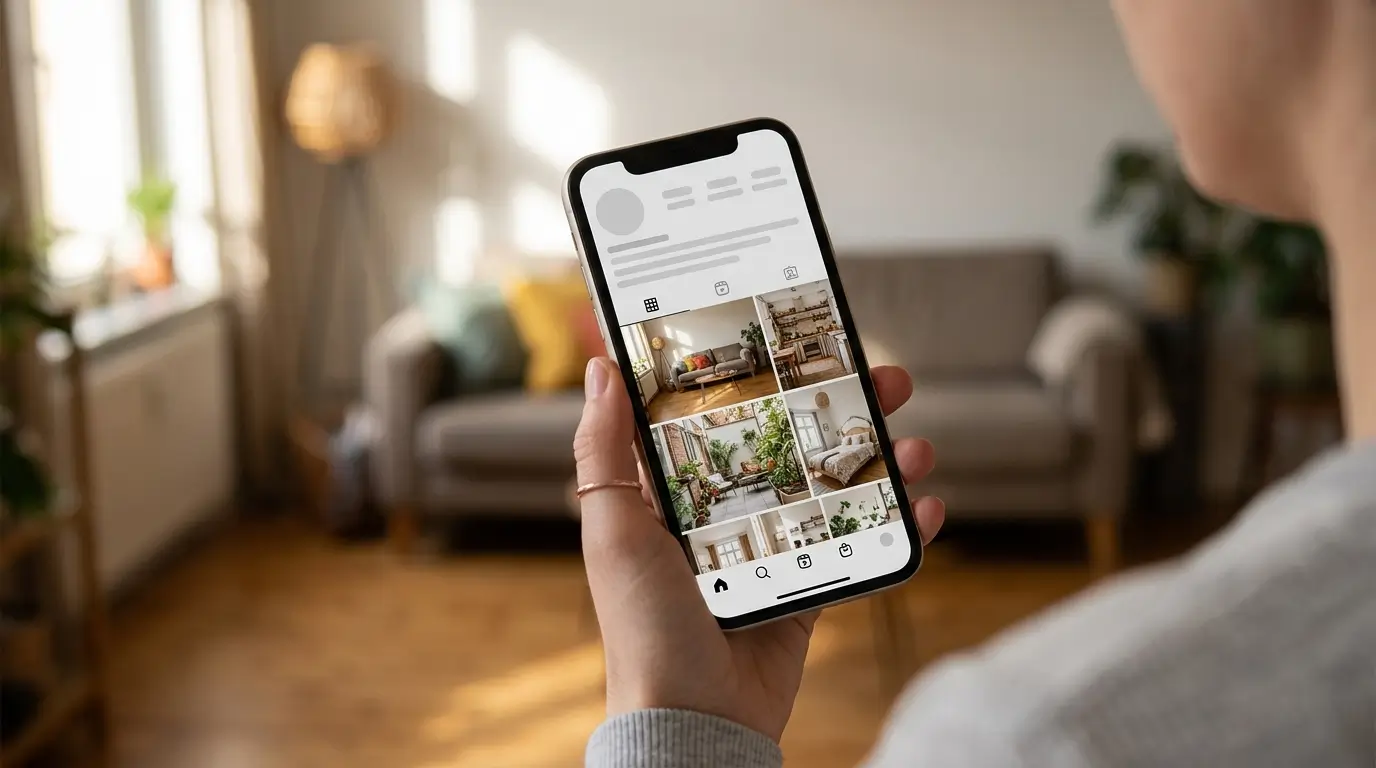
A direct booking link is a link to your own Airbnb listing, generated in the Listing editor, that you share yourself. Reservations arriving through it are reportedly attributed to you as host-referred, and Airbnb charges a lower service fee on them. You put it wherever you already talk to people: an Instagram bio, a newsletter, a reply in a Facebook group. The guest clicks it, books on Airbnb exactly as they would otherwise, pays Airbnb and keeps AirCover. What that changes, so far as anyone outside the pilot can see, is the fee: hosts in it report Airbnb taking 6% or 10% instead of the standard 15.5% host-only fee. Airbnb has published nothing official about any of it: no help center article, no newsroom post, no terms page.
What is actually being reported
Skift reported on 29 August that Airbnb had sent some hosts a message titled "Share your link, get a lower fee," saying the links were now available in the Listing editor, that shares through social media, email and message boards qualify, and that the bookings still take place on Airbnb with its usual benefits including AirCover. Scott Eddy, writing in PhocusWire the next day, put a number on the variance: some hosts in the test report paying 6%, others report 10%. Nobody has explained the gap. Bloomberg's 31 August headline places the pilot in the US at those same two rates.
What it would look like if you got the email
This is a pilot, not a launch, its provenance is screenshots in Facebook groups that we are not going to republish, and we are not in it. On what has been reported, the shape for a host with a handful of listings:
The link lives in your Listing editor. Whether it is per listing or per account is not stated.
You share it yourself. Skift names social media, email and message boards. Anything beyond that is unstated.
The guest books normally. Your usual listing page, Airbnb's checkout, Airbnb's payment, AirCover intact, the same review afterward.
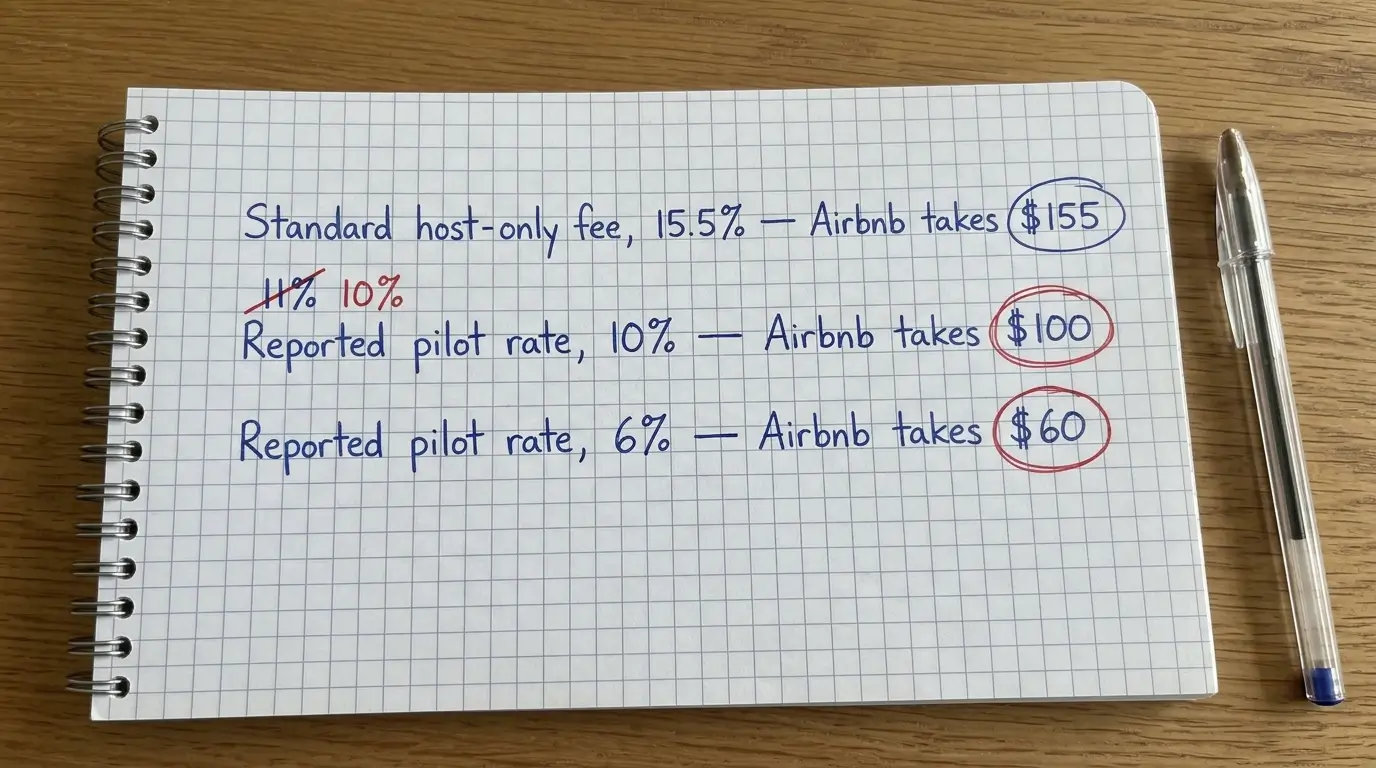
The fee on a qualifying booking drops. On a booking where your side totals $1,000, 15.5% is $155. At 10% it is $100 and at 6% it is $60.
A guest-facing discount is reportedly in the same editor. Who absorbs it is undocumented, and one you fund yourself could give back most of step 4.
Eligibility, expiry, caps, and how a click gets attributed if the guest wanders off and books a week later, are all unpublished. Beyond the fee, no account of the pilot describes anything else changing: no new inbox, no extra detail about the guest, the same work during the stay. That is what hosts have seen so far in an unfinished pilot. Attribution reporting, link analytics and controls over the guest discount are all things a platform normally builds around a feature like this, and any of them could appear without notice.
So what is the fee actually buying?
Read plainly, the deal is that you do the marketing and Airbnb discounts its cut for it. Which raises the obvious question: if you found the guest, what is the remaining 6% or 10% paying for?
Airbnb's standard fee bundles two things and this pilot unbundles them. One is demand: the search results, an app full of people who have never heard of you. The other is the transaction: checkout, payment processing, chargeback and fraud exposure, AirCover, dispute handling when something breaks, and a guest who already has an account and does not think twice about entering a card. Bring your own demand and you stop paying for the first while still buying the second, which for a lot of guests is the reason they booked at all.
Scott Eddy makes the same split in his PhocusWire piece:
If the host finds the customer but that traveler still wants Airbnb involved, Airbnb should get paid for the technology, protections and trust it provides. Those are different services.
The other side of it is worth naming. A host sharing that link also hands Airbnb a customer who might have booked somewhere else, and an account is worth more to Airbnb than one reservation.
The cost math in the coverage was built for a bigger operator than you
SCALE Wire published an analysis on 29 August pricing what an independent direct booking costs a professional operator: payment processing, third-party screening and damage waiver, and a booking engine with hosting. Their total is 5.5% to 7%. Worth knowing who published it, since SCALE also runs a vendor directory covering that same stack. Their conclusion, that Airbnb priced the link at roughly the cost of your own stack, follows at 6%.
Read their advice section, though. It tells operators to contact their PMS provider about dual-rate ledger attribution and to halt automated owner payouts pending an audit. That is an article for somebody with owner statements. At three listings, the cost stack underneath it is not yours.
Cost line | Professional operator, per SCALE Wire | One to twenty listings |
|---|---|---|
Payment processing | Stripe or Adyen, 2.9% plus a fixed fee | Same rate. Stripe publishes 2.9% plus $0.30 per successful domestic card charge |
Screening and damage waiver | 1.5% to 2% through a third-party product | Often not carried at all, in which case it drops out of the total |
Booking engine and hosting | 1% to 2% | A fixed subscription, so the percentage depends entirely on how many bookings you take |
The left column is SCALE's costing. The right is our reading of it, not a second study. Read that way, the variable half of the stack is cheaper for a small host and the fixed half is where it bites: a booking engine subscription spread across four hundred reservations disappears into the noise, and across forty it does not.
Two lines never make it into anyone's stack. Replacing damage and liability protection means a paid product or a deposit-and-agreement workflow you run yourself, which is money and an evening of admin per incident. And demand: an independent site produces guests only after a year or two of feeding it, the honest timeline in our own direct bookings post.
So which rate you are offered decides most of it, and nobody can tell you that yet. At 6% a reduced-fee link competes with going independent for a low-volume host once fixed costs and cover are counted, which cuts against what we had assumed. At 10% it gets less compelling on SCALE's numbers, since that sits above the top of the range they modelled. Numbers are not all of it either, for the reasons in the last section: what you keep buying at 10% is the same protection you keep buying at 6%, and none of it shows up as a percentage. Our read is that at high volume independent still wins on either number.
The fee moves, and what you can do with that guest afterward does not
Does the off-platform policy cover these bookings? Airbnb has not said, so here is the reasoning, not the assertion. The Off-Platform and Fee Transparency Policy is scoped to hosting on Airbnb generally, opening "By hosting on Airbnb, you agree to abide by our terms and policies." It names no exception for links a host shares, and a link-originated booking is an Airbnb booking on every account of it. So the working assumption has to be that it applies unchanged. That is an assumption rather than something Airbnb has confirmed, and it is the safe one to plan around. What the policy actually restricts, clause by clause, is in the direct bookings post.
The plumbing looks unchanged too. That same policy still names Airbnb's messaging system and its email alias as the channels a host has, and nothing reported so far suggests a link-originated booking hands over more than an ordinary one. That is a reasonable inference, not a documented fact, and it is how we would plan until Airbnb says otherwise.
Which is the part we keep coming back to. In our experience the guest relationship does not get settled at checkout on either channel. It gets settled during the stay, and whether it holds afterward depends on having a compliant way to reach that person later. Changing the fee number does not touch any of that.
It is also where SmoothStay honestly belongs in this post. Guest Registration captures name, email, phone, language and country from guests who choose to register, each consenting for themselves, which is how a double room can yield several contacts where the booking yielded one. OTA Compliance Mode handles the channel difference: on an OTA-restricted link the marketing opt-in never appears, and hiding the form entirely there is a separate setting. Reservation links carry that restriction automatically; a general link you share through a channel you set to Restricted yourself. Activating the widget needs your own privacy policy URL, your legal obligation rather than our rule. Contacts export by CSV or webhook into your own email tool, since we do not send guest email ourselves, and it runs the same on every channel you list on.
Where we would actually use one
We are reading this from the outside like everyone else. No email, no toggle in our Listing editor, five listings across Washington, DC and the Riviera Maya. If one appeared tomorrow: cold social traffic, without much hesitation. Someone who found the property on Instagram and has never stayed with us gets the platform's checkout and its protections, worth something real to a first-time guest. Repeat guests are different. Those people are the asset, and a few points on one booking is a thin reason to run them back through a channel. One placement worth clearing with Airbnb first is the guidebook. Nothing in the policy appears to prohibit pointing a guest back at Airbnb, but the language predates all of this.
FAQ
Is the Airbnb direct booking link fee 6% or 10%?
Hosts in the pilot report both. PhocusWire reported the two figures side by side, and no source explains what decides which one a host sees. Until Airbnb documents it, treat any single number as unconfirmed.
Has Airbnb officially announced direct booking links?
No. As of 1 September 2026 there is no help center article, no newsroom post and no terms page. What exists is a message to selected hosts, screenshots of it, and trade coverage of both.
Does Airbnb's off-platform policy apply to a booking from my own link?
Airbnb has not said. The policy is scoped to hosting on Airbnb generally and names no exception for host-shared links, and the booking itself runs on Airbnb, so the working assumption is that it applies unchanged. Treat that as an assumption, not a documented answer, and plan around it either way.
Should I stop building a direct booking site because of this?
Nothing here is a reason to stop. A pilot with no published terms is thin ground for a strategy, and the case for demand you generated yourself never rested on the fee number.
The part that outlasts the fee number
Whatever rate this settles at, Airbnb sets it and you find out by email. What happens between check-in and checkout is the part you actually run. If you would rather not build the guidebook, the registration flow and the consent handling yourself, you can have all three running in minutes on a 14-day trial, no card needed.
Sources, all reviewed 1 September 2026: Skift, 29 August; PhocusWire, 30 August; SCALE Wire, 29 August; Bloomberg, 31 August; Stripe's published US pricing; and Airbnb's Off-Platform and Fee Transparency Policy. This is an undocumented pilot and the details may change without notice.
Latest articles

How to Automate Check-In Instructions for Short-Term Rental Guests
Automate check-in instructions for short-term rental guests: the four-send sequence, what goes in a message versus a guidebook, and a copy-ready sample.

Vrbo Premier Host in 2026: Every Listing Now Stands on Its Own Record
Vrbo Premier Host requirements changed in 2026: per-listing scoring, tighter thresholds, quarterly checks. What each one means, and how it compares to Superhost.
Booking.com Guest Messaging Rules: What Hosts Can Send, When, and Why Links Get Removed
Booking.com guest messaging rules, verified at source: how long you can message a guest, why your links get removed, and what the partner terms say.
Vrbo's New Features for Fall 2026: What's Live, What's Gated, and What's US-Only
We sorted Vrbo's new features for fall 2026: what is live globally, what is gated behind eligibility, and what is US-only. Verified against Vrbo's own pages.