

Guest registration for short‑term rentals lets hosts collect essential guest details—name, contact info, and consent—while staying compliant with local laws and OTA rules that restrict data collection on platforms like Airbnb. Using SmoothStay’s channel‑aware widget, hosts can automatically hide prohibited fields on OTA links and build a clean, consent‑based contact list for direct bookings.
What is guest registration for short-term rentals?
Guest registration for short-term rentals is the practice of collecting each guest's details, name, contact information, country, and sometimes ID, and keeping a record of who stayed and when. It quietly does two different jobs that people tend to lump together: meeting a legal duty to report guests to local authorities, and building your own consent-based contact list so you don't rent your guest relationships from a booking platform forever. It is not screening or vetting. You're recording who's staying, not deciding whether to let them in.
We run properties in Washington, DC and across the Riviera Maya, plus two we co-host for other owners in Mexico. Guest registration is one of those chores that sounds trivial until you learn a booking platform can penalize you for doing it the wrong way, and a local authority can fine you for not doing it at all. Getting both halves right is mostly a matter of keeping them separate.
Two things people mean by "guest registration"
The phrase pulls double duty, and the overlap is where hosts make expensive mistakes.
The first meaning is legal. A growing list of countries and cities now require you to report your guests to a government system, often within 24 hours of arrival. Spain runs this through its national police SES Hospedajes platform, Italy through Alloggiati Web, and the EU's short-term rental regulation adds monthly platform reporting on top from May 2026. This kind of registration usually wants ID or passport data, and the specifics change completely depending on where your property sits.
The second meaning is commercial and operational. It's collecting a guest's name, email, phone, language, and country for your own records, so you can reach them again, understand who's actually staying, and build a direct-booking list you own outright. No government involved. Just good hosting that happens to be good business.
Different problems, different tools. The rest of this post keeps them apart on purpose.
What guest information should you collect?
For your own records, less is more. Every extra field is one more reason a tired guest abandons the form before finishing. Collect what you'll actually use, and nothing you won't.
What to collect | Why you'd want it | Consent note |
|---|---|---|
Name | Personalize messages and match the guest to the reservation | Basic, low-friction |
The one field a direct-booking list can't live without | Needs clear marketing opt-in if you'll email offers | |
Phone | Reach a guest fast during the stay | Optional; ask only if you'll use it |
Country and language | Serve the guidebook in their language, understand your mix | Low-sensitivity, useful for hosting |
Marketing opt-in | Permission to email them later | Must be explicit, timestamped, and never pre-ticked |
Government ID | Only where a law requires reporting it | Handle under that law's rules, not for casual collection |
Notice that ID sits alone at the bottom. For your own list you almost never need it, and collecting it "just in case" creates a data-protection headache you don't want. Ask for a passport number only when a statute actually tells you to.
The OTA rules you can't ignore
Here's where good intentions get hosts suspended. If your booking came through Airbnb, you are not free to collect whatever you like, however you like.
Airbnb's Off-Platform Policy bars you from soliciting a guest's email or other off-platform contact through Airbnb's messaging after a booking, and from asking guests to fill out forms that let you contact them directly. Asking for a copy of a guest's government ID before arrival isn't allowed either, unless it's genuinely required for a legal or compliance reason that you can verify and that you've spelled out in your listing. Penalties run up to removal from the platform. Vrbo and Booking.com enforce their own versions of the same idea: the channels don't want you lifting the guest relationship off their rails.
So the practical rule is channel-based. What you can ask a direct guest, you frequently can't ask an Airbnb guest. Your registration setup has to know where the booking came from, or you're one marketing checkbox away from a warning.
How to register guests without tripping the platform
The classic mistake is running one registration form for everyone. A marketing opt-in that's perfectly fine on your own website becomes a policy violation the moment it shows up on an Airbnb link.
The fix is to make collection channel-aware. The form should change based on the booking source, not the arrival date or the time of day. On a link you shared through Airbnb, the marketing opt-in shouldn't render at all, and you may want to hide the whole form. On your own direct link, it works exactly as you set it up.
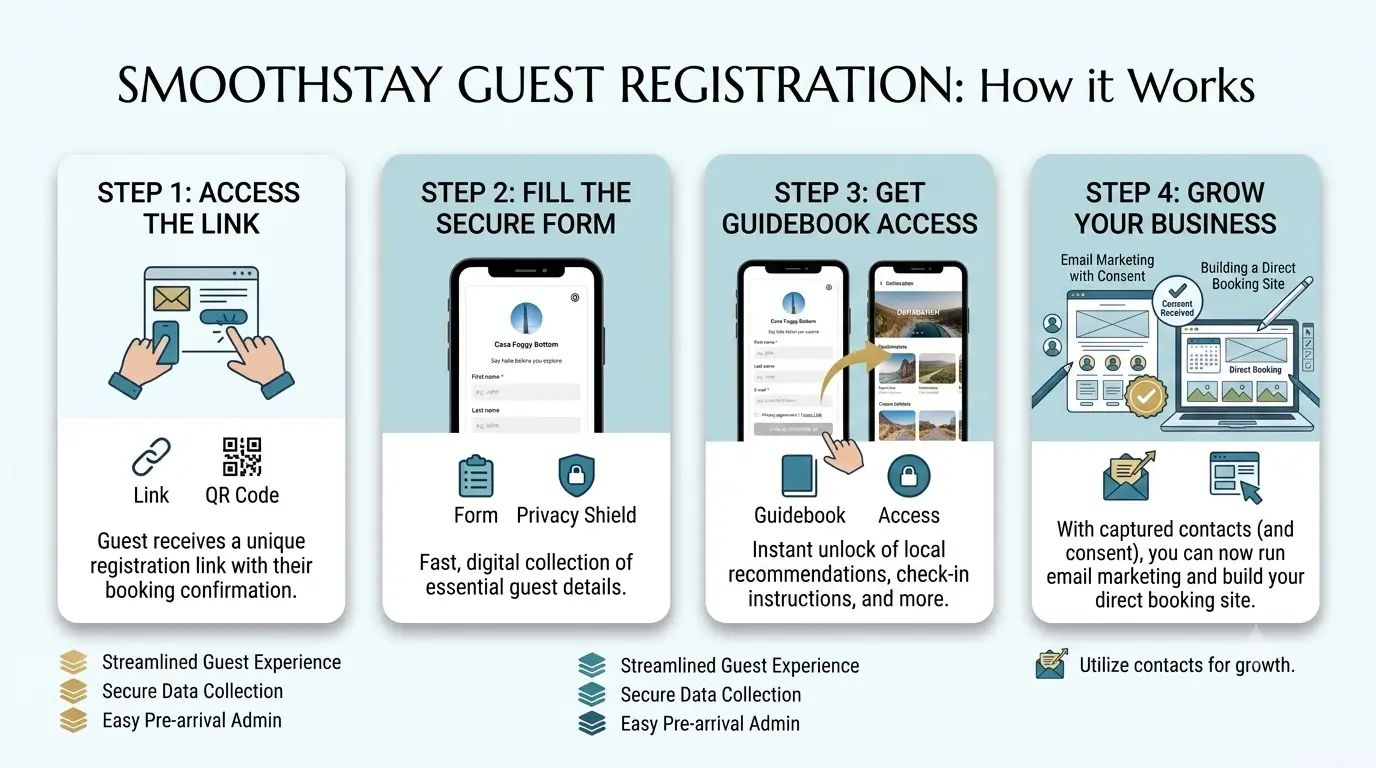
That gating is the entire job of our OTA Compliance system. It recognizes the channel a reservation or share link came from based on your settings and reservation details, and adapts what the guest sees, across the whole platform rather than as a single checkbox you have to remember to flip. Our Guest Registration widget plugs straight into it: it captures name, email, phone, language, and country when a guest opens the guidebook, and on OTA-restricted links the marketing opt-in never appears. On your direct links, you build a clean, consent-based list. The gate is the booking source, and only the booking source.
Every guest who registers lands in your Contacts, which you can export to CSV and email through your own marketing tool whenever you're ready. It's your list to keep.
Consent and a privacy policy aren't optional
If you're collecting personal data, consent has to be real: an explicit opt-in the guest chooses, recorded with a timestamp and the source it came from, never a box that's ticked for them. That record is what protects you if anyone ever asks how a contact ended up on your list.
You also need your own privacy policy before you collect anything. That's a legal requirement for handling guest data and it varies based on your location. If you don't have one, free generators like Termly or iubenda will produce a hosted policy in a few minutes, and SmoothStay won't switch the registration widget on until you've added the link. Slightly annoying, entirely the point.
The legal side: report guests where the law says so
This is the half that varies most, so treat it as its own task. Spain wants each guest filed with the national police within 24 hours and the forms kept for years. Italy runs guest identity reporting through Alloggiati Web. The EU's short-term rental data regulation layers monthly reporting from platforms to authorities on top from May 20, 2026. Plenty of US cities have their own registration numbers and rules.
Two honest points. First, none of this is legal advice, and requirements shift, so confirm what your specific city and country ask of you before you rely on anything here. Second, a guidebook registration widget that collects contact details is not the same as a system that submits passport scans to a police portal. Those statutory reporting tools are usually jurisdiction-specific, and often live in your PMS or a dedicated check-in service. Use the right tool for the legal job, and keep your own contact collection separate and clean.
Why bother building a list at all?
Because the guests you collect the honest way are the ones you can host again without paying a platform to reintroduce you. A consent-clean contact record is the foundation of direct bookings, and it doubles as a way to actually know your guests. If you want the next step after collection, using that data to tailor the stay, we wrote about personalizing the guest experience with data separately. And if the underlying problem you're trying to solve is fewer repetitive messages, our take on common guest questions is the better place to start.
FAQ
Is guest registration required for Airbnb?
Airbnb doesn't require you to run a separate registration form, and its rules actually limit what you can collect from Airbnb-sourced guests. Where registration is required is by local law: many cities and countries make you report guests to a government system regardless of which platform they booked through. That legal duty applies to you as the operator, not to Airbnb.
Can I ask Airbnb guests for ID?
Generally no, not before arrival, and not as a routine step. Airbnb's Off-Platform Policy prohibits asking for copies of a guest's government ID ahead of the stay, with one exception: when a genuine legal or compliance requirement demands it, you can verify that requirement, and you've disclosed what you need and why in your listing description. Outside that, keep ID out of it.
What guest information should I collect?
For your own records, name and email cover most of the value, with country and language close behind because they help you serve the guidebook better. Add phone only if you'll use it, and a marketing opt-in only if you plan to email offers. Skip government ID unless a law requires you to report it.
Where is guest registration legally required?
It's spreading. Spain, Italy, Portugal, and much of the EU now mandate some form of guest or property registration, and many US municipalities require a registration number and guest records. The details differ enough that the only safe answer is to check your own jurisdiction's current rules before you rely on any summary.
Doesn't building a guest contact list break Airbnb's rules?
Not if you do it on the right channel and with real consent. The rules restrict soliciting off-platform contact from Airbnb guests through Airbnb. They don't stop you from collecting details on your own direct bookings, or from letting a guest voluntarily opt in where that's permitted. Channel-aware collection is what keeps the line clean.
Do I need a privacy policy to collect guest data?
Yes. Collecting names and emails means you're handling personal data, and a privacy policy is a baseline legal requirement for that almost everywhere. It's quick to generate one, and worth doing before you collect a single address.
If you'd rather not wire this up yourself
Guest registration comes down to two separate jobs done cleanly: report guests where the law tells you to, and collect your own contacts with real consent on the channels where it's allowed. You can absolutely build that by hand. If you'd rather not, SmoothStay's registration widget captures the details you're allowed to collect, hides the marketing opt-in automatically on OTA links to help you stay compliant, and drops every direct booking contact into a list that's yours to export. Built by hosts who juggle these same rules across two countries.
Latest articles

How to Automate Check-In Instructions for Short-Term Rental Guests
Automate check-in instructions for short-term rental guests: the four-send sequence, what goes in a message versus a guidebook, and a copy-ready sample.

Vrbo Premier Host in 2026: Every Listing Now Stands on Its Own Record
Vrbo Premier Host requirements changed in 2026: per-listing scoring, tighter thresholds, quarterly checks. What each one means, and how it compares to Superhost.
Booking.com Guest Messaging Rules: What Hosts Can Send, When, and Why Links Get Removed
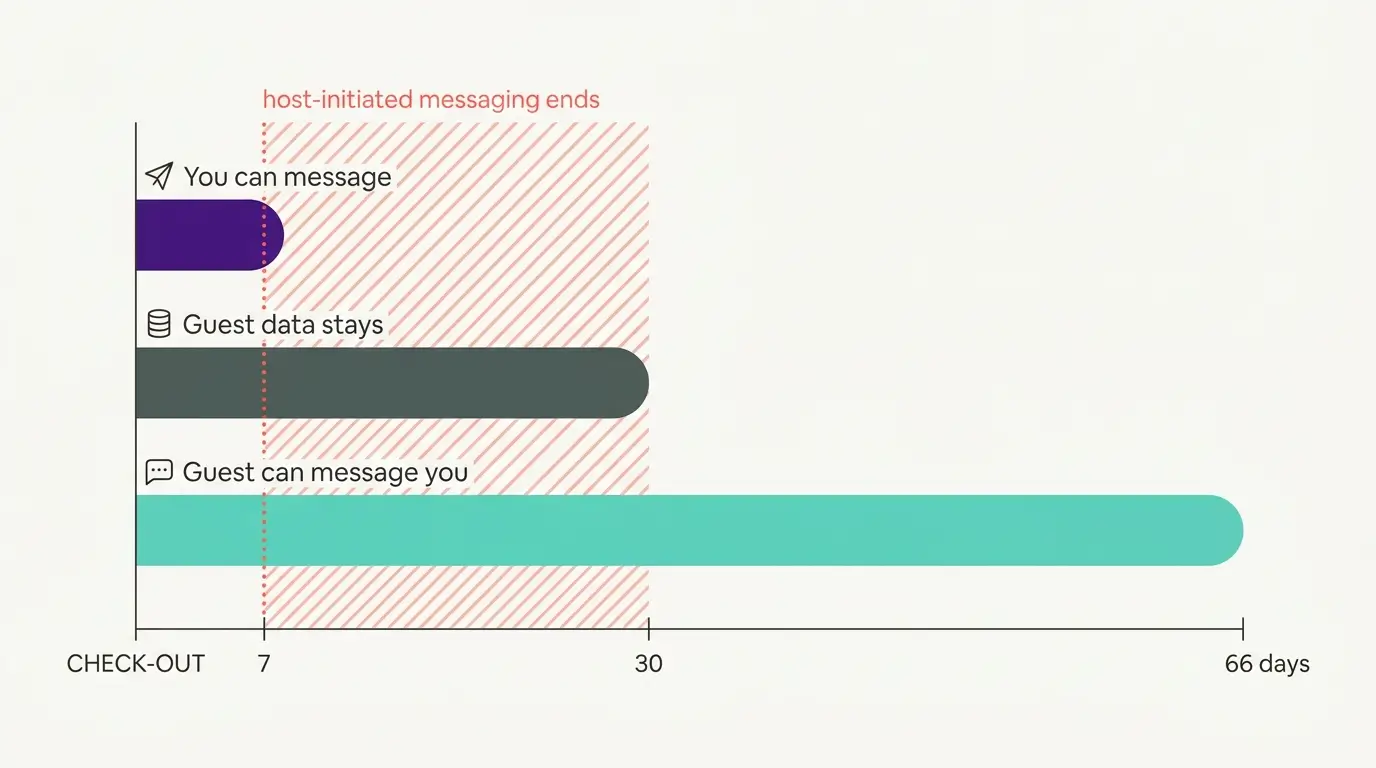
Booking.com guest messaging rules, verified at source: how long you can message a guest, why your links get removed, and what the partner terms say.

Vrbo's New Features for Fall 2026: What's Live, What's Gated, and What's US-Only
We sorted Vrbo's new features for fall 2026: what is live globally, what is gated behind eligibility, and what is US-only. Verified against Vrbo's own pages.