Learn how to craft an Airbnb description that attracts bookings by focusing on specific guest needs, using concrete details, and structuring the copy for easy scanning, while also creating effective titles that highlight key amenities and location. The post provides a step‑by‑step guide, real‑world examples from two listings, and practical tips for keeping the copy honest, SEO‑friendly, and compelling.
We've written the listing copy for every property we run, in Washington DC and the Riviera Maya, and rewritten most of them more than once. Some lines pulled their weight. Some sat there doing nothing for months until we cut them. This is what we've learned actually moves a guest from scrolling to booking, with two of our own listings broken down line by line so you can see the choices, not just read about them.
How do you write a good Airbnb description?
Lead with the one thing that makes your place worth booking, written for a specific kind of guest, then back it up with concrete details instead of adjectives. Keep the opening two lines tight, because that's all most people read before they decide to keep scrolling or tap away. Be honest about the quirks. A description that oversells gets you a booking and a three-star review; a description that's accurate gets you a guest who already knows what they're walking into.
Everything below is how we get there.
How the Airbnb algorithm reads your description
Airbnb's search ranks listings by how likely a guest is to book them, not by how nicely they're written. Your description feeds two of those signals: whether people click your listing from the search grid, and whether they book once they land on it. Good copy lifts both. Keyword-stuffing lifts neither, and it's read the way you'd expect, as a listing trying to game the system.
What changed recently matters here. In its 2026 Summer Release, Airbnb began rolling out natural-language search, where a guest types something like "quiet 4-bedroom near the beach with a pool and fast wifi" instead of clicking filters. The system reads that sentence and matches it against your listing's actual content. So the details you write out plainly, the pool, the dedicated workspace, the walk time to the beach, are the things that surface you for the right searches. Vague copy doesn't match anything specific.
A few practical consequences:
Name your amenities in words, don't just rely on the checkboxes. "Dedicated workspace with a second monitor" earns the remote-worker search; an unmentioned desk doesn't.
Front-load location and proximity. Distance to the things people actually search for ("10 minutes to the beach," "two blocks from the metro") is doing real work now.
Stop chasing a magic keyword density. The system is reading for meaning, not counting terms.
Reviews, response time, and pricing still outweigh your copy in the ranking, so keep those healthy too. If pricing is the part you're least sure about, we wrote a separate piece on setting up an Airbnb pricing strategy that pairs well with this one.
How to write the description itself
Win the first two lines
The search grid and the top of your listing only show a sliver of your description before the "show more" cut. Treat those first two lines as the whole pitch. Put the strongest, most specific hook there: the private pool, the Capitol File magazine feature, the cenote in the neighborhood. Save the towel-and-shampoo inventory for further down, where the already-interested guest will actually read it.
Write for one specific guest
A description aimed at everyone lands with no one. Before writing, we pick the guest the property is really for. Casa Koba is built for a family or two couples who want space, a pool, and a kitchen they can cook in. Our DC row house is for people who want to walk to everything in the city. Once you know who you're writing for, the right details pick themselves, and you stop padding with lines meant to cover every possible visitor.
Show, don't adjective-stack
"Stunning, luxurious, spacious" tells a guest nothing, because every listing says it. Specifics do the convincing. "Each of the four bedrooms has its own full bathroom" beats "spacious and private." "Two blocks from the metro and Whole Foods" beats "great location." If a sentence could sit on any listing in your market without changing a word, it's not earning its place. Replace it with something only your property can say.
Make it scannable
People skim listings on their phones between other tabs. Break the body into short labeled sections (the kitchen, where you'll sleep, getting around) and use bullets for amenity runs. Bullets aren't a ranking trick, they're a courtesy to a tired person deciding where to spend a thousand dollars. Strong photos carry as much weight as the copy, so if yours need work, our Airbnb decor and styling tips cover how to make a space photograph well.
Be honest about the quirks
This is the one most hosts skip, and it's the one that protects your reviews. We tell guests up front that beach access in our gated community takes a 10-minute drive, that the area isn't for partygoers, and that small wildlife is part of life in the tropics. We lose the occasional booking from someone who wanted something else. We avoid a lot of one-star surprises from someone who didn't read closely and felt misled. That trade is always worth it.
How to write an Airbnb title that earns the click
Your title is the headline in a grid of fifty competitors. It has one job: get the click. A few rules we hold to:
Put the bedroom count and capacity in. "4BR" and a guest count answer the first question most travelers have, before they even open the listing.
Lead with one proof point or hook. A pool, a view, a walk score, a magazine feature. One strong detail beats three weak adjectives.
Keep it tight. Airbnb truncates long titles, especially on mobile, so the front of the title has to carry the message. Aim short enough that nothing important gets cut.
Skip the filler. "Beautiful," "amazing," and "cozy" are invisible. The space you spend on them is space you didn't spend on a real selling point.
Two of our real listings, broken down line by line
This is the part no generic guide can give you. Here's the actual copy from two properties we run, and why each choice is there.
Casa Koba, Riviera Maya
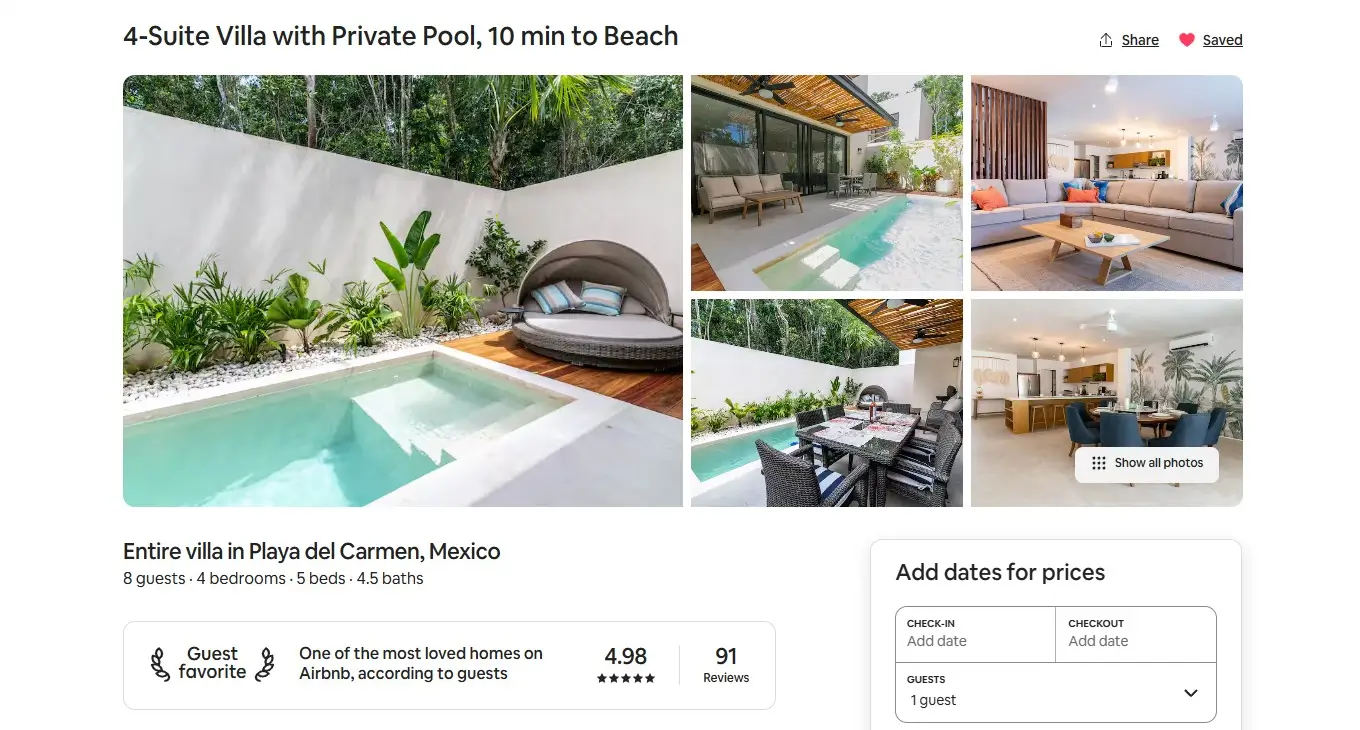
Title: 4-Suite Villa with Private Pool, 10 min to Beach
Every word is pulling weight. "4-Suite" signals more than four bedrooms; it tells a family that everyone gets their own full bathroom, which is the thing groups actually fight over. "Private Pool" is the single most-searched amenity in our market and the first thing guests mention in reviews. "10 min to Beach" sets honest expectations: we're not beachfront, and saying so up front filters out the guest who'd be disappointed and rates us down for it. No adjectives. Four concrete facts.
Opening line: "Our 4BR home, each bedroom with its own full bathroom, is the perfect base to explore the Riviera Maya, with beach clubs and golf courses within a 10-minute drive."
It repeats the bathroom point because that's the differentiator, names the region a guest is searching by ("Riviera Maya"), and gives proximity to the two things our guests come for. Notice it doesn't open with "Welcome to our beautiful home." It opens with a reason to book.
We trimmed this title down over time. An older version stuffed it with pipes and capacity codes, and as Airbnb tightened how titles display and started reading for natural-language search, the plain-English version started doing better. You can see the current live listing here: airbnb.com/h/casakoba.
Our Washington, DC row house
Title: Gorgeous 4BR House | 8PX | 2 Garage | 96 WalkScore
Opening line: "Featured in Capitol File magazine as one of DC's most luxurious rentals. Walk to everything. Two blocks from metro and Whole Foods, and walking distance to the White House, Georgetown, and the monuments."
The third-party feature does the credibility work no self-description can: a magazine said it, not us. "2 Garage" is gold in a city where parking is a daily problem, and "96 WalkScore" is a number a DC traveler immediately understands. The opening line is a list of proximity hooks, each one a thing a guest might be typing into search. It earns the click before the photos even load.
Weak vs. strong: the same room, two descriptions
Weak | Strong |
|---|---|
Spacious and luxurious kitchen with everything you need. | Six-burner gas range, full-size dishwasher, and a coffee maker that does 14 cups, so a full house can actually cook together. |
Great location close to the beach. | A 10-minute drive to beach clubs, golf, and a private neighborhood cenote you can swim in. |
Cozy bedrooms perfect for relaxing. | Four bedrooms, each with its own full bathroom, so nobody's negotiating shower times. |
The strong column isn't longer for the sake of it. It just trades adjectives for facts a guest can picture.
Where SmoothStay fits nicely
Your listing's job ends the moment someone books. After that, the job is delivering the stay you promised, and that's a different tool. We run a digital guidebook that hands guests the wifi code, the door instructions, and our real local recommendations the second they arrive, so the experience matches the listing that sold them. The listing sells the stay; the guidebook delivers it. We're also building an AI wizard that will read your Airbnb listing and draft a starting guidebook from it, which is one more reason to write the listing out clearly. To be clear, we don't write Airbnb descriptions for you, and no honest tool does that part for you yet.
If you're still getting your first listing live, our guide on how to start an Airbnb business covers the steps that come before the copy.
FAQ
How long should an Airbnb description be?
Long enough to answer a guest's real questions, no longer. In practice that's a tight two-line hook up top, then a few short labeled sections covering the space, the bedrooms, the kitchen, and the quirks. Comprehensive beats padded. If a sentence isn't helping someone decide, cut it.
What words sell an Airbnb listing?
Concrete nouns, not adjectives. "Private pool," "dedicated workspace," "two blocks from the metro," and "en-suite bathroom" sell because a guest can picture them and search for them. "Stunning," "luxurious," and "cozy" are on every listing, so they sell nothing.
Should I put keywords in my Airbnb description?
Write naturally and name your real features in plain language. Airbnb's 2026 search reads for meaning and matches full-sentence guest queries, so describing your actual amenities clearly does the SEO work. Stuffing repeated keywords doesn't help your ranking and reads like spam to guests.
What should the first line of an Airbnb description say?
Your single strongest selling point, written for the specific guest you want. Lead with the pool, the location, the magazine feature, or whatever makes your place worth choosing over the listing next to it. The first two lines are often all a guest reads before deciding, so don't waste them on "welcome."
How often should I update my Airbnb listing?
Revisit it whenever your space changes, a new nearby attraction opens, or Airbnb shifts how search works, as it did with natural-language search in 2026. At a minimum, reread your copy each season and cut any line that isn't earning its place. A listing is never finished.
If you'd rather spend your time on the listing and not on building the guest experience behind it, you can have a SmoothStay guidebook running in under an hour, ready for the first guest your new description books.
Latest articles

How to Automate Check-In Instructions for Short-Term Rental Guests
Automate check-in instructions for short-term rental guests: the four-send sequence, what goes in a message versus a guidebook, and a copy-ready sample.

Vrbo Premier Host in 2026: Every Listing Now Stands on Its Own Record
Vrbo Premier Host requirements changed in 2026: per-listing scoring, tighter thresholds, quarterly checks. What each one means, and how it compares to Superhost.
Booking.com Guest Messaging Rules: What Hosts Can Send, When, and Why Links Get Removed
Booking.com guest messaging rules, verified at source: how long you can message a guest, why your links get removed, and what the partner terms say.
Vrbo's New Features for Fall 2026: What's Live, What's Gated, and What's US-Only
We sorted Vrbo's new features for fall 2026: what is live globally, what is gated behind eligibility, and what is US-only. Verified against Vrbo's own pages.