

Travelers are increasingly using AI chat tools to discover and shortlist accommodations, shifting the early research phase from keyword‑based list browsing to conversational, intent‑driven recommendations, though most bookings still finish on traditional OTAs or host sites. While AI can boost engagement and surface options from OTA inventories, challenges remain with hallucinated details, inconsistent citations, and limited visibility for smaller properties.
We run properties in Washington, DC and the Riviera Maya, and over the past year we have watched the way guests find us change under our feet. Fewer of them arrive saying they scrolled past our listing on Airbnb or VRBO. More and more, they tell us a chatbot pointed them to the area or surfaced a shortlist that happened to include our direct booking site. That is not a small tweak to marketing. It is a different front door.
How do travelers use AI to find places to stay?
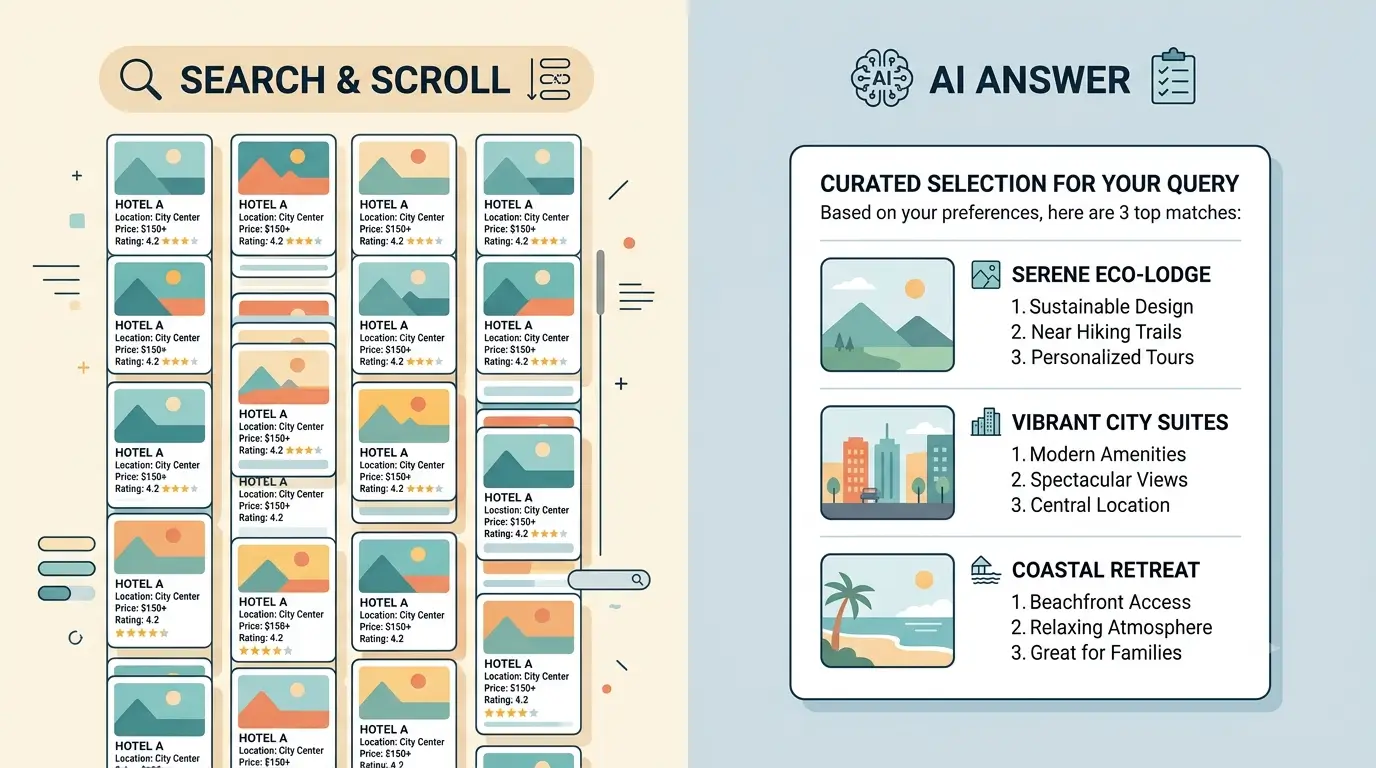
Increasingly, some travelers begin with AI instead of a traditional search engine. Instead of typing "beach house Tulum 4 bedrooms" into a search box and scrolling through ten listing pages, they ask a chatbot a full sentence: where should a family of six stay in the Riviera Maya for a week in March, walkable to the beach, with a pool, under $400 a night. The AI treats that as intent, pulls from OTA inventory, guest reviews, and the public web, and hands back a short synthesized shortlist with reasons attached. The old search-then-scroll pattern is turning into ask-then-shortlist. Most of the actual booking still finishes somewhere else, but the discovery step, the part that used to belong to Google and the big OTAs, is moving into the chat window.
That is the whole shift in one sentence. The rest of this post is what sits underneath it, and where it still breaks.
A page of options versus a verdict
A normal search hands you the raw material and makes you do the work. Ten tabs, a spreadsheet in your head, a filter for price and another for dates. An AI answer does the filtering first and gives you a verdict: here are three places, here is why each one fits, here is the one I would pick. The traveler moves from idea to a short list without visiting most of the sites that used to sit in the middle.
For the person planning the trip, that is faster and less tiring. For anyone who runs a property, it means the moment a guest decides you are worth considering now happens inside a tool you cannot see into and did not know you were being ranked by.
How big is the shift, really
Big enough to stop calling it early. Adobe, which has tracked this since October 2024, found that traffic from AI sources to US travel sites grew 194% year over year in May 2026, and is up 2,215% since it started measuring. Travel and hospitality now pull some of the highest AI referral rates of any industry.
The quality of that traffic is the part that surprised us. Adobe's data shows AI-referred visitors are 21% more engaged, spend about 70% longer per visit, and bounce 41% less than people arriving from other sources. They convert about 28% less often, so the booking still lags, but that gap has shrunk by nearly 70% since late 2024. People who show up from an AI answer already know what they want.
On adoption, roughly 40% of travelers worldwide say they have used an AI tool to plan a trip, and that number climbs sharply among younger travelers. Be careful with the eye-popping figures floating around here. A widely quoted claim that "91% of travelers rely on AI planners" traces back to a survey run by a booking platform, and vendor surveys tend may overstate the trend they are selling into. The direction is real. The exact percentage depends on who paid for the study.
Where the AI gets its recommendation
An AI answer is only as good as what feeds it, and the feed is a mix. OTA inventory, review sites, the open web, and increasingly direct partnerships the platforms strike to get clean, bookable data.
The clearest example is Perplexity, which built a hotel booking flow with Tripadvisor and Selfbook. Ask it for a hotel in natural language and it surfaces bookable properties drawn from that partnership, with Tripadvisor reviews attached, and lets some users complete the booking without leaving the app. Google went the other way, wiring its own AI into inventory it already owns. Its Gemini assistant and AI Mode pull live options from Google Flights and Hotels, so you can describe a "highly rated boutique hotel in a walkable neighborhood under $200" and get real, current listings back inside the answer. ChatGPT sits in a third spot: strong at building an itinerary and talking through ideas, weaker at real-time pricing and availability unless it is reaching out to live data.
The practical takeaway is that there is no single AI travel index. Each tool sees a different slice of the market, depending on who it partnered with and what it can crawl.
From a shortlist to an actual booking
This is where the hype gets ahead of the reality. Discovery has moved into AI. Booking mostly has not.
Most reservations still complete on an OTA or a host's own site. Perplexity's in-app booking is the exception that shows where things are heading, not the norm yet. And the plumbing matters more than people expect. Adobe found that hotels and car rentals lead the travel sector in how readable their pages are to machines, while airlines trail. Reporting on that data pinned down why: airline fares are often rendered client-side with JavaScript that most AI crawlers do not execute, so they are effectively invisible to the tools, while hotels and rentals tend to publish server-rendered pages an AI can actually read. So lodging shows up in these answers more easily than flights do, almost by accident of how the pages are built.
What is still unresolved
Plenty. This is not a solved system, and pretending it is does travelers and operators a disservice.
Hallucination is the loud one. A language model predicts plausible text, so it will occasionally state that a property has a heated pool it does not have, or list hours that are wrong, with total confidence. CNBC covered this trust gap directly: the tools are popular and getting better, and they still invent details.
Then there is the visibility gap. A 2026 study by the hotel-tech firm Tharro ran 695 unbranded hotel searches through ChatGPT and Google's AI Mode and compared the roughly 10,000 recommendations against nearly 294,000 ranked Google and Bing results. It found that about half of the hotels the AI named did not appear in Google's own top results for the same query. A strong Google ranking helped the odds but did not guarantee a mention. Worth naming the source's angle: Tharro sells AI-visibility tools to hotels, so the finding also serves its pitch, though the method is laid out openly enough to judge on its own. The takeaway holds either way. The AI surface and the search surface do not agree on who is worth showing, so a property can be invisible on one and prominent on the other. Smaller and independent operators tend to lose here, because they have the least time and expertise to chase visibility across yet another channel.
And citations are thin. When an AI names three hotels, it often will not show its work, so a traveler cannot easily check why those three and not others. Fast and confident is not the same as accurate. The honest read on all of this is that AI has become a genuine discovery channel, still stapled to an older booking machine, with real accuracy problems in the seam between them.
What this means if you run a property
Keep it simple, and keep your expectations grounded. You cannot make an AI rank you, and anyone promising they can is selling something. What you can do is tend the public signals these tools actually read.
Your OTA listing quality. Accurate amenities, current details, honest photos. A clear, correct listing description is what the AI paraphrases when it recommends you, so wrong or vague copy travels straight into the answer.
Your own website, ideally one that can take a direct booking. AI will recommend you but usually will not complete the reservation, so a traveler who lands on a page that only describes the place tends to drift back to an OTA to actually book. A crawlable site an AI can read, with a real booking path on it, is the one surface here where you influence discovery and keep the reservation instead of handing it to Booking.com or Airbnb.
Your Google Business Profile, where it applies, kept accurate and complete.
Your reviews. They are the raw material almost every one of these tools leans on to decide whether you are worth mentioning.
That is public-web discovery, and it is genuinely different from the in-stay experience you control directly. This shift is part of a bigger pattern we have written about, where every big OTA is turning itself into an AI platform and Airbnb's own 2026 releases push toward planning the whole trip. Worth watching. Not worth panicking over.
FAQ
Do people actually book stays through AI, or just research them?
Mostly research, for now. AI has become a real discovery and shortlisting channel, and adoption is climbing fast, but the majority of bookings still finish on an OTA or a host's own site. In-app booking, like Perplexity's hotel flow, exists and is growing, but it is not yet where most reservations complete.
Which AI tool is best for finding a place to stay?
They are good at different things. Perplexity and Google's Gemini pull live, bookable inventory through partnerships and their own travel data, which makes them stronger for real options and current pricing. ChatGPT is better for shaping an itinerary and talking through ideas than for live availability. Most serious planners end up using more than one.
Can AI travel recommendations be wrong?
Yes, and it is worth checking anything specific before you rely on it. These tools sometimes invent amenities, hours, or policies that sound plausible but are not true. Confirm details like pet rules, parking, and cancellation terms on the property's own listing or site before booking.
Why does an AI recommend hotels that do not show up in a normal Google search?
Because the two systems draw on different data and rank it differently. In a 2026 study of 695 hotel searches by the hotel-tech firm Tharro, about half of the hotels recommended by ChatGPT and Google's AI Mode did not appear in Google's top results for the same query. An AI answer weighs reviews, partnerships, and public web content in its own way, so the list it produces can look nothing like a standard search page.
How can a small property show up in AI travel answers?
There is no button for it, and no one can guarantee placement. The realistic path is tending the public signals these tools read: accurate OTA listings, a clear website, a complete Google Business Profile, and a steady base of genuine reviews. That is influence, not control.
Is AI going to replace OTAs like Airbnb and Booking.com?
Not soon. The OTAs hold the inventory, the payment systems, and the trust layer that booking still runs on, and several are building AI directly into their own platforms rather than ceding the ground. What is changing is the discovery step in front of the booking, which is moving into conversational tools. The booking machine underneath is, for now, the same one.
Latest articles

How to Automate Check-In Instructions for Short-Term Rental Guests
Automate check-in instructions for short-term rental guests: the four-send sequence, what goes in a message versus a guidebook, and a copy-ready sample.

Vrbo Premier Host in 2026: Every Listing Now Stands on Its Own Record
Vrbo Premier Host requirements changed in 2026: per-listing scoring, tighter thresholds, quarterly checks. What each one means, and how it compares to Superhost.
Booking.com Guest Messaging Rules: What Hosts Can Send, When, and Why Links Get Removed
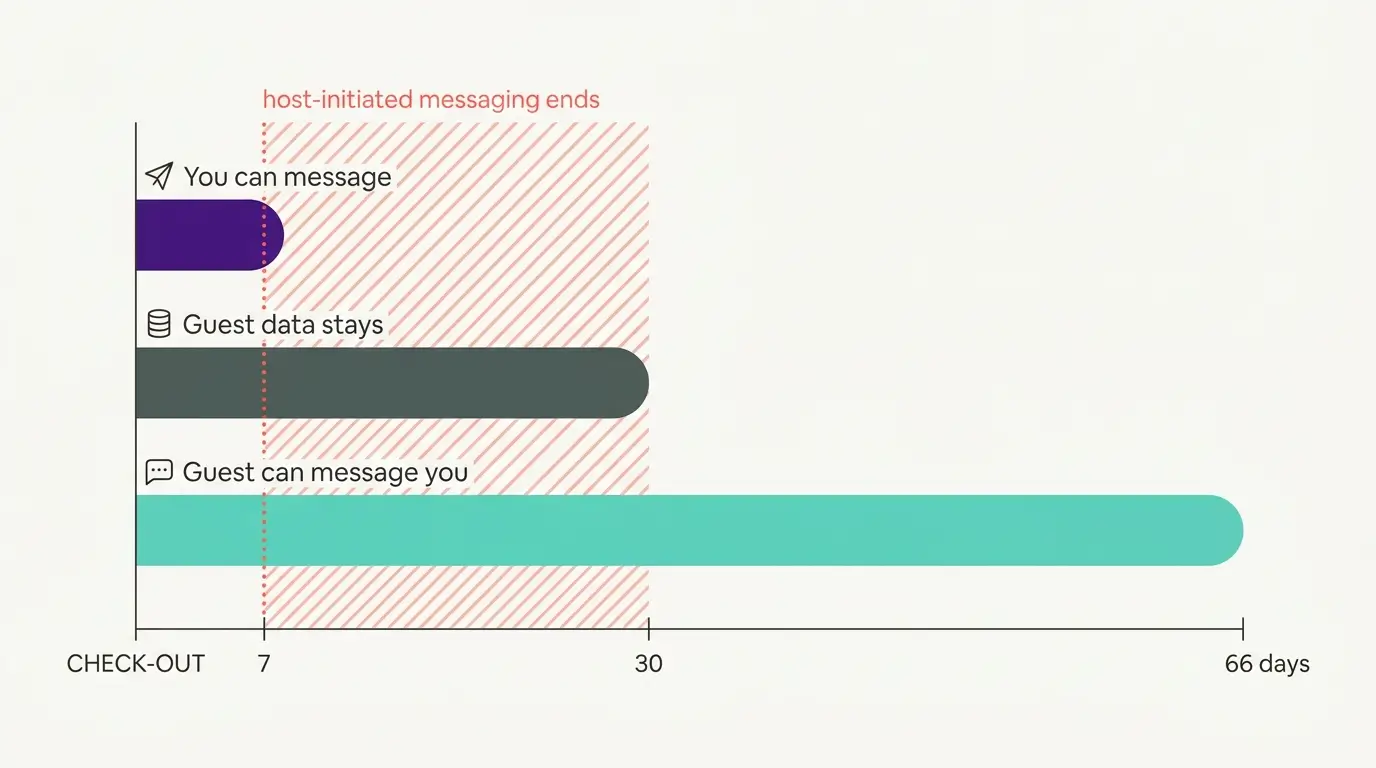
Booking.com guest messaging rules, verified at source: how long you can message a guest, why your links get removed, and what the partner terms say.

Vrbo's New Features for Fall 2026: What's Live, What's Gated, and What's US-Only
We sorted Vrbo's new features for fall 2026: what is live globally, what is gated behind eligibility, and what is US-only. Verified against Vrbo's own pages.