A Host's Guide to Managing Vacation Rental Properties
Discover proven strategies for managing vacation rental properties. Our guide offers real-world tips on automation, guest experience, and scaling your business.
Disclosure: Some links in this article are affiliate links. If you make a purchase, we may earn a commission at no extra cost to you. This helps support our content.
Managing vacation rental properties is a business of details. From our experience, success isn't just about having a clean space; it’s about building a solid, stress-free system that protects your investment and wows guests from the moment they book.
Building Your Foundation for 5-Star Hosting
Before you can even think about hitting "publish" on a listing, you need a rock-solid foundation. This is the pre-launch checklist we've spent over a decade refining—from our 4-bedroom house in Washington, D.C., to our beach getaways in the Riviera Maya. We've found that getting these pillars right from day one is what separates the hosts who are constantly stressed from those who run a streamlined, successful business.
The vacation rental market is growing fast, with some projections showing it could hit $111.2 billion by 2030. With online bookings on the rise, a polished digital presence is more critical than ever to stand out.
Craft a Listing That Converts
Think of your online listing as your digital storefront. Of course, high-quality photos are non-negotiable, but your description is where you sell the experience. Don't just list amenities; paint a vivid picture for your future guests.
Instead of just saying "king bed," try something like, "Sink into a plush king bed with blackout curtains, guaranteeing a restful night's sleep after a sun-soaked day at the beach."
Figure out who your ideal guest is and write directly to them. We’ve learned that being upfront about potential quirks—like the street noise at our D.C. property—actually builds trust and attracts the right kind of visitors who appreciate the honesty.
Set Up Your Space for Success
When it comes to furnishing your rental, durability is your best friend. We make it a point to prioritize commercial-grade or highly durable items that can stand up to heavy use. This means performance fabrics for sofas, sturdy dining chairs that don't wobble, and quality mattresses that won’t sag after just a few months.
Here are a few must-haves we've learned to include:
Smart Locks: Keyless entry is a game-changer. It simplifies check-in for guests and completely eliminates the headache of lost keys.
Ample Outlets: We install power strips with built-in USB ports near the beds and in the main living areas. It’s a small, inexpensive touch that guests consistently mention.
A Well-Stocked Kitchen: Go beyond the bare minimum. A quality coffee maker, toaster, blender, and decent cookware show you care about the details.
From what we've seen, a small investment in guest comfort upfront pays for itself tenfold in five-star reviews and fewer panicked maintenance calls. A happy, comfortable guest is far less likely to sweat the small stuff.
Protect Your Business and Investment
Managing a vacation rental means you're a business owner. Your first move should be to get a handle on your local regulations. Different cities have wildly different rules for short-term rentals, covering everything from permits and taxes to specific safety requirements.
Next up, get the right insurance. Your standard homeowner's policy almost certainly won't cover commercial rental activity. You need a dedicated short-term rental policy to protect yourself from liability claims and property damage. It’s non-negotiable.
To tie it all together, you'll want to find the best software for property managers to help automate your daily tasks. And to make sure every process is documented and repeatable, check out our guide on creating a standard operating procedure template for your rental.
To help you get started, we've put together a quick checklist of the foundational tasks to tackle before welcoming your first guest.
Your Vacation Rental Launch Checklist
This table summarizes the essential setup tasks to ensure your property is ready for its first guests and protected from day one.
Task Area | Key Actions | Why It Matters |
|---|---|---|
Listing & Marketing | Professional photos, compelling description, identify ideal guest avatar. | Your listing is your first impression. A great one attracts better guests and justifies higher rates. |
Property Setup | Furnish with durable items, install smart lock, stock kitchen essentials, add convenience items like USB ports. | A well-equipped, comfortable space leads to 5-star reviews and reduces wear-and-tear costs over time. |
Legal & Compliance | Research and comply with local STR laws, obtain necessary permits/licenses. | Avoids hefty fines, legal trouble, and potential shutdowns. It’s the cost of doing business responsibly. |
Insurance & Protection | Secure a specific short-term rental insurance policy, establish clear house rules. | Protects your property, your finances, and you from liability in case of accidents or guest-related damages. |
Operational Systems | Create cleaning checklists, find a reliable handyman, set up a system for restocking supplies. | A smooth, repeatable process is the key to scaling your business and avoiding burnout from constant challenges. |
Nailing these fundamentals from the get-go will save you countless headaches down the road and set the stage for a thriving, profitable vacation rental business.
Crafting a Smart Pricing and Occupancy Strategy
Getting your pricing right is one of the most powerful levers you have for maximizing revenue. When we started with our first properties, we learned a tough lesson: setting a single nightly rate and forgetting about it is a quick way to leave money on the table. A smart pricing strategy isn't just about the number you charge; it’s about why you charge it.
This means ditching the static price tag and adopting a dynamic approach that flexes with the market. The goal is to hit that sweet spot where your calendar stays full at the best possible price, giving you a steady, reliable income stream.
Understanding Your Market’s Rhythm
Every market has its own unique pulse. For our place in Playa del Carmen, the high season is all about winter travelers escaping the cold. Meanwhile, our D.C. property lights up around holidays and major political events. The very first thing you need to do is get a handle on these patterns.
We make it a habit to research local events, conferences, and holidays a full year out and get them on our calendar. This lets us proactively adjust rates to capture that peak demand. Don't just guess here—use tools like AirDNA or PriceLabs to see what your direct competitors are charging for those key dates.
Our rule of thumb is this: if your calendar is fully booked more than three months in advance, your prices are almost certainly too low. You're likely leaving cash on the table by not waiting for demand to build.
Dynamic Pricing and Minimum Stays
Dynamic pricing is just a way of saying you adjust your rates based on supply and demand. You can definitely do this by hand, but we’ve found that an automated pricing tool saves an incredible amount of time and helps us react faster than we ever could on our own. These platforms analyze market data to recommend daily rates.
Another powerful tool in your arsenal is the minimum night stay. Being strategic with this setting can boost your revenue per booking and cut down on the operational headache of constant turnovers. For example, requiring a 7-night minimum during a holiday week makes a huge difference.
Here’s a quick peek at how we adjust our minimums throughout the year:
Peak Season: 5-7 nights to lock in those high-value, week-long bookings.
Shoulder Season: 3-4 nights to appeal to weekend travelers and fill in the gaps.
Low Season: 2 nights to stay competitive and keep our occupancy from dipping.
This flexible strategy helps prevent those awkward one-night gaps in your calendar that are almost impossible to fill. You can learn more about finding the right balance by exploring our guide on key factors in an Airbnb pricing strategy.
Smart Discounts and Filling Gaps
While it's crucial to raise prices when demand is high, offering strategic discounts is just as important for keeping your calendar full. We've had a lot of success with "last-minute" discounts for any unbooked nights within the next 3-7 days. "Length-of-stay" discounts for guests booking a full week or month have also worked well for us.
Most booking platforms let you automate these discounts, which is perfect for filling those tricky calendar gaps without any extra work. Offering a 15% discount for stays of 7 nights or more, for instance, encourages longer, more stable bookings—which often means less wear and tear and fewer cleanings.
Of course, pricing is only one part of the equation. You also need a solid plan for getting eyes on your listing. To make sure you have a steady stream of potential guests, it’s worth learning how to market rental properties effectively.
Ultimately, a balanced approach that combines data-driven pricing, strategic minimums, and smart discounts is what will transform your rental from a side project into a truly profitable business.
Automating Communication Without Losing Your Personal Touch
Answering the same questions at all hours—“What’s the Wi-Fi password?” or “How does the coffee maker work?”—is one of the fastest routes to host burnout. We learned this the hard way. This is where smart automation becomes your secret weapon, freeing you up to focus on the bigger picture.
It’s all about creating a system that anticipates what guests need and delivers that information exactly when they need it, without you having to lift a finger for every inquiry. This isn't about being less personal; it’s about being more consistently helpful.
The industry is catching on fast. A 2023 Skift report noted that 61% of property managers are increasing their investment in technology. As more travelers pick rentals over hotels, using tech to create a smooth experience is no longer just a nice-to-have—it's essential. You can dig deeper into how technology is shaping the vacation rental market in this report.
Building Your Automated Messaging Workflow
A great communication workflow feels completely natural to the guest. It guides them through their stay with timely, relevant information. Here’s the simple, effective sequence we use for all our properties.
Booking Confirmation: This is your first touchpoint after they book. An immediate message goes out thanking them and confirming the dates. We also include a link to our digital guidebook, inviting them to start exploring the property and the area.
Pre-Arrival Message (7 Days Out): This message is all about building excitement. We remind them of their upcoming stay and sometimes ask if they're celebrating a special occasion. It's also a great chance to offer early check-in or late checkout for a small fee if your calendar has the space.
Check-In Instructions (24 Hours Before): This is the big one. It has to include the full address, the door code, Wi-Fi details, and one last link to the guidebook. Clarity and conciseness are key here to prevent any arrival-day stress.
Mid-Stay Check-In (Day 2): A simple, automated message asking, "Hi [Guest Name], just checking in to make sure everything is perfect for your stay!" shows you care. More importantly, it nips potential issues in the bud before they can turn into a negative review.
Checkout Reminder (Evening Before Departure): We send a friendly note reminding guests of the checkout time and any simple departure tasks, like taking out the trash or starting the dishwasher.
Post-Stay Thank You: A few hours after checkout, a final message thanks them for staying and kindly asks them to leave a review.
This structured flow makes sure guests feel supported at every stage, and it dramatically cuts down on the number of repetitive questions that hit your inbox. To really nail the wording, check out our guide on how to automate your Airbnb messages.
The Power of a Centralized Digital Guidebook
Scheduled messages are fantastic, but they can't answer every unique question a guest might have. That's where a comprehensive digital guidebook becomes the true centerpiece of your communication strategy. Forget the dusty binder—a digital guide is an always-on, interactive resource for your guests.
A well-crafted digital guidebook is the single most effective tool we've found for reducing guest inquiries. For us, it cuts down on repetitive questions by up to 80%, giving us back hours every week.
A platform like SmoothStay lets you create a beautiful, custom guidebook that centralizes everything a guest could possibly need to know. This isn't just about the Wi-Fi password. It's a complete hub for their entire stay.
Think about including things like:
Appliance Instructions: Short videos or step-by-step photos are gold. Show guests exactly how to use the TV remote, washing machine, or thermostat.
Local Recommendations: This is where you shine. Share your personal favorite coffee shops, family-friendly restaurants, and hidden gems they won't find in a generic travel guide.
Emergency Information: List contact details for local clinics, your property manager, and emergency services. Peace of mind is priceless.
House Rules: A clear, friendly reminder of your policies on noise, extra guests, and other property specifics.
By empowering guests with this information, you completely change their experience. They feel more in control and confident, and you get to spend less time being a remote concierge and more time actually growing your business.
Developing a Bulletproof Cleaning and Maintenance System
If there’s one thing we’ve learned after more than a decade of hosting, it’s this: cleanliness is everything. A single missed detail—a dusty shelf or a stray hair—can completely overshadow an otherwise perfect stay and sink your chances of a five-star review. It’s the bedrock of managing vacation rental properties successfully.
Over the years, we've fine-tuned a system that’s less about just cleaning and more about creating a repeatable, high-quality turnover process. This isn't just about making the beds; it’s about resetting the entire guest experience every single time. A consistent process is your best defense against bad reviews.
This flowchart maps out the typical guest journey, where a seamless turnover between checkout and the next check-in is a critical, behind-the-scenes step.
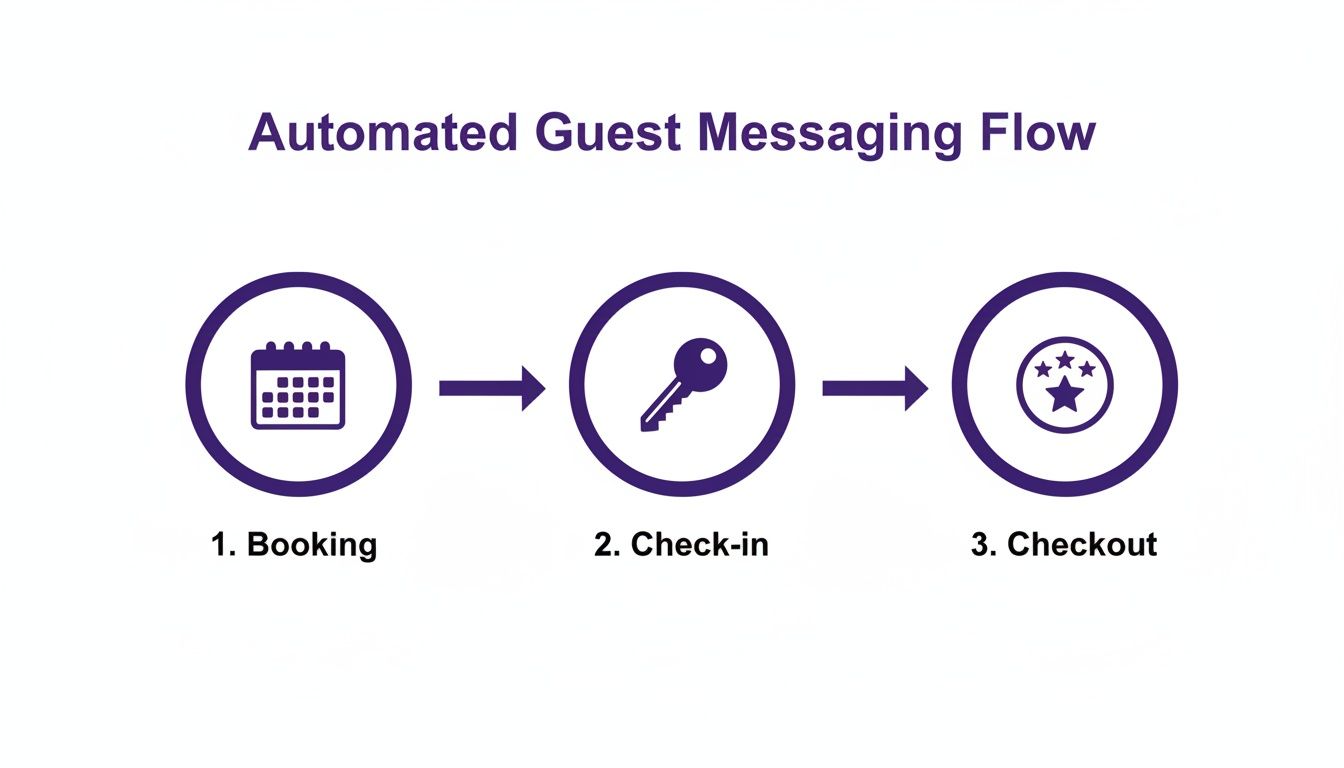
The flow from booking to checkout highlights how each stage builds on the last. A spotless property at check-in sets a positive tone for the entire stay.
Building Your Turnover Team
Finding a reliable cleaning crew is one of the biggest challenges for any host. A great cleaner is more than just someone who tidies up; they are your eyes and ears on the ground, spotting potential maintenance issues before they become guest emergencies.
When vetting cleaners, we always do a paid trial clean and provide them with our detailed checklist. We look for individuals or teams who communicate proactively—sending photos of any damage or low supply levels is a huge plus. It’s a partnership, and treating them as a valued part of your team goes a long way.
The Power of a Detailed Checklist
Saying "clean the bathroom" isn't enough. A truly effective system relies on a detailed checklist that leaves zero room for interpretation. Our checklist is a living document, refined over hundreds of turnovers, and it’s the exact tool our teams use for every single property.
A good checklist should be broken down by room and include tasks that are easy to forget:
Kitchen: Wipe inside the microwave, check for expired items in the fridge, run the garbage disposal with a cleaner, and restock coffee pods.
Bedrooms: Check under the beds for forgotten items, inspect linens for any stains, and sanitize all high-touch surfaces like light switches and remote controls.
Bathrooms: Sanitize the toilet handle, wipe down the hairdryer, and ensure the shower curtain is free of mildew.
What's worked for us is having our cleaning team take a time-stamped photo of each completed room before they leave. It provides accountability and gives us peace of mind that the job was done right.
To help you get started, here's a look at the essential phases of our turnover process. This simple workflow ensures nothing falls through the cracks and that every guest walks into the same, sparkling-clean space.
Essential Turnover Workflow
Phase | Key Tasks | Pro Tip |
|---|---|---|
Guest Checkout | Confirm guest has departed. Report any immediate damage or excessive mess. Strip beds and gather all used linens. | Have your cleaner do a quick video walkthrough to document the property's initial condition before they start. |
Cleaning & Sanitizing | Follow the room-by-room checklist meticulously. Focus on high-touch surfaces. Report any maintenance issues. | Use a separate, color-coded set of microfiber cloths for bathrooms and kitchens to prevent cross-contamination. |
Restocking & Staging | Replenish all guest consumables (coffee, toiletries, paper goods). Make beds and stage pillows/throws. | Create pre-packaged "starter kits" for each turnover (e.g., a small bag with coffee pods, sugar, and creamers) to speed things up. |
Final Inspection | Do a final walkthrough to check for missed spots. Take completion photos of each room. Lock up and confirm the job is done. | The "final look back" from the doorway of each room is great for spotting things that are out of place or forgotten. |
This table is just a starting point. Feel free to adapt it and add details specific to your property. The key is having a documented process that your team can follow every single time.
From Reactive Repairs to Proactive Maintenance
Waiting for something to break is a recipe for unhappy guests. A guest calling to report a dead smoke detector battery at 10 PM is stressful for everyone. That’s why we schedule routine preventative maintenance checks to catch small issues before they escalate.
This proactive approach is crucial for the long-term health of your property. Our maintenance calendar includes simple, recurring tasks:
Quarterly: Test all smoke and carbon monoxide detectors, deep clean appliances like the dishwasher and washing machine, and check for slow drains.
Bi-Annually: Inspect and clean HVAC filters, check fire extinguisher expiration dates, and touch up any scuffed paint on walls.
Annually: Schedule professional pest control and deep clean carpets and upholstery.
This systematic approach minimizes unexpected disruptions for your guests and protects your investment. By creating a robust system for both cleaning and maintenance, you’re not just managing a property; you're building a reliable, five-star hospitality business.
Using Data to Make Smarter Decisions and Scale
For a long time, we made decisions based on what felt right. But let's be honest: gut feelings can only get you so far. Managing a vacation rental is running a business, not a hobby.
The real shift for us happened when we stopped guessing and started tracking a few key numbers. This data-driven approach is what allows you to move from hoping to knowing. It’s how we confidently manage properties in different markets and it’s what will help you spot growth opportunities and make decisions that actually improve your bottom line.
Key Metrics Every Host Should Track
You don't need a degree in finance to master the numbers that matter. In our experience, focusing on a few core metrics gives you about 80% of the insight you need.
Here are the non-negotiables we monitor:
Occupancy Rate: This is the simplest one—the percentage of booked nights out of your total available nights. It's a quick pulse check on your property's popularity.
Average Daily Rate (ADR): This is your average income per booked night. To get it, just divide your total revenue by the number of nights you booked in a given period.
Revenue Per Available Room (RevPAR): This metric is the gold standard. It combines occupancy and ADR to give you the clearest picture of your performance. Calculate it by multiplying your ADR by your occupancy rate.
We live and die by RevPAR. Why? Because it shows the crucial balance between keeping your calendar full and charging a healthy rate. A high occupancy rate doesn't mean much if your daily rate is too low to be profitable.
We once had a property with a 95% occupancy rate that was actually less profitable than another with 75% occupancy. The second property had a much higher ADR and, therefore, a stronger RevPAR. That was a huge "aha" moment for us.
Turning Data Into Actionable Decisions
Tracking numbers is pointless if you don't use them. This is where the data becomes your strategic guide for everything from pricing adjustments to marketing spend and even operational improvements.
For instance, if you notice your RevPAR always dips in April, you can dig in. Is it because your occupancy is dropping, or is your ADR too low? This insight lets you take targeted action. You might run a special spring promotion to boost bookings or hold firm on your pricing if you see that competitors are still getting solid rates.
This analytical approach helps you answer critical business questions:
Pricing: Is there a specific day of the week where we could slightly increase our rates without hurting bookings?
Marketing: Are our low-season marketing efforts actually driving reservations?
Operations: How much are we spending on supplies per booking, and can we trim those costs?
Analyzing Guest Feedback Beyond the Stars
Your numbers tell you what is happening, but your qualitative data—guest feedback—tells you why. Don't just glance at the star rating. Dive into the actual written reviews to find patterns you can act on.
We make it a practice to categorize feedback from every single review. Do guests consistently mention the comfortable beds? Awesome, let's highlight that in our listing description. Is there a recurring comment about the complicated TV remote? That’s our cue to create a simple instruction guide in our SmoothStay digital guidebook.
This level of analysis turns subjective feedback into a concrete action plan. It’s these small, data-informed adjustments that compound over time, leading to better guest experiences, glowing reviews, and a stronger, more resilient business that’s ready to scale.
Your Remote Hosting Questions Answered
As you dive deeper into this world, the same questions always seem to surface. We've been there, and we still get these from fellow hosts all the time. Here are our takes on the most common challenges, pulled from our experiences managing everything from our family row house in D.C. to our beach properties down in Mexico.
How Can I Make My Rental Stand Out in a Crowded Market?
It’s easy to think you need the fanciest furniture or the latest gadgets, but standing out is really about creating a specific, memorable experience. Zero in on what makes your property unique. Is it the killer sunset view from the balcony? The fact that you're steps away from a legendary hiking trail? Whatever it is, lean into that hard in your photos and listing description.
We've learned over the years that small, thoughtful touches have a massive impact. A welcome basket with some local coffee and snacks, a handwritten note, or a digital guidebook packed with your personal favorite restaurants—these are the details that elevate a stay from pretty good to totally unforgettable. It's this stuff that gets you those glowing five-star reviews.
High-quality photography is non-negotiable, of course. But don't just set it and forget it. We make it a point to refresh our photos at least once a year and tweak our descriptions with the seasons to appeal to different travelers.
What's the Best Way to Handle Guest Communications?
The secret to great guest communication is being proactive and consistent. Guests want to feel like you've got their back, but they don't want to be smothered. This is where a smart, automated messaging sequence—like we covered earlier—is an absolute game-changer for all the routine stuff.
For everything else, a single source of truth is your best friend. A polished digital guidebook is the perfect tool for this. It gives guests the power to find answers on their own schedule, whether it’s 2 PM or 2 AM.
Our approach is pretty simple: automate the predictable, but always be available for the exceptions. Nothing builds trust faster than clear, timely communication.
We make sure our guests have a direct line to us for anything truly urgent. But honestly, a well-built guidebook has dramatically cut down on the number of non-urgent questions we field. That frees us up to provide better, faster support when it's genuinely needed.
Should I Really Invest in Smart Home Technology?
Absolutely, but you have to be strategic. The right smart home tech can make your life easier and seriously improve the guest experience, but there's no need to turn your property into a sci-fi movie set.
Start with the essentials that give you the biggest bang for your buck:
Smart Locks: Keyless entry is a non-negotiable for us. It kills the hassle of key exchanges, prevents lockouts, and lets you grant or revoke access from anywhere.
Smart Thermostats: These are a huge win for managing utility bills. You can set schedules and remotely adjust the temperature the minute a guest checks out, saving a ton on energy costs.
Noise Monitoring Devices: If your property is in a noise-sensitive area, these are a lifesaver. They alert you if decibel levels get too high, helping you stop a party before it gets out of hand. And don't worry—they only measure volume, not conversations, so guest privacy is protected.
These three pieces of tech solve real, everyday problems for hosts, from operational headaches to property protection.
Just How Important Are Guest Reviews?
Guest reviews are the absolute lifeblood of your vacation rental business. They are the single most powerful form of social proof you have, period. A steady stream of positive reviews has a direct impact on your search ranking, your visibility, and ultimately, your booking rate. With more than 90% of travelers reading reviews before booking, you just can't overstate their importance.
Always, always encourage happy guests to leave a review. We slip a gentle prompt into our final automated message after checkout. It’s also critical to respond to every single review, good or bad. A thoughtful response to a negative review shows future guests that you're an engaged, professional host who actually cares about feedback. It tells them that even when things go wrong, you’re committed to making them right.
Managing a vacation rental is a journey of constant learning and tweaking. What works today might need an adjustment tomorrow, but by focusing on a solid foundation, smart systems, and a guest experience that truly shines, you can build a resilient and profitable business.
We built SmoothStay because we lived these challenges firsthand. Our customizable, professional guidebooks are designed to give your guests everything they need for a perfect stay, reducing your workload and helping you earn more five-star reviews. With guest-first features and AI-powered tools, you can create a seamless experience that feels both personal and professional.
Start your free 14-day trial today and see the difference a great guidebook can make.