
A Superhost's Guide on How to Rent Your Home on Airbnb
Considering how to rent your home on Airbnb? Learn from Superhosts how to prep your space, create a standout listing, and earn five-star reviews.
Disclosure: Some links in this article are affiliate links. If you make a purchase, we may earn a commission at no extra cost to you. This helps support our content.
Thinking about renting your home on Airbnb? It’s more than just snapping a few photos and hitting "publish." From our experience, the real work is in getting your property ready for guests, creating a listing that stands out, pricing it smartly, and then, of course, managing the people who stay there.
It all starts with a gut check: is this the right move for you? Let's walk through that first.
Is Renting Your Home on Airbnb Right for You?
Before you start dreaming about welcome baskets and five-star reviews, let's talk about whether hosting is a good fit for you and your life. When we first considered listing our 4-bedroom house in Washington, D.C., we had the same questions you probably do. Is all the effort actually worth it? What are the real downsides?
Let's be clear, the potential is huge. As of early 2024, Airbnb has grown to over 8 million active listings worldwide. Hosts have welcomed guests for more than 1.5 billion stays so far, a number that shows just how massive the demand is. You can see more on the platform's incredible growth on Hotelagio.com.
But success isn't guaranteed. It comes down to getting honest with yourself from the very beginning.
The Three Core Questions for Every Future Host
After more than a decade in this business—from our own home in DC to beach properties in Mexico—we've boiled it down to three fundamental questions. Forget about paint colors and decor for a minute—if you can’t answer these honestly, you’re not ready.
What are your financial goals? Are you just trying to cover the mortgage, or are you aiming to build a full-time income stream? Your "why" will dictate your pricing strategy, how often you rent your place out, and how you handle the entire operation.
How much time can you realistically commit? Let’s bust a myth right now: hosting is not passive income, especially when you're starting out. It’s a hands-on job that involves answering inquiries at all hours, coordinating cleaners, and being on call for guest issues. Be real about your availability.
Are you truly comfortable with strangers in your space? This is the big one. Welcoming guests means accepting a certain amount of wear and tear. It means trusting people to be respectful. You have to have a genuine hospitality mindset, or you'll burn out fast.
This little infographic breaks down the self-assessment we walk every new host through.
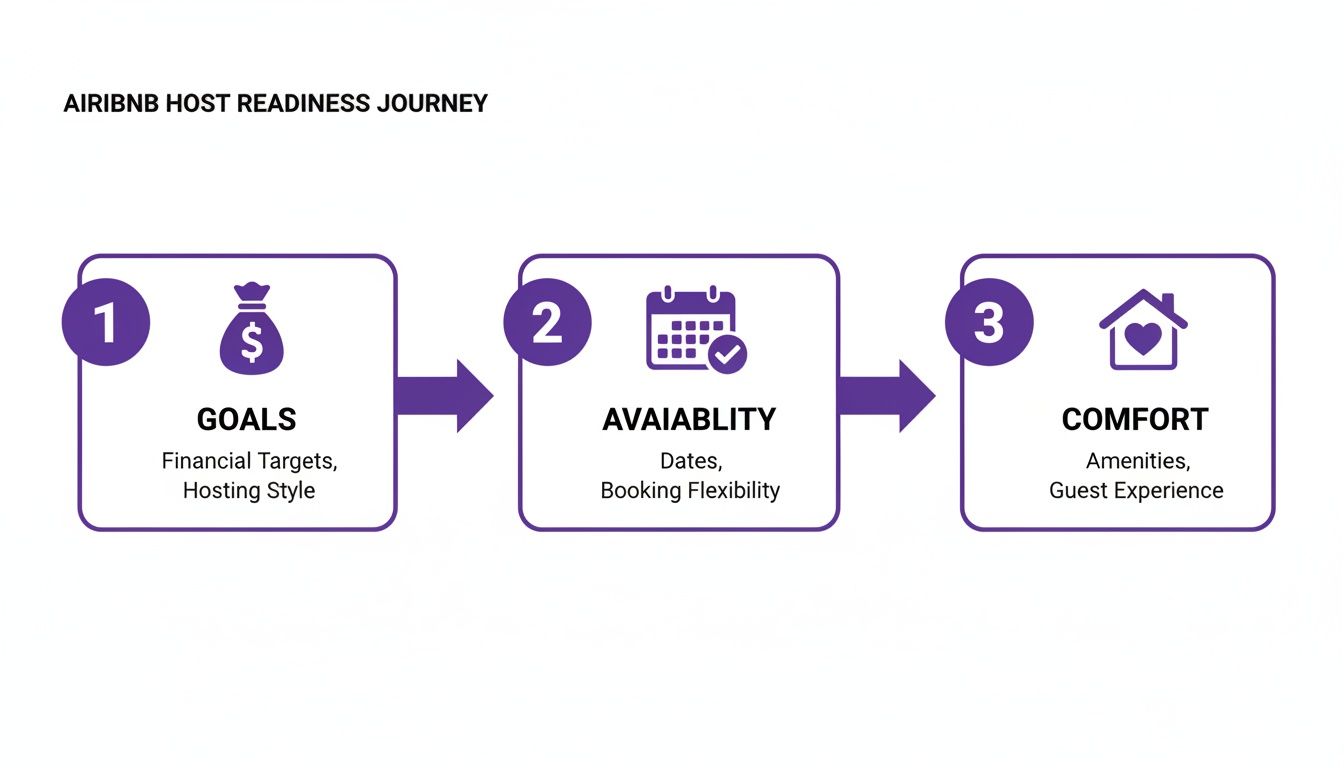
This quick reality check helps you align what you want with what hosting actually demands.
Short-Term Fun or Long-Term Business?
Finally, decide on your level of commitment. Are you just dipping your toes in by renting a spare room on weekends? Or are you all-in, turning a property into a dedicated short-term rental business?
Each path comes with its own set of legal, financial, and operational rules. Figuring this out early will save you a world of headaches and set you up for success from day one. If you're weighing your options, our guide on the differences between short-term and long-term rentals is a great place to start.
Getting Your Space Guest-Ready
Alright, so you’ve decided to jump into hosting. This is where the real fun begins—turning your property from just a house into the kind of welcoming spot guests rave about. It’s about more than a quick cleanup; it’s about looking at your space through a guest’s eyes and creating an experience that feels effortless.
When we first started with our place in DC, we learned pretty fast that it’s the small, thoughtful details that separate a decent stay from a truly great one. Grand gestures aren't necessary. It's all about making the stay seamless and comfortable.
The Foundation: Cleanliness and Comfort
Before anyone even thinks about booking, your property needs to be spotless. I’m not talking about a casual tidy-up. I mean a deep, top-to-bottom clean that sets the standard for every single guest who walks through your door.
A pristine space is the non-negotiable baseline for getting five-star reviews. We live and die by a detailed checklist for our cleaners, making sure nothing gets missed between turnovers. To see exactly what we cover, check out the comprehensive vacation rental cleaning checklist we've perfected over the years.
Keeping your furniture in top shape is another must for those glowing reviews. To make sure your sofas and chairs are always guest-ready, it helps to know how to effectively clean your fabric sofa with just a few simple tricks.
Our rule of thumb has always been simple: If we wouldn't feel comfortable using it, eating off it, or sleeping in it ourselves, then it has no business being in our rental. That goes for everything, from the forks in the drawer to the sheets on the bed.
Stocking Amenities That Actually Matter
Right after cleanliness, amenities are what guests notice and appreciate most. You don't have to go overboard, but stocking your place strategically can make a massive difference in the guest experience. Just think about what a traveler really needs and what little extras would make their life easier.
After hosting in different properties, from the city to the beach, we’ve found a few key items that are consistent crowd-pleasers.
Kitchen Essentials: Go a step beyond the basics. Make sure you have sharp knives, a decent coffee maker (with good coffee!), and enough pots and pans for someone to cook an actual meal.
Bedroom Comfort: This is where you really invest. A comfortable mattress and quality linens are worth every penny. We always provide two types of pillows per guest (like one firm, one soft) and blackout curtains—these are absolute must-haves for a good night's sleep.
Tech and Connectivity: Fast, reliable Wi-Fi isn't a perk anymore; it's an expectation. We also add extra phone chargers by the beds and a simple, laminated guide for using the TV and any other electronics.
Bathroom Basics: Have plenty of fluffy towels, quality hand soap, and a little basket with essentials like a travel-sized toothpaste or cotton swabs. It’s a small touch for guests who might have forgotten something.
These are the kinds of details that show you're thinking about your guest's comfort, which is what real hospitality is all about.
The Legal and Safety Must-Haves
Creating a memorable stay also means creating a safe and legally sound one. This isn't the most exciting part of hosting, but it's absolutely critical for protecting you, your guests, and your property. Skipping this step can land you in serious legal and financial trouble.
Before you even think about hitting "publish" on your listing, make sure these are checked off:
Safety Equipment: At a bare minimum, every rental needs working smoke and carbon monoxide detectors, a fire extinguisher, and a well-stocked first-aid kit.
Insurance Review: Your standard homeowner's insurance policy almost certainly does not cover short-term rental activity. You need to call your provider and ask about a specific short-term rental policy or a rider for your existing plan.
Local Regulations: Do your homework on your city and county laws. Many areas require permits, licenses, and the collection of occupancy taxes. Not knowing the rules won't protect you if you break them.
Getting these fundamentals right from day one gives you peace of mind and builds a professional foundation for your hosting business. It means you're prepared for whatever comes your way and are operating completely above board.
Crafting an Airbnb Listing That Converts
Think of your Airbnb listing as your digital storefront. It’s the very first impression a potential guest has of your place, and in a market flooded with options, a nice space just isn't enough. Your listing has to grab attention, tell a story, and convince travelers that your home is the spot for their trip.
After managing listings for everything from our bustling DC rowhouse to quiet beach escapes in Mexico, we’ve learned that a great listing is a blend of art and science. It’s all about showcasing your property’s best features in a way that feels authentic and inviting.
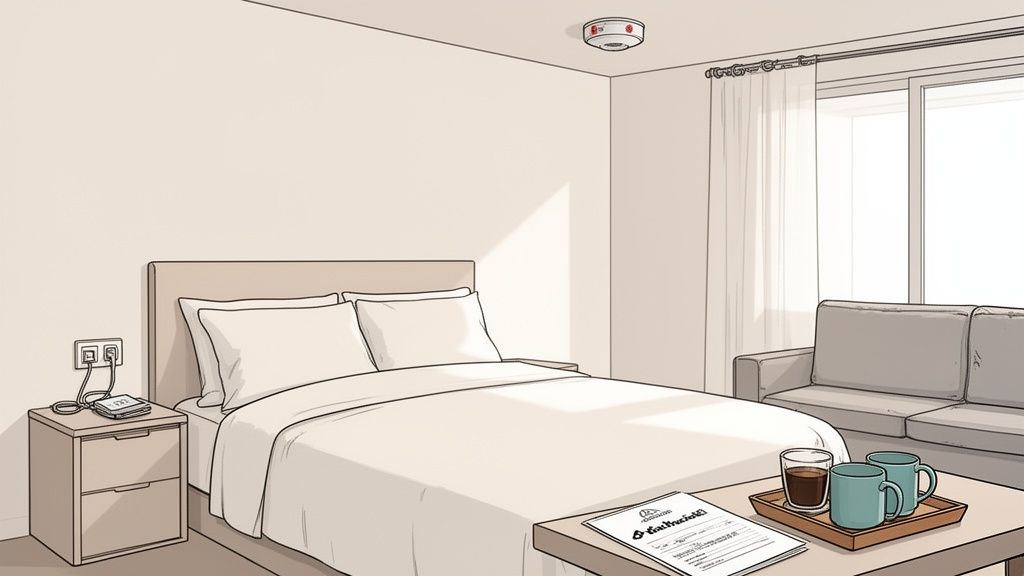
Your Photos Are Your Most Powerful Tool
Long before a guest reads a single word of your description, they’re scrolling through your photos. High-quality images are completely non-negotiable—they're the single most important factor in getting someone to click on your listing. You don't need to hire a professional right away, but you do need to put in the effort.
We've shot most of our own photos over the years, often with just a smartphone, by sticking to a few simple rules that always work.
Let there be light. Open every curtain and blind, and turn on every single light in the house. Always shoot during the daytime to get those bright, airy photos that make a space feel clean and welcoming. Whatever you do, avoid using flash; it just creates harsh, unflattering shadows.
Stage every single shot. Make the beds perfectly, fluff the pillows, and clear all the clutter off countertops and tables. We like to add a small, thoughtful touch, like a bowl of fresh limes on the kitchen counter or a couple of neatly folded towels on the bed. It makes the space feel lived-in and cared for.
Show off the vibe, not just the room. Don't just take wide-angle shots of empty rooms. Capture the details that give your home its character. Zoom in on that cozy reading nook, the view from the balcony, or the fancy espresso machine you provide. You want to help guests imagine themselves actually enjoying the space.
Your goal here is to tell a visual story. The first few photos need to be your absolute showstoppers—a stunning shot of the living room, the master bedroom, or a unique feature that sets you apart. This is what will make people stop scrolling and click.
Writing a Description That Sells the Experience
Once your photos have piqued their interest, your words need to seal the deal. This is your chance to highlight what the pictures can’t fully capture—the feeling of your home and the unique experience you're offering.
Your headline is your hook. Forget something generic like "2 Bedroom Condo with Pool." Try to paint a picture. For our Tulum condo, we might use a title like, "Boho-Chic Retreat with Private Plunge Pool, Steps to Town." It immediately sets a scene and highlights a killer feature.
When it comes to the summary, it’s all about storytelling.
We’ve found the most effective descriptions don’t just list features; they describe benefits. Instead of saying, "There's a back patio," we say, "Enjoy your morning coffee on the private, sun-drenched patio." It helps guests visualize their stay and connect emotionally with the space.
Remember to be honest and transparent. If your apartment is on the fourth floor with no elevator, say so. Managing expectations is the absolute key to getting great reviews.
Strategically Selecting Amenities and Setting House Rules
The amenities section of your listing is more than just a checklist; it's a powerful tool for getting found in search. Guests are constantly filtering for specific things like "pet-friendly," "hot tub," or "dedicated workspace." Go through the entire list Airbnb provides and meticulously check off everything you offer. The more searchable features you have, the more often your listing will pop up.
Finally, your house rules are all about setting clear expectations from the get-go. This isn't about being overly strict; it’s about making sure you and your guests are a good fit. Keep your rules simple, clear, and friendly.
Be specific. Instead of a blunt "No parties," try something like, "We welcome small gatherings, but loud parties that disturb the neighbors are not permitted."
Explain the 'why.' Briefly explain the reason behind a rule. For example, "Please respect quiet hours after 10 PM as we have close relationships with our wonderful neighbors."
Keep it positive. Frame rules in a positive light whenever you can. "Please enjoy smoking on the outdoor patio" sounds so much better than "No smoking inside."
Clear rules protect your property and help guests understand how to be respectful, which leads to a smoother experience for everyone involved. To attract a steady stream of guests, consider broader strategies for marketing rental properties that extend beyond just the Airbnb platform.
Mastering Your Pricing and Calendar Strategy
Getting your Airbnb price right can feel like walking a tightrope. Go too high, and you're staring at an empty calendar. Price too low, and you're leaving money on the table. After years of tweaking rates for our places in DC and the Riviera Maya, we've learned that a smart pricing strategy isn't static—it's dynamic, driven by data, and it's your single most powerful tool for maximizing income.
It all begins with knowing your local market. Before you even think about setting a price, you need to do a little recon. Spend some real time scrolling through comparable listings in your area. Look at places that are a similar size with similar amenities, and see what they're charging for weekdays, weekends, and during different seasons. This isn't just busywork; it's how you establish a solid baseline for what guests in your area are actually willing to pay.

To Smart Price or Not to Smart Price
Airbnb pushes a tool called Smart Pricing, which automatically adjusts your nightly rate based on its own demand algorithm. It’s a tempting, set-it-and-forget-it option, but honestly, we've found it has some serious drawbacks.
The upside? It’s incredibly simple and reacts to some market trends without you having to lift a finger.
The downside? From our experience, it often prices properties too low, especially during high-demand periods like holidays or big local events. Its goal is to get you a booking, not necessarily the most profitable booking.
We learned early on to set our own rates. Yes, it’s more hands-on, but it gives us total control to capitalize on what makes our properties special and what’s happening locally. This is how you really start to optimize your revenue.
Building Your Own Dynamic Pricing Model
Start thinking about your pricing like an airline does. A seat on a Tuesday morning flight in February is going to cost a lot less than the same seat on the Friday before a holiday weekend. Your property is exactly the same.
Here’s the simple framework we use to set our own dynamic rates:
Find Your Base Rate: This is your starting point—your standard, non-peak weekday price. It needs to be competitive with those comparable listings you researched earlier.
Add a Weekend Premium: For most locations, demand spikes on Fridays and Saturdays. We typically bump our rates by 20-40% for those nights.
Think Seasonally: This one is huge. For our beach properties in Mexico, high-season rates in the winter are dramatically higher than in the summer. Back in DC, spring and fall are prime time. You have to understand the tourist rhythm of your city and price accordingly.
Hunt for Local Events: This is where you can really see a boost. Is there a massive conference, a music festival, or a major sporting event coming to town? Demand is about to skyrocket, and your prices should, too.
The real secret is just being proactive. We sit down at least once a month to review our calendar and pricing, specifically looking ahead at local event schedules to manually adjust our rates. This one habit has consistently boosted our revenue far beyond what any automated tool would have delivered.
Smart Calendar Management for Better Bookings
Your calendar settings are just as critical as your pricing. Managing it smartly can boost your profitability and, just as importantly, reduce the stress of frantic, back-to-back turnovers.
Set Minimum Night Stays: A one-night booking is often more trouble than it's worth when you factor in the cleaning costs and coordination. We always set a two or three-night minimum, especially on weekends, to make sure every booking is actually profitable.
Block Off Prep Time: Use your calendar settings to automatically block one day between bookings. This gives your cleaning team a comfortable, stress-free window to do their job right and ensures you're never scrambling.
Use a Channel Manager for Multiple Listings: If you're listing on both Airbnb and Vrbo, a channel manager is a non-negotiable. It syncs your calendars across all platforms in real-time to prevent that dreaded double-booking nightmare.
When you get this right, a thoughtful pricing and calendar strategy is what turns hosting from a casual hobby into a legitimate business. While the average global nightly rate hovers around $163, the top-performing hosts are hitting much higher occupancy and revenue numbers. In the U.S., hosts managing multiple units are seeing occupancy rates around 56.2% simply by fine-tuning these very strategies. If you want to dive deeper into the data, you can discover insights on hospitality trends from Engine.
Automating Your Guest Communication and Operations
Exceptional hospitality is built on timely, helpful communication. But being a great host doesn't mean you have to be glued to your phone 24/7, anxiously waiting for the next guest question to pop up. This is where you learn to work smarter, not harder, by building systems that run in the background, giving your guests what they need, right when they need it.
When we started managing our properties in the Riviera Maya from our home base in DC, we couldn't just pop over to fix a Wi-Fi issue. We had to create systems that empowered our guests and our local teams. This shift from reactive to proactive management was a total game-changer, and it’s the secret to scaling your hosting business without burning out.
Setting Up Smart, Automated Messaging
The key to automation is to anticipate your guests' needs at each stage of their journey. Airbnb's built-in scheduled messaging tool is perfect for this. It lets you create message templates that automatically go out at specific times, ensuring consistent and professional communication for every single booking.
Here are the three essential messages we have set up for all our properties:
The Booking Confirmation: This message goes out instantly after a guest books. It’s a warm thank you and a confirmation of their dates. We also use this message to let them know they’ll receive their check-in details a few days before arrival, which manages their expectations right away.
The Pre-Arrival Check-In Guide: We schedule this one to send 48-72 hours before check-in. It includes all the critical information: the full address, lockbox or smart lock codes, parking instructions, and a link to our digital guidebook.
The Pre-Checkout Reminder: This message is scheduled for the evening before checkout, usually around 7 PM. It’s a friendly reminder of the checkout time and any simple departure tasks, like taking out the trash or starting the dishwasher.
These three simple messages handle the majority of routine communication, freeing you up to focus on more important things while still making your guests feel well-cared for.
The Power of a Digital Guidebook
If there’s one tool that has saved us more time than any other, it’s the digital guidebook. Think of it as an interactive, always-on concierge for your property. Instead of a dusty binder on the coffee table, a digital guide lives on your guests' phones, providing instant answers to their most common questions.
In our experience, a comprehensive digital guidebook can eliminate up to 80% of repetitive guest questions. The first time you get to sleep through the night without a "What's the Wi-Fi password?" message at 11 PM, you'll understand its value.
We build our guidebooks using SmoothStay, which lets us create a beautiful, custom-branded guide for each property. It's where we put everything:
Wi-Fi Password: Front and center, impossible to miss.
Appliance Instructions: Short videos or step-by-step guides for the coffee maker, TV, and thermostat.
House Rules: A friendly recap of the key rules they agreed to.
Local Recommendations: Our personal favorite restaurants, coffee shops, and things to do, complete with addresses and links.
This not only provides immense value to your guests but also positions you as a knowledgeable, professional host.
Streamlining Your Cleaning and Turnover Process
Finally, a smooth operation relies on a flawless turnover process. The goal is to make it so efficient that it’s almost invisible to you. The key to this is creating a clear, repeatable system for your cleaning team.
We created a detailed checklist that our cleaners use for every single turnover. It’s not about micromanaging; it’s about setting a clear standard for cleanliness and ensuring nothing is ever missed. The checklist includes everything from sanitizing high-touch surfaces to restocking toilet paper and coffee. For a deeper dive into creating these systems, our complete guide to vacation rental automation covers everything from messaging to operations.
Automating these core parts of your business—communication, guest information, and cleaning—is what allows you to deliver five-star hospitality consistently, whether you have one property or ten.
Achieving Consistent Five-Star Reviews
Positive reviews are the lifeblood of your Airbnb. They’re the social proof that tells future guests, “This place is great, and you’ll be in good hands.” After hosting for more than a decade, we’ve learned that earning consistent five-star feedback isn’t about one grand gesture. It’s about a series of small, thoughtful actions that make guests feel genuinely cared for.
It all starts with a seamless check-in. A guest's first few moments at your property set the tone for their entire stay. Clear, simple instructions delivered a day or two before arrival can prevent a world of stress for a weary traveler. This is the moment to be overly clear—provide photos, lockbox codes, and parking details so there’s absolutely no guesswork involved.
Communicating Like a Pro Host
Once your guests are settled in, a little proactive communication goes a long way. A quick message on the first morning of their stay shows you’re available without being intrusive.
Something simple like, “Hope you settled in comfortably! Just wanted to check in and see if you need anything at all,” is perfect. This small touch often heads off minor issues before they have a chance to become bigger problems.
Of course, things will eventually go wrong. The Wi-Fi will go out, or a pipe will leak. How you handle these moments is what truly defines you as a host and separates the good from the great.
We’ve learned that when an issue arises, the best approach is to respond with empathy, act with urgency, and communicate transparently. Acknowledge the inconvenience, apologize sincerely, and then clearly outline the steps you’re taking to fix it. Guests are often more understanding than you’d think, especially when they see you’re actively working to resolve their problem.
The Gentle Art of Encouraging Reviews
After a successful stay, you need to gently nudge your guests to share their experience. A pushy request can definitely backfire, but a well-timed, friendly message often does the trick.
We typically send a message on the morning of checkout that says something like this: “Thanks again for staying with us! We hope you had a wonderful trip. We’ve left you a review and would be so grateful if you could take a moment to share your feedback about your stay when you have a chance.” It’s polite, low-pressure, and highly effective.
Finally, treat every piece of feedback—both public reviews and private messages—as a gift. It’s free advice on how to make your property better. If a guest mentions the kitchen knives are dull, replace them. If they suggest a lamp for the reading corner, consider it. This constant process of listening and refining is the real secret to becoming a top-rated host who doesn't just get bookings, but earns loyal, repeat guests.
Your Airbnb Hosting Questions, Answered
Jumping into the world of Airbnb hosting always kicks up a lot of questions. Over the years, we've heard just about all of them from hosts who are just getting started. Let’s get you some straight answers to the most common ones.
How Much Can I Realistically Make?
Honestly, this is the million-dollar question, and it really hinges on your location, property size, and what the local demand looks like. Your best first move is to do some recon. Hop on Airbnb and see what similar listings in your neighborhood are charging per night.
For a more data-driven forecast, tools like AirDNA can give you a solid baseline. Just remember that things like seasonality, big local events (like a festival or conference), and the overall quality of your listing will make a huge difference. A well-run property can easily become a serious source of supplemental income—or even scale into a full-time gig.
What Are the Biggest Risks I Should Know About?
The main things that keep hosts up at night are property damage, difficult guests, and getting tangled up in local regulations. The good news is you can get way out in front of these issues. A thorough guest screening process, crystal-clear house rules, and a security deposit are your first lines of defense.
While Airbnb’s AirCover for Hosts is a nice safety net, it is not a replacement for proper insurance. We can't stress this enough: get a dedicated short-term rental insurance policy to make sure you’re truly covered.
It's also absolutely critical to stay on top of your city's short-term rental laws. A little homework now can save you from big fines or legal headaches later.
How Do I Handle a Tough Guest or a Bad Review?
Sooner or later, it happens to every host. When you're dealing with a difficult guest, the golden rule is to keep all your communication on the Airbnb platform. This creates an official record. Stay professional, keep your cool, and focus on finding a solution.
If a negative review lands on your listing, take a deep breath before you do anything. Then, post a public response that is polite and professional. Address their points calmly, state the facts without getting defensive, and mention any steps you took to make things right. Future guests will see your thoughtful reply, and that often says more about you as a host than the original bad review.
We built SmoothStay because we know firsthand the challenges hosts face. Our goal was to eliminate the stress of guest communication by putting everything they need into one beautiful, easy-to-use digital guidebook. With AI-powered features, customizable designs, and scalable pricing, our platform is designed by hosts to help you deliver a five-star experience, every single time. Start your free 14-day trial today and see the difference for yourself.