How to Make Money with Airbnb: Insider Tips from a 10+ Year Superhost
Discover how to make money with airbnb with proven strategies from a 10+ year Superhost. Get actionable tips on setup, listing optimization, and growth.
Disclosure: Some links in this article are affiliate links. If you make a purchase, we may earn a commission at no extra cost to you. This helps support our content.
The simple answer to how to make money with Airbnb is to create a desirable space in a good location, list it with compelling photos and descriptions, and manage it efficiently to earn five-star reviews. It’s about building a small hospitality business, one guest at a time.
Your Foundation for Airbnb Success
Getting started on Airbnb can feel like a huge task, but after more than a decade of hosting, we’ve learned it all comes down to a solid foundation. Whether you’re renting a spare room in your Washington, D.C. house or launching a beach condo in Tulum, the core principles are the same. This is about building a sustainable business, not just chasing a quick payout.
The goal here is to give you a clear, actionable path to get your property guest-ready and listed efficiently. We want to help you sidestep the common mistakes we made early on.
Understanding The Potential And The Market
Before you buy a single pillow, you need to understand the numbers. Imagine turning your spare bedroom into a source of income—that's the reality for over 5 million Airbnb hosts worldwide. They're the ones driving the platform's massive $11.94 billion revenue in the 12 months ending September 30, 2025.
With 8 million active listings globally, there's plenty of opportunity. The average host in a major market like North America can expect nightly rates around $173.
But raw numbers only tell part of the story. Your success depends entirely on your specific market. Start by asking yourself:
Who is my ideal guest? Are they families, solo business travelers, or couples on a weekend getaway?
What does my competition look like? Dive into nearby listings. Analyze their pricing, amenities, and occupancy rates to see what works.
What are the local regulations? Some cities have strict rules on short-term rentals. Do your homework now to avoid hefty fines later.
We’ve always found that the most successful hosts don’t just offer a place to sleep; they solve a problem for their target traveler. For our D.C. house, that meant creating a comfortable base for families visiting the capital. For our Riviera Maya properties, it’s all about offering a seamless beach escape.
To get a clearer picture of your earning potential, let's look at how occupancy rates can impact your bottom line.
Potential Annual Earnings at Different Occupancy Rates
This table illustrates potential gross annual income for a single property based on its Average Daily Rate (ADR) and occupancy percentage, before fees and expenses.
Average Daily Rate (ADR) | Annual Income at 40% Occupancy | Annual Income at 55% Occupancy | Annual Income at 70% Occupancy |
|---|---|---|---|
$125 | $18,250 | $25,094 | $31,938 |
$175 | $25,550 | $35,131 | $44,713 |
$225 | $32,850 | $45,169 | $57,488 |
$275 | $40,150 | $55,206 | $70,263 |
As you can see, even a small increase in your occupancy rate can make a significant difference in your annual revenue. This is why nailing your listing and guest experience is so critical.
Preparing Your Space For Guests
Once you've done your research, it’s time to get your space ready. This isn't just about cleaning; it's about creating an experience. The whole process really breaks down into three core phases: research, preparation, and listing.
This flowchart breaks down the essential steps for building your Airbnb foundation.
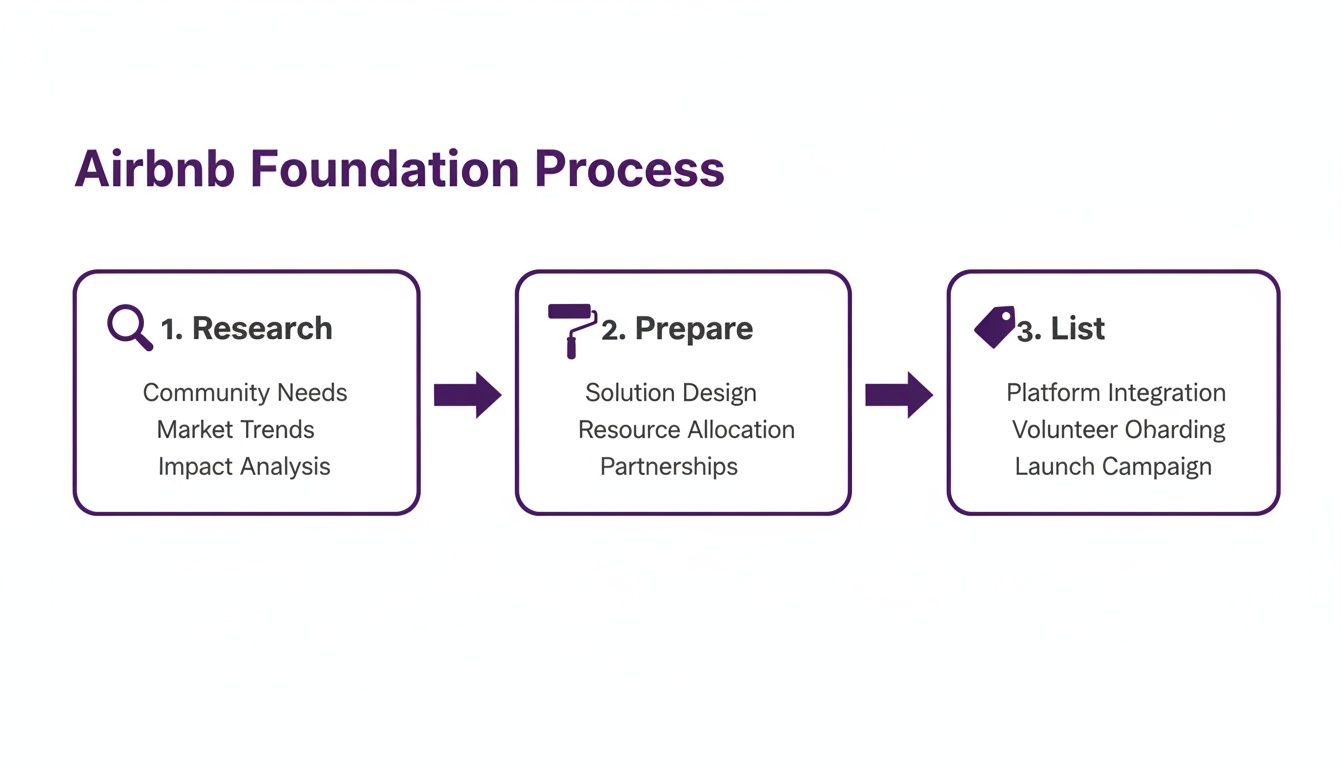
As the diagram shows, success starts long before your first guest arrives. Careful market analysis and thoughtful property setup are the bedrock of a profitable listing.
Focus on durable, stylish furnishings and guest-centric amenities. Think sharp knives in the kitchen, blackout curtains in the bedrooms, and fast, reliable Wi-Fi everywhere. These small touches are what differentiate you from the competition and are often the details guests mention in five-star reviews.
Getting Your Finances In Order
Treating your Airbnb like a business from day one is the most important advice we can give. That means tracking every dollar that comes in and goes out. To build a strong financial foundation, accurately tracking your income and expenses is non-negotiable.
Honestly, learning how to hire a bookkeeper can reclaim your sanity and ensure your financial records are pristine from the start.
By setting up this foundation correctly, you're not just listing a room; you're launching a business poised for long-term profitability and growth.
Crafting a Listing That Turns Views into Bookings
Think of your Airbnb listing as your digital storefront. In a marketplace packed with options, your listing is the one thing that separates a fully booked calendar from an empty one. We've learned over the years that getting this right is a mix of art and science, and it all boils down to two things: incredible photos and compelling words.
Nailing these two elements means you’re creating an honest, attractive, and informative page that answers a guest’s questions before they even think to ask. This proactive approach is the first real step toward smoother hosting and, ultimately, making more money with your Airbnb.
Investing in Professional Photography Is Non-Negotiable
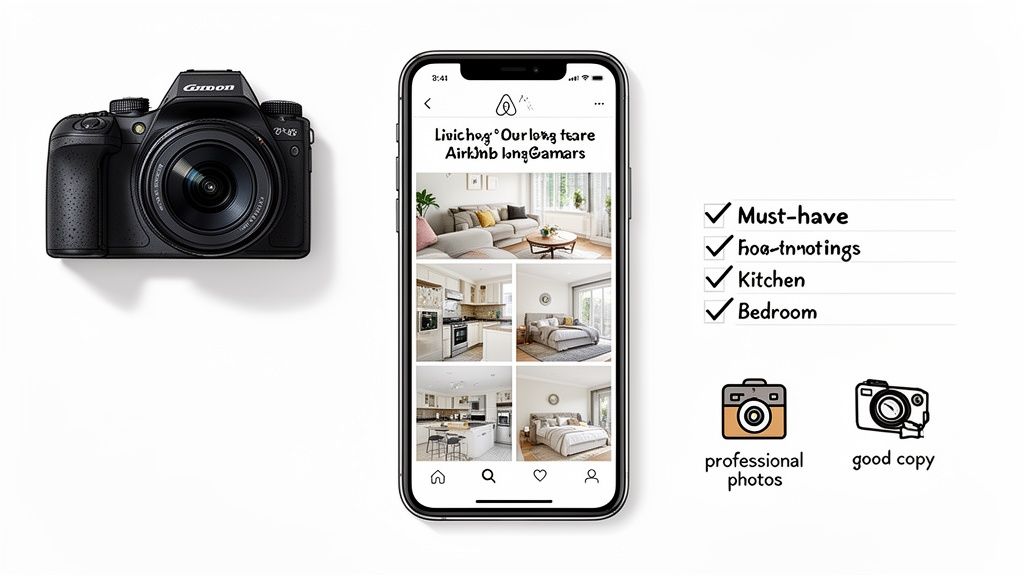
If there's one piece of advice we give every new host, it's this: hire a professional photographer. Your photos are the most important factor in a guest’s decision to even click on your listing, let alone book it. We learned this the hard way with our first property; as soon as we swapped our phone shots for professional images, our booking rate shot up almost overnight.
High-quality photos do more than just show off the space—they sell an experience. A pro knows exactly how to use light, angles, and staging to make your property look its absolute best without being misleading.
Your photo gallery should tell the complete story of a stay. Here's a simple shot list we use as a starting point for every new property:
The Hero Shot: That one stunning photo of the exterior or living room that becomes your cover image.
Every Bedroom: Capture each one from multiple angles, highlighting the bed, windows, and any seating.
The Kitchen: Show off your well-stocked kitchen, including the coffee station, appliances, and cookware.
Living & Common Areas: Emphasize the spaces where guests will relax and spend time together.
Bathrooms: They need to look sparkling clean. Show off key features like a rain shower or a soaking tub.
Outdoor Spaces: Patios, balconies, and backyards are huge selling points. Don't skip them.
Unique Details: Got a hot tub, a cozy reading nook, or cool local art? Showcase it!
Think of your photo gallery as a virtual tour. A potential guest should be able to mentally walk through your entire home just by swiping through the images. This builds trust and sets clear expectations right from the start.
Writing Copy That Sells and Sets Expectations
Once your photos have grabbed their attention, your words need to seal the deal. Your headline and description are your chance to highlight what makes your property unique and to speak directly to the kind of guest you want to attract.
Start with a magnetic headline. Instead of something generic like "2BR Condo in Tulum," try painting a picture: "Boho-Chic Condo with Rooftop Pool, Steps to the Beach." That immediately tells guests about the style, a key amenity, and the location.
Your description should be easy to scan and packed with useful information. We've found that breaking the text down into small, digestible chunks works far better than a wall of text.
Structuring Your Listing Description for Success
We organize our descriptions to guide the reader through the property and the experience. This approach helps manage expectations and seriously cuts down on repetitive questions.
The Hook: Kick things off with a short, welcoming paragraph that sums up the best parts of your property and the experience it offers.
The Space: Dedicate a section to describing the layout, bedrooms, kitchen, and living areas. Use bullet points to list key amenities so people can scan them quickly.
Guest Access: Be crystal clear about what parts of the property guests can use, especially if it’s a shared space.
The Neighborhood Vibe: Describe the local area, mentioning nearby attractions, great restaurants, or anything unique that would appeal to your ideal guest.
Getting Around: Give them helpful info on transportation, like parking, public transit, or how walkable the area is.
Throughout your copy, weave in keywords that potential guests are likely searching for, like "family-friendly," "pet-friendly," "work from home setup," or "romantic getaway." This simple SEO tactic helps your listing show up in more relevant searches on Airbnb. For a deeper dive, check out our guide on how to write a killer Airbnb description.
By combining stellar photos with clear, persuasive copy, you create a listing that doesn’t just get views—it consistently turns them into bookings.
Mastering Your Pricing and Calendar Strategy
Leaving money on the table is one of the easiest and most common mistakes new hosts make. After setting up a beautiful listing, many just switch on Airbnb's Smart Pricing and hope for the best. While it’s a decent starting point, letting it run on autopilot means you're almost certainly not maximizing your revenue.
The real key to making serious money with Airbnb is dynamic pricing—the art and science of adjusting your rates based on real-time market data. We quickly learned that a more hands-on approach was essential for our properties. Our strategy evolved to bake in seasonal trends, local events, and competitor data to find that sweet spot where our price is attractive to guests and highly profitable for us.
Setting Your Foundational Rates
Your first step is to nail down a solid base price. This isn't just a random number; it's the absolute minimum you're willing to accept for a single night that covers all your costs—fixed and variable—while still turning a profit. This includes everything from your mortgage or rent to utilities, supplies, and cleaning fees.
When you're fine-tuning your pricing, it's critical to account for cleaning expenses correctly. Using a specialized tool like an Airbnb cleaning fee calculator can help you set a fair and accurate fee that covers your costs without scaring away potential guests. Once that's set, you can build out your entire pricing structure.
Here’s a simplified look at the core parts of a dynamic pricing model:
Base Rate: Your profitable minimum for a low-demand weeknight.
Weekend Premium: A higher rate for Friday and Saturday nights, typically 10-30% more than your base.
Seasonal Adjustments: Higher prices for peak season (like summer for our beach properties) and lower prices for the off-season to stay competitive.
Event-Based Pricing: Big price hikes for major local events, holidays, or conferences when demand skyrockets.
Think of your base rate as your anchor. All other pricing decisions—weekend bumps, seasonal highs, and last-minute discounts—should pivot from this carefully calculated number. Getting it right is fundamental to your profitability.
Leveraging Minimum Stays and Calendar Rules
Pricing isn't just about the nightly rate; it's also about how you manage your calendar. Minimum-stay requirements are one of your most powerful tools for maximizing both occupancy and revenue. Setting a one-night minimum might seem like it opens you up to more bookings, but it often leads to high turnover costs and awkward, unbookable gaps in your calendar.
For most of our properties, we’ve found a two- or three-night minimum works best. It attracts more serious guests and makes the effort of cleaning and prepping for each stay far more worthwhile.
Here are a few calendar strategies we swear by to stay profitable:
Orphan Day Rules: To avoid those unbookable single-night gaps between longer stays, we use calendar rules that automatically offer that night at a slight discount or require it to be booked with an adjacent reservation.
Longer Minimums for Holidays: For major holidays like Christmas or the Fourth of July, we set a longer minimum stay—think 5-7 nights—to capture guests looking for a full vacation week.
Last-Minute Discounts: If we have unexpected availability within the next few days, we’ll offer a small discount of 10-15% to attract spontaneous travelers and fill the vacancy.
This kind of proactive calendar management ensures you’re not just getting bookings, but the right kind of bookings—longer, more profitable stays that actually reduce your operational workload. You can learn more about the nuances of this approach by exploring our deeper guide on the key factors to consider when setting up your Airbnb pricing strategy.
By combining smart pricing with strategic calendar management, you’ll be well on your way to running a much more lucrative Airbnb business.
Building Systems for a Five-Star Guest Experience
Consistently earning five-star reviews isn't a matter of luck. It’s the direct result of building seamless, repeatable systems that deliver a top-tier experience for every single guest—all while saving you a ton of time and stress. This is where you graduate from being a reactive host to a proactive business owner.
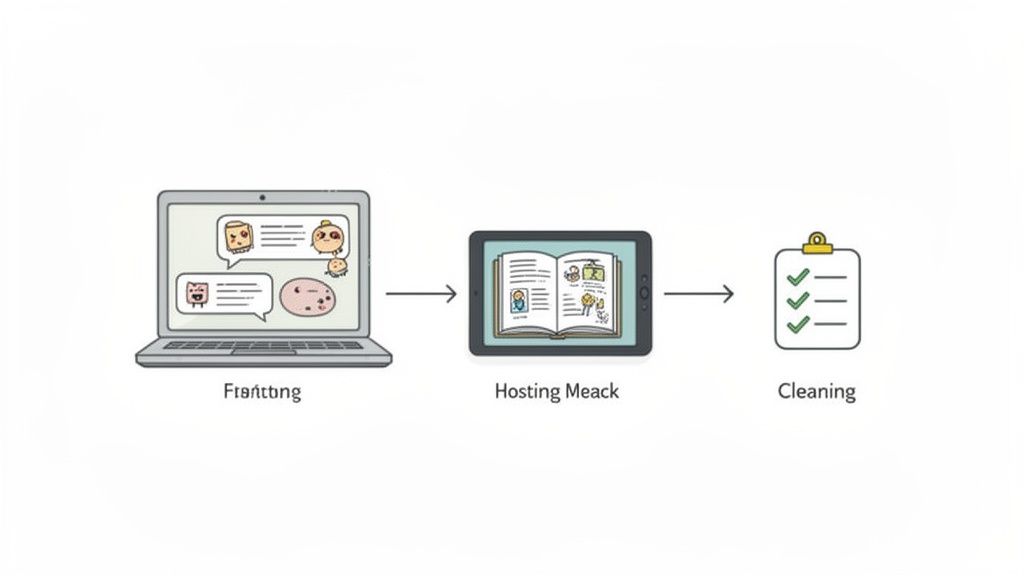
This shift in mindset is all about creating a well-oiled machine. It means finding and managing a reliable cleaning team, automating guest communication with perfectly timed messages, and dialing in a check-in process so smooth that guests feel relaxed the moment they arrive.
The Power of a Reliable Cleaning Crew
Let's be direct: your cleaning team is the most important partnership you'll have in this business. A spotless property is the absolute minimum for a good review; anything less is a fast track to complaints and headaches. Finding the right crew took us some trial and error, but it's an investment that pays for itself ten times over.
Look for a team that actually specializes in vacation rentals. They understand the need for speed, consistency, and an eye for the little details guests always notice, like perfectly staged pillows or leaving a welcoming scent. We give our cleaners a detailed checklist with photos showing how each room should look. This removes all the guesswork and ensures our standards are met, every single time.
We consider our cleaning team a true extension of our hospitality business. We pay them well, treat them with respect, and communicate clearly. In return, they're our eyes and ears on the ground, often spotting maintenance issues before they become real problems for a guest.
Automating Guest Communication
Early on, we spent hours answering the same questions over and over. "What's the Wi-Fi password?" "Where should we park?" "What's the best place for tacos?" It was exhausting and totally inefficient. Automating our messaging was a complete game-changer.
By setting up scheduled messages, you can proactively send key information right when guests need it. This not only makes you look like a hyper-attentive host but also drastically cuts down on those repetitive questions.
Here’s a simple messaging flow that works wonders for us:
Booking Confirmation: An immediate thank-you that confirms their reservation and sets expectations.
Pre-Arrival: Sent a few days before check-in, this message includes the address, parking info, and a link to our digital guidebook.
Check-In Day: This goes out a few hours before their arrival with the access code and a final welcome.
Mid-Stay Check-Up: A short, friendly message on their first morning to ask if everything is okay.
Check-Out Instructions: Sent the evening before departure, this message outlines the check-out process, making their morning less stressful.
Leveraging Technology with a Digital Guidebook
This brings us to one of the most impactful tools in our hosting arsenal: a digital guidebook. When you put all the essential info in one accessible, professional-looking place, you show guests you've thought of everything. That's how you earn those coveted five-star reviews.
For a savvy host, the goal is to make money with Airbnb by creating an experience so smooth it practically runs itself. Recent data shows just how big the opportunity is, with 134.4 million nights and experiences booked globally in a single quarter, fueling $3.1 billion in revenue. The key to cashing in is efficiency; hosts who slash repetitive guest questions using tools like AI-powered guides are the ones who see their five-star reviews—and their income—skyrocket. You can see more of the latest Airbnb statistics at ElectroIQ.
A great digital guidebook acts as a 24/7 concierge for your guests. We use SmoothStay for all our properties because its customizable, guest-first features let us create a branded, professional experience. Its AI-powered capabilities have been instrumental in cutting our guest inquiries by nearly 80%, freeing us up to focus on growing our business instead of answering the same questions over and over.
This proactive approach—building systems, automating communication, and providing comprehensive information—is what separates good hosts from great ones. It's how you create an experience that not only impresses guests but also makes your life as a host infinitely easier.
Scaling Your Airbnb Business to the Next Level
Once you’ve got the systems for your first property running like a well-oiled machine, it's natural to start thinking bigger. Making that leap from a side hustle to a full-fledged business is the next logical step. We hit this point with our D.C. house; the check-ins, cleaning, and guest communication were so smooth that we knew we had a model we could replicate. That’s when we turned our sights to our beach properties in Playa del Carmen and Tulum, applying the very same principles.
Scaling isn’t just about collecting more keys; it’s a total shift in how you think about your operations and finances. It’s about taking your proven processes and turning them into a standardized playbook you can hand off to a team. This is where your small operation truly begins to grow into a real business.
Choosing Your Growth Model
When you're ready to expand, you’ve got a few different paths you can take. Each one comes with its own level of risk, required investment, and potential reward. We’ve explored a mix of these ourselves, and honestly, the "best" one really depends on your financial situation and how much risk you're comfortable with.
Purchasing More Properties: This is the most capital-intensive route, no doubt. But it also offers the highest potential for long-term equity and appreciation. It demands rock-solid financial planning and a deep understanding of which markets have real promise.
Rental Arbitrage: This model involves leasing a property long-term and then re-listing it on Airbnb. It’s a lower-cost way to grow your portfolio, but it absolutely hinges on getting explicit, written permission from the landlord and carefully navigating local regulations.
Co-Hosting: If you've mastered the operational side of things but don't have the capital to buy, co-hosting is a fantastic option. You manage properties for other owners in exchange for a slice of the booking revenue, which is typically between 15-25%.
In our experience, the key to successful scaling is to standardize everything. From the cleaning checklists to the automated messages, consistency is what allows you to maintain a five-star experience across multiple properties without completely burning out.
Standardizing for Quality and Efficiency
As your portfolio grows, you simply can't be the person doing everything anymore. Your success will depend on creating foolproof systems that other people can execute flawlessly. This means documenting every single process, from how to stage the welcome basket to the exact wording of a check-out reminder message.
Think of it like creating a franchise model for your own brand. A guest should get the same high standard of service whether they're staying in your first property or your tenth. This consistency not only protects your hard-earned reputation but also makes training new team members, like cleaners or virtual assistants, incredibly straightforward.
Tracking the Right Financial Metrics
When you start scaling, you have to shift your mindset from host to investor. Gut feelings don’t cut it; every decision needs to be backed by data. It's no longer just about making money with Airbnb—it's about maximizing your returns strategically.
The numbers show that scaling isn't just hype; it’s a calculated move. Airbnb's recent financial results reported a staggering $4.1 billion in quarterly revenue and a massive $4.5 billion in free cash flow over the trailing 12 months. For hosts, this signals a robust market where strategic expansion pays off. This is especially true since emerging markets are showing double the growth in nights booked compared to core ones. You can read more about Airbnb’s Q3 financial results to see just how strong the market is.
To make smart expansion decisions, you need to live and breathe these key performance indicators (KPIs) for each property:
Metric | What It Tells You | Why It Matters for Scaling |
|---|---|---|
Occupancy Rate | The percentage of booked nights. | Helps you identify underperforming properties and spot high-demand markets. |
ADR (Average Daily Rate) | Your average income per booked night. | Crucial for forecasting revenue and setting competitive pricing strategies. |
RevPAR (Revenue Per Available Room) | Your ADR multiplied by your occupancy rate. | This is the gold standard for measuring profitability and comparing performance across your portfolio. |
By keeping a close eye on these metrics, you can quickly identify which properties are your winners, which markets offer the best opportunities for growth, and when it’s the right time to make your next move. This data-driven approach is what transforms a successful Airbnb listing into a scalable, profitable hospitality business.
Burning Questions About Making Money on Airbnb
After managing our own properties for over a decade—from our family home in D.C. to condos down in the Riviera Maya—we get asked a lot of the same questions by hosts who are just starting out. Here are the straight-up, honest answers based on what we’ve learned works (and what doesn't).
So, How Much Can I Realistically Make?
This is always the first question, and the only honest answer is: it depends entirely on your market, your property, and how you run it. Profit isn't just about your nightly rate. It’s a delicate dance between occupancy, your operational costs, and what people are willing to pay in your area.
A host in a bustling city center will see a totally different revenue stream than someone in a quiet, seasonal beach town. The trick is to be brutally realistic with your numbers. Before we even think about listing a property, we build out a detailed spreadsheet. It accounts for everything: the mortgage, utilities, supplies, cleaning fees, and even a 15% vacancy buffer for those slower months. This gives us a crystal-clear picture of our break-even point and helps us set profit goals that are actually achievable.
Forget trying to match the top earner in your city overnight. Your first goal should be to consistently cover your costs. Sustainable income is built on a solid financial foundation, not wishful thinking.
Do I Actually Need to Own a Property to Get in on This?
Absolutely not. While owning is the most straightforward route, it's far from the only one. The short-term rental world is a massive ecosystem with plenty of ways to make money without ever taking on a mortgage.
We've seen people do very well with a few different models. You just have to find what plays to your strengths.
Co-Hosting: This is a fantastic way to get your feet wet. If you've nailed the operational side of things—like guest messaging, coordinating cleaners, and tweaking listings—you can manage properties for other owners. You'll typically earn 15-25% of the booking revenue without any of the risks of ownership.
Rental Arbitrage: This is where you sign a long-term lease on a property and then re-list it on Airbnb. It requires way less capital than buying, but you must get written permission from your landlord. Seriously, don't skip this. You also need to be meticulous about checking local regulations to stay on the right side of the law.
Side Hustles & Services: Every host needs help. You could build a killer business around a specific niche, like specialized vacation rental cleaning, professional-level photography, or even curating and delivering local welcome baskets for other hosts.
Is Airbnb Still Worth It with All the Competition?
Yes, but you have to be smarter about it. The early days of just listing a spare room and watching the cash roll in are pretty much over. With over 8 million listings on the platform now, the market is definitely crowded. But all that competition just means guests have higher expectations, and hosts who deliver a truly great experience will always win.
Today, it's all about standing out. It’s not just about providing a clean bed anymore; it’s about creating a memorable stay. We’ve found that the small, thoughtful touches are what really drive five-star reviews and get people coming back.
Think about what makes a stay feel special. Could you leave an Instant Pot for a family on a longer trip? What about a handwritten list of your favorite local coffee shops that aren't plastered all over the travel blogs? These little details don’t have to cost a lot, but they show you actually care and help you build a brand that guests trust.
How Much Time Does It Really Take to Manage an Airbnb?
Let's be real: in the beginning, it takes a ton of time. The initial setup—furnishing the place, getting great photos, writing the listing, and figuring out your systems—is a huge upfront investment of your energy. But once you get those systems humming, the day-to-day management can become surprisingly hands-off.
Our goal was always to automate as much as humanly possible without sacrificing that personal touch. Using things like scheduled messages and a comprehensive digital guidebook handles the vast majority of routine guest questions. That frees us up to focus on the bigger picture, like improving the property or scouting our next investment. A well-oiled Airbnb can easily be managed in just a few hours a week once you're up and running.
Turning your property into a successful Airbnb is a marathon, not a sprint, but it’s one that’s incredibly rewarding. You're not just renting a space; you're building a small business centered on genuine hospitality.
At SmoothStay, we built our tools based on this exact journey. Our AI-powered digital guidebooks are designed to give your guests everything they need for a seamless, five-star stay, which in turn drastically cuts down your workload so you can focus on growing your business.
Ready to provide a better guest experience with a lot less effort? Start your free 14-day trial of SmoothStay today.