A Host's Guide to Short Term Rental Occupancy Rates
Boost your bookings with our guide to short term rental occupancy rates. Learn to calculate, benchmark, and increase your occupancy with proven strategies.
Disclosure: Some links in this article are affiliate links. If you make a purchase, we may earn a commission at no extra cost to you. This helps support our content.
Your short-term rental occupancy rate is one of the most honest numbers in your hosting business. It’s a simple metric for understanding how you’re really doing.
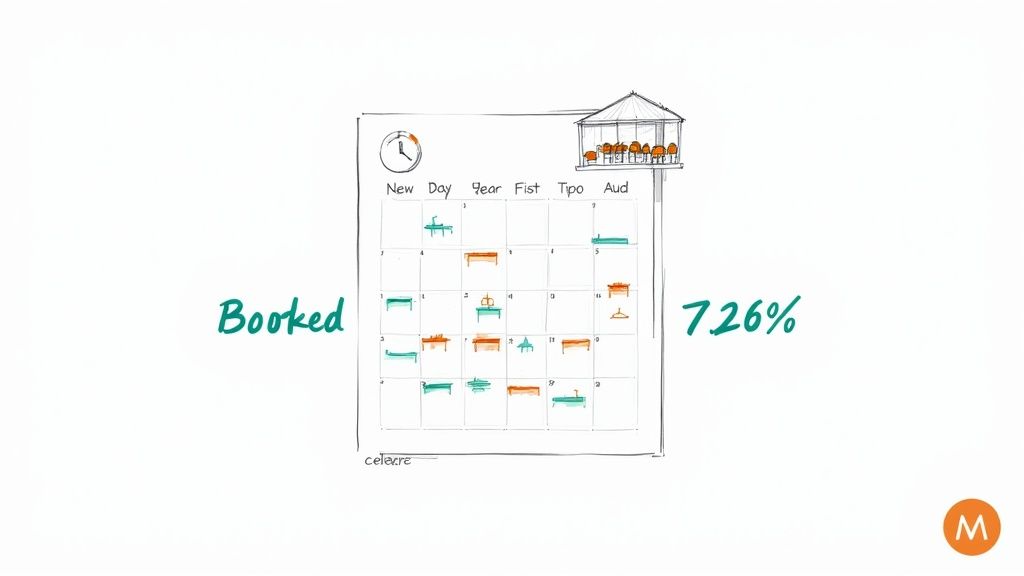
Put simply, it’s the percentage of nights your property was booked compared to the total number of nights it was available. Think of it as the pulse of your rental's financial health.
Why Occupancy Rate is So Foundational
When you’re running a rental, you’re not just a host—you're a small business owner. And every business needs a core metric to track success. For us, it’s occupancy. It cuts through the noise and tells you one critical thing: how often your property is actually making you money.
When my wife and I started with our first property, a four-bedroom house in Washington, D.C., our main focus was getting five-star reviews. Reviews are crucial, of course, but it wasn't until we started obsessively tracking our occupancy rate that we truly shifted from a hobby into a real, profitable business. This single number tells a story about your pricing, marketing, and guest experience all at once.
A Quick Restaurant Analogy
Imagine you own a cozy little restaurant with ten tables. If only two tables are full during the dinner rush, you’re running at 20% occupancy. You might be serving the most incredible food in town, but you’re not close to hitting your potential.
Your short-term rental works the same way. Every empty night is an empty table—a missed opportunity to generate revenue.
The goal isn't just to fill every single night, but to understand the why behind the number. Why was last month so much busier than this one? Are your weekends packed but your weekdays a ghost town? Answering these questions all starts with knowing your occupancy rate.
A healthy occupancy rate is the bedrock of a successful rental business. It signals strong demand, validates your pricing strategy, and directly impacts your bottom line. Get this right, and you’re on the path to maximizing your investment.
What This Number Really Tells You
Keeping an eye on your short-term rental occupancy rate is about more than just hitting a target percentage. It’s about unlocking deeper insights into what’s working and what isn’t. Consistently monitoring this metric helps you:
Validate your pricing: A consistently high rate might mean you’re leaving money on the table. A low rate could be a sign that your prices are too high for the current market.
Spot seasonal trends: You'll quickly see your peak and slow seasons, which allows you to adjust your pricing and marketing strategies accordingly.
Measure your marketing efforts: Did that professional photo shoot or that revamped listing description actually lead to more bookings? Your occupancy rate will give you the answer.
This is the starting point. To really dig in, you can explore a whole range of performance indicators in our complete guide to short-term rental analytics. But it all begins with this one fundamental number.
How to Calculate Your Occupancy Rate (The Right Way)
Knowing your occupancy rate is step one. But calculating it correctly? That’s where the real insight is. It's easy to get this wrong—we made this mistake early on, and it painted a misleadingly rosy picture of our performance. It’s a common pitfall, but thankfully, it’s easy to avoid once you know what to look for.
The basic formula seems simple enough:
Occupancy Rate = (Booked Nights / Available Nights) x 100
But the devil is in the details, specifically in how you define "Available Nights." This is where countless hosts get tripped up. Do you include the week you blocked off for your family's vacation? What about the three days your property was offline for plumbing repairs? The answer dramatically changes your numbers.
The Critical Difference Owner Blocks Make
To get a true measure of your business performance, you should only count the nights that were actually available for a guest to book. This is often called the Adjusted Paid Occupancy Rate, and it’s the metric that really matters.
Here's why this distinction is so important. Let's take our condo in Tulum as an example for a 30-day month:
Booked Nights: 21 nights
Owner-Blocked Nights: 4 nights (we visited for a long weekend)
Maintenance Block: 1 night (had to fix a leaky faucet)
Vacant Nights: 4 nights
If you calculate your occupancy based on all 30 days in the month, you get 21 / 30 = 70%. Not bad, but it’s not the whole truth. Those five blocked-off nights were never actually on the market.
Here’s the more accurate calculation:
Genuinely Available Nights: 30 total nights - 5 blocked nights = 25 nights
Adjusted Occupancy Rate: 21 booked nights / 25 available nights = 84%
That 84% figure gives you a much clearer, more honest picture of how well you’re attracting guests when your property is actually open for business.
Looking Beyond Occupancy Alone
While a high occupancy rate feels great, it doesn't tell the whole story. A full calendar means nothing if your nightly rates are so low that you’re barely breaking even. That's why it's essential to track occupancy alongside two other key metrics to get a complete view.
Average Daily Rate (ADR): This is the average price guests pay per night. It tells you the actual value you're getting for each booking.
Revenue Per Available Night (RevPAN): This is the powerhouse metric. It combines your occupancy and ADR to show your average earnings per available night, giving you a holistic view of your rental's financial health.
Tracking these three metrics together creates a dashboard for your rental's performance. It helps you find that sweet spot between filling your calendar and charging what your property is truly worth. To really dive into the numbers and see how different scenarios play out, our vacation rental investment calculator is a fantastic tool for modeling your potential earnings.
While your occupancy rate is a vital performance indicator, it's just as important to understand how it connects to your overall profitability. Learning how to calculate cash flow on rental property will help you link your booking performance directly to your bottom line.
Benchmarking Your Performance in Your Local Market
So, you've calculated your occupancy rate. The next question is always the same: "Is this number any good?" Knowing you hit 75% last month feels great, but it’s just a number floating in space until you have something to compare it against. This is where benchmarking comes in—it’s how you measure up against the competition right in your own backyard.
The whole point of useful benchmarking is making an "apples-to-apples" comparison. It makes no sense to compare your two-bedroom condo to that massive five-bedroom house down the street. To get a realistic picture, you have to look at properties that are genuinely similar to yours.
Finding Your True Competitors
We learned this lesson the hard way. When we first started with our D.C. house, we were comparing our numbers to the city-wide average. That included everything from tiny studio apartments to sprawling townhomes. Our numbers looked just okay, and frankly, it was a bit discouraging until we seriously narrowed our focus.
For a comparison to mean anything, you need to look at properties with a similar:
Property Type: Compare your condo to other condos, not single-family homes.
Bedroom and Bathroom Count: This is one of the biggest factors guests filter for.
Neighborhood: A property in a buzzing downtown area will have a totally different demand pattern than one in a quiet, residential suburb.
Key Amenities: If you offer a pool or a hot tub, you should be looking at other properties that offer similar perks.
When you focus on this specific competitive set—your real competitors—you get a much more accurate and actionable benchmark for your own short term rental occupancy rates.
Using Data to Set Realistic Goals
Okay, so where do you find this data? This is where industry tools like AirDNA or STR become invaluable. They gather market-level data, letting you filter by location, property size, and more to see what average occupancy rates look like for your direct competitors. This isn't just about satisfying your curiosity; it's about setting achievable goals based on what's actually happening in your market.
The Power of Local Knowledge
Data tools are incredibly powerful, but they’ll never replace your on-the-ground knowledge. Seasonality and local events can cause huge swings in demand that broad data sets might miss. For instance, our peak season in Washington, D.C. is driven by spring tourism and political events—a world away from the winter high season at our beach house in Playa del Carmen.
This local context is everything. Knowing when your city hosts a major conference, a music festival, or a holiday parade allows you to get ahead of demand spikes and adjust your strategy.
The short-term rental market is also in constant motion globally. A look at the numbers shows how different regional dynamics can be, making local benchmarking even more critical.
Regional Occupancy Rate Snapshot
To give you a clearer picture, here’s a comparative look at average occupancy rates across different global regions. Notice how much they can vary.
Region | Average Occupancy Rate | Key Market Trend |
|---|---|---|
North America | 58.2% | Stable demand with moderate supply growth. |
Europe | 56.5% | Strong summer peaks, with increasing urban travel. |
Asia | 62.1% | Rapid growth in emerging tourist destinations. |
Africa | 59.8% | Significant increase in new listings and travel interest. |
This data, based on recent market trends, highlights why a one-size-fits-all approach doesn’t work. For more on these global shifts, you can dig into this detailed market analysis.
Your goal isn't to match the global average; it's to outperform your specific, local market. Use data to set the baseline, then layer in your local expertise to find your competitive edge.
Proven Strategies to Increase Your Occupancy Rate
Knowing your numbers is the first step. The next, more exciting one? Actually improving them.
Boosting your short term rental occupancy rates isn't about luck. It's about deploying smart, repeatable strategies that make your property the obvious choice for travelers. These are the very same tactics we've fine-tuned over a decade of hosting, from our own D.C. home to our properties down in the Riviera Maya.

Master Dynamic Pricing
Setting your prices once and forgetting them is one of the biggest mistakes a host can make. Your market is alive—it ebbs and flows with seasons, holidays, local events, and even weekends. Dynamic pricing is simply the practice of adjusting your nightly rates to match this fluctuating demand.
When a big conference rolls into town, your rates should go up. During a slow Tuesday in the off-season, they should come down to attract budget-conscious travelers. Using a dynamic pricing tool automates this entire process, ensuring you’re never leaving money on the table or pricing yourself out of a booking.
Optimize Your Listing to Perfection
Your online listing is your digital storefront. It needs to be polished, professional, and persuasive. This really boils down to two core components that work together to grab a traveler's attention and not let go.
Invest in Professional Photos: This is non-negotiable. Your photos are the single most important factor in getting a guest to click on your listing. We saw a near-instant 20% jump in bookings for our Playa del Carmen house the moment we hired a professional photographer. It’s the highest ROI investment you can make, period.
Write Compelling Copy: Your photos hook them; your words seal the deal. Tell a story. Don't just list amenities—describe the experience. Instead of "queen bed," write "sink into a plush queen bed after a day of exploring the city." Highlight what makes your property unique and answer potential guest questions before they even have to ask.
Encourage Longer Stays with Strategic Discounts
A one-night booking can sometimes be more work than it's worth, especially after you factor in cleaning and turnover time. Encouraging longer stays is a fantastic way to secure your occupancy calendar and dramatically reduce your workload.
Try offering small, strategic discounts for weekly or monthly stays. For example, a 10% discount for a week-long booking or a 25% discount for a 28-day stay can be incredibly appealing to remote workers or families on an extended vacation. This locks in revenue and gives you a much more predictable income stream.
A recent report highlighted that dynamic pricing tools were instrumental for 62% of hosts in staying competitive. The study also found that in Summer 2025, approximately 40% of STR operators saw increases in both occupancy and daily rates, showing that smart pricing and guest-focused strategies are driving profitability. Read the full analysis on how operators are boosting occupancy and rates on Hostaway.com.
Achieve 5-Star Reviews Through Great Communication
Excellent reviews are your single best marketing tool. They build trust and social proof, making new guests far more likely to book with you. The secret to consistently earning five-star reviews is proactive, clear, and friendly communication.
From the moment a guest books, make them feel welcome and informed. A simple welcome message, crystal-clear check-in instructions, and a quick "hope you're settling in okay!" message on their arrival day go a long, long way.
This is where a digital guidebook becomes a game-changer. It puts all the essential information—from the Wi-Fi password to your favorite local restaurant recommendations—right at their fingertips. This reduces their stress and, just as importantly, reduces your repetitive questions.
Expand Your Visibility Across Multiple Platforms
Don't put all your eggs in one basket. While Airbnb might be the biggest name, platforms like Vrbo, Booking.com, and others attract different types of travelers. Listing your property on multiple channels—a practice known as multi-channel distribution—dramatically increases your visibility.
More eyes on your listing means a higher chance of getting booked. A channel manager is a key tool here, helping you sync your calendars across all platforms to avoid the dreaded double-booking. When we listed our Tulum condo on a second platform, we filled an extra four nights in the very first month, which more than paid for the effort.
These are just a few of the many ways to get your property in front of more potential guests. For an even deeper dive, check out our complete guide on how to increase Airbnb bookings.
How Guest Experience Drives Repeat Bookings and Higher Occupancy
A high occupancy rate isn’t just about attracting new guests; it's about creating an experience that earns glowing reviews and brings people back for more.
Think of it this way: acquiring a new customer is always more expensive than keeping an existing one. That same rule applies directly to hosting. A happy guest who leaves a five-star review and books with you again is the most sustainable path to a consistently full calendar.
This is a lesson we learned quickly with our own properties. At first, we were obsessed with getting the listing perfect. But we soon realized the real magic happens after the booking is confirmed. The experience you provide is your most powerful marketing tool, and it has a direct line to your short term rental occupancy rates.

From Check-In to Check-Out: The Moments That Matter
A memorable stay is built on a series of small, thoughtful interactions that make guests feel genuinely cared for. It’s not about grand, expensive gestures. It’s about reducing friction and adding personal touches that show you're paying attention.
These are the things that consistently lead to better reviews and repeat bookings for us:
Seamless Communication: Proactive, friendly messages before, during, and after their stay show you’re an attentive host who’s on top of things.
A Spotless Space: This is non-negotiable. A clean property is the absolute foundation of a five-star experience.
Personalized Touches: A simple handwritten welcome note or a small local snack can make a huge impression for very little effort.
Anticipating Needs: Providing clear instructions for everything from the coffee maker to the TV remote prevents guest frustration before it even starts.
By turning these small acts of hospitality into a regular part of your process, you create an experience that feels effortless for the guest and becomes second nature for you.
Turning Hospitality into a System
The secret to consistently great guest experiences is to stop reinventing the wheel for every new arrival. Creating systems allows you to deliver five-star service without burning yourself out. One of the most effective systems we ever put in place was a professional digital guidebook.
A great guest experience is your best defense against a slow season. Happy guests leave glowing reviews, which act as social proof to attract new bookings and build a loyal base of repeat visitors who fill your calendar year-round.
A digital guidebook centralizes all the essential information, which dramatically cuts down on the number of repetitive questions you have to answer. It empowers guests to find what they need, when they need it—from the Wi-Fi password to recommendations for the best tacos in town. This not only improves their stay but also frees up a ton of your time. Our guide on what is guest satisfaction explores how these small improvements can make a big impact.
On top of that, a pristine property is paramount. Consider using an ultimate short-term rental cleaning checklist to make sure every corner of your space is perfect for arriving guests.
When you invest in the guest experience, you're not just being a good host; you're making a savvy business decision. Tools like SmoothStay are designed to help you do just that. Our customizable, AI-powered guidebooks help you systematize excellence, turning first-time visitors into repeat guests and advocates for your property.
Creating a System to Track and Improve Your Rates
All the strategies in the world won’t help if you don’t actually track what’s happening. Turning data into action is what separates hobbyist hosts from professional business owners. The good news is, you don’t need a complicated system—just a consistent one to see what’s working and what isn’t.
Honestly, a simple spreadsheet can be a game-changer when you're starting out. Think of it as your first performance dashboard. The key is to consistently log your most important numbers—occupancy rate, ADR, and RevPAN—every single month.
This simple habit is the only reliable way to spot trends, measure the real impact of your changes, and uncover opportunities you might have otherwise missed.
Setting Realistic Goals for Improvement
Once you have a baseline from your tracking, you can finally set tangible goals. Forget vague wishes like "I want more bookings." It's time to get specific.
For example, a solid starting goal might be: "Increase occupancy by 5% next quarter."
Now you have a clear target. Did those new professional photos move the needle? Did relaxing your minimum stay requirement during the off-season actually fill those empty weekdays? Your tracking system will give you the real answer, creating a powerful feedback loop for continuous improvement. While you're at it, check out our guide on how to automate repetitive tasks to free up more time for this kind of big-picture thinking.
The Journey of a Host
Managing a rental is a journey, not a destination. The market is always shifting. The global short-term rental market is projected to hit USD 256.31 billion by 2030—a massive wave of growth that’s happening everywhere. North America, which held about 35% of the market share in 2024, is just one piece of the puzzle as new destinations continue to pop up and attract travelers. You can dive deeper into this incredible growth in this short-term rental market analysis.
Hosting is a marathon, not a sprint. The most successful hosts we know are the ones who are always learning, testing, and adapting. Your tracking system is your compass on that journey.
At SmoothStay, we’re right there with you. We’ve been hosts ourselves for over a decade, and we built the tools we always wished we had. Our AI-powered features and customizable guidebooks are designed to make your life easier and your business more profitable. Because we’ve been in your shoes, and we truly believe that with the right approach, every host can succeed.
Answering Your Burning Questions
We've been in the trenches as hosts, so we get it—you've got questions. Let's tackle some of the most common ones we hear about short-term rental occupancy rates with some straightforward, no-fluff answers.
What Is a Good Occupancy Rate for a Short Term Rental?
Honestly, anyone who gives you a single "magic number" is selling you something. The truth is, a “good” rate is completely relative. It shifts dramatically depending on your market, the season, and the type of property you have.
Sure, you might see global averages floating around the 50-60% mark. But a beach house crushing it at 85% in July and then dipping to 30% in January is perfectly normal. Don't chase a universal standard that doesn't exist. Instead, get obsessed with your local market. Your real mission is to meet, or even better, just slightly edge out the average for similar properties right in your backyard.
How Can I Increase My Occupancy Rate During the Off Season?
The off-season isn't a time to panic; it's a time to pivot. First things first: get aggressive with your pricing. Use a dynamic pricing tool to drop your rates and become an irresistible deal for travelers on a budget. Next, loosen up your booking rules. Ditch that strict seven-night minimum and you'll start catching all those last-minute weekend warriors who couldn't book with you before.
This is also your chance to get creative with marketing. Is it cold and snowy? Talk up your cozy fireplace. Rainy season? Highlight how close you are to fantastic indoor museums or breweries. Think about who travels in the slow months—often remote workers or digital nomads—and target them with a special offer for a discounted month-long stay.
A quick word of caution: A completely booked calendar isn't the ultimate prize. If you're at 100% occupancy, it's a massive red flag that your prices are too low. You're almost certainly leaving money on the table. The sweet spot is a healthy dance between your occupancy rate and your Average Daily Rate (ADR).
How Much Does Professional Photography Impact Occupancy?
The impact is massive. It’s probably the single highest-return investment you can make as a host, full stop. Your photos are the first impression, the hook, and often the final nudge that gets a guest to click "Book Now" on your listing instead of the one next to it.
We saw this firsthand. When we swapped our old iPhone pictures for a professional shoot at our place in Playa del Carmen, the jump in bookings was immediate and undeniable. Great photos don't just show your space; they build trust, communicate value, and directly fuel a higher occupancy rate. Think of it less as an expense and more as a foundational piece of your marketing strategy.
At SmoothStay, we're hosts building the tools we always wished we had. Our customizable, AI-powered digital guidebooks help you create a seamless five-star experience, cut down on repetitive questions, and earn the kind of reviews that lead to a fuller calendar. Start your free 14-day trial today.