A Host's Guide to Short Term Rental Management
Unlock higher profits and better reviews with this practical guide to short term rental management, filled with strategies from experienced hosts.
Disclosure: Some links in this article are affiliate links. If you make a purchase, we may earn a commission at no extra cost to you. This helps support our content.
Short-term rental management is the entire engine that runs a successful rental. It’s everything you do, day in and day out, to turn an empty property into a profitable, 5-star experience for travelers, from marketing and guest communication to cleaning and maintenance.
What Is Short Term Rental Management, Really?
Forget the textbook definitions. At its core, short-term rental management is about creating a seamless, memorable stay for your guests while running an efficient, profitable business. When we first started renting out our 4-bedroom house in Washington, DC over a decade ago, we learned fast that it was way more than just handing over a key.
Think of yourself as the CEO of a mini-hotel. Your product is the stay, your customers are the guests, and your goal is to earn positive reviews and consistent revenue. It's a dynamic role that blends marketing, customer service, operations, and financial savvy. The good news? The industry is growing, and the support systems for hosts are stronger than ever.
A Rapidly Growing Market
The demand for unique, private stays has absolutely exploded in recent years. This shift in how people travel has fueled massive industry growth, with global revenue expected to climb from $89.3 billion in 2023 to over $105.7 billion by 2025.
This surge means more opportunity, but it also means more competition. That’s why excellent management isn’t just a nice-to-have anymore—it’s what separates the top performers from everyone else. You can explore the full market analysis on Phocuswright for a deeper dive into these trends.
Two Paths for Every Host
Ultimately, every property owner faces a big choice that will shape their workload, profitability, and lifestyle. There are two main ways to tackle short-term rental management:
Self-Management: You, the owner, handle every single piece of the business. You're in charge of listing the property, managing bookings, talking to guests, scheduling cleanings, and fixing anything that breaks. It’s a hands-on approach that gives you maximum control and keeps every dollar of profit in your pocket.
Hiring a Professional Manager: You bring in a third-party company or individual to run the day-to-day operations for a cut of the rental income. This is the hands-off approach, perfect for owners who live far away, have multiple properties, or just don't have the time to manage all the details.
There’s no single "right" answer here. We’ve done both—managing our own properties in Playa del Carmen and Tulum while also partnering with third-party owners. Your best path depends on your financial goals, how much time you can realistically commit, and whether you actually enjoy the art of hosting.
This guide will walk you through the specifics of each approach to help you make the smartest choice for your business.
Building Your Core Operational Systems
A successful rental is built on reliable, repeatable systems, not on luck. Think of your operations as the invisible framework holding up every single 5-star guest experience. When we started managing properties remotely in the Riviera Maya, we learned a tough lesson fast: without documented processes, quality control from thousands of miles away is practically impossible.
This is where Standard Operating Procedures (SOPs) become your best friend. An SOP is just a simple, step-by-step instruction guide that anyone on your team can follow to get a task done right, every time. Nailing down your SOPs for the big three—check-in, cleaning, and maintenance—is the secret to scaling your business and actually getting your time back.
This flowchart maps out the entire short-term rental management journey, showing you the two main paths: handling it all yourself or bringing in a professional manager.
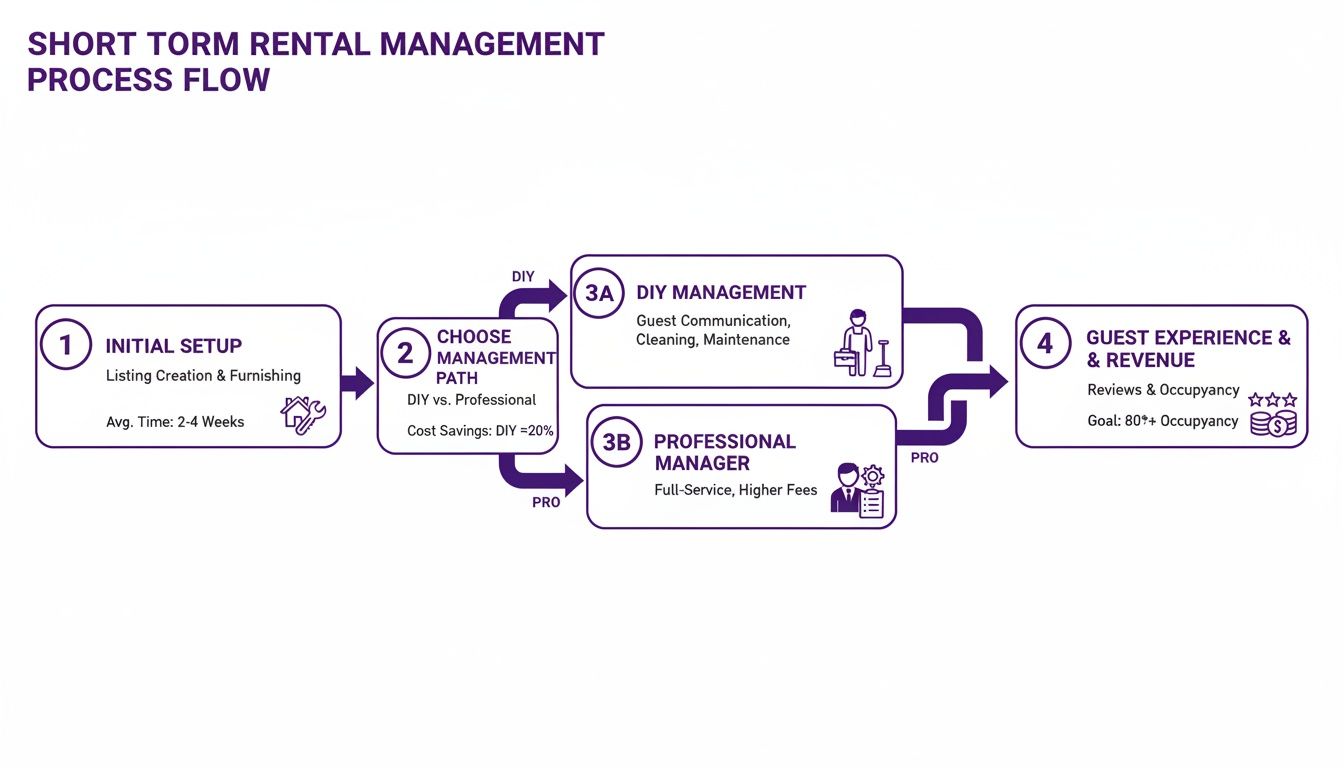
As you can see, it doesn't matter which route you take. A rock-solid operational foundation is non-negotiable for success, whether you're the one doing the work or just overseeing it.
The Seamless Check-In Process
A guest's arrival is their first impression, and it sets the tone for their entire trip. A clunky, confusing check-in can sour their mood from minute one. But a smooth, effortless arrival makes them feel welcomed and looked after right away.
Your mission is to make getting into your property dead simple. That means sending crystal-clear instructions long before they ever pull up to the curb.
Automated Messaging: Set up a message to go out a few days before their stay with the address, access codes, and a link to your digital guidebook.
Smart Lock Technology: Keyless entry is a total game-changer in our experience. It gets rid of awkward key handoffs, saves guests from getting locked out, and lets you grant or cancel access from anywhere.
Visual Aids: Don't just tell them, show them. Pop a few photos or even a quick video into your instructions that show how to find the unit and use the lock. You'd be surprised how much a simple picture helps a tired traveler.
A Cleaning Protocol for 5-Star Reviews
Let's be blunt: nothing tanks a review faster than a dirty property. Your cleaning protocol needs to be ironclad, guaranteeing the same sparkling-clean result for every guest, no exceptions. This is especially vital when you have a cleaning team, as it leaves zero room for misinterpretation of your standards.
The difference between a good host and a great host often comes down to the details. A detailed cleaning checklist ensures that nothing gets missed, from wiping down light switches to checking under the beds.
We’ve learned that a super-detailed checklist is the only way to go. It breaks down the entire cleaning process, room by room, task by task. If you're starting from scratch, you don't have to reinvent the wheel. You can find a helpful standard operating procedure template online to build out your cleaning system and other core tasks. This ensures your team knows exactly what you expect, every single time.
Proactive Property Maintenance
Stuff breaks. It’s a fact of life as a property owner. But a proactive maintenance plan helps you spot the small issues before they blow up into big, expensive problems that ruin a guest’s vacation. Instead of just putting out fires, you're actively protecting your investment.
A huge piece of this for any rental is pest management. If an issue pops up, knowing how to get rid of bed bugs fast is crucial for protecting your reputation and your guests.
Your maintenance SOP should cover a few key areas:
Regular Inspections: Schedule monthly or quarterly walkthroughs to check for leaks, test smoke detectors, and make sure appliances are working properly.
Seasonal Tasks: Keep a calendar for the big stuff, like cleaning out the gutters, servicing the HVAC system, or winterizing the pipes.
A Network of Professionals: Don't wait for a toilet to explode to find a good plumber. Build a go-to list of trusted local pros you can call when you're in a pinch.
To get these core systems dialed in, a clear checklist is your best tool.
Essential Operational Checklist for STR Hosts
Here’s a quick-start checklist to help you build out the foundational SOPs for your short-term rental. Think of this as your roadmap to creating a smooth, guest-ready operation from day one.
Operational Area | Key Tasks & SOPs | Pro Tip |
|---|---|---|
Guest Arrival & Check-In | Develop pre-arrival message template with address, access codes, Wi-Fi info, and guidebook link. Create visual instructions (photos/video) for lockbox or smart lock operation. | Automate your pre-arrival message to send 3 days before check-in. This gives guests time to review everything without feeling rushed. |
Cleaning & Turnover | Create a detailed, room-by-room cleaning checklist. Establish a clear linen protocol (e.g., 3 sets of sheets/towels per bed). Document restocking procedures for consumables. | Take photos of how each room should look when perfectly staged. Share these with your cleaning team so they have a clear visual reference. |
Maintenance & Upkeep | Schedule and document quarterly inspections (smoke detectors, fire extinguishers, filters). Compile a vetted list of emergency contacts (plumber, electrician, HVAC). | Keep a small "owner's closet" stocked with backup essentials like batteries, light bulbs, and basic tools so your team can handle minor fixes instantly. |
By turning these core operations into documented systems, you're building a business that’s resilient and can run without your constant attention. It’s what creates that predictable, high-quality experience for guests and gives you the peace of mind to focus on the bigger picture.
Crafting an Unforgettable Guest Experience
Great hospitality is what turns a decent stay into a memorable one—the kind that earns glowing reviews and repeat bookings. When you're managing a short-term rental, the guest experience starts the moment someone books and doesn't end until long after they've checked out. It all boils down to clear, friendly, and timely communication at every single step.
When we first started hosting, we felt like a broken record, answering the same questions over and over: "What's the Wi-Fi password?" "Where's the best taco spot?" "How does this coffee maker work?" We quickly learned that being proactive not only saved us a ton of time but also made our guests feel more confident and cared for.
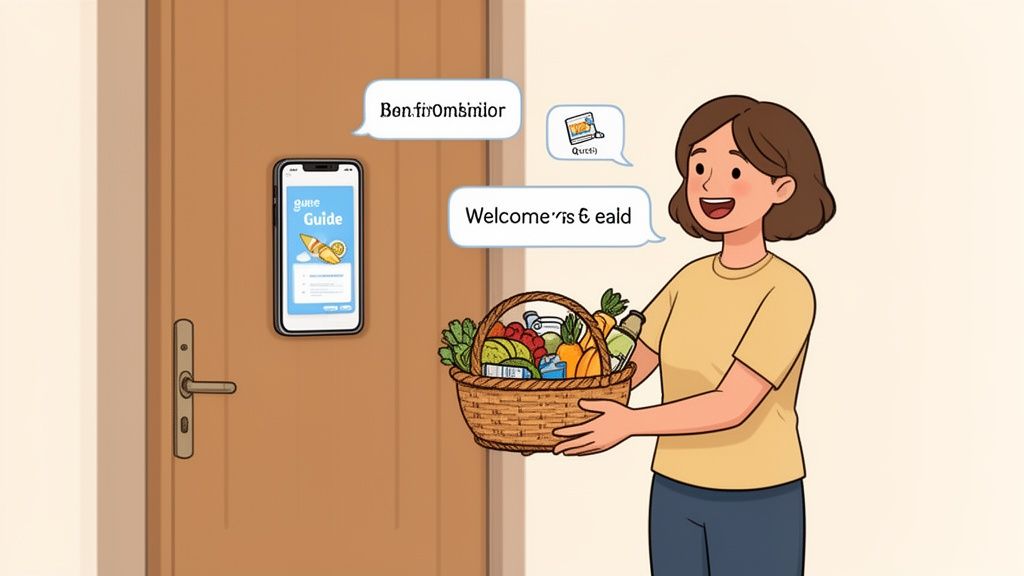
The secret is to anticipate what guests will need and give them the answers before they even think to ask. This simple shift changes your role from a reactive problem-solver to a thoughtful, professional host.
Mastering Guest Communication at Every Stage
Think of guest communication as a journey with a few key milestones. By putting a system in place for your messaging, you can make sure every guest gets the same high standard of service without adding more to your plate. This is where a little automation goes a long way.
Here’s a simple messaging flow that has worked wonders for us across all our properties, from DC to the Riviera Maya:
Booking Confirmation: The moment they book, send an immediate, friendly message thanking them. This confirms their reservation is locked in and shows you're on top of things from day one.
Pre-Arrival Message: About a week before their stay, send a message to get them excited. This is the perfect time to share a link to your digital guidebook and drop a few insider tips on local attractions or restaurants.
Check-In Instructions: Send all the arrival details 24-48 hours before check-in. This should include the address, access codes, parking info, and another link to your guidebook for good measure.
First-Day Check-In: On the evening of their arrival, a quick message asking if they got in okay and if everything looks good shows you care. It can also nip small issues in the bud before they become bigger problems.
Pre-Departure Reminder: The day before they leave, send a friendly reminder about the checkout time and any simple tasks, like taking out the trash or starting the dishwasher.
Post-Stay Thank You: A day after checkout, a final message thanking them for their stay and kindly asking for a review closes the loop.
This structured approach makes guests feel supported throughout their entire trip, from booking to heading home.
The Power of a Digital Guidebook
While automated messages are great for logistics, they can't answer every single question. This is where a modern digital guidebook becomes an essential part of your strategy. Don't think of it as a dusty old binder—think of it as a 24/7 digital concierge that puts all the answers right at your guests' fingertips.
An exceptional guest experience is built on a foundation of empowerment and convenience. Giving guests the tools to find their own answers—whether it's the Wi-Fi password at 11 PM or a great coffee shop recommendation at 7 AM—makes them feel independent and well-cared for.
When you put all your property information and local recommendations in one easy-to-access spot, you dramatically cut down on the number of repetitive questions you have to answer. For hosts, a well-crafted Airbnb welcome book is more than just a document; it's the central hub for the entire guest experience. Modern tools like SmoothStay let you create a beautiful, customizable guidebook that guests can pull up on their phones—no app download required. You can even embed video tutorials for tricky appliances or include an AI-powered chatbot that answers questions instantly.
Handling Problems with Professional Grace
No matter how dialed-in your systems are, things will go wrong. A pipe will leak, the Wi-Fi will go down, or a guest will lock themselves out. How you handle these moments is what truly defines you as a host. Even with smart locks, lockouts can happen, and having a go-to for emergency lockout services is a lifesaver for solving problems fast and keeping guests happy.
The key is to respond with three things: speed, empathy, and a solution.
Acknowledge and Apologize: First, let the guest know you hear their frustration and you're sorry for the inconvenience.
Communicate Your Plan: Tell them exactly what you're doing to fix it and give them a rough timeline.
Follow Up: Once the problem is solved, check in to make sure everything is back on track.
Turning a negative situation into a positive one by handling it like a pro is often what leads to the most loyal guests and the most glowing reviews. It shows you're a host who genuinely cares and will go the extra mile to make things right.
Assembling Your Smart Hosting Tech Stack
You can't do it all yourself—and you don't have to. Technology is a modern host's most powerful ally. Effective short-term rental management isn’t about working harder; it’s about working smarter. The right set of tools can automate all those repetitive tasks, freeing you up to focus on what really matters: creating a standout guest experience.
Think of your tech stack as your behind-the-scenes digital team, working 24/7 to keep your business running smoothly. When we started scaling from our DC house to our beach properties, we realized we couldn't be everywhere at once. A smart, integrated system became our solution for delivering consistent quality from afar.
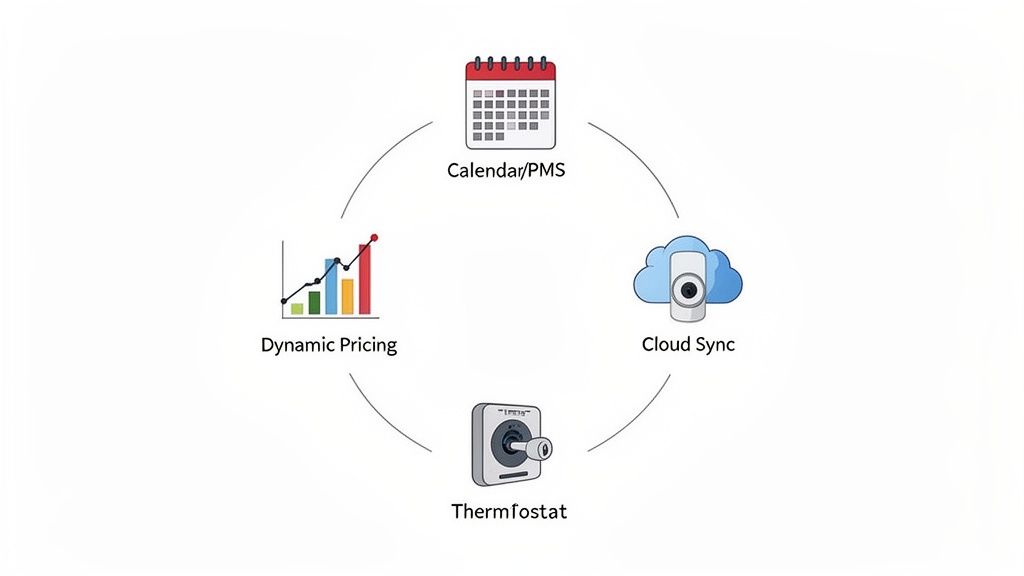
This tech ecosystem is what ensures every part of your operation, from booking to checkout, is connected and efficient.
The Core Components of Your Tech Stack
While the options can seem overwhelming, most successful hosts rely on a few key categories of software to manage their properties. You don't need everything at once, but understanding these core tools will help you build a system that grows with you.
Property Management System (PMS): This is the central hub of your operation. A PMS syncs your calendars across all booking platforms (like Airbnb and Vrbo), preventing double bookings and giving you a single dashboard to manage reservations.
Dynamic Pricing Tools: These tools analyze market data—like local events, seasonality, and competitor pricing—to automatically adjust your nightly rates. This helps you maximize revenue by charging more during peak demand and staying competitive during slower periods.
Smart Home Devices: This category includes smart locks for keyless entry, smart thermostats to save on energy costs, and noise monitoring devices to protect your property and keep neighbors happy.
Getting these pieces to work together is the goal. For a deeper look into the top platforms, our guide on the best vacation rental management software compares the features that matter most for hosts.
The Guest Experience Platform
While the tools above manage the property, a guest experience platform manages the person. This is where you bring all your communication and hospitality efforts together. The central piece of this is a modern, AI-powered digital guidebook.
Instead of a binder collecting dust on a coffee table, a digital guidebook gives guests instant access to everything they need right on their phone. This includes:
Check-in instructions with photos or videos.
Wi-Fi passwords and appliance tutorials.
House rules and emergency contact information.
Personalized local recommendations for restaurants, cafes, and activities.
By putting answers directly in your guests' hands, you aren't just saving yourself time—you're empowering them to have a better, more independent stay. It transforms their experience from good to great.
Why an AI-Powered Guidebook Is a Game-Changer
Modern guidebooks do more than just display information; they interact with it. An AI-powered tool like SmoothStay acts as an instant concierge, answering guest questions automatically. When a guest asks, "What time is checkout?" or "Where's the closest grocery store?" the AI provides an immediate, accurate answer, day or night.
This automation has a huge impact. It cuts down on the constant back-and-forth messaging, letting you focus on bigger-picture management tasks. It also ensures every guest receives a prompt, professional response, which is a key driver of positive reviews.
Ultimately, a smart tech stack is your key to scaling. By letting technology handle the routine work, you can provide a polished, professional experience that feels personal and attentive. It’s the secret to running a top-tier short-term rental management business without burning out.
A Practical Guide to Pricing and Profitability
Let's talk about the bedrock of any sustainable short-term rental business: your finances. Getting your pricing right isn’t just about picking a number out of thin air. It's a strategy, and it’s the one thing that will make or break your success. We'll walk you through the exact methods we use for our own properties, from our DC home to our places in the Riviera Maya, so you can make data-driven decisions that protect your bottom line.
Choosing Your Pricing Strategy
Your approach to pricing will probably evolve as you get more experience, but every host starts with one of two basic models. Each has its pros and cons, really depending on how hands-on you want to be.
Flat-Rate Pricing: This is the simplest way to go. You set a consistent nightly rate that only changes for weekends or maybe a major holiday. It's incredibly easy to manage, but you're almost guaranteed to leave money on the table.
Dynamic Pricing: This is where the real potential is. You adjust your nightly rates based on what the market is doing in real-time. Things like seasonality, local events, the day of the week, and even how far out a guest is booking all come into play.
While dynamic pricing takes more effort (or a specialized tool to do it for you), it’s what most serious hosts use to squeeze every last dollar of revenue out of their property. This is what worked for us. We learned that a fixed price for our Playa del Carmen house meant we were a bargain during music festivals and way overpriced in the slow season.
Key Metrics You Need to Track
To price your property like a pro, you need to speak the language of rental analytics. Forget wrestling with complicated spreadsheets; just get laser-focused on three core numbers that tell you the real story of your property’s financial health.
Occupancy Rate: Simply put, the percentage of nights your property is booked out of the total available nights.
Average Daily Rate (ADR): The average income you make per paid, occupied night.
Revenue Per Available Room (RevPAR): This is your ADR multiplied by your Occupancy Rate.
RevPAR is the single most important metric for understanding performance. A sky-high ADR doesn't mean much if your place is sitting empty half the time. RevPAR cuts through the noise, combining both occupancy and rate to show you your actual earning power.
Understanding Market Dynamics
Your property doesn't exist in a bubble. What's happening in the broader market directly impacts your bottom line. For instance, recent data shows a complex but surprisingly resilient market. While U.S. occupancy saw a slight 3% dip in early 2025, the total number of guest nights booked actually rose by 2%. This tells us that demand is still strong, it's just spread across more properties.
This highlights the huge differences in earning potential depending on your location. Top global markets can bring in staggering returns, but even smaller properties in popular spots can do incredibly well. After a dip in 2024, the average RevPAR for U.S. rentals grew by 1.8% in early 2025, showing a steady recovery. Keeping an eye on these trends helps you set realistic goals. You can find more insights into these vacation rental statistics on StayFi.com.
Setting Your Fees Thoughtfully
Beyond your nightly rate, fees are a critical piece of your pricing puzzle. They’re there to protect your business and cover real costs, but they have to be transparent and fair. Price them too high, and you'll scare off potential guests.
Cleaning Fees: This should only cover the actual cost of your cleaner’s time and supplies. It is not a profit center. Do a little research to see what comparable properties in your area are charging and stay in that ballpark.
Additional Guest Fees: If your base rate covers, say, two guests, it’s completely fair to charge a modest fee for each extra person. This helps account for the added wear and tear and utility usage.
Pet Fees: If you decide to allow pets, a flat fee is a smart way to cover the extra cleaning that's almost always needed.
Mastering your pricing and profitability is an ongoing process of learning, testing, and adjusting. By tracking the right numbers and staying plugged into market shifts, you can build a financial strategy that sets you up for long-term success on your short term rental management journey.
Navigating Local Laws and Regulations
Let's talk about the less glamorous, but absolutely critical, side of hosting: legal compliance. Operating a short-term rental legally is non-negotiable. It can feel like wading through a tangled mess of permits, zoning ordinances, and taxes, but getting this right from day one protects you, your guests, and your entire investment.
Think of it less as a hurdle and more as the cost of doing business professionally.
Now, we're not lawyers, and this isn't legal advice, but our experience has taught us that the first step is always to do your homework. Every city, county, and even neighborhood can have its own rulebook. Your local city planning department or tourism office is usually the best place to start digging for clear answers.
Common Regulations to Look For
As you start your research, you'll probably run into a few common themes. These types of rules are becoming pretty standard as the short-term rental world matures.
Permits and Licenses: Many cities now require hosts to get a business license or a specific short-term rental permit before they can legally operate.
Zoning Restrictions: Some areas are zoned strictly for residential use, which might limit or even prohibit short-term rentals altogether.
Lodging and Occupancy Taxes: Just like hotels, you'll almost certainly need to collect and pay local and state taxes on your rental income.
Safety Requirements: Expect to see rules about smoke detectors, fire extinguishers, and having clear emergency exit plans posted for guests.
The Global Trend Toward Compliance
This push for regulation isn't just happening in one or two cities; it’s a worldwide shift. Regulatory pressures are reshaping how short-term rental management works on a global scale. For instance, France now caps primary residence rentals at 90 days per year, Spain requires a unique property code for every listing, and Australia is rolling out a national registration system with limits of 60-180 days annually.
These changes all point to one clear trend: greater accountability and professionalism in our industry. You can discover more insights about 2025 short-term rental trends on Ensoconnect to see where things are headed.
Don't Forget About Insurance
Finally, let's be clear: your standard homeowner's insurance policy is almost never enough. Platform protections like AirCover are a decent safety net, but they often have gaps.
A dedicated short-term rental insurance policy is essential for real peace of mind. It provides liability coverage if a guest gets injured and proper protection for your property and belongings. Once you have the right legal framework and insurance in place, you can finally host with real confidence.
Common Questions About Short Term Rental Management
We connect with hosts all the time who are either just starting out or trying to get a better handle on their business. After years of doing this ourselves, we've noticed a few questions that pop up again and again. Here are the straight-up answers based on our own experience.
How Much Time Does It Take To Manage a Rental?
Honestly, it really depends, but a good rule of thumb for self-managing is about 5 to 10 hours a week for each property. That number can swing quite a bit based on how many bookings you're getting and how much of your process you've managed to automate.
The initial setup is always the most time-consuming part. Once you're up and running, most of your time will be spent talking to guests, coordinating with your cleaners, and handling the inevitable maintenance pop-ups. This is where tools like a good PMS and a digital guidebook can be a lifesaver, especially for automating messages and answering questions before guests even have to ask.
What Are the Most Important Metrics To Track?
You don't need a massive, complicated spreadsheet to know if your business is healthy. Just keep your eye on three core numbers:
Occupancy Rate: Simply, what percentage of available nights is your property actually booked?
Average Daily Rate (ADR): This is your average income for every night that's booked.
Revenue Per Available Room (RevPAR): This is the killer metric. It’s your ADR multiplied by your Occupancy Rate, and it gives you the truest picture of your property's earning power.
Beyond those big three, we always keep a close watch on our net profit (what's left after all expenses) and our average guest review score. Those tell the rest of the story.
Is Hiring a Management Company Worth the Cost?
This one really boils down to your personal goals and what you want out of hosting. A professional manager will typically charge between 20-40% of your revenue. That can be an absolute bargain if you live far away, are juggling multiple properties, or just want a completely hands-off investment.
But if you enjoy the hosting process and want to maximize your profit, self-managing with a smart tech stack is almost always more rewarding. The trick is to be realistic about the time and effort it truly takes to do it right.
We hope these real-world insights help you feel more confident on your hosting journey. Ready to streamline your operations and give guests a 5-star experience? SmoothStay offers customizable, AI-powered guidebooks that answer questions for you, saving you time and earning you glowing reviews. Built by hosts, designed for guests. Start your free trial today at https://www.smoothstay.io.