A Host's Guide To Short-Term Property Management
Master short-term property management with our host-to-host guide. Learn to streamline operations, boost revenue, and create five-star guest experiences.
Disclosure: Some links in this article are affiliate links. If you make a purchase, we may earn a commission at no extra cost to you. This helps support our content.
So, what exactly is short-term property management? We see it as the art of turning a property into a thriving hospitality business, one guest at a time. It's a world away from traditional long-term rentals, which usually involve year-long leases and minimal tenant interaction. Here, you're focused on creating memorable guest stays over much shorter periods.
What Short-Term Property Management Really Means
Let's cut through the jargon. At its core, short-term property management is about a lot more than just handing over keys. You need to stop thinking like a landlord and start acting like the CEO of a small hotel. Your product isn't just a place to sleep; it's the entire guest experience, from the moment they book until they leave that glowing review.
This mindset shift is everything, especially in a vacation rental market that's fast-paced and packed with competition. A successful host is really just managing an ecosystem of moving parts to make sure it all runs like clockwork. We've learned this firsthand managing our own properties—from our 4-bedroom house in Washington, DC, to a few beach properties in the Riviera Maya. Success isn't about one big thing; it's about nailing dozens of small details, over and over again.
The Key Differences from Long-Term Rentals
The biggest difference is the operational tempo. A long-term rental might need your attention a few times a year. A short-term rental? It demands constant oversight, often daily. This high-touch model is what truly sets it apart.
Here are the key operational shifts we've found make the biggest difference:
High Guest Turnover: Instead of one tenant for a whole year, you might welcome 30-50 different guests. That means constant communication, coordinating check-ins, and prepping the property again and again.
Intense Cleaning and Maintenance: The property has to be reset to pristine condition between every single stay. There’s absolutely no room for error when a new guest is arriving in just a few hours.
Dynamic Pricing: Your rates aren't fixed. They need to fluctuate daily based on seasonality, local events, and demand. This requires active management to make sure you're maximizing revenue.
A Hospitality Focus: You're not just providing housing; you're facilitating an experience. This means offering local recommendations, solving problems on the spot, and making guest comfort your top priority.
Ultimately, effective short-term property management transforms a physical asset into a revenue-generating business built on positive guest experiences. It’s a continuous cycle of marketing, operations, and customer service that demands a professional and systematic approach.
This shift from passive income to active business management is the foundation of everything we'll cover. When you start seeing your property through this lens, you set yourself up to not just survive but thrive. It's a skill set any dedicated host can learn, and it all starts with understanding the true scope of the job.
The Core Responsibilities Of A Property Manager
So, what does it actually take to run a successful short-term rental day-to-day? Whether you’re managing your own place or thinking about hiring help, you have to nail these core tasks. It’s all about building a reliable system that hums along smoothly, even when you're not there.
Think of it less like renting out a room and more like running a small hospitality business with three distinct goals.
We see the whole operation as a balancing act between creating memorable stays for guests, maximizing your revenue, and protecting your own time.
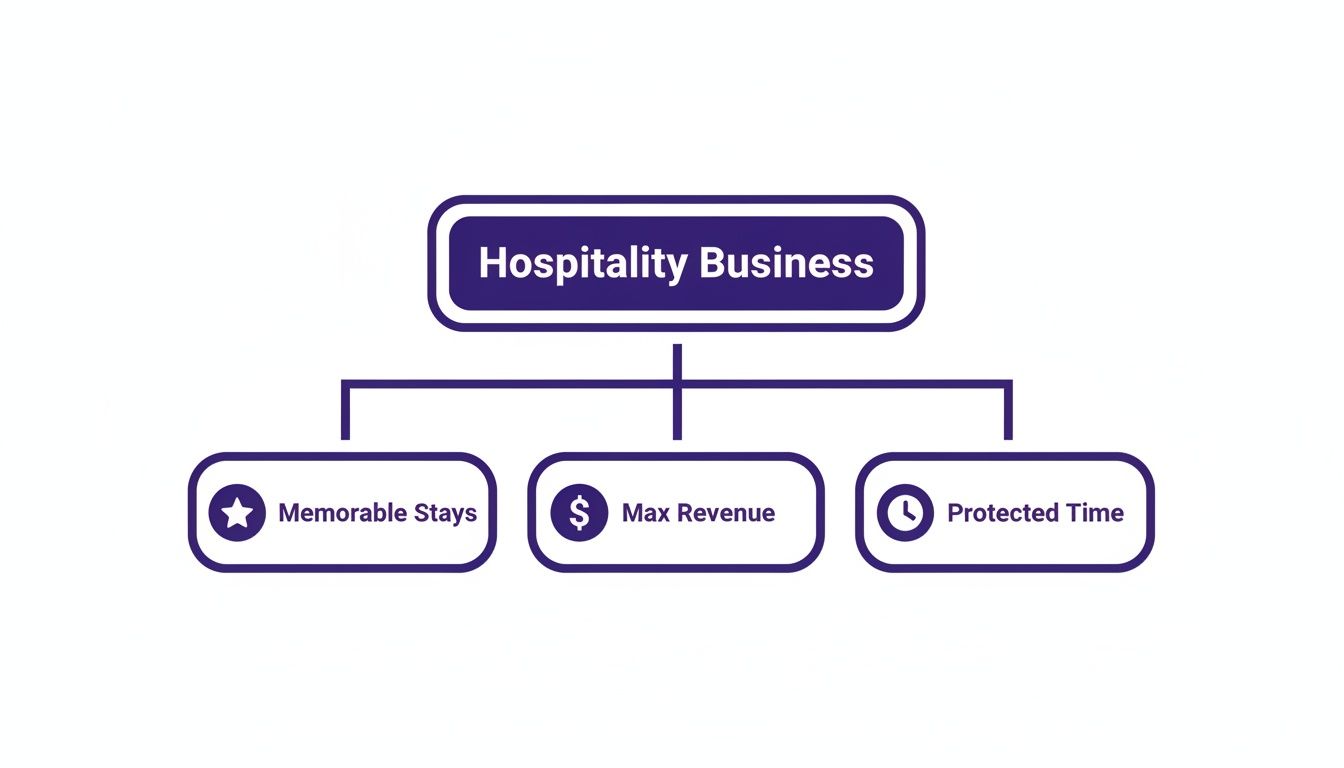
Ultimately, every single task you do should feed into one of these pillars. Get it right, and you create a powerful cycle where happy guests lead to better revenue, all without burning you out.
Guest Communication And Experience
This is where you earn those five-star reviews. Guest communication isn't just about answering questions—it's about anticipating needs and solving problems before they pop up. It starts the moment a potential guest sends an inquiry and continues long after they’ve checked out.
We learned this lesson the hard way. With properties in different time zones—from DC to the Riviera Maya—a 24/7 presence became non-negotiable. Guests don’t care what time it is for you; they just know their key code isn’t working at midnight.
This pillar breaks down into a few key stages:
Pre-Arrival Communication: Sending out check-in details, house rules, and a few local tips to get them excited.
In-Stay Support: Being on call to help with the Wi-Fi, recommend a great taco spot, or handle an unexpected issue.
Post-Stay Follow-Up: Prompting for reviews and privately addressing any feedback to show you care.
Great communication does more than just solve a problem. It builds trust, shows professionalism, and turns a good stay into a great one. That’s what brings people back.
Listing Management And Dynamic Pricing
Your online listing is your digital storefront. It needs to be sharp, accurate, and splashed across multiple platforms like Airbnb and Vrbo to catch the biggest audience. This means professional photos, a compelling description, and a perfectly synced calendar to avoid the dreaded double-booking.
But a pretty listing is only half the battle. Pricing is where the real strategy comes in. Unlike long-term rentals with a fixed monthly rate, short-term rental pricing has to be dynamic. You have to constantly adjust.
Effective pricing strategies always factor in:
Seasonality: High season, low season, and those tricky shoulder seasons in between.
Local Events: That big concert, festival, or conference can send demand through the roof.
Day of the Week: Weekends almost always command higher rates than a Tuesday night.
Competitor Rates: You have to keep an eye on what similar properties are charging.
Setting your prices once and forgetting them is a surefire way to leave money on the table. We’re constantly tweaking our rates to match market demand, squeezing every bit of revenue out of the calendar.
Operations And Logistics
This is the engine room of your rental business—the behind-the-scenes work that keeps everything running. Operations are all about coordinating the physical side of the rental to make sure it’s perfect for every single guest, every single time. There is zero room for error here.
The key logistical tasks are:
Cleaning Coordination: This is the most critical operational task. You need to schedule professional cleaners to handle the often-tight turnaround between one guest's checkout and the next one's check-in.
Maintenance and Repairs: A reliable team of handymen, plumbers, and electricians on speed dial is essential. A broken AC unit in July can absolutely ruin a guest's trip and your review score.
Inventory Management: You have to keep essentials like coffee, toiletries, and paper towels fully stocked. Nothing says "we don't care" like a single, sad-looking roll of toilet paper.
A huge part of this is having strict cleaning protocols. To keep things consistent, a detailed short term rental cleaning checklist ensures nothing gets missed. When you build repeatable processes for these tasks, you turn potential chaos into a smooth, scalable operation.
Choosing Your Path: Self-Manage Or Hire A Pro?
This is one of the biggest crossroads every host hits. Do you go the DIY route and run the show yourself, or do you hand the keys over to a professional? There’s no single right answer here—the best path depends entirely on your goals, your lifestyle, and just how deep in the weeds you want to get.
We’ve walked both paths. We self-manage our four-bedroom home in Washington, DC, because we genuinely enjoy being close to the operation and, let's be honest, keeping a bigger slice of the profit. But for our beach properties down in the Riviera Maya, being thousands of miles away makes professional help an absolute necessity. Both models have worked great for us, but for totally different reasons.
At its core, the decision boils down to a simple trade-off: your time versus your money. Let's break down what each path really looks like so you can figure out which one is the right fit for you.
The Case For Self-Management
Going it alone puts you squarely in the driver's seat. You have 100% control over every single decision, from tweaking the nightly rate to picking out the throw pillows. For hosts who love getting the details just right and crafting a very specific guest experience, this level of control is a massive draw.
Of course, the biggest perk is financial. When you cut out the middleman, you keep the entire payout from every booking (minus platform fees, of course). This can seriously boost your profit margins, especially if you have the time and the grit to manage the day-to-day grind effectively.
But make no mistake, this path demands a serious commitment. You're not just a host; you're the marketer, the pricing guru, the guest support agent, the maintenance coordinator, and the head of housekeeping, all rolled into one. It comes with a steep learning curve and a big-time investment, often at the most inconvenient hours.
When To Hire A Professional Property Manager
Bringing on a professional short-term property management company is like hiring an expert business partner. Their entire job is to handle the daily operations so you don’t have to. This is the perfect route if you value your time more than squeezing out every last dollar, if you own a property far from home, or if you simply want a more hands-off, passive investment.
A good manager comes with proven systems for marketing, dynamic pricing, and logistics. They already have a team on standby for late-night emergencies and a deep-seated knowledge of the local market. This expertise often translates to higher occupancy and more revenue, which can help offset their fees. The global short-term rental market is a competitive space, and professional management can be the edge you need to grab your share.
The main drawback is the cost. Management fees typically run anywhere from 15% to 30% of your booking revenue, which is a significant chunk of your income. You also give up some direct control over the guest experience, as your property will be represented by the manager’s brand and their way of doing things. You can dive into a full breakdown of these expenses in our guide to property management costs.
The best way to decide is to be brutally honest about your own resources. Do you have more time than money, or more money than time? Answering that one question will usually point you in the right direction.
If you’re leaning toward getting help but aren't ready for a full-service contract, a hybrid approach can be a great middle ground. For example, you could hire a specialized short-term rental virtual assistant to handle all the digital tasks like guest communication and listing updates, while you manage the on-the-ground logistics yourself. It’s a smart way to get professional support without the full management price tag.
Building Your Tech Stack For Effortless Operations
In today's world of short-term property management, technology isn't just a nice-to-have—it's your most valuable employee. A smart tech stack can take a mountain of manual work and turn it into a sleek, automated operation that hums along in the background. Think of it as your digital team, working 24/7 so you don't have to.
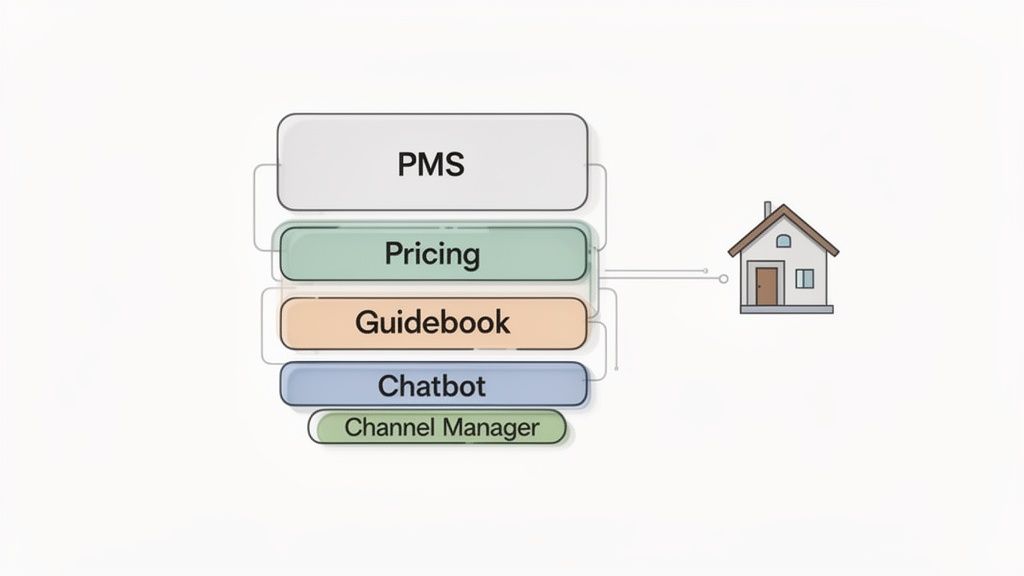
When we first started out, we tried juggling everything with spreadsheets and sticky notes. That system fell apart fast, especially once we added our Riviera Maya properties. Building a real tech stack wasn't just an option; it was the only way we could scale without completely burning out.
Core Components Of A Host's Tech Stack
Your tech stack is simply the collection of software tools that work together to automate and organize your business. Each piece of software solves a specific problem, and when they're all connected, they create a powerful system that saves you time and makes your guests happier.
Here are the absolute essentials we believe every host should have in their toolkit:
Property Management System (PMS): This is the heart of your operation. A good PMS syncs your calendars across all booking sites, manages all your reservations, and often handles basic guest messaging. It’s the foundation that stops double-bookings dead in their tracks and keeps you organized.
Dynamic Pricing Tool: These tools are pure magic. They crunch market data, keep an eye on local events, and watch what your competitors are doing in real-time to suggest the perfect nightly rate. They take the guesswork out of pricing, so you're not leaving money on the table in high season or sitting empty during the slow months.
Channel Manager: If your PMS doesn’t have this built-in, a channel manager is a must-have. It pushes your listing out to multiple OTAs (Online Travel Agencies) like Airbnb, Vrbo, and Booking.com, making sure your rates and availability are perfectly in sync everywhere.
The Game-Changer: Guest Communication Tools
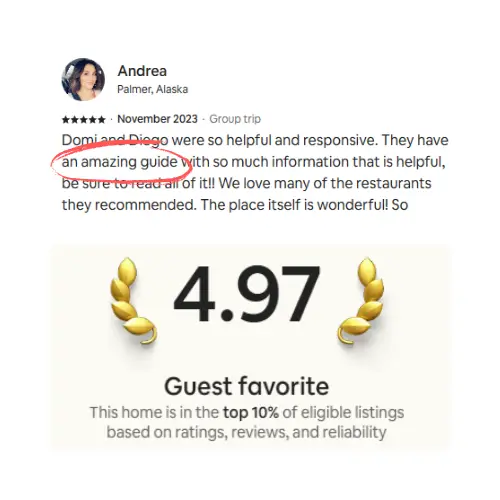
While a PMS is your command center, dedicated guest communication tools are where you can truly elevate the guest experience. This is exactly why we built SmoothStay—we were drowning in the same repetitive questions about Wi-Fi passwords and how to use the coffee machine.
A digital guidebook is the perfect fix. It's a single, mobile-friendly spot where guests can find everything they need, right on their phones. No app to download, no clunky PDFs to scroll through—just instant answers.
By anticipating guest needs with a comprehensive digital guidebook, you shift from reactive problem-solving to proactive hospitality. This simple change drastically reduces repetitive questions and empowers guests to feel more independent and informed.
This is especially critical as you scale. According to AirDNA data from early 2025, the number of available short-term rental listings has grown 9% year-over-year. As demand keeps climbing, hosts with multiple properties need technology to handle the growing workload without letting service quality slip. For a deeper look at this trend, you can explore the latest vacation rental statistics.
Making Your Tech Stack Work For You
The goal isn't just to collect a bunch of apps; it's to build a seamless, interconnected system. When your pricing tool, PMS, and guidebook platform can all "talk" to each other, your business runs with far less effort from you.
For us, adding an AI-powered guidebook was a real turning point. Our guests can now use a chatbot to get instant answers, and our customizable templates mean every property has a professional, on-brand guide. This one addition slashed our repetitive guest messages by a huge margin, freeing us up to focus on growing the business.
When you're choosing your tools, always think about how they'll work together. You can learn more about how to evaluate different platforms in our guide to comparing property management software.
Navigating The Legal Landscape
Let's be honest, nobody gets into hosting because they love reading municipal codes. But as the short-term rental world matures, so do the rules. Tackling legal compliance isn't the most glamorous part of the job, but getting it right is the foundation of a sustainable business that will be around for the long haul.
Ignoring the regulations isn’t a strategy—it’s a gamble. We’ve seen hosts get completely blindsided by new city ordinances, leading to steep fines or even being forced to shut down. The only way we’ve found to operate with confidence is to treat compliance as a core business function from day one. Think of these rules less as barriers and more as the professional standard for running a legitimate hospitality business.
Common Types Of Local Regulations
While the specific rules can feel like they change from one town to the next, most of them fall into a few common buckets. Use this as a general roadmap for what to look out for. Your first and most important stop should always be your local city or county government's website—that’s where you’ll find the official, non-negotiable truth.
Here’s what you’re likely to run into:
Registration and Licensing: More and more cities require hosts to register their property and get a license or permit to operate legally. This usually involves an application, a fee, and a registration number that you have to display on your listing.
Occupancy Taxes: Just like hotels, you'll almost certainly need to collect and pay local lodging or tourism taxes. Some platforms like Airbnb handle this automatically in certain regions, but it's ultimately your responsibility to make sure you're fully paid up.
Day Limits: To strike a balance between tourism and local housing availability, some cities put a cap on the number of nights you can rent out your property each year.
Zoning and Safety Rules: Be aware of specific zoning laws that might restrict short-term rentals in certain neighborhoods. You'll also need to meet safety standards, like having working smoke detectors, carbon monoxide detectors, and a fire extinguisher.
Why Local Knowledge Is Everything
These regulations are anything but static; what’s true today might be different six months from now. Staying on top of these changes is an ongoing part of the job. For instance, regulatory headwinds are reshaping the industry, with some cities and countries implementing new rules each year.
For hosts, being able to adapt is key. In the U.S., RevPAR (a key performance metric) climbed 1.8% in early 2025 after a recent dip, which signals a recovery for the compliant operators who can pivot with the market.
Think of compliance as your business's insurance policy. It protects you from fines, builds trust with your community, and ensures you can continue hosting for years to come. It’s a non-negotiable part of professional short-term property management.
The key is to be proactive, not reactive. Set a reminder to check your local government’s website for updates every quarter. Join local host groups or online forums where this kind of information gets shared quickly. By building compliance checks into your regular routine, you can stay ahead of any changes and keep your business running smoothly and, most importantly, legally.
Measuring Success With Metrics That Actually Matter
If you want to understand your rental business, you need to speak its language—and that language is data. Moving beyond just looking at your monthly payout to tracking key performance indicators (KPIs) is what separates casual hosts from professional operators. These metrics are the vital signs of your rental business.
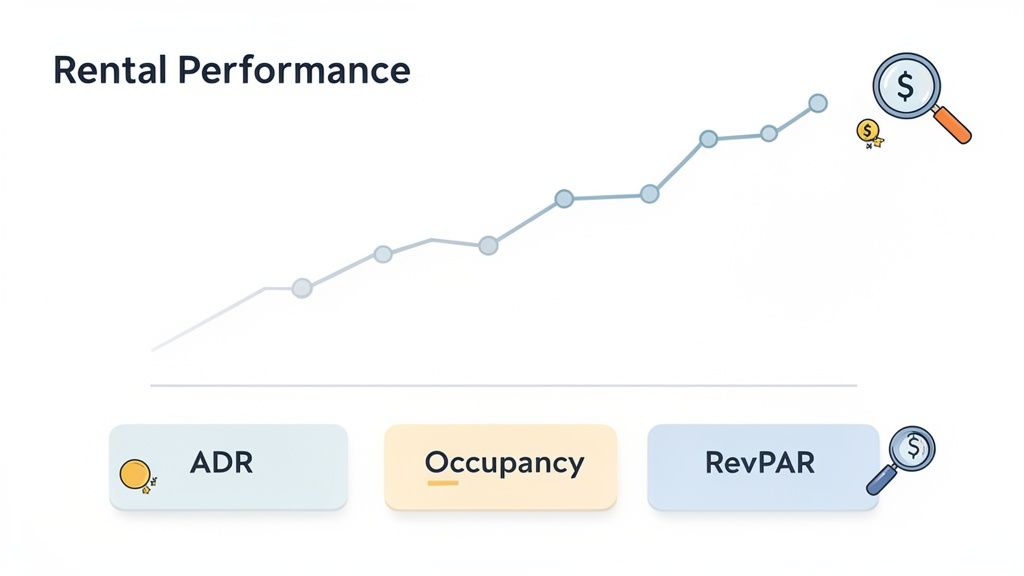
When you track the right numbers, you can stop guessing and start making informed decisions. It’s how you spot opportunities, patch up weaknesses, and consistently level up your profitability and your guest experience. Let's break down the essential metrics you should be watching.
The Big Three Rental Metrics
While you could track dozens of data points, a few core metrics tell most of the story. From our house in DC to our places in Mexico, these are the numbers we check constantly. They give us a quick, clear snapshot of how we’re doing at any given moment.
These are the non-negotiables:
Average Daily Rate (ADR): This is simply the average price you earn per booked night over a certain period. To get it, you just divide your total rental revenue by the number of nights guests actually stayed. Your ADR shows you what guests are willing to pay, on average, to book your property.
Occupancy Rate: This tells you what percentage of your available nights were actually booked. You find it by dividing the number of booked nights by the total number of available nights. A high occupancy rate is a great sign that your property is in demand.
Revenue Per Available Room (RevPAR): This is the gold standard for measuring your rental’s performance. RevPAR is so powerful because it blends ADR and occupancy to show you how much revenue you're making for every night your property is available—booked or not. The formula is simple: just multiply your ADR by your Occupancy Rate.
RevPAR is the ultimate metric because it forces you to balance price with bookings. A crazy-high ADR means nothing if your place sits empty half the month, and a 100% occupancy rate isn't so great if you had to slash your prices to get there. RevPAR tells you if you've found that profitable sweet spot.
Connecting Metrics to Real-World Decisions
These numbers aren't just for spreadsheets; they should be driving your strategy. Once you understand how these KPIs work together, you can start making small, data-driven tweaks that have a huge impact.
For instance, you might notice that lowering your minimum stay from three nights to two actually increases your overall RevPAR, even if it brings your ADR down a bit. Or you might see that investing in a professional digital guidebook leads to better reviews, which in turn lets you command a higher ADR without hurting occupancy.
To learn more about putting your data to work, check out our full guide on short-term rental analytics.
Ultimately, tracking these metrics is what empowers you to run your rental like a real business. It shifts your focus from just collecting income to actively optimizing your performance, ensuring your property works smarter for you, not just harder.
Your Short-Term Property Management Questions Answered
We’ve covered a lot of ground, but we know managing a rental always brings up new questions. After years in this business, we’ve heard a handful of the same practical concerns from fellow hosts. These are the details that pop up once you’ve nailed the basics, so let’s get you some clear, straightforward answers.
What Is a Realistic Profit Margin for a Short-Term Rental?
This is the big one, and the honest answer is: it varies wildly. Your profit margin depends entirely on your location, property type, and how you choose to manage it. For hosts who self-manage, it’s not uncommon to see profit margins in the 10% to 20% range after all expenses are paid—mortgage, taxes, and operating costs included.
But that number can swing. If you hire a professional manager, they’ll typically charge 15-30% of your booking revenue, which eats directly into your profit. On the flip side, some recent data shows that larger, multi-bedroom vacation rentals are pulling in higher occupancy rates and ADRs. This can lead to much stronger profits, even with their higher operating costs.
How Much Time Does Self-Managing Really Take?
Don't underestimate the time commitment, especially at the start. When you're just getting your sea legs, expect to spend anywhere from 8 to 10 hours per week on a single property. That time is filled with handling inquiries, coordinating with your cleaner, tweaking your pricing, and being on-call for guest needs.
As you build out your systems and bring in technology—like a digital guidebook that fields common questions for you—this time can drop significantly. But that initial setup and the learning curve are intense. You are the 24/7 support line, so be prepared for messages at all hours.
The most common mistake we see new hosts make is thinking self-management is a passive activity. It’s a hands-on business, especially in the beginning. The time you invest upfront in creating systems is what eventually buys you back your freedom.
Can I Manage a Property Remotely?
Absolutely, but you must have a reliable local team. We manage our Riviera Maya properties from the U.S., and it would be completely impossible without our "boots on the ground." For us, this means a trustworthy cleaner, a go-to handyman, and sometimes a co-host for emergencies.
Technology is your best friend here. A smart lock for keyless entry, a video doorbell for security, and a robust property management system are non-negotiable for remote hosting. At the end of the day, effective remote management is all about having the right people and the right tools in place to handle things when you can’t be there yourself.
At SmoothStay, we believe being a great host means creating amazing guest experiences without sacrificing your own peace of mind. Our AI-powered digital guidebooks were built by hosts, for hosts, to help you automate communication, delight your guests, and earn more five-star reviews. With guest-first features and customizable templates, you get a professional guidebook that matches your brand and solves problems before they start.
Ready to see how much time you can save? Start your free 14-day trial today and build your first guidebook in minutes.