Comparing Property Management Software: A Host's Guide
comparing property management software? Use this clear framework to evaluate features, pricing, and support to pick the best PMS for your vacation rental.
Disclosure: Some links in this article are affiliate links. If you make a purchase, we may earn a commission at no extra cost to you. This helps support our content.
Picking a property management software (PMS) feels like a huge commitment—and it is. From our experience, the best software isn't the one with the most features. It's the one that solves your biggest headaches, whether that's finally stopping double-bookings or getting guest messages off your plate.
Taking a smart approach to comparing property management software from the get-go means you’ll end up with a tool that helps you build a better business, not just another subscription hitting your credit card each month.
Getting Ready for Your Software Search
Before you jump into a rabbit hole of demos and feature lists, it helps to take a step back and figure out why you're looking for a tool in the first place. When we expanded from running our own house in DC and a few beach properties to managing for other owners in the Riviera Maya, our trusty spreadsheets went from helpful to hazardous overnight. We needed one central place to keep everything from getting out of hand.
The goal isn’t just to find one tool. It's to build a "tech stack" that gives you your time back so you can focus on what actually moves the needle: creating five-star guest experiences. You’re not just buying software; you’re investing in your own efficiency and sanity.
Why a Good PMS Is No Longer Optional
The short-term rental world is leaning heavily into tech for a reason. The global property management software market is projected to hit USD 54.16 billion by 2032, which tells you one thing: hosts everywhere are using technology to work smarter, not harder. This isn't just a trend; it's a fundamental shift in how successful rental businesses are run.
What worked for us: The right PMS didn't just put out fires—it opened up new doors. It took away that constant low-level anxiety about calendar mistakes and gave us the confidence to grow our portfolio without everything falling apart.
A Smart Framework for Comparing Your Options
To cut through the marketing fluff, you need a solid framework. Think of it as a checklist to make sure you're asking the right questions. We've put together a quick table outlining the essential criteria we use to vet any PMS. It’s the same lens we use when looking at new tools for our own business.
For a deeper dive into our top picks, you can also check out our detailed guide on the best property management systems.
Quick Framework for Comparing PMS Options
Here’s a simple but powerful way to structure your evaluation. Use this table to compare each platform apples-to-apples and see how they stack up against your specific business needs.
Evaluation Criteria | Why It Matters for Your Business | Key Question to Ask Vendors |
|---|---|---|
Pricing Model | Predictable costs are essential. Per-property fees can get expensive as you scale, while percentage-based models might eat into profits during peak season. | "What is your complete pricing structure, including any setup, transaction, or hidden fees?" |
Channel Management | Direct API integrations with major OTAs (like Airbnb, Vrbo, Booking.com) prevent double-bookings and ensure calendar and pricing sync is instant and reliable. | "Do you have direct, two-way API integrations with the channels I use, or do you rely on iCal?" |
Automation Tools | This is where you get your time back. Automated messages, review requests, and task scheduling for cleaners are non-negotiable for efficiency. | "Can I create custom automation rules for messaging and tasks based on triggers like check-in or checkout?" |
Guest Communication | A unified inbox that pulls messages from all channels into one dashboard is a game-changer for staying organized and responsive. | "Does your platform offer a unified inbox for all my booking channels?" |
Integrations | No PMS does everything perfectly. Strong integrations with dynamic pricing tools, smart locks, and accounting software let you build a best-in-class tech stack. | "What third-party tools (pricing, locks, accounting) do you integrate with directly?" |
Reporting & Analytics | You can't improve what you don't measure. Good reporting helps you track occupancy rates, revenue per available night (RevPAN), and other key metrics. | "What key performance indicators can I track directly within your dashboard?" |
Scalability & Support | The software that works for one property might not work for 20. Look for a platform that can grow with you and has responsive, helpful customer support. | "How does your platform support hosts as they scale, and what are your customer support hours and channels?" |
Using a structured approach like this helps you move beyond flashy features and focus on what will genuinely make a difference in your day-to-day operations.
Establishing Your Core Evaluation Criteria
Choosing the right property management software isn't about chasing the flashiest feature list. It starts with a solid evaluation framework. After years of trial and error—from managing our own house in DC to our beach properties in Mexico—we’ve learned to zero in on a few non-negotiable pillars. The real key to comparing these tools effectively is to look past the marketing claims and analyze what actually matters for your business.

This is all about understanding how each software component will directly impact your daily workflow, your bottom line, and frankly, your sanity.
Pricing Models: Predictability vs. Scalability
The first fork in the road is almost always pricing. PMS platforms usually fall into two main camps, and the right choice really depends on your business.
Per-Property/Per-Unit Fee: This model charges a flat monthly rate for each listing. It’s predictable and simple, which makes budgeting a breeze. The downside? It can get expensive as your portfolio grows.
Commission-Based Fee: This model takes a small slice of each booking’s revenue, often between 0.5% to 1%. This is great for new hosts or anyone with high seasonality because your costs scale directly with your income. Just remember, a blockbuster month means a bigger software bill.
For us, a flat fee made sense when we had a consistent number of our own properties. But once we started managing for others, a percentage model felt much fairer and more aligned with our growth.
Channel Management: The API vs. iCal Difference
This is arguably the most critical pillar of any PMS. Flawless, real-time synchronization between your calendar and booking channels like Airbnb and Vrbo is non-negotiable. There are two types of connections out there, and one is vastly superior.
An iCal sync is not enough. It's a basic, one-way link that only blocks off dates and can have serious delays. This is how hosts end up double-booked during busy season—a painful lesson we learned the hard way at our Tulum condo one year.
What you really need is a direct API (Application Programming Interface) connection. An API creates a deep, two-way, real-time integration that syncs everything instantly—reservations, pricing updates, messages, and listing details. If you're serious about hosting, a reliable API is the only way to go.
Automation: Where You Get Your Time Back
Automation is where a good PMS truly pays for itself. The whole point is to eliminate the repetitive tasks that drain your time and energy, freeing you up to focus on high-impact hospitality. For a deep dive, check out our guide on building a powerful property management workflow automation strategy.
Look for robust automation in these key areas:
Guest Messaging: Can you schedule messages based on triggers like booking confirmation, check-in, or checkout? Customization is key here to keep that personal touch.
Review Management: Does the software automatically prompt guests for a review after they leave? Can it even post a review for them on your behalf?
Task Scheduling: Can you automatically assign cleaning and maintenance jobs to your team with every new booking? This one feature eliminates endless back-and-forth texts and calls.
Integrations: Building Your Perfect Tech Stack
Let’s be honest: no single PMS does everything perfectly. That’s why seamless integrations with other essential tools are so important. Your PMS should act as the central hub of your operations, connecting easily with the other software you rely on every day.
As you define your criteria, think about how a PMS fits with tools like real estate market analysis software, which is vital for setting competitive prices and making smart investment decisions. Other key integrations to look for include dynamic pricing tools (like PriceLabs), smart lock systems (like Schlage or August), and accounting software. A strong ecosystem of integrations lets you build a best-in-class tech stack tailored to your exact needs.
A Nuanced Comparison of Top PMS Platforms
Now that you have a solid framework for evaluating property management software, let's put it to the test. Comparing these platforms isn't about finding a single "best" option—because one doesn't exist. It's about finding the tool whose strengths are a perfect match for your specific portfolio and what you're trying to achieve.
We’re going to dive into three popular platforms in the short-term rental world: Guesty, Hostaway, and OwnerRez. We’ve either used these tools ourselves or know plenty of successful hosts who rely on them daily. While this isn't an exhaustive list, it covers a great spectrum of what's out there, from all-in-one solutions built for scale to powerful tools for operators focused on direct bookings.
Guesty For Hosts: The All-In-One Powerhouse
Guesty for Hosts (which you might remember as Your Porter App) is often the first stop for hosts getting serious about scaling their business. Think of it as the central command center for a growing property portfolio.
Its biggest advantage is its all-in-one nature. Everything from a unified inbox that corrals messages from all your channels to sophisticated automation for messaging and reviews is built to handle complexity. When we started managing properties for other owners in the Riviera Maya, its owner portal and detailed financial reporting became absolutely indispensable.
Ideal User Profile: The scaling manager with 4 to 20+ properties who needs advanced automation, team management, and clear owner reporting.
Key Strength: A powerful, centralized platform that brings nearly every part of short-term rental management—from guest communication to operations—under one roof.
But all that power can feel like overkill if you're only managing one or two properties. The learning curve is a bit steeper, and while the price is fair for what you get, it’s a bigger investment for someone just starting out.
Hostaway: The Flexible Channel Manager
If there's one thing Hostaway is known for, it's exceptional channel management. It has one of the most extensive lists of direct API integrations in the game, connecting you not just to giants like Airbnb and Vrbo, but to a ton of niche booking sites as well. This makes it a phenomenal choice for hosts who want to get their listings in front of as many eyes as possible.
The platform is also celebrated for its flexibility and open API, which means it plays nicely with a whole ecosystem of third-party tools. If you already have a tech stack you love—like a specific dynamic pricing tool or smart lock system—Hostaway is great at fitting right in.
Our takeaway: We've noticed that hosts who are laser-focused on distribution and maximizing their reach almost always gravitate toward Hostaway. Its ability to seamlessly sync calendars and rates across a huge number of channels is a massive competitive edge.
The user interface is clean and modern, so it’s pretty easy to get the hang of. While its feature set is broad, some users find that certain modules, like its accounting tools, aren't quite as deep as what you'd find in a more specialized platform like OwnerRez.
OwnerRez: The Direct Booking Champion
OwnerRez has cultivated a fiercely loyal following, especially among hosts who are determined to take control of their business and drive more direct bookings. Its crown jewel is its powerful, highly customizable direct booking engine and website builder. If your main goal is to build your own brand and cut down your dependency on the big OTAs, OwnerRez gives you the tools to do it right.
Beyond that, it's known for an incredibly deep feature set, particularly around property and financial management. You can customize just about anything, from rental agreements to ridiculously complex pricing rules. This level of granular control is a dream for detail-oriented hosts, but it can feel a bit overwhelming for those who just want something that works out of the box.
Ideal User Profile: The independent host or small manager who is obsessed with building a direct booking business and wants total control over every operational detail.
Key Strength: Unmatched direct booking capabilities paired with deep, customizable features for property and financial management.
For hosts who want an even deeper dive, we've put together more insights into the best vacation rental management software in another guide.
Side-By-Side Functional Comparison
To really see how these platforms stack up, let's put them head-to-head on some of the critical functions we talked about earlier. Here’s a quick look at how they approach the core needs of a host.
Comparative Analysis of Core PMS Features
Core Functionality | Guesty for Hosts | Hostaway | OwnerRez |
|---|---|---|---|
Channel Management | Strong API connections to major OTAs, designed for reliability and ease of use. | Industry-leading number of direct API integrations, ideal for maximum distribution. | Solid API connections, but the primary focus is on empowering its direct booking engine. |
Automation | Excellent. Offers sophisticated, customizable rules for messaging, reviews, and tasks. | Very capable, with a user-friendly rule builder for guest messaging and team tasks. | Powerful and highly customizable, but can have a steeper learning curve to set up. |
Direct Bookings | Offers a website builder, but it's more of a supporting feature than a core strength. | Provides a good direct booking engine and website builder with solid functionality. | Best-in-class. Offers extensive customization, widgets, and payment processing options. |
Unified Inbox | A robust and well-designed unified inbox is central to the platform's workflow. | A clean and effective unified inbox that integrates smoothly with all connected channels. | Functional and reliable, though some users find the interface less modern than competitors. |
At the end of the day, the right choice really boils down to your priorities. Are you building a management company? Guesty is probably your best bet. Trying to maximize your online footprint? Take a hard look at Hostaway. Focused on building an independent brand? OwnerRez is likely the answer.
Matching Software Capabilities to Your Hosting Style
The perfect property management software for a host with one beachfront condo is worlds away from what a manager juggling ten city apartments needs. After years of running our own places and then managing for others, we learned that comparing property management software isn't about finding the single "best" platform—it’s about finding the right fit for your specific hosting style.
Context is everything. A feature that saves one host ten hours a week might just be an expensive, unused button for another. By figuring out your host persona first, you can cut through the marketing noise and zero in on the features that will actually solve your biggest headaches and help you grow.
This decision tree helps visualize how different hosting goals point you toward different software priorities.
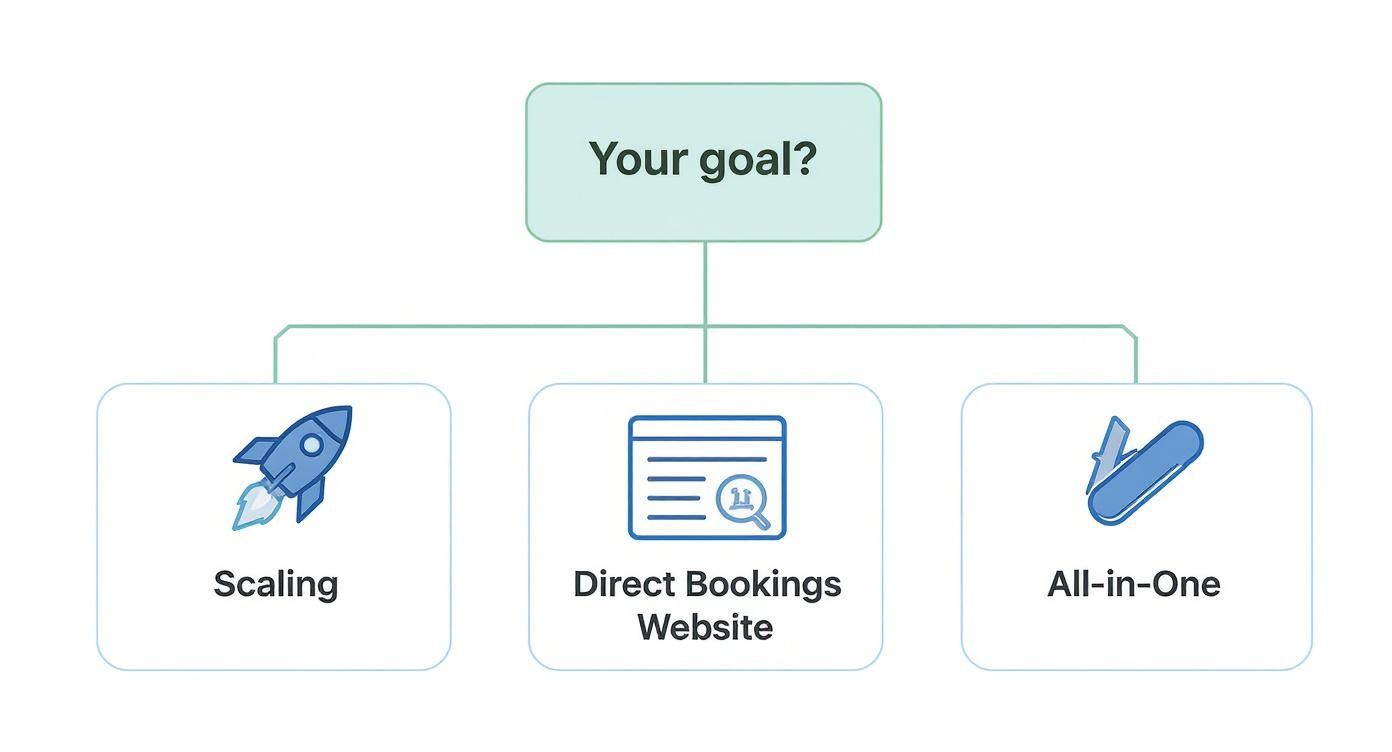
As you can see, your main objective is the first and most important filter in your search, whether that's scaling your portfolio, driving direct bookings, or just finding a simple all-in-one solution.
The Side-Hustle Host (1-3 Properties)
If you're managing just a few properties on the side, your biggest needs are simplicity, affordability, and reliability. You don't want a system with a steep learning curve or dozens of features you'll never touch. The whole point is to automate the basics so you can get your weekends back.
What to prioritize:
A rock-solid calendar sync: Direct API connections are a non-negotiable to prevent double-bookings.
Simple automated messaging: Set up your welcome messages, check-in instructions, and checkout reminders, and then let it run on autopilot.
A clean, intuitive interface: You should be able to get around the platform without needing a user manual.
For hosts in this boat, an overly complex system can actually create more work than it saves. Start with a tool that absolutely nails the fundamentals without overwhelming you.
The Scaling Manager (4-10+ Properties)
This is where the game completely changes. Once you move past a handful of properties, especially if you're managing for other owners, your needs get a lot more complex. This was the turning point for us; spreadsheets became a liability, and we desperately needed a system that could handle multi-unit operations without dropping the ball.
For managers looking to grow, whether you're handling a few units or exploring options like small hotel management software, the focus has to shift to more robust operational tools.
From our experience: When we started managing for others, our software needs changed overnight. Suddenly, features like owner portals, automated financial reporting, and team management tools went from "nice-to-have" to "absolutely essential."
What to prioritize:
Advanced automation: This goes way beyond simple messaging. Think automated rules for assigning cleaners, scheduling maintenance, and even managing reviews.
Owner reporting: A dedicated portal for owners to see their property's performance is non-negotiable. It builds trust and saves you from endless back-and-forth emails.
Team management: The ability to create separate accounts for cleaners and maintenance staff with specific permissions is crucial for smooth operations.
The Direct Booking Pro
For hosts who are all-in on building their own brand and cutting down their reliance on OTAs, the PMS becomes the heart of their marketing and sales engine. Your priority is finding a platform that empowers you to capture and convert direct traffic effectively.
The industry trend toward flexible access really supports this model. While cloud-based products held a dominant 62.6% market share in 2023, hybrid models are growing faster, showing that operators want both accessibility and control. You can learn more about these property management software market trends.
What to prioritize:
A powerful website builder: Look for customizable templates, built-in SEO tools, and a seamless booking experience for your guests.
Integrated payment processing: The ability to securely process credit card payments directly on your site is a must-have.
Guest data ownership: You absolutely need a system that captures guest information so you can build your own marketing list for future promotions and repeat bookings.
Implementing Your New PMS and Avoiding Common Mistakes
Choosing your software is a huge step, but a thoughtful implementation plan is what truly sets you up for success. We’ve been through this process a few times—from onboarding our first properties in Playa del Carmen to switching systems as we grew—and we've learned that a little planning upfront prevents major headaches down the road.
This process isn’t just about flipping a switch. You’re carefully migrating your business's central nervous system from one platform to another. With a clear roadmap, you can manage the transition smoothly and start reaping the benefits of your new tool right away.
Your Pre-Launch Checklist
Before you go live, a methodical approach is your best friend. We treat every implementation like a mini-project with distinct phases. This ensures nothing critical gets missed during the excitement of launching a new tool.
Here's the simple, step-by-step checklist we follow:
Data Migration First: This is the foundation. Meticulously export all guest data, future bookings, and financial records from your old system. Clean up any outdated or duplicate entries before you import them. A clean start is a good start.
Connect and Test Your Channels: Link your OTA listings one by one. Do not skip testing. Create a test booking to ensure the API sync is working perfectly. Check that the calendar blocks instantly and that rates and availability are correct across all platforms.
Configure Your Automation Rules: This is where you reclaim your time. Set up your automated messages, review requests, and cleaning tasks. We recommend sending test messages to yourself to check for tone, accuracy, and proper use of shortcodes.
Train Your Team (and Yourself): If you have cleaners, a co-host, or a VA, walk them through the new system. Show them exactly how their part of the workflow has changed. Documenting these steps is a great idea; you can learn more in our guide on how to create an SOP for your business.
Avoiding Common Implementation Pitfalls
We’ve made a few mistakes over the years so you don’t have to. The property management software market is growing fast—projected to hit USD 4.0 billion by 2033—and a messy implementation can put you behind the curve. You can see more insights into the property management software market growth.
The biggest mistake we ever made was setting up automated messages that were too generic. A guest at our DC house received a welcome message mentioning the beach. It was embarrassing and made us look careless. Personalization is key, even in automation.
Here are a few common traps to watch out for:
Rushing the Calendar Sync: Misconfigured calendar syncs are the number one cause of double-bookings. Triple-check that your API connections are active and that any old iCal links have been completely removed.
Forgetting to Inform Your Team: A surprise switch can create chaos for your cleaners and maintenance crew. Give them a heads-up and provide clear, simple instructions on how to use the new system for their tasks.
Setting Confusing Automated Messages: Avoid creating messages that feel robotic or impersonal. Use custom fields to include the guest’s name and specific reservation details. The goal is efficiency that still feels like genuine hospitality.
A thoughtful launch protects your revenue, your reputation, and your sanity. Take your time, follow a checklist, and you'll build a solid foundation for a more efficient and profitable hosting business.
Building a More Efficient Hosting Business
Let's be honest: the right property management software is really an investment in your most valuable asset—your time. When you're comparing platforms, the goal isn't just to add another monthly subscription to your expenses. It's about finding a tool that genuinely automates the repetitive tasks and gives you the insights to make smarter business decisions. This is what frees you up to focus on what actually matters: creating the kind of guest experiences that earn five-star reviews.
But it’s important to remember that no single platform is a silver bullet. From our own experience managing properties, we’ve learned the most effective setup is usually a core PMS combined with a few specialized tools that absolutely nail specific jobs. Think of your PMS as the operational hub handling bookings and calendars, while other tools perfect different parts of the guest journey.
Finding Your Perfect Tech Combination
A modern tech stack isn't about having the most tools; it's about building a more resilient and efficient business. For example, a PMS manages your day-to-day operations, but a dedicated tool like SmoothStay focuses entirely on elevating the guest experience once they've booked. We built SmoothStay to fill that exact gap, providing beautiful, professional, and completely customizable guidebooks that put everything a guest could need right at their fingertips.
Our AI-powered features help hosts create stunning, genuinely helpful content in minutes, which drastically cuts down on the time spent answering the same questions over and over. This kind of specialized tool complements your PMS, creating a seamless experience from the moment of booking all the way through checkout. To build a truly efficient business, hosts should also consider leveraging cutting-edge technologies like AI for real estate marketing to streamline operations and attract new guests.
The real win comes from creating a system where technology handles the busywork, so you can focus on genuine hospitality. The goal should always be to use tools that make you a better, more responsive, and more efficient host.
Your Path Forward
As you make your final choice, concentrate on what will help you achieve steady, meaningful progress. Don't chase the idea of instant perfection or get paralyzed trying to find one single tool that does everything. The best approach is to take it one step at a time. Start with a solid PMS foundation, then add specialized tools that solve your biggest pain points as they pop up.
Build a tech stack that will grow with you, whether you’re managing your first property or scaling to your fiftieth. By focusing on efficiency and the guest experience, you’re not just buying software—you’re building a stronger, more sustainable hosting business.
Common Questions Hosts Ask About PMS Software
When you're digging through the options for property management software, a lot of the same questions tend to pop up. Having been in your shoes, we've pulled together the ones we hear most often from other hosts. Here are some quick, no-nonsense answers from our own experience.
When Do I Actually Need a PMS?
From what we've seen, the tipping point is usually around your second property, or whenever you realize you're sinking more than a few hours a week into pure admin.
If you’re losing sleep over potential double bookings, manually replying to every single guest message, or trying to coordinate cleaners over text chains, you're already there. Honestly, even with just one property, the right automations can give you your life back.
What’s the Real Difference Between an API and iCal Sync?
This is a big one, and it's something every host needs to get right. Think of an iCal sync as a basic, one-way street for your calendar. It just blocks off dates, and it often comes with a delay—which is exactly how you end up with those nightmare double bookings during peak season.
An API connection, on the other hand, is a deep, two-way, real-time conversation between your systems. It syncs everything instantly: new reservations, pricing changes, messages, and listing details between your PMS and channels like Airbnb and Vrbo. For any host who’s serious about their business, a solid API isn't just nice to have; it's non-negotiable.
Can I Switch to a Different PMS Later?
You can, but it’s definitely a project. Making a switch means exporting all your reservation history and guest data, importing it into the new system, and then reconnecting all your listings on each channel. It's a time-consuming process that can get pretty stressful if you have bookings stacked back-to-back.
That’s why we always tell hosts to take full advantage of free trials and live demos. Get your hands on the software. Test the user interface and the features that matter most to you before committing. A little due diligence upfront will save you a massive headache down the road.
How Much Should I Budget for a PMS?
The pricing is all over the map, but it almost always boils down to one of two models.
Flat Monthly Fee: Some platforms charge a predictable flat rate per property, maybe $20/listing. This is great for hosts who have a stable number of properties and want consistent costs.
Percentage of Booking Revenue: Other tools take a small slice of your booking revenue, typically between 0.5% to 1%. This model scales with your income, which can be easier to manage when bookings fluctuate.
Take a look at your booking volume and seasonality to figure out which structure makes the most financial sense for your operation.
Ready to elevate your guest experience and cut down on repetitive questions? SmoothStay complements your PMS with beautiful, AI-powered digital guidebooks that guests love. With our customizable branding, fair and scalable pricing, and guest-first features, it's the perfect tool to earn more 5-star reviews. Built by hosts, for hosts—we get it. Start your free 14-day trial today.