
The post explains why an Airbnb house manual is the essential first system for hosts, outlining how it creates consistent guest experiences, reduces communication friction, and boosts reviews. It then presents a three‑stage framework—starting with a manual, adding a PMS at stage 2, and expanding tools at stage 3—to help hosts scale their operations effectively.
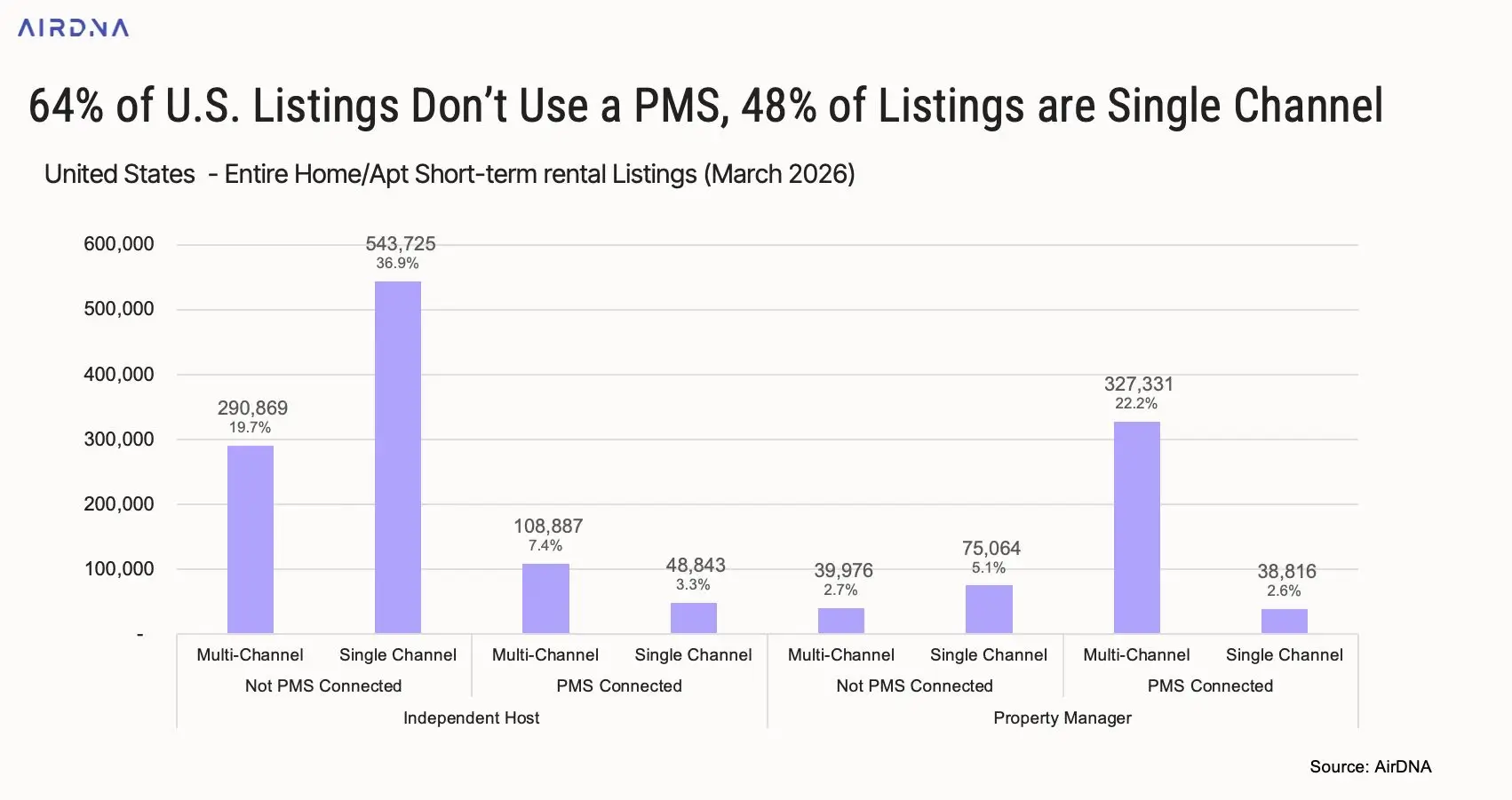
The data behind this post: AirDNA Chief Economist Jamie Lane shared a detailed breakdown of U.S. short-term rental listings by PMS usage and channel distribution in March 2026. View the original LinkedIn post →
The Chart Everyone in STR Is Talking About
AirDNA's Jamie Lane recently published data covering U.S. entire home and apartment short-term rental listings as of March 2026. The headline numbers were stark: 64% of listings don't use a property management system, and 48% are listed on a single channel. The LinkedIn comment section lit up with responses from property managers, tech founders, Superhosts, and data analysts — all trying to make sense of what it means.
What Is an Airbnb House Manual?
An Airbnb house manual is the document that tells guests how your home works: check-in and access, Wi-Fi, parking, appliances, house rules, local tips, and checkout. It's the first system worth building because it pays off at every stage, one property or fifty, with or without a PMS. Most hosts now deliver it as a mobile digital guidebook rather than a printed binder.
That definition matters for reading Jamie's chart. Break the data down and the largest single segment is 543,725 independent host listings, single-channel with no PMS, or 36.9% of the entire U.S. market. At the other end, 327,331 property manager listings run fully PMS-connected across multiple channels (22.2%). Everything in between is hosts at various stages of building out their operational stack.
64% of U.S. STR listings run without a PMS
48% of listings are on a single channel only
5% of professionally managed listings: no PMS, no multi-channel
~35% of listings managed by a property manager (per Jamie Lane)
"I'd be curious to see guest review scores layered into each of these categories."— Jonathan Wicks, founder, Well & Good Professional Services
That's the sharpest observation in the entire comment thread. A PMS doesn't generate five-star reviews. Synced calendars don't make guests feel welcome. And multi-channel distribution doesn't answer the question a guest texts you at 11pm about how the hot tub turns on. The tools gap in Jamie's data is real, but the guest experience gap is older, wider, and touches every host in every segment on that chart.
What "Systemizing" Actually Means for Hosts
The STR industry tends to equate systems with software. Get a PMS. Connect your channels. Automate your pricing. If you're managing two or more properties, or listed on more than one platform, those tools matter enormously, and we'll come back to them. But the instinct to wait until you have "enough properties" to justify building systems is backwards.
Systems are about more than managing complexity. They're how you deliver consistency. Think about any hospitality brand you trust: a well-run boutique hotel, a polished vacation rental company. What makes them feel reliable isn't scale. It's that every guest touchpoint follows a predictable, professional pattern. Guests know what to expect, and nothing falls through the cracks.
That consistency starts with documentation. And the most important document in any host's toolkit, the one that applies on day one, at one property, with zero software, is the Airbnb house manual.
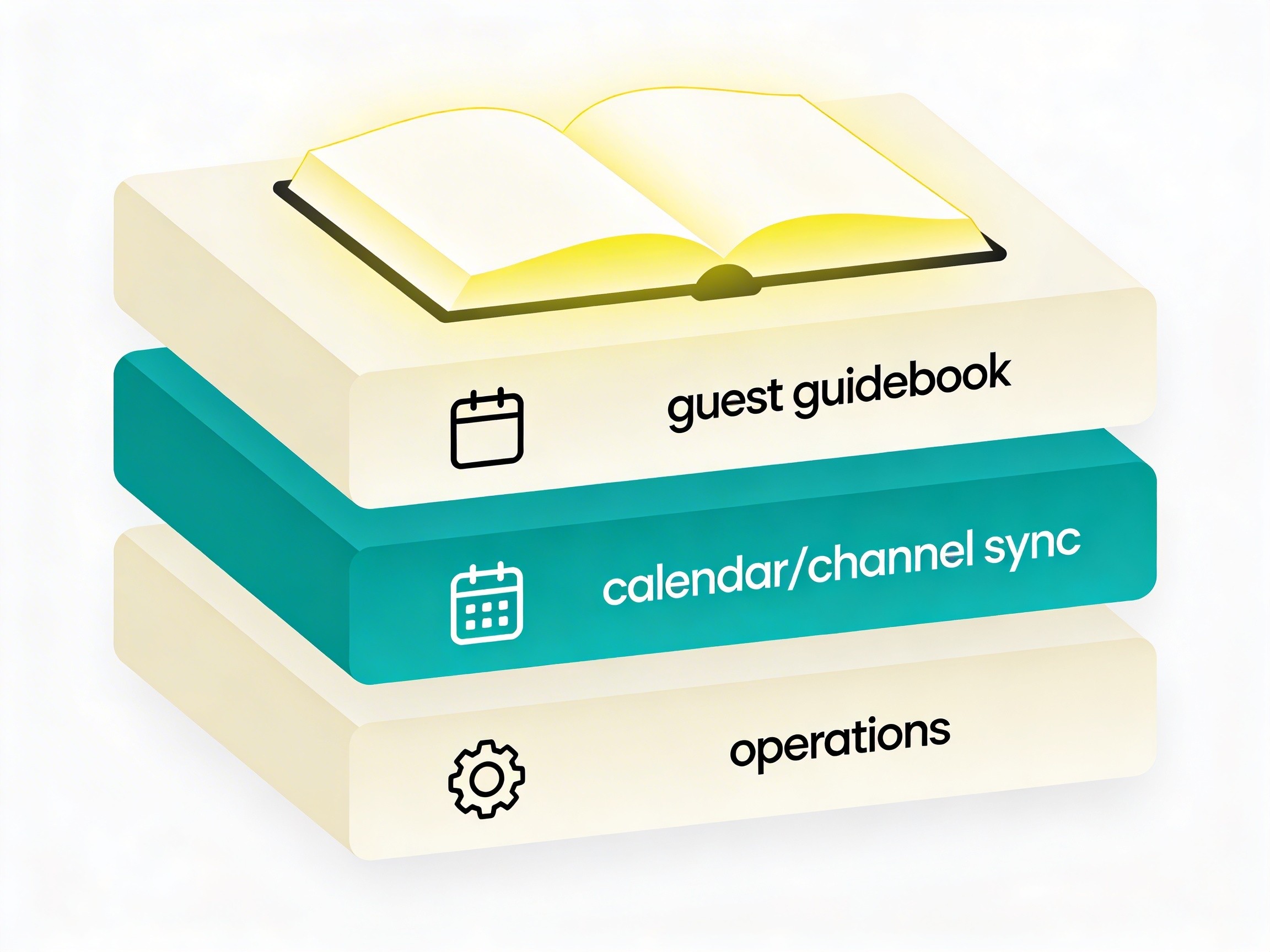
Why Your Airbnb House Manual Is Infrastructure, Not Admin
Most hosts think of a house manual as a convenience, a way to cut down on a few repeat questions. The reality is more valuable than that. A well-built house manual is operational infrastructure. It's the first place where your hosting "system" becomes real and tangible for your guest.
It encodes your standards
The moment you write down how you want guests to check in, what the house rules are, how the appliances work, and what you expect at checkout, you've created a repeatable standard. That standard can be handed to a co-host, onboarded to a new property manager, or used as the blueprint when you add a second property. Without it, you're improvising every time.
It works when you can't
Your house manual is on duty at 2am when a guest can't figure out the thermostat. It answers questions before they're asked. Every question your manual answers is a message you don't have to send. The most common guest inquiries (Wi-Fi, parking, check-in, appliance instructions) are all answerable in a good house manual.
It's the guest's first impression of how you operate
Most guests check the house manual within the first hour of arriving. Before they've slept in your bed or written you a review, they've already formed an opinion about you as a host based on what your manual communicates. Is it clear? Is it warm? Does it feel like someone cared? Or does it read like a legal waiver?
It drives reviews, directly
The link between clear guest communication and positive reviews shows up consistently across host experiences. Confused guests don't leave reviews that say "the manual was bad." They leave reviews that say "communication could be improved" or "check-in was confusing." Those phrases are code for friction a better house manual would have prevented. We've written more about fixing poor guest reviews with better communication.
What a Great Airbnb House Manual Contains
A house manual isn't a list of rules. The most effective ones are structured around how a guest actually moves through a stay, from the moment they arrive to the moment they leave.
Arrival & Access: Precise check-in instructions, smart lock codes, parking (with a map if possible), Wi-Fi credentials front and center, and a brief warm welcome note that sets the tone. This is the highest-anxiety moment for any guest.
The Property: A room-by-room overview of anything that needs explanation: heating and cooling, smart home features, appliances with a learning curve, where to find essentials like extra linens and trash bags. Trash and recycling instructions are one of the most common sources of guest confusion.
House Rules (Done Right): Tone matters as much as content. Rules written as restrictions create defensiveness; rules framed as shared standards feel collaborative. Noise policies, pet and smoking rules, occupancy limits: write them as "here's how we keep this place great for everyone."
Local Recommendations: Your top 3–5 restaurant picks with a line about why you love each, the nearest grocery store and pharmacy, hidden gems, and practical logistics. This is where your manual becomes hospitality rather than logistics. It takes 30 minutes to write and adds memorable value to every stay.
Checkout Instructions: Clear, friendly, and specific. What to do with linens, where to leave the key, what time checkout is, and a closing note that invites a review. Clear checkout instructions protect your property, simplify your cleaner's job, and set expectations before they become a problem.
"A large share of supply is still being run as listings, operating like a side hustle. Clearly a maturity gap. The market is already institutionalizing." — Maricarmen Cárdenas, Hospitality Tech Executive
The Format Problem: Why Most House Manuals Don't Get Read
Here's the uncomfortable truth: most Airbnb house manuals don't get read. Not because guests are careless, but because most manuals are designed in a way that works against reading.
A printed binder gets ignored. A wall of plain text in a message gets skimmed. A PDF attachment doesn't get opened on a phone. And an outdated manual that still references the old TV remote actively erodes guest trust. After 10+ years hosting our row house in Washington DC, what finally made us retire the printed binder was the binder being left in a drawer all stay. The shift to digital guidebooks is a response to how guests actually navigate a stay. They're on their phones. They want to tap a link, find what they need in seconds, and get back to their trip.
An effective digital house manual is:
Mobile-first. Guests open it on any device without downloading anything.
Visually organized. Sections with clear headers, short paragraphs, icons. Not dense blocks of text.
Always current. When the Wi-Fi password changes or checkout time shifts, the update is instant. No reprinting, no resending.
Branded. It should feel like it belongs to your property, not a generic form.
This is what we built SmoothStay's guidebook around: mobile-first sections, instant updates, your own branding, and content tags and templates you can reuse across properties. The difference between a guest who messages you three times a day and one who self-serves effortlessly often comes down entirely to format.
The Framework: Match Your Tools to Your Stage
The AirDNA data doesn't mean every host needs the same stack. What it reveals is a market splitting between professional operators and casual side-hustle hosts. Here's a clear-eyed view of where to focus at each stage.
Stage | Where you are | What to add | What to keep |
|---|---|---|---|
Stage 1 | One property, one channel | House manual, communication habits, cleaning checklist | — |
Stage 2 | Two+ properties or multi-channel | A PMS (Hospitable, Hostaway, OwnerRez) | A polished house manual per property |
Stage 3 | Scaling a portfolio | Dynamic pricing, direct booking, analytics | Quarterly manual reviews, tags and templates |
Stage 1 — One property, one channel
You may not need a PMS yet. But you do need habits that scale. Focus on guest experience fundamentals now:
Build your Airbnb house manual: structured, warm, digital if possible.
Create a standard 4-message communication sequence (pre-arrival, check-in, mid-stay, checkout). This is a habit, not a tool; you can run it from any inbox.
Standardize your cleaning and checkout checklist.
These habits cost nothing and compound in reviews from your very first stay.
Stage 2 — Two+ properties or multi-channel
Get a PMS. Full stop. At this stage, operational complexity outpaces what manual management can handle. Double bookings, unsynced calendars, and missed messages are predictable outcomes without one.
Tools like Hospitable, Hostaway, or OwnerRez are purpose-built for this moment.
The cost pays for itself in avoided mistakes within the first month.
AND maintain a polished house manual for each property. The PMS manages operations; the manual manages how guests feel.
The two are not substitutes. They work together.
Stage 3 — Scaling a portfolio
By this point you're adding dynamic pricing, direct booking, and analytics. The systems from stages one and two are now your competitive advantage.
Hosts who skipped foundations find scaling amplifies their problems rather than solving them.
Use content tags and templates across properties to keep a consistent brand experience at scale.
Review each property's guest manual quarterly: outdated info is a reviews liability.
Building Your Airbnb House Manual: Where to Start Today
If you don't have a comprehensive house manual yet, here's how to build one without overthinking it.
Brain dump every question you've ever been asked. Open a document and list them all: Wi-Fi, parking, coffee machine, trash schedule, checkout time. That list is the skeleton of your manual. If a guest asked it once, another guest will ask it again.
Organize by guest journey. Sort your brain dump into Arrival → The Home → Rules → Local Tips → Checkout. You now have a structure, and sequence matters: guests need arrival info first, checkout info last.
Write for a first-time guest. Don't assume knowledge. Don't abbreviate. Write as if you're explaining your home to someone who has never been there and will arrive after you've already left.
Make it digital and mobile-friendly. A living, updateable digital guidebook serves guests better than any static format. It travels with them on their phones and doesn't go stale the moment something changes.
Review it after every stay for 90 days. In the first three months, your manual will have gaps. Every question a guest asks is a prompt to add a section. By month three, you'll have something close to complete, and it will show in your reviews.
The Market Is Professionalizing. The Gap Is Closing.
Elizabeth Muckensturm, an Airbnb Superhost and Superhost Ambassador who commented on Jamie's post, was refreshingly honest: "I'm the 5% [without multi-channel]. Other listing sites are clunky and not user-friendly so I don't waste my time." She's right that tools aren't everything. Experience and judgment still matter, and a thoughtful host with one well-run listing can outperform a multi-channel operator running chaos.
But the trajectory is clear. Maricarmen Cárdenas's observation that the market is institutionalizing is borne out in the numbers. Supply is maturing. Guest expectations are rising. The hosts competing effectively in 2026 are running tighter operations and delivering more consistent experiences. That doesn't require a massive software stack on day one. It requires building the right systems for where you are now.
The system that applies at every stage, costs nothing to start, and becomes the foundation for everything after? Your Airbnb house manual. Build it first. Build it well. The rest of the stack can follow.
FAQ
What should an Airbnb house manual include?
Five sections, ordered by the guest journey: arrival and access (check-in steps, codes, parking, Wi-Fi), how the home works (appliances, heating, where things live), house rules, local recommendations, and checkout instructions. If a guest has asked it once, the answer belongs in the manual.
Do I need a PMS or just a house manual?
Start with the house manual. With one property on one channel, a PMS is usually premature. Once you run two or more properties or list on multiple channels, get a PMS, and keep the manual: the PMS runs your operations, the manual shapes how guests feel. They're complements, not substitutes.
Is a digital house manual better than a printed one?
For most hosts, yes. A digital manual opens on the guest's phone, updates instantly, and never sits outdated on a shelf. One honest caveat: it needs an internet connection to load, so encourage guests to open the link before they head somewhere with weak signal, and keep a one-page printed fallback (Wi-Fi, lock codes, emergency contacts) at the property.
What's the difference between a house manual and an Airbnb guidebook?
Inside Airbnb, the "guidebook" is your local recommendations and the "house manual" is a short text field about how the home works. In practice, hosts combine both into one mobile digital guidebook so guests get access details, house instructions, and local tips in a single link.
How long should an Airbnb house manual be?
As short as it can be while still answering real questions. Structure beats length: clear sections a guest can scan in seconds do more than ten extra pages. Start with the questions you've actually been asked and trim anything no guest has ever needed.
If you'd rather not format all this yourself, you can have a free digital house manual running in SmoothStay in under an hour. Start with one property on the free plan, no card needed, and build it out from your first guest question.
Latest articles

How to Automate Check-In Instructions for Short-Term Rental Guests
Automate check-in instructions for short-term rental guests: the four-send sequence, what goes in a message versus a guidebook, and a copy-ready sample.

Vrbo Premier Host in 2026: Every Listing Now Stands on Its Own Record
Vrbo Premier Host requirements changed in 2026: per-listing scoring, tighter thresholds, quarterly checks. What each one means, and how it compares to Superhost.
Booking.com Guest Messaging Rules: What Hosts Can Send, When, and Why Links Get Removed
Booking.com guest messaging rules, verified at source: how long you can message a guest, why your links get removed, and what the partner terms say.
Vrbo's New Features for Fall 2026: What's Live, What's Gated, and What's US-Only
We sorted Vrbo's new features for fall 2026: what is live globally, what is gated behind eligibility, and what is US-only. Verified against Vrbo's own pages.