

Airbnb is testing a new promotion that offers around a 10% discount to “top‑rated guests” — travelers with about a 4.8+ rating and several completed stays. The goal is to reward reliable guests, boost listing visibility in search, and help hosts attract smoother, higher‑review stays, but the discount can interact with existing promotions, length‑of‑stay deals, and non‑refundable rates in ways that quietly erode profit if it is not configured carefully.
Airbnb has started quietly inviting hosts to hand their best guests a discount. We've hosted since 2015, first out of our row house in Foggy Bottom in Washington DC and now on properties we run in the Riviera Maya, and we've learned to read these tests carefully before opting in. This one is worth understanding, because the headline number isn't the part that costs you money.
What is Airbnb's top-rated guest discount?
It's a test promotion that invites hosts to give roughly 10–20% off to "top-rated guests" — travelers with around a 4.8+ guest rating and several completed stays — in exchange for extra visibility in search. The host funds the entire discount; Airbnb contributes the placement, not a cent of the price cut. As of June 2026 it's still a limited test, not a platform-wide program, so not every host sees the invitation.
The rest of this breaks down what the promo actually is, why Airbnb is building toward it, and how to run it without quietly wrecking your margins.
What the discount actually is
Hosts are seeing a message in their dashboard or calendar inviting them to add a percentage discount for a specific date range. In return, the listing gets promoted to highly rated guests, usually with a badge and a strikethrough price that signals a deal.
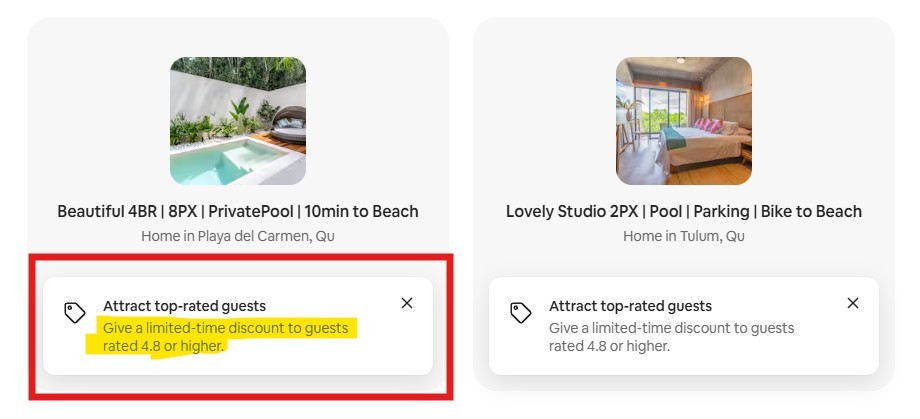
Unlike a generic price drop, the promo is aimed at better-behaved guests while lifting your search position, which is why it's caught the attention of serious hosts and pricing analysts. It's also worth saying what it isn't: this is separate from the standard 20% new-listing discount Airbnb applies until a property gets its first three reviews. That one solves the cold-start problem and ends on its own. This one targets established listings and ties the discount directly to ranking.
Why Airbnb is pushing this now
Read it as part visibility boost, part early step toward a behavior-based loyalty layer. Instead of rewarding guests purely for spending the most, Airbnb is experimenting with rewarding the ones who consistently earn high ratings from hosts.
That's not a guess about the roadmap. On Airbnb's Q4 2025 earnings call in February 2026, CEO Brian Chesky confirmed the company is trialing loyalty components — and signaled that rather than a conventional points program, Airbnb is testing several different approaches. For a company that resisted loyalty tiers for years, the top-rated guest discount looks like one of those experiments in the wild.
It's only possible because Airbnb's two-way review system has years of data on how guests behave, something traditional OTAs don't expose the same way. The obvious comparison is Booking.com's Genius program, which normalized discount-for-visibility and became a structural part of that marketplace. The two aren't identical, but they pull the same lever:
Airbnb's top-rated guest discount | Booking.com Genius | |
|---|---|---|
Who qualifies | Guests with a 4.8+ rating and 3+ reviews | Guests by booking frequency, in tiers |
How you join | Invite-only, per listing, time-limited | Formal enrollment, ongoing once you're in |
Who funds the discount | The host | The host |
What it rewards | Guest behavior (ratings) | Guest spend and frequency |
For hosts, the implication is concrete: great guests are becoming a segment you can deliberately market to — if you're willing to fund the discount.
Why the idea appeals to hosts
Top-rated guests tend to be the ones who communicate clearly, respect house rules, and leave the place in good shape. Those are the stays that protect the 4.8+ overall rating Superhost status depends on, and they're the guests most likely to leave a thoughtful review.
Small, targeted discounts can lift click-through and occupancy when you use them in the right windows — shoulder season, mid-week gaps, a new-listing ramp. Point one at an already high-quality guest segment and the trade gets more interesting: you give up some margin for a smoother stay and a better review. That's the appeal. The risk is everything sitting underneath it.
The hidden risk: stacking and margin erosion
The danger isn't the 10% headline. It's how the promo compounds with every other discount already running on your calendar. Airbnb applies discounts in a specific order, and the order is what bites.
Per Airbnb's own help documentation, discounts layer like this:
Your rule-set or manual price applies first — that's the base.
A promotion, like the top-rated guest discount, is calculated on that already-adjusted price.
The non-refundable discount is applied last, on top of the promotional price.
Airbnb's own example makes the compounding obvious: a July rule-set price of $100 (down from $120), a 20% promotion that takes it to $80, and a non-refundable option that knocks another 10% off lands the guest at $72 a night. The non-refundable discount and rate adjustments are among the few things that genuinely stack, which is exactly how a "modest" promo turns into a much deeper effective discount than you intended.
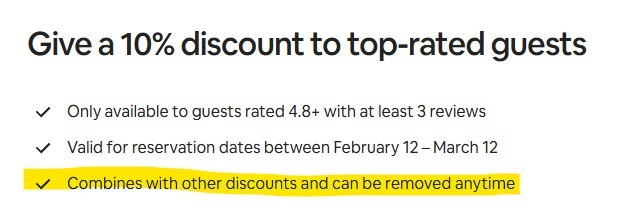
Run that promo alongside length-of-stay, early-bird, last-minute, and non-refundable options all at once and you get what hosts call a stacking accident: you give away far more than you meant to. The promo isn't dangerous on its own. In combination, it can quietly erase your margin.
How to decide if it fits your strategy
Weigh the promo through three lenses.
Visibility. Airbnb is dangling a ranking carrot: discount for top-rated guests, get promoted in search for a set window. If your calendar is soft and your photos and reviews are already dialed in, it's worth testing.
Guest quality. Targeting guests with 4.8+ ratings and several past stays skews you toward people who know how the platform works and respect your place. For anyone chasing or holding Superhost, that segment lines up with the low-issue stays the status rewards.
Margin. Every percent is funded by you, not Airbnb. The only rational way in is to run the math on the worst case — promo plus any other active discount plus non-refundable — and confirm the final nightly rate still clears your profit line.
A practical framework to use it safely
1. Audit every active discount
Before you opt in, spend 30 minutes mapping the full pricing stack for each listing: weekly and monthly discounts, early-bird and last-minute settings, any custom promotions already on the calendar, and your non-refundable habits. Most experienced managers hold themselves to one or two primary levers — say, length-of-stay plus one targeted promo — rather than running every tool at once. Fewer levers, fewer surprises.
2. Decide where the promo fits on your calendar
Treat it like a scalpel, not a hammer. Use it in shoulder seasons, mid-week gaps, and new-listing ramp-up periods, where extra visibility has real upside. Keep it off high-demand dates that already sell at full price — holidays, events, school breaks, the weekends that book out months ahead.
3. Protect yourself from over-stacking
Turn off or reduce the non-refundable discount while the promo runs, since that's the one most likely to compound.
Pause one of your automatic discounts (early-bird or last-minute) during the promo window so you know exactly what's in play.
Use Airbnb's price-breakdown view on a few test dates to confirm the final guest price and your payout, line by line.
Hosts who check the breakdown after every new feature rollout catch misconfigurations early, before they cost months of underpriced bookings.
4. Monitor it like an experiment
Think 30 to 60 days, not a permanent setting. Track occupancy, average nightly rate, and profit per stay both before and during the promo. Watch the guest-quality signals too — message tone, rule adherence, condition at checkout, review quality. More bookings but lower net income means scale the discount back. Higher-quality guests and better reviews at an acceptable margin means you've found a playbook for slow periods. We've used Beyond Pricing on our own properties in the past for exactly this test-and-learn cycle and still recommend it for hosts who want the math handled automatically (full disclosure: Beyond is a SmoothStay partner).
How to turn top-rated guests into long-term assets
Attracting great guests is half the game. Keeping them in your orbit is where the long-term profit lives, and the lever there isn't pricing — it's the experience once they've booked.
A clear, well-built digital guidebook cuts repetitive questions and confusion, which makes for smoother stays and better reviews. Pair it with the kind of proactive communication the best Superhosts treat as a habit, and you've removed most of the friction that turns a good guest into a neutral review. Our guides on building a welcome book and handling common guest questions walk through both, and if you want the review angle specifically, we wrote about earning better reviews through communication.
If Airbnb really is moving toward rewarding the best guests with access to better listings and pricing, the hosts who consistently deliver polished, low-friction stays are the ones who'll benefit most. A top-rated guest who gets a seamless guidebook, clear house rules, and thoughtful local tips is far more likely to leave a detailed five-star review, book you again, and send friends your way.
Where SmoothStay fits
We built SmoothStay because we needed it — two hosts tired of reprinting guidebook pages and answering the same questions at midnight. It's the guest-experience layer, not a pricing tool: the discount strategy above is yours to run, but the guidebook and welcome book are what make every new booking smoother instead of just cheaper. If you're pushing more volume through promotions, those systems are what protect your rating while you do it. Strong reviews also compound into pricing power, which is the other half of the equation — we cover that in our pricing-strategy post.
If you decide to test Airbnb's top-rated guest discount, pair it with the systems that turn a one-time promo into a repeat guest. You can have a free SmoothStay guidebook running on a property in about an hour. Free tier, no card needed.
FAQ
Is the Airbnb top-rated guest discount worth it?
Sometimes. It's worth testing in soft periods if your listing quality is already strong and you've confirmed that the discount, stacked with everything else active, still clears your profit threshold. It's not worth it on high-demand dates that sell at full price anyway.
How much is the discount, and who pays for it?
It's roughly 10–20% off, and the host funds all of it. Airbnb's contribution is the search visibility and the deal badge, not any share of the discount.
Is this a permanent Airbnb feature?
Not yet. As of June 2026 it's a limited test, not a platform-wide program, so not every host sees the invitation. Airbnb has said its loyalty plans are still evolving, so the terms could change.
What's the biggest mistake hosts make with it?
Letting it stack. Airbnb applies your rule-set price first, the promotion on top of that, and the non-refundable discount last — so a "10%" promo can quietly become a much deeper cut. Pause overlapping discounts and check the price breakdown before you commit.
Does a discount like this hurt my reviews or my rating?
The discount itself doesn't. Pulling in more bookings without a system to handle them is what hurts. A clear guidebook and proactive communication keep the experience consistent as volume rises, which is what protects the rating the promo is supposed to reward.
Latest articles

How to Automate Check-In Instructions for Short-Term Rental Guests
Automate check-in instructions for short-term rental guests: the four-send sequence, what goes in a message versus a guidebook, and a copy-ready sample.

Vrbo Premier Host in 2026: Every Listing Now Stands on Its Own Record
Vrbo Premier Host requirements changed in 2026: per-listing scoring, tighter thresholds, quarterly checks. What each one means, and how it compares to Superhost.
Booking.com Guest Messaging Rules: What Hosts Can Send, When, and Why Links Get Removed
Booking.com guest messaging rules, verified at source: how long you can message a guest, why your links get removed, and what the partner terms say.
Vrbo's New Features for Fall 2026: What's Live, What's Gated, and What's US-Only
We sorted Vrbo's new features for fall 2026: what is live globally, what is gated behind eligibility, and what is US-only. Verified against Vrbo's own pages.