

A Host's Guide To Seamless Guest Registration
Optimize your registration of guests with our host-tested guide. Learn how to meet legal needs and automate your check-in for a 5-star guest experience.
Disclosure: Some links in this article are affiliate links. If you make a purchase, we may earn a commission at no extra cost to you. This helps support our content.
The registration of guests is your first real handshake with a visitor. It’s so much more than just collecting names on a form; it's a critical moment that sets the tone for their entire stay, keeps you legally compliant, and protects your property. A smooth, professional process builds instant trust and quietly signals that a high-quality experience is ahead.
Why A Smooth Guest Registration Process Matters
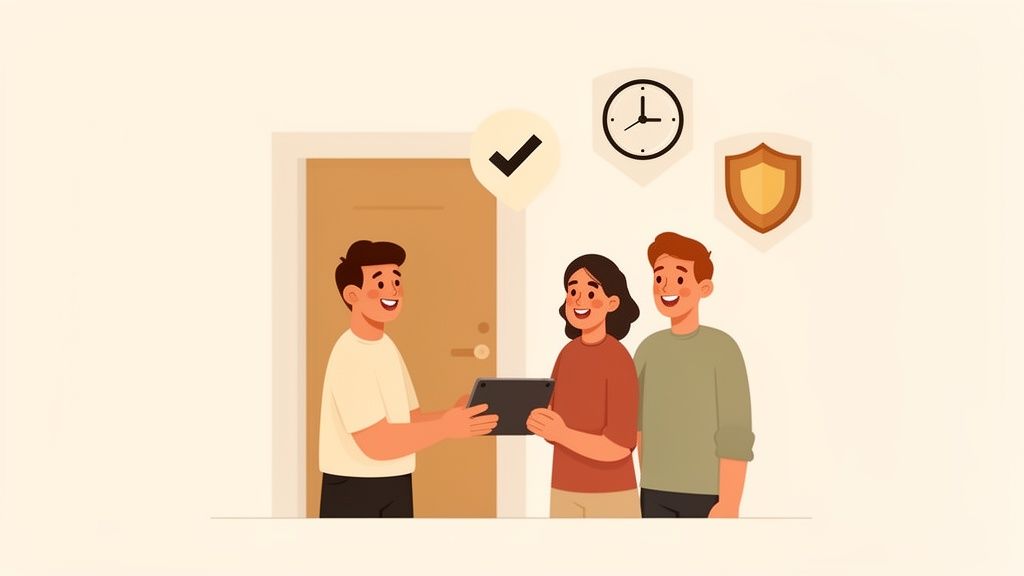
First impressions are everything, and we learned this the hard way. Early on, we went from fumbling with lockboxes at our D.C. house to navigating the local ordinances for our beach properties in the Riviera Maya. A clunky, confusing, or insecure check-in can sour a guest's mood before they've even dropped their bags.
That’s why a polished registration process is non-negotiable for any serious host.
Think of it as the foundation of the guest experience. It’s your first and best chance to show you’re a professional who cares about the details. When guests encounter an organized system right from the start, they feel more confident in their choice and can finally start to relax into their vacation.
The Core Goals of Guest Registration
From our experience, a really well-designed registration system accomplishes three key things at once. It’s not just about paperwork—it’s about creating a secure, welcoming, and seamless environment.
Fulfilling Legal Duties: Many cities and countries require hosts to collect and sometimes report guest information. This could mean anything from passport details for international visitors to local ID numbers. Staying compliant keeps you out of trouble with fines and establishes you as a responsible operator in your community.
Protecting Your Property: Knowing exactly who is staying in your rental is just fundamental security. It helps with accountability if anything goes wrong and is often a non-negotiable requirement for short-term rental insurance policies.
Enhancing the Guest Experience: A simple, digital pre-arrival registration removes a major point of friction. Guests can complete it on their own time, which reduces that arrival-day stress and makes them feel like you’ve thought of everything.
We found that improving our registration process had a direct and noticeable impact on our reviews. When guests feel secure and the check-in is effortless, it contributes significantly to their overall impression. You can learn more about what is guest satisfaction in our dedicated guide.
Ultimately, a streamlined approach to the registration of guests is about building trust and efficiency from the moment a booking is confirmed. It shows you’re a pro who has thought through every detail of their stay, paving the way for a five-star experience.
Navigating Guest Registration Legal Requirements
Figuring out the local laws for guest registration can feel like a maze, but it's one of the most important parts of being a responsible host. Over the years managing our own places, we've learned that what's required in Washington, D.C. is completely different from the rules in Tulum. Getting this right from the start protects your business and builds trust with local authorities.
The first step is always research. Your local city hall, tourism board, or municipal government website is the best place to find official documentation. Don't rely on hearsay from other hosts, as rules can change.
Identifying What You Need to Collect
Once you find the regulations, you'll need to pinpoint exactly what data you're required to collect. This often varies based on whether your guests are domestic or international.
Common requirements include:
Full Name and Address: This is almost always a baseline requirement.
Government-Issued ID: Many places require a copy or number from a driver's license, national ID card, or passport.
Dates of Stay: Authorities often need to know the exact check-in and check-out dates.
Number of Guests: This is crucial for fire safety and occupancy limits.
For example, at our property in Playa del Carmen, we're required to collect passport details from all non-Mexican citizens and report them. It's a non-negotiable step that's built directly into our pre-arrival check-in process. This approach makes the registration of guests feel like a standard, professional procedure rather than an intrusive demand upon arrival.
The key is to frame this as a routine part of the booking process. We’ve found that when you present these requirements clearly and confidently, guests understand it’s for compliance and security, not because you're being nosy.
This is also a great time to ensure your rental agreement is solid. A well-drafted contract can reference your legal requirement to collect guest data, making the process even smoother. If you need help, check out our guide on creating effective vacation rental agreements.
Handling Data Privacy and Security
Collecting sensitive information means you have a duty to protect it. Laws like GDPR in Europe set a high bar for data privacy, and the principles are a good standard to follow no matter where you are.
Be transparent with your guests about why you need their information and how you'll store it. Use secure, encrypted digital forms for collection—never ask for passport photos over unsecured email or messaging apps.
Most importantly, have a clear policy for how long you'll retain the data and how you'll dispose of it securely once it's no longer legally required. Building a compliant registration process isn't just about avoiding fines; it's about operating a professional, trustworthy business that both guests and your community can respect.
Creating Your Digital Pre-Arrival Registration
Let’s be honest, nobody enjoys filling out paperwork the moment they arrive for a vacation. Taking your guest registration process online before anyone even packs their bags is a total game-changer. It shifts a clunky, on-arrival task into a smooth, professional touchpoint that sets the right tone from the start.
This simple move saves you a ton of time, cuts down on those repetitive questions, and lets your guests start their trip feeling organized and cared for.
The goal here is to create a digital check-in that’s fast, clear, and mobile-friendly. Think of something your guest can complete in just a few minutes while waiting to board their flight. This approach doesn't just handle the necessary paperwork; it reinforces that you're a detail-oriented host who values their time.
What to Include in Your Digital Form
Building your form is a balancing act between what you need to know and what’s convenient for your guest. Clutter is your enemy. Stick to the absolute essentials to keep the process quick and painless.
Here’s a breakdown of what we’ve found works best for our own properties:
Primary Guest Information: Full name, email, and phone number of the person who made the booking. This is non-negotiable.
Total Number of Guests: Get a final headcount of adults and children. This helps you prepare the space and stay compliant with occupancy limits.
Guest ID Upload: If it’s legally required in your area, include a secure field for guests to upload a photo of their government-issued ID or passport.
House Rules Agreement: A simple checkbox where guests must confirm they've read and agree to your rules is crucial for accountability.
Estimated Time of Arrival (Optional): This can be incredibly helpful for coordinating cleanings or a personal greeting, but we always frame it as optional. It gives guests flexibility and avoids adding stress to their travel day.
Our rule of thumb is to never ask for information you don't actually need. Every extra field you add increases the chance a guest will abandon the form and "deal with it later"—exactly what you're trying to avoid.
Before you start building your form, it's a great idea to separate the must-haves from the nice-to-haves. This table breaks down what we consider essential versus what you might add to elevate the experience.
Essential Vs Optional Information For Your Guest Registration Form
Data Point | Category (Essential/Optional) | Purpose & Best Practice |
|---|---|---|
Full Name of Primary Guest | Essential | For legal records, communication, and security. Must match the booking. |
Contact Info (Email & Phone) | Essential | Crucial for sending check-in instructions and for urgent communication. |
Total Guest Count | Essential | Ensures compliance with occupancy limits and safety regulations. |
Guest ID/Passport Upload | Essential (if legally required) | Check local laws. Use a secure platform for uploads to protect guest data. |
House Rules Agreement | Essential | A simple checkbox provides documented proof that guests acknowledged your rules. |
Estimated Arrival Time | Optional | Helps with scheduling, but keep it optional to avoid stressing guests. |
Vehicle Information | Optional | Useful if you have limited or assigned parking. Otherwise, skip it. |
Special Requests | Optional | A great way to add a personal touch (e.g., setting up for an anniversary). |
Thinking through this list will help you create a form that's both compliant and guest-friendly, gathering what you need without becoming a burden.
Structuring the Form for a Great Experience
How you present the information is just as important as what you ask for. A poorly designed form can feel like an interrogation. A well-structured one feels like a helpful, organized step in their journey.
Start with the easy stuff, like names and contact info, before moving on to anything that requires a bit more effort, like finding and uploading an ID. We’ve also found that adding a progress bar is a nice touch—it shows guests exactly how close they are to being finished.
Platforms like SmoothStay are built specifically for this. You can integrate your registration form directly into your digital guidebook. When a guest books, the system automatically sends them a link. They complete the form, and once it's done, they get full access to the guidebook with all your property details and local tips.
It’s a seamless loop that saves you from manually chasing down information. This setup can also tie directly into a QR code check-in system, making the entire arrival process incredibly smooth and modern. By automating your pre-arrival registration, you collect all the necessary details upfront, confirm rule agreements, and give your guests a single, reliable source of information—all before they even leave home.
Managing On-Site Verification And Guest Welcome
Even with a flawless digital pre-arrival system, the moment your guests actually step onto the property is make-or-break. This is where on-site check-in happens, and your goal is to make it feel less like a security checkpoint and more like a warm, genuine welcome. It’s a delicate dance between maintaining security and kicking off a great guest experience.
Over the years, we've experimented with a few different methods. For our properties in the Riviera Maya, a quick in-person ID check is sometimes unavoidable due to local regulations. But for our D.C. house, a fully remote process works perfectly. What truly matters is that your method is clear, simple, and communicated to your guests well before they arrive.
Finding Your On-Site Verification Style
When it comes to on-site verification, you’re looking at two main paths: the traditional in-person greeting or a secure self-check-in. Neither one is universally better; the right choice really hinges on your property, its location, and your personal hosting style.
In-Person Greetings:
This approach offers the highest level of security since you can physically match the guest to the ID they submitted online. It also adds a personal touch that many guests still appreciate.
The downside? It means you or your staff have to be physically present, which can be a scheduling challenge with flight delays and unpredictable travel.
Secure Self-Check-In:
This is all about convenience and flexibility. Guests can arrive whenever they want without feeling rushed, and it’s a lifesaver for hosts managing properties from a distance.
Of course, this means your verification relies entirely on the digital info you’ve already collected. It also requires an investment in solid tech like smart locks and, of course, disclosed external security cameras.
Our own approach has evolved into a hybrid model. We use smart locks with unique codes for every guest, but we also have a trusted local contact who can perform an in-person check if something feels off. It gives us peace of mind without inconveniencing our guests.
Communicating the Process Clearly
The key to a smooth on-site welcome is setting expectations long before your guests arrive. Nothing creates friction faster than surprising someone with a last-minute request to see their passport. Your digital guidebook is the perfect place to lay out the entire arrival process.
Create a dedicated "Check-In Instructions" section and spell out exactly what will happen.
For self-check-in: Explain precisely how and when they will receive their unique access code. A short, simple video showing how to operate the smart lock is a fantastic touch that guests love.
For in-person greetings: Be clear about who will be meeting them and mention that they'll need to briefly present the same government-issued ID they used for the digital registration. Frame it as a quick, final step to ensure everyone's safety.
At SmoothStay, we designed our digital guidebooks to be the single source of truth for guests. You can use time-based access to reveal check-in details only after the registration of guests is complete and just before their arrival. This keeps everything secure and ensures your guests have the right information at exactly the right time, starting their stay on a positive note.
Automating Guest Registration With Modern Tools
When you’re growing from one property to a handful, manual processes will absolutely kill your momentum. Trust us, we’ve been there. Automation is the only way to scale your registration of guests without losing that personal touch that gets you great reviews. It’s all about working smarter, not harder.
Modern tools can put this entire process on autopilot. A booking is confirmed, and a system instantly sends a welcome email with a registration link. No more remembering to follow up or sending late-night messages. The machine handles it, ensuring every guest gets what they need, right on time.
This entire automated flow can be boiled down to a simple, three-step journey for your guests: verify, welcome, and access.
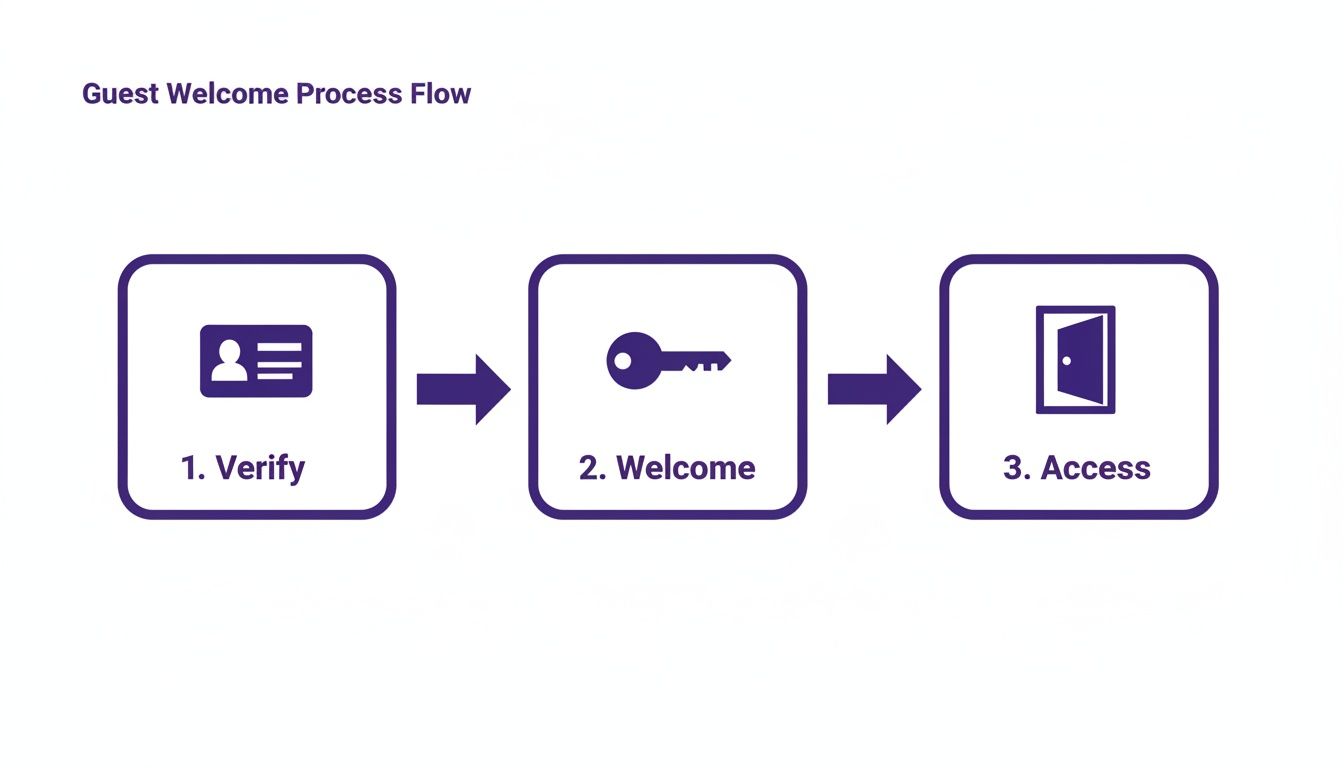
This process moves guests smoothly from booking to check-in, cutting out the friction and making the whole experience feel professional and seamless.
Smart Access and Automated Reminders
The real magic happens when you connect registration directly to property access. In our properties, we’ve set up our system to automatically release access to our digital guidebook and smart lock codes, but only after a guest completes their registration. This one simple rule has saved us from countless headaches by making sure we have all the required info before anyone steps foot inside.
But what about the guests who forget? Instead of you personally chasing them down, the system sends out polite, automated nudges for you.
First Nudge: A friendly reminder goes out a few days before check-in if the form isn't done.
Final Nudge: Another one is sent 24 hours before arrival, clearly stating that access details are unlocked upon completion.
This creates a self-managing loop that keeps everything on track without your constant oversight. If you're interested in digging deeper, it's worth exploring the future of business efficiency through automation to see how these concepts apply across the board.
Leveraging QR Codes and AI Chatbots
Automation can also solve those little on-the-fly problems. We stick a simple QR code inside our rentals that links straight to the registration form. If a guest shows up with an unexpected visitor, they just scan the code and get registered in seconds. Our records stay accurate, and there's zero hassle for anyone.
Another game-changer has been adding an AI chatbot to our digital guidebook. It can instantly field all those common questions about registration, Wi-Fi passwords, or check-out times, 24/7.
We found that about 80% of our guest questions were the same few inquiries. An AI chatbot now handles these, freeing up hours of our time each week. This is what worked for us.
This gives guests immediate answers and lets you focus on running the business, not just answering the same questions over and over.
Answering Those Tricky Guest Registration Questions
Even with the slickest system in place, you're going to run into tricky situations. After more than a decade of hosting, we've been asked just about every question you can imagine when it comes to guest registration. Here are our honest, experience-based answers to the questions that pop up most often.
What If a Guest Refuses to Register or Provide Their ID?
For us, this is a firm line in the sand. If a guest refuses to complete the required registration—especially when it's a legal requirement in our area—we simply don't allow them to check in. It’s a non-negotiable part of our terms, something we state clearly in our listing and house rules.
We'll politely explain that registration is mandatory for local compliance and our insurance policy. It's there to protect both them and us. If they still push back, we contact the booking platform's support team immediately. We’d advise never to hand over the keys if a guest won't follow your essential safety procedures or makes you feel uncomfortable.
How Should I Handle Last-Minute, Unregistered Guests?
It happens. Your primary guest shows up with a partner or a friend who wasn't on the original booking. The key here is to have a simple, low-friction process ready for this exact scenario.
We keep a QR code on the back of the front door that links directly to our registration form. We just ask the new person to scan it and fill out their details right then and there. This keeps our records accurate without turning it into a big, awkward ordeal. It shows we’re flexible but still serious about knowing who is staying on our property.
Is It Safe to Store Guest ID Photos Digitally?
This is a totally valid concern, and data security has to be your top priority. The first rule is to never ask guests to send sensitive documents like passports over unsecured channels like email or standard messaging apps.
We exclusively use a secure, encrypted platform designed specifically for this purpose. The data is protected, and we have a strict policy to permanently delete all ID copies within a set period after a guest checks out—usually 7 to 14 days, unless local laws require us to hold onto them longer.
This approach keeps us compliant while respecting our guests’ privacy. It's all about using the right tools to handle sensitive information responsibly.
Ready to build a registration process that impresses guests and saves you hours of back-and-forth? As hosts ourselves, we built SmoothStay to solve these exact challenges. Our platform offers customizable, professional guidebooks with integrated, secure guest registration and guest-first AI features to put your workflow on autopilot. It's the tool we wished we had from day one.
Explore SmoothStay's features at https://www.smoothstay.io