Long Term Rentals vs Short Term Rentals: A Host's Guide
Deciding between long term rentals vs short term rentals? This guide compares income, workload, and regulations to help you choose the best strategy.
Disclosure: Some links in this article are affiliate links. If you make a purchase, we may earn a commission at no extra cost to you. This helps support our content.
The big question for any property owner is whether to go for long-term or short-term rentals. It really boils down to a trade-off: do you want the higher potential income and flexibility that comes with short-term stays, or the greater stability and predictability of having long-term tenants?
Your choice here really depends on whether you see yourself running an active hospitality business or prefer a more passive income stream.
Choosing Your Rental Strategy: A Quick Comparison
Deciding between a short-term rental (STR) and a long-term rental (LTR) is one of the biggest forks in the road you'll face as a property owner. We’ve been there ourselves with our own properties—from our four-bedroom house in Washington, DC, to our beach properties in the Riviera Maya—and we know the "right" answer completely depends on your market, your property, and your personal goals.
Think of it this way: an STR operates a lot like a small hotel. It demands constant attention, marketing, and top-notch guest service. An LTR, on the other hand, is much more like a traditional investment, giving you a steady, hands-off income stream once you find a reliable tenant.
If you really want to get into the weeds, there are great resources for evaluating various rental property types like HMOs and serviced accommodation that can deepen your understanding.
This initial comparison is designed to give you a clear, at-a-glance overview of the core differences.
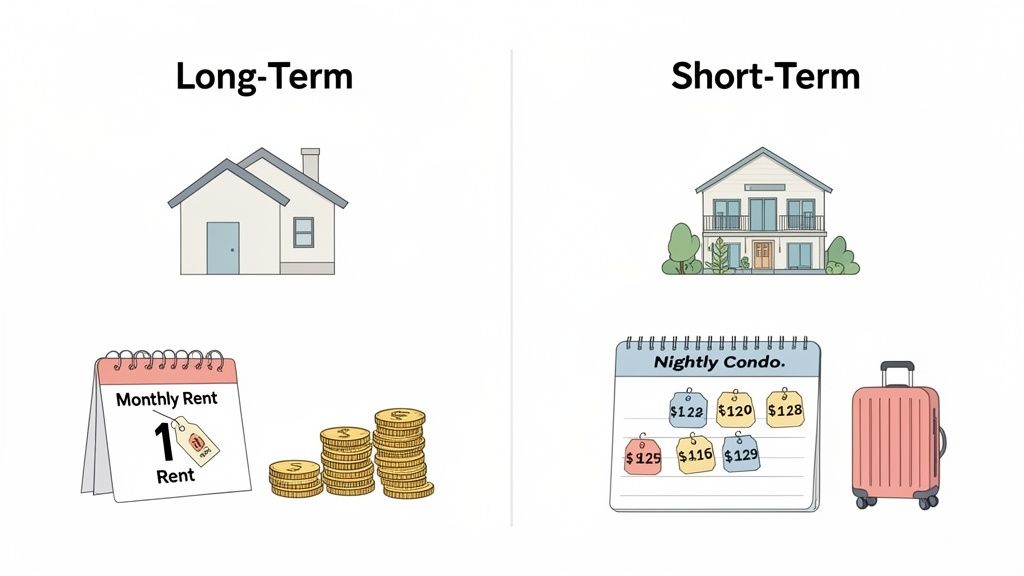
Quick Glance Comparison: Short Term vs Long Term Rentals
To make this decision a bit easier, we've broken down the key differences into a simple table. This covers the categories that matter most when you're weighing your options.
Factor | Short-Term Rental (STR) | Long-Term Rental (LTR) |
|---|---|---|
Income Potential | Higher potential gross revenue, but more volatile and seasonal. | Lower but highly consistent and predictable monthly income. |
Operational Workload | High and active; requires daily management of bookings, guest communication, and cleanings. | Low and passive; minimal involvement after tenant placement. |
Upfront Costs | Significant; includes furnishing, professional photography, amenities, and decor. | Minimal; property is typically rented unfurnished. |
Occupancy | Variable and subject to market demand, seasonality, and competition. | Consistently high (often near 100%) with a signed lease. |
Regulations | Complex and strict; often involves licenses, zoning laws, and occupancy taxes. | Standardized and predictable landlord-tenant laws. |
Guest/Tenant Vetting | Limited to platform reviews and brief communication before a short stay. | Thorough screening process, including credit checks and references. |
As you can see, there’s no single "better" option—just the one that fits your financial goals, your tolerance for risk, and how much time you're willing to invest.
Comparing Revenue Potential and Cash Flow
Let's get right to the money, because this is where the debate between long-term and short-term rentals really gets interesting. The biggest lure of short-term rentals (STRs) is their potential to bring in significantly more cash, but that’s only half the picture.
When my wife and I first started with our DC house, we were definitely tempted by the higher nightly rates we could command compared to what we’d get from a standard year-long lease. This approach lets you tap into market demand in a way that long-term rentals simply can’t.
Short-Term Rentals and Dynamic Income
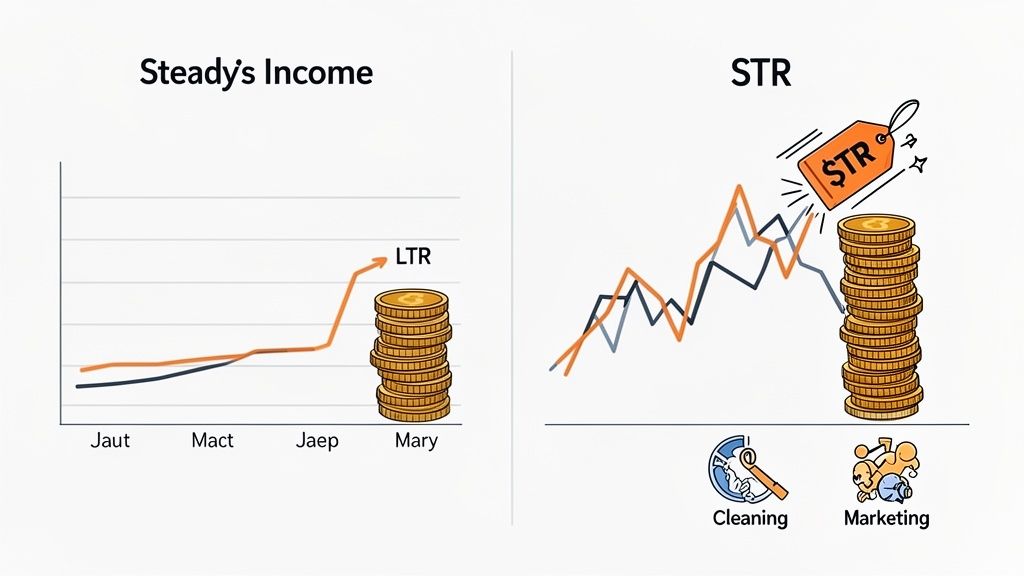
With an STR, your income is never set in stone. You can—and absolutely should—use dynamic pricing to adjust your rates based on the season, local events, holidays, or even just a busy weekend. A place that might rent for $200 on a Tuesday in February could easily pull in $500 a night during a big festival.
This flexibility can really blow the ceiling off your revenue potential. But that higher upside comes with a pretty big catch: income volatility. One month might be a massive success, but the next could be a complete dud. That inconsistency makes budgeting and financial planning a whole different ballgame.
We learned the hard way that one great month doesn't mean you can coast. You have to constantly be thinking three steps ahead, building up a cash reserve during the high season to float you through the slow months. It's a completely different mindset than just cashing a predictable rent check.
On top of the unpredictable income, the operating costs for STRs are way higher. And these aren't just one-time expenses; they're constant, recurring costs that eat into your profit.
Professional Cleaning: This is non-negotiable and has to be done after every single stay. Those costs add up fast and can easily run into thousands of dollars a year.
Restocking Supplies: From coffee and shampoo to paper towels and welcome snacks, these things need to be replenished constantly.
Higher Utility Bills: With guests coming and going, you can bet your electricity, water, and gas bills will be higher.
Platform and Marketing Fees: Sites like Airbnb and Vrbo take a cut of every booking, which comes directly out of your bottom line.
Because of all this, figuring out your net income requires a much deeper dive. It’s not just about how many nights you book; it’s about juggling a budget that changes from week to week. We strongly recommend digging into the data to really understand your market. To get started, you can check out our detailed guide on short-term rental analytics.
Long-Term Rentals and Predictable Cash Flow
Now, let's flip the coin. Long-term rentals (LTRs) are all about stability and predictability. The day your tenant signs that one-year lease, you know exactly how much money is coming in each month for the next twelve months. Period.
This consistency makes financial planning a breeze. You can easily figure out your monthly cash flow by subtracting your fixed expenses—mortgage, insurance, taxes, and a small buffer for maintenance—from the rent. There are no surprises, which is a massive relief for property owners who want a more hands-off investment.
The operational costs are also much, much lower and less frequent.
Turnover Costs are Minimal: You only have to worry about a deep clean and minor touch-ups once a year or so when a tenant moves out.
No Supply Restocking: Tenants buy their own toilet paper and coffee.
Predictable Maintenance: While things will break, it’s not a constant, weekly demand on your time and wallet.
Tenants Cover Utilities: In most LTRs, tenants pay for their own utilities, which takes a big variable expense off your plate.
The trade-off, of course, is a lower gross revenue ceiling. You can't just triple your rent because there's a holiday weekend. However, the lower operating costs and near-zero vacancy (with a good tenant) often mean the net profit is a lot more solid and reliable than it might look on the surface.
Ultimately, the numbers still show that short-term rentals often deliver higher returns, but you have to accept more risk and a lot more work. Some industry data from 2023 suggests STRs can yield a net return of 6%–12%+, which is often higher than traditional leasing. Of course, this depends heavily on your location and management style.
Occupancy, Demand, and the Saturation Problem
High revenue from a short-term rental comes down to one simple thing: keeping it booked. And when you're weighing a long-term vs. short-term rental, you have to understand that the market dynamics for each are worlds apart—and they're shifting under our feet.
The short-term rental world has definitely grown up. Those early days of explosive, almost effortless growth are pretty much over. What’s left is a much tougher, more competitive landscape where hosts have to fight for every booking.
The New Reality of STR Saturation
When we first listed our condo in Playa del Carmen, the competition felt manageable. Today, a quick search pulls up hundreds of similar spots all chasing the same travelers. This saturation hits your bottom line directly, pushing nightly rates down and making consistent bookings a serious grind.
This isn't just a hunch; the data tells the same story. The U.S. short-term rental market has seen a massive influx of new listings. According to AirDNA's 2024 outlook, available listings grew by 19% in 2023. While demand is still growing, the rapid increase in supply means competition is stiffer than ever.
In a crowded market, you can't just list it and forget it. To actually succeed, you need to bring your A-game:
An Exceptional Guest Experience: Think seamless check-ins, personal touches, and anticipating needs before they arise.
Professional-Level Marketing: High-quality photos and a killer description are the absolute baseline now.
Smart, Strategic Pricing: You have to be constantly tweaking your rates based on seasonality, local events, and what your direct competitors are up to.
In our experience, market saturation forces you to stop acting like a casual landlord and start operating like a boutique hotel manager. You are actively competing for every single booking, and that's a huge operational lift.
The Quiet Consistency of LTR Demand
Now, contrast that with the long-term rental market. Sure, it has its own cycles, but the fundamental demand for stable housing is far more consistent and less vulnerable to the wild swings of the tourism industry. In most places, finding a great tenant for a year-long lease is a pretty straightforward process.
Once you have a tenant locked in, you achieve something almost unheard of in the STR world: near-100% occupancy for a full year or even longer. That consistency completely removes the stress of the booking chase and gives you a predictable, steady stream of income.
So, how do you figure out which model makes sense for your area? You've got to do your homework. Start by digging into platforms like Airbnb and Vrbo to see how many STRs are in your neighborhood. Don't just look at their listings; check their calendars to get a feel for their actual occupancy, not just their availability. Then, compare that to the LTR demand on sites like Zillow or local housing groups. This kind of on-the-ground research will give you a real-world view of the competition and help you decide if you're better off chasing nightly bookings or locking in a reliable long-term tenant.
Comparing The Day-To-Day Operational Workload
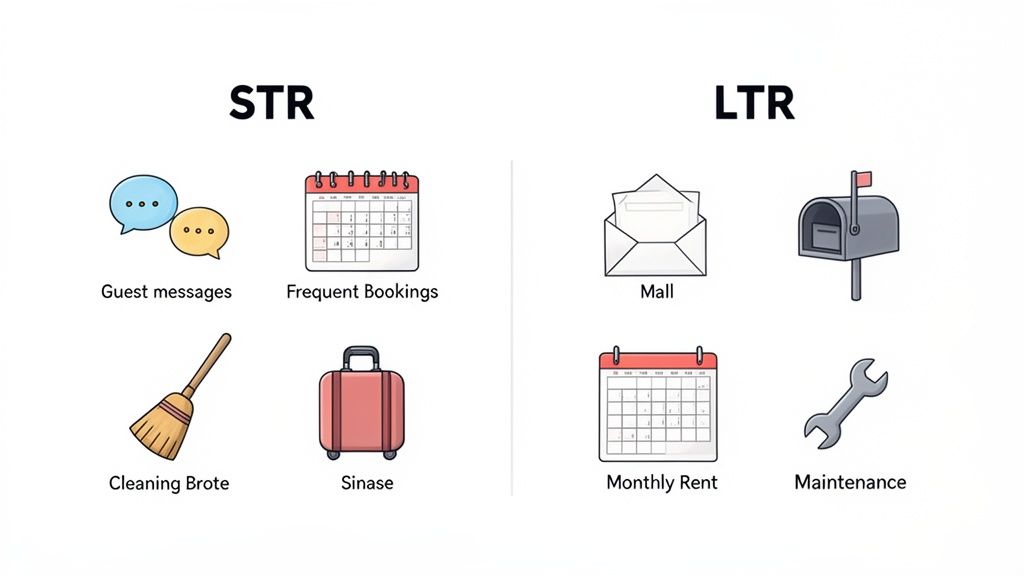
When you’re weighing long-term vs. short-term rentals, the daily reality of being a host is where the rubber truly meets the road. This isn’t just about income statements; it’s about your time, your energy, and ultimately, your lifestyle. The two models couldn't be more different in terms of hands-on involvement.
A short-term rental isn’t a passive investment—it’s an active hospitality business, plain and simple. A long-term rental, on the other hand, is far more hands-off, demanding very little attention once a tenant is settled in.
The High-Touch World of Short-Term Rentals
Running a successful short-term rental (STR) means you're always on. From our experience managing properties in different markets, we can tell you it's a constant cycle of tasks that demand attention every single day and week. Think of it as running a small, personalized hotel.
Your workload is heavily front-loaded with guest interactions. You’re not just a landlord; you’re a concierge, a troubleshooter, and a local guide all rolled into one.
Here’s a realistic look at what’s on your plate:
Constant Communication: Answering pre-booking questions, sending check-in instructions, fielding mid-stay queries, and following up for reviews after checkout.
Booking Management: Juggling calendars across multiple platforms, tweaking your pricing strategy, and coordinating check-in and out times.
Turnover Coordination: After every single stay, you have to schedule professional cleaning, manage laundry, and inspect the property for any potential damage.
Restocking Amenities: This is a constant inventory game, keeping tabs on everything from coffee pods and toiletries to toilet paper and cleaning supplies.
We figured out fast that about 80% of guest questions were the same things over and over: "What's the Wi-Fi password?" or "How does the coffee maker work?" It’s a huge time drain that pulls you away from the tasks that actually grow your business.
This is where smart tools become a lifesaver. To slash those repetitive questions, we started using digital guidebooks. An AI-powered guidebook from a service like SmoothStay, for instance, can automatically answer common guest queries and put all the necessary info in one spot, giving you a massive amount of your time back.
The Hands-Off Approach of Long-Term Rentals
Managing a long-term rental (LTR) feels like a different universe entirely. Once you’ve put in the initial legwork to find and screen a quality tenant, your day-to-day involvement plummets. Your role shifts from being an active manager to more of a passive overseer.
After the lease is signed and your tenant is moved in, your responsibilities become far more periodic and predictable.
Your monthly to-do list is refreshingly simple:
Rent Collection: This is your main monthly task, and it can be easily automated with online payment platforms.
Occasional Maintenance: You’ll handle repair requests as they come up—a leaky faucet here, a broken appliance there. It's purely reactive, not a constant demand on your time.
Lease Renewals: Once a year, you’ll either manage the lease renewal process or start the search for a new tenant if the current one decides to move on.
The difference in time commitment is stark. An STR might demand several hours of your attention each week, whereas an LTR might only need a few hours of work over an entire year, unless a major issue pops up. Choosing the right rental strategy means being honest about how much time and energy you’re truly willing to invest.
Navigating Regulations, Taxes, and Compliance
The legal side of things is, without a doubt, one of the biggest lines in the sand between a long-term and short-term rental. If there's one area where you absolutely have to do your homework before picking a side, it's this one. A misstep here can be incredibly expensive.
Short-term rentals (STRs) are under a microscope. Cities all over the world are rolling out complex, often restrictive rules, and just keeping up can feel like a full-time job. We're not just talking about a simple business license anymore; it's a tangled web of zoning laws, occupancy taxes, safety inspections, and sometimes, outright bans.
The Shifting Rules of Short-Term Rentals
Jumping into the STR game means you have to get comfortable with understanding local short-term rental regulations. These policies can change in a flash and vary wildly from one neighborhood to the next.
What we’re seeing is a clear trend toward stricter enforcement. This regulatory pressure is reshaping the entire STR landscape, with places like New York City implementing what amounts to a de facto ban in 2023. This dynamic tends to favor larger, professional operators who have the resources to absorb the high costs of compliance, making it tougher for solo hosts to compete.
Before you even think about buying furniture for an STR, your first stop should be your local city or county government’s website. Dig into their specific rules. And don't forget about Homeowners Associations (HOAs)—their restrictions can be even more stringent than the city's.
In our own hosting journey, we've had to navigate everything from specific zoning in DC to tourism taxes in the Riviera Maya. Our best advice? Assume nothing. Always verify the rules directly with the source, because what works for a host just a few blocks away might not apply to your property at all.
The Predictable Path of Long-Term Rentals
Long-term rentals (LTRs), on the other hand, operate under a much more established and predictable set of rules. These are typically governed by state and local landlord-tenant laws that have been on the books for decades.
While these laws provide significant protections for tenants—covering things like security deposits, eviction procedures, and property maintenance standards—they are generally consistent and well-documented. You’re not going to wake up one morning and find your business model has been outlawed.
The main compliance tasks for an LTR usually involve:
Using a legally sound lease agreement that complies with state laws.
Following fair housing regulations during your tenant screening process.
Adhering to laws around property access and required maintenance.
A Quick Look at Tax Implications
Taxes are another key area where these two models diverge. STR income is often treated as active business income, which means you'll be on the hook for collecting and remitting occupancy or lodging taxes—just like a hotel.
LTR income is typically considered passive rental income. The tax filings are generally more straightforward, although the deductions are different. For both models, maximizing your write-offs is crucial for improving your bottom line. We've put together a resource that breaks this down further; check out our guide on short-term rental tax deductions for more detail.
Ultimately, a crystal-clear understanding of the legal and tax obligations is non-negotiable for success, no matter which path you choose.
Making the Right Decision for Your Property
So, how do you choose the right path for your property? There's no single right answer in the long-term vs. short-term rental debate, but there is a right answer for you. It comes down to an honest look at four key areas: your property’s location, your financial goals, your stomach for risk, and the time you can actually commit.
We’ve found this framework helps clarify the decision, whether we’re evaluating a new property in the Riviera Maya or fine-tuning the strategy for our DC home. Both models can be wildly successful, but they demand very different things from you as an owner.
Evaluating Your Core Factors
Start by asking yourself a few direct questions. Your realistic answers here will point you toward the strategy that truly fits your life.
Location, Location, Location: Is your property in a high-demand tourist area, a stone's throw from an airport, or near a major event venue? If so, an STR has a natural edge. But if it’s in a quiet, residential neighborhood with good schools and local coffee shops, an LTR might be a more stable and less disruptive choice.
Financial Goals and Risk: Are you aiming for the highest possible monthly cash flow and are you comfortable with income that ebbs and flows with the seasons? An STR offers a much higher ceiling. Or do you prefer a stable, predictable income stream you can count on every single month to cover the mortgage? An LTR provides that security.
Time and Energy Commitment: Do you have the time to be an active, hands-on business owner, managing guest communications and turnovers week in and week out? Or does a more passive, hands-off investment sound more appealing? Your answer here is a massive differentiator.
Putting It All Together: A Scenario-Based Approach
Let's look at how this plays out in the real world. A host with a condo in a bustling downtown arts district, who actually enjoys the hospitality side of things and has the financial cushion for slow seasons, is a prime candidate for a successful STR. They can use dynamic pricing for local festivals and command premium rates.
On the flip side, an owner of a single-family home in a quiet suburb, who works a demanding full-time job and just wants a predictable return to help pay the mortgage, would likely find an LTR to be a much better fit. The stability and low operational workload line up perfectly with their lifestyle.
One of the first and most critical steps is researching local regulations—this can often make the decision for you. This flowchart shows a simplified decision-making process based on local compliance.
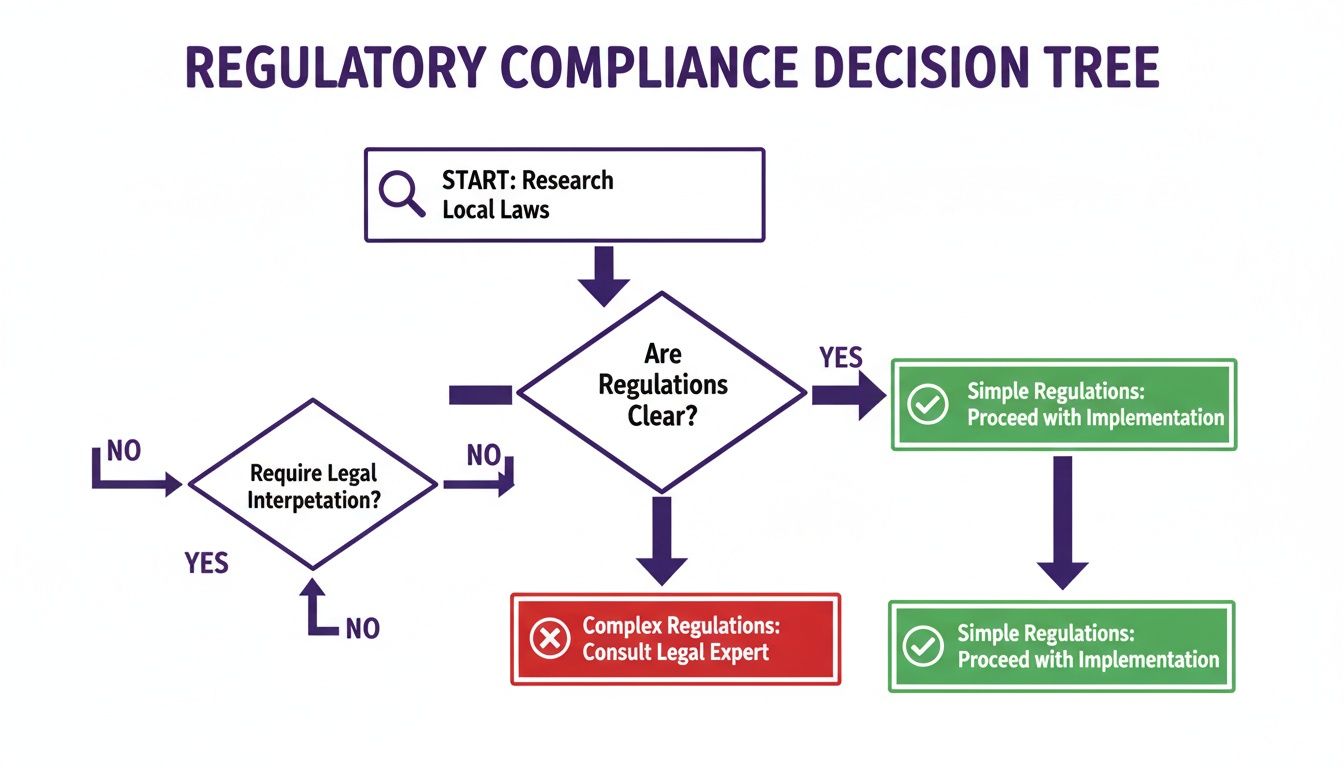
This visual drives home a key point: if your local laws are complex or restrictive, the STR path becomes significantly more challenging, often pushing hosts toward the much simpler LTR model.
Ultimately, the best choice is the one that aligns with your unique circumstances. And if you do choose the STR path, remember that you don't have to manage everything alone. For hosts looking to streamline operations, tools like SmoothStay’s AI-powered guidebooks can make all the difference. They automate guest communication and provide a professional, guest-first experience, helping you run a manageable and profitable business from day one.
Your Questions, Answered
Even with all the data, we get it—making the final call between a long-term and short-term rental can feel like a huge decision. Let's walk through some of the most common questions we hear from fellow hosts who are in the exact same spot you are right now.
Can I Switch from a Short Term to a Long Term Rental?
Absolutely. Pivoting your strategy isn't just possible; sometimes, it's the smartest move you can make. Plenty of hosts make this switch because of new local laws, a saturated market, or simply because they want a more hands-off income stream. From our experience, it’s usually a much smoother transition than going the other way.
The process is pretty straightforward:
Prep the Property: This usually just means clearing out the STR-specific amenities (like single-serve coffee pods and toiletries) and making sure the home is a blank slate for a tenant to make their own.
Learn the Local Landlord-Tenant Laws: This is a big one. Get familiar with your state and local rules on leases, security deposits, and tenant rights. They are very different from STR regulations.
Get a Solid Lease Agreement: Don't just download the first template you find. Use a legally sound lease that clearly spells out all the terms for a long-term tenancy.
What Are the Hidden Costs of Short Term Rentals?
This is where a lot of new STR hosts get tripped up. Beyond the obvious stuff like cleaning fees and restocking shampoo, there are a handful of "hidden" costs that can eat into your profits if you're not ready for them. Budgeting for these from day one is key to knowing what you'll actually make.
Here are the most common ones people forget:
Higher Utility Bills: With guests constantly coming and going, expect your electricity, water, and gas bills to jump. People on vacation aren't always mindful of turning off lights or the AC.
Platform and Payment Fees: Booking sites like Airbnb and Vrbo take a cut of every booking, and payment processors have their own small fees on top of that.
Specialized Insurance: Your standard homeowner's policy almost certainly won't cover commercial STR activity. You'll need a more expensive, specialized insurance policy designed for vacation rentals.
Wear and Tear: More guests means more use. Furniture, linens, towels, and appliances will all wear out much faster than they would with a single long-term tenant, so you'll be replacing things more often.
Which Rental Model Has a Better Return on Investment?
This is the million-dollar question, and the honest answer is: it completely depends. Your specific market, the property itself, and how you manage it will determine the winner. Generally speaking, short-term rentals have a higher potential ROI because you can charge premium nightly rates, especially during holidays and peak season.
But that higher potential comes with way more risk, income swings, and much higher operational costs. What we've seen work for us is to budget around 50% of revenue for STR expenses. Long-term rentals give you a much more stable and predictable ROI. The ceiling is lower, but so are the expenses, which we typically budget at around 35% of revenue.
Your best bet is to run the numbers for your specific property. Open up a spreadsheet and model out both scenarios. Factor in realistic occupancy rates, nightly/monthly rent, and every single associated cost to see which model actually delivers a better net return in your location.
Deciding on your rental strategy is a huge step, and having the right tools makes all the difference. If you're leaning toward short-term rentals, SmoothStay can help you deliver a 5-star experience from day one. Our customizable, AI-powered guidebooks automate guest communication, answer common questions instantly, and help you earn more positive reviews—all with fair, scalable pricing built for hosts like you.
Start your free 14-day trial today and see how SmoothStay can simplify your hosting journey.