Airbnb Check-In Instructions: A Host's Guide to a Flawless Arrival
check in instructions airbnb: Master simple, host-tested tips to prevent issues, reduce questions, and earn 5-star reviews.
Disclosure: Some links in this article are affiliate links. If you make a purchase, we may earn a commission at no extra cost to you. This helps support our content.
Your Airbnb check in instructions are the first real handshake you have with your guest. Get them right, and you've laid the groundwork for a fantastic, five-star stay.
Get them wrong? You're setting yourself up for late-night calls, frustrated travelers, and a negative review before they've even dropped their bags.
Why Great Check-In Instructions Are Your Secret Weapon
Perfect check-in instructions do more than just get guests through the door. They create a seamless, stress-free arrival that makes travelers feel confident and cared for from the very beginning.
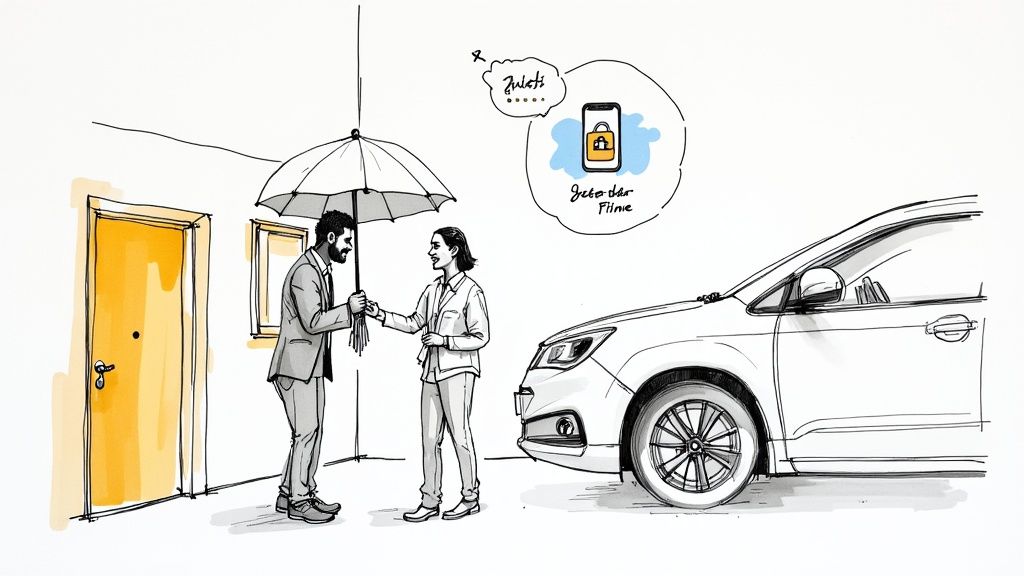
We learned this lesson the hard way. One rainy evening at our Washington, D.C. house, a simple lockbox misunderstanding—a detail we thought was crystal clear—left a family fumbling in the dark. That experience taught us that flawless instructions aren't just a nice-to-have; they are a core part of the hospitality experience itself.
The True Impact of a Smooth Arrival
A smooth arrival immediately builds trust and reassures guests they made the right choice booking with you. This positive first impression can set a forgiving, relaxed tone for the rest of their stay.
Clear, thoughtful communication delivers some serious benefits:
It Lightens Your Workload: Proactive instructions answer questions before they’re even asked. That means fewer messages and calls for you to handle.
It Prevents Common Problems: Detailed directions for parking, finding the entrance, or using a smart lock stop the most common arrival hiccups dead in their tracks.
It Directly Influences Reviews: The "Check-in" category is one of the first things guests rate. Nailing this part of the experience starts your overall rating off on the right foot.
The data backs this up. Unclear arrival details are a massive pain point for travelers. A recent survey found that 67.76% of Airbnb guests reported issues with confusing check-in or check-out instructions, making it one of the top five complaints on the platform. You can dig into more of these guest experience stats on PhotoAiD.com.
From our experience managing our city house and our beach properties in Mexico, we've seen a direct line between the clarity of our arrival guides and the quality of our reviews. When guests feel guided and secure, they relax and start enjoying their vacation that much sooner.
Ultimately, perfecting your Airbnb check in instructions is a smart investment in your business. It protects your time, boosts your ratings, and creates the kind of welcoming experience that turns first-time visitors into repeat guests. It’s one of the simplest, highest-impact ways to elevate your hosting.
Crafting Your Perfect Check-In Guide
Think of your check-in instructions less like a quick message and more like a mini-guide for a flawless arrival. This is where you go beyond just the address and door code. You want to get ahead of every little snag a guest might hit, especially if they're showing up tired after a long travel day.
Your mission is to answer their questions before they even have a chance to ask them. We've fine-tuned our own instructions over the years by walking through the guest's journey, from finding our street to logging into the Wi-Fi. What works for our row house in D.C. is totally different from what’s needed for our condo in Tulum, where street signs can feel more like a friendly suggestion than a hard rule.
Getting There and Getting In
This part is absolutely critical. If a guest can't find your place or get through the front door, their experience is already starting on the wrong foot. We always write these instructions as if the guest is arriving late at night, in the pouring rain, with a phone battery hovering at 5%. How ridiculously easy can you make it for them?
Start with the essentials, but then layer on the helpful details. Don't just give them the street address; provide a direct GPS link from Google Maps or Waze. For our properties in the Riviera Maya, we always include a screenshot of the map and a photo of the building's exterior. That visual confirmation is a huge relief for a guest who isn’t sure they’re in the right spot.
Next, get super specific about parking:
Designated Spots: "You can park in the spot labeled 'Unit 7B.' Here’s a photo of the garage entrance and the spot itself so you know exactly what to look for."
Street Parking: "Street parking is free, but it can be tough to find a spot after 6 PM. Your best bet is usually Maple Avenue, which is one block north."
Paid Garages: "The closest public garage is at 123 Main Street, just a 3-minute walk from here. It typically costs around $25 for a 24-hour period."
Once they've parked, walk them right to your door using landmarks they can actually see. For instance, "Go through the black iron gate between the coffee shop and the bakery. Our door is the third one on your left—it's painted bright blue." Photos for each step here are a must. Show the gate, the keypad, and even a quick shot of how to work a tricky lock if it has a special quirk.
Connecting and Settling In
Once they’re inside, a guest’s first two thoughts are almost always the same: connect to the internet and get comfortable. Make this information impossible to miss.
In our welcome guides, we put the Wi-Fi network and password right at the top of our "Welcome!" section. It's the first thing guests hunt for, and giving it to them immediately shows you're on their wavelength.
This part of your guide should also cover immediate comforts. A brief note on how to use the thermostat or AC, especially if it's not intuitive, can save you a late-night text. Something as simple as, "The AC is controlled by the remote on the coffee table," makes a world of difference.
While the nitty-gritty details belong in a full guest manual, sprinkling a few key pointers into your check-in message can really improve that initial experience. If you want to build the ultimate resource, we have a whole guide dedicated to creating an amazing Airbnb welcome book that your guests will actually use.
Just-In-Case Scenarios
A truly foolproof guide anticipates the unexpected. You don't need to outline every possible disaster, but addressing the most common hiccups shows you're a thoughtful and prepared host. This is how you prevent minor issues from turning into major panic.
Before you send anything off, run through this quick checklist to make sure you've covered all the essentials.
Essential Information Checklist for Your Instructions
This table breaks down the must-have details that turn good instructions into great ones, ensuring your guests feel supported from the moment they book until they check out.
Information Category | Must-Have Details | Pro-Tip From Our Experience |
|---|---|---|
Contact Information | Your primary phone number for calls/texts and a backup contact. | We always add, "If you can't reach me for any reason, please contact my co-host, Maria, at..." It provides a reliable safety net. |
Lockout Procedure | Clear steps for what to do if a smart lock battery dies or a key is lost. | For smart locks, be specific about where the backup physical key is located (e.g., "in the small lockbox to the left of the door"). |
Emergency Info | The local emergency number (it's not 911 everywhere!) and the full property address. | Having the address pre-written makes it easy for guests to copy and paste for a taxi, food delivery, or emergency services. |
By structuring your instructions this way—moving logically from arrival to comfort to contingencies—you create a guide that's incredibly easy for guests to follow. You're not just sending information; you're designing a seamless welcome that kicks off a great stay.
Timing and Delivering Your Instructions Perfectly
Even the most beautiful check-in guide is worthless if it shows up at the wrong time or gets buried in a guest’s inbox. Getting the "when" and "how" of delivery right is just as important as the content itself. After years of managing properties from our D.C. home to our places at the beach, we've honed a communication timeline that hits the sweet spot—proactive, but never overwhelming.
The whole point is to give guests information exactly when they need it. A well-timed message doesn’t just deliver instructions; it builds confidence and shows you’re a host who has their act together.
Our Proven Communication Timeline
This is what works for us. It prepares guests ahead of time and gives them a nudge right when they need it most, which has practically eliminated those frantic, last-minute calls.
Three Days Before Arrival: This is when you send the main event. It's a comprehensive message with the address, a GPS link, parking info, and a link to your full digital guidebook. Sending it three days out gives guests plenty of time to look everything over and ask questions before they're in a rush to pack or catch a flight. It sets their mind at ease.
Morning of Arrival: On check-in day, around 10 AM, we send a much shorter, friendlier message. This one is just a quick reminder that contains the most important piece of the puzzle: the door code. By holding the code until that morning, you prevent guests from showing up too early and ensure that critical detail is sitting right at the top of their inbox when they’re on their way.
Airbnb Messages vs. a Digital Guidebook
So, where do you actually send all this stuff? You've got a couple of options, and the best strategy uses both.
Sending instructions through the Airbnb platform is a must. It creates an official record of your communication, which protects both you and your guest. But let’s be honest—the platform can be a bit clunky. Links sometimes break, and character limits can make it tough to be as thorough as you'd like.
That's exactly why we pair our Airbnb messages with a dedicated digital guidebook. Using a tool like SmoothStay gives you total control. You can add as many photos, videos, and formatted text as you need without fighting against a platform’s limitations. It just looks more professional.
Guest expectations are shifting fast. A 2025 report mentioned that over 60% of listings in North America and Europe now offer self-check-in, a massive leap from just 35% in 2020. This trend underscores the demand for the kind of convenient, tech-forward experience that a digital guide provides. You can read more about these Airbnb booking trends on RedAwning.com.
A digital guide centralizes everything in one clean, easy-to-access link. You can even generate a simple QR code for guests to scan when they arrive. If you want to dive deeper, we have a whole article on setting up a QR code check-in system for your rental.
Our Go-To Pre-Arrival Message Template
Subject: Your upcoming stay at [Property Name]!
"Hi [Guest Name],
We're so excited to host you in just a few days! To help you plan for a smooth arrival, here is some key information:
Address: [Your Full Address]
GPS Link: [Google Maps Link]
Full Guidebook: For detailed directions, photos, Wi-Fi info, and local tips, please see our digital guide: [Link to Your SmoothStay Guidebook]
Check-in is anytime after [Check-In Time] on [Date]. On the morning of your arrival, I'll send you another quick message with the unique door code.
Let us know if you have any questions before you travel.
Safe travels!
[Your Name]"
This message is friendly, direct, and points them to one single source of truth—setting the stage for a flawless arrival.
Ready-To-Use Templates for Any Check-In Scenario
Okay, let's get practical. Theory is great, but what you really need are templates you can copy, paste, and adapt for your own listings. These are the exact ones we’ve tweaked and perfected over the years, born from real-world hosting wins (and a few headaches).
We've found that nearly every guest arrival fits into one of three scenarios. Whether it’s our tech-heavy D.C. property or a simple lockbox setup at one of our beach properties, the goal is always the same: make the guest feel confident and taken care of from the moment they book.
Each template comes with our little notes—the "why" behind the wording. These are the details you only learn from experience, like after a guest calls you in a panic because they can't figure out the smart lock in the dark. Getting these small things right makes a huge difference.
The Smart Lock Self Check-In
This is our go-to for most of our properties. It's incredibly convenient for everyone, but tech can be intimidating. The key here is to write instructions that are so clear, your guest feels like an expert before they even arrive.
Template: Smart Lock Arrival
Hi [Guest Name],
Your check-in day is here! We're excited for you to arrive.
You can check in anytime after [Check-In Time].
Your unique entry code is: [Door Code]
How to Use the Smart Lock:
Wake up the keypad by pressing the [Brand Name] logo.
Enter your code: [Door Code]
Press the [Checkmark/Lock Icon] to unlock. You'll hear the deadbolt retract.
The door will automatically lock behind you after 30 seconds.
Our Pro-Tip: We added the "wake up the keypad" step because, believe it or not, it's the #1 reason guests struggle with smart locks. This one little sentence prevents so many confused messages.
Just-In-Case Add-On:
Troubleshooting: If the lock doesn't respond, the batteries might be low. Don't worry! There is a backup lockbox with a key located [describe location, e.g., "on the railing to the left of the door"]. The code for that is [Lockbox Code]. Please let me know if you need to use it!
Why We Include This: A dead battery is rare, but it happens. Giving guests a backup plan right away turns a potential crisis into a minor hiccup. It shows you’re prepared and keeps their stress levels low.
The Classic Lockbox Method
Good old-fashioned lockboxes are a hosting staple for a reason—they just work. But their simplicity can be a problem if your instructions aren't super specific. A guest fumbling around in the dark trying to find the box is not the first impression you want to make.
Template: Lockbox Arrival
Hi [Guest Name],
Welcome! We're looking forward to your stay. Check-in is available anytime after [Check-In Time].
You'll find a lockbox [describe exact location with a visual cue, e.g., "attached to the black metal railing next to the front door"].
The code to open it is: [Lockbox Code]
Here’s a quick photo to show you exactly where it is: [Insert Photo of Lockbox Location]
Our Pro-Tip: That photo is non-negotiable. It removes all doubt. We learned this the hard way after a guest spent ten minutes searching for a "lockbox on the porch" at our Playa del Carmen house, which had three different places it could have been.
Inside, you will find the key to the front door. Please remember to return the key to the lockbox upon checkout.
The Personal In-Person Welcome
For unique properties or guests who might need a bit more hand-holding, nothing beats a personal welcome. This template is less about codes and all about coordinating a smooth and timely handover.
Template: In-Person Meet & Greet
Hi [Guest Name],
We're so excited to welcome you to [City/Neighborhood] today!
As a reminder, check-in is at [Check-In Time]. I will be there to greet you, give you the keys, and show you around.
Could you please send me a quick message when you are about 30 minutes away? That way, I can make sure I'm at the property right on time for your arrival.
My number is [Your Phone Number] if you need to call or text. Looking forward to meeting you!
Our Pro-Tip: The 30-minute heads-up is the sweet spot. It respects that travel plans can be unpredictable for the guest while making sure you aren't left waiting around for an hour.
No matter which check-in method you use, consistency is your best friend. Having these messages saved and ready to go will save you a ton of time. To make things even easier once guests are inside, we also put up helpful signs around the property. For some great ideas, check out our free signs for your Airbnb template.
How Automation Can Streamline Your Check-Ins
As fellow hosts, we know your time is your most valuable asset. Manually sending the same check-in details to every single guest isn't just tedious; it's a surefire way to make mistakes and burn yourself out.
This is where the classic "work smarter, not harder" mantra really comes into play. By automating your check-in communication, you can get hours back every week and guarantee every guest gets consistent, timely, and professional instructions. It’s all about building a system that runs smoothly in the background, giving you peace of mind to focus on the bigger picture.

This really captures the vibe of a modern, automated hosting setup. It's about using technology to connect all the dots for a seamless guest experience.
Getting Started with Airbnb Scheduled Messages
The easiest way to dip your toes into automation is by using Airbnb’s own built-in feature: Scheduled Messages. This tool lets you draft messages ahead of time and set them to send automatically based on triggers like booking confirmation, check-in, or check-out. It’s a game-changer for getting the basics right.
We use this for our essential communication timeline:
The 3-Day Welcome: Three days before arrival, a message goes out confirming the booking and providing a single, clean link to our digital guidebook. That’s it.
The Morning-Of Code Drop: On arrival day at 10 AM, a much shorter, separate message is sent with just the keyless entry code.
This simple two-step process ensures guests have everything they need without you lifting a finger on check-in day. But it's worth noting that relying only on the Airbnb platform has its drawbacks. As many of us have learned the hard way, platform updates can sometimes break your links or change character limits without warning, creating chaos for an arriving guest.
Taking Your Automation to the Next Level
While scheduled messages are a fantastic start, truly leveling up your guest experience means looking beyond the platform's basic toolset. This is especially true once you start managing multiple properties. Juggling different instructions for our D.C. house and our Riviera Maya rentals got complicated, fast.
This is where dedicated tools built for hosts make all the difference. We transitioned to a solution like SmoothStay to create professional, beautiful digital guidebooks that put everything a guest could possibly need in one spot.
Instead of sending a long, clunky message that guests have to scroll through, we send them one beautiful, mobile-friendly link. It contains everything from arrival photos and Wi-Fi details to local restaurant recommendations and instructions for the espresso machine.
This approach gives you some serious advantages:
Consistency and Professionalism: Every guest receives the exact same high-quality, branded experience.
Efficiency at Scale: Updating one central guidebook is worlds easier than editing multiple scheduled messages across different listings.
Deeper Insights: Analytics can show you which sections guests look at the most, helping you refine your information over time.
AI-Powered Assistance: Newer tools can even use AI to instantly answer common guest questions, freeing you up even more.
Building an automated workflow is one of the most important things you can do to scale your hosting business without losing your sanity. For more on this, we have an article on perfecting your vacation rental communication that covers automation in more detail.
Ultimately, the goal of automation is simple: create a flawless, repeatable system that delivers great service every single time. It's an investment that pays for itself in saved time, happier guests, and better reviews.
Common Check-In Questions Answered
Even with the clearest instructions and the slickest automation, hiccups are just part of the hosting gig. After a decade in this business, we’ve seen it all—from guests who swear they never got an email to folks showing up during a tropical downpour at our place in Playa del Carmen.
To wrap things up, here’s a quick Q&A of the most common issues that pop up. Think of this as your troubleshooting cheat sheet, filled with practical solutions that have helped us keep arrivals smooth and guest stress low.
What's the Best Time to Send the Actual Door Code?
We've experimented a lot with this, and the sweet spot is definitely the morning of check-in, usually around 10 or 11 AM local time.
If you send it days in advance, it’s bound to get lost in a crowded inbox. But if you wait until the exact check-in time, you risk causing anxiety for guests who arrive a few minutes early and are left standing at the door. A morning-of message feels timely and keeps the code right at the top of their messages when they're on their way.
How Can I Make My Instructions Accessible for International Guests?
Keep it simple. Use direct, straightforward language and ditch any regional slang or idioms that might not translate well. Visuals are your best friend here because they’re universally understood.
Numbered steps for a lockbox or smart lock are a must.
Clear photos showing landmarks, the parking spot, and the front door can be a lifesaver.
A short video walkthrough (under 60 seconds) from the street to the door is even better.
For our properties in Tulum and Playa del Carmen, we often include key phrases in Spanish and use universal symbols (like a Wi-Fi or parking icon) in our digital guidebooks to bridge any language gaps. It works wonders.
A great rule of thumb we follow: provide enough detail so a guest arriving in the dark, in the rain, with a dying phone could still get inside without stress.
What Should I Do If a Guest Claims They Never Received the Instructions?
First off, stay calm and be helpful. This is exactly why communicating through multiple channels is so important. Always send instructions through the Airbnb platform itself, since it creates an official record of communication.
If they still can't find them, have a simple text message version ready to send directly to their phone. We also keep a PDF of our guide saved in the cloud and can share a link as a final backup. This layered approach has saved us more times than I can count.
How Much Detail Is Too Much Detail?
You want to be thorough without being overwhelming. The trick is to structure your information logically. The initial check-in message should focus only on the critical path to entry: finding the property, parking, and getting through the front door. That’s it.
All the other stuff—like how to use the coffee maker, TV remotes, or complex appliances—belongs in a separate house manual or a comprehensive digital guidebook. This stops guests from having to wade through a wall of text just to find the door code. This approach makes everything much easier to digest.
By anticipating these common questions, you're not just providing information. You're showing guests you're a proactive, thoughtful host who's genuinely invested in making their arrival as seamless as possible.
At SmoothStay, we're all about empowering hosts with the tools to create those five-star arrivals, every single time. Our customizable, AI-powered digital guidebooks are designed by hosts, for hosts, to help you reduce guest questions and deliver a professional, guest-first experience from the moment of booking. See how SmoothStay can transform your guest communication.