Finding the Best Vacation Rental Software for Your Business
Discover the best vacation rental software to streamline your hosting. Our guide compares top platforms to help you automate operations and boost your revenue.
Disclosure: Some links in this article are affiliate links. If you make a purchase, we may earn a commission at no extra cost to you. This helps support our content.
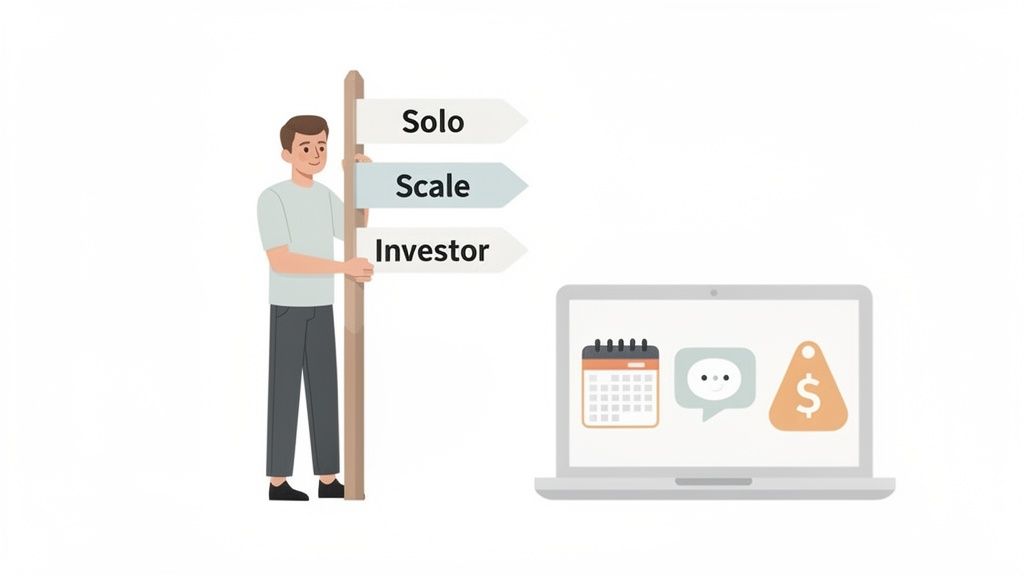
Finding the best vacation rental software comes down to one simple truth: there is no single "best" platform for everyone. The right choice is all about your hosting style. Are you a solo host with one property, an investor scaling a portfolio, or a professional manager overseeing dozens of units?
The trick is to match the software’s core strengths to your specific operational needs and, most importantly, your business goals.
How to Choose Your Perfect Vacation Rental Software
Picking the right software can feel like a massive decision, but it doesn't have to be overwhelming. As hosts who've managed everything from our own 4-bedroom house in Washington, D.C. to a few beach properties in the Riviera Maya, we’ve learned the 'best' software is simply the one that fits your unique situation.
This guide is designed to cut through the noise. We'll start with a clear overview of the main software categories, then give you a simple framework to evaluate them based on your goals, property count, and where you want your business to be in a few years.
Understanding the Main Software Categories
Before you start comparing features, it helps to know what kind of tool you’re even looking for. Most platforms fall into a few general categories, each built for a different type of host. Getting this right is the first step to narrowing your search.
To make it simple, here’s a quick breakdown of the main software types you’ll run into.
A Quick Guide to Vacation Rental Software Types
Software Type | Best For | Core Function |
|---|---|---|
All-in-One PMS | Hosts managing multiple properties across channels like Airbnb, Vrbo, and direct sites. | Centralizes everything—calendars, guest messaging, payments, and cleaning schedules—in one place. |
Channel Manager | Hosts focused on maximizing visibility and preventing double bookings across OTAs. | Syncs availability and pricing across multiple online travel agencies (OTAs) automatically. |
Guest Experience Tools | Hosts who want to perfect the guest journey, from pre-arrival info to post-stay reviews. | Specializes in enhancing communication through digital guidebooks, automated messaging, and local tips. |
Knowing which category fits you best helps you zero in on the right tools and avoid paying for features you'll never use.
The global vacation rental software market is booming, valued at USD 8.6 billion and projected to hit USD 14.1 billion by 2034, according to a 2024 report by Global Market Insights. This growth is fueled by hosts like us looking for better ways to stay competitive and efficient.
Our goal here is to help you move beyond generic feature lists and pinpoint the tools that will genuinely solve your biggest challenges—whether that’s chaotic guest communication, messy calendars, or pricing.
By first identifying your primary need, you can avoid paying for features you'll never touch. For a deeper dive on the operational side, check out our guide to streamlining property management. It’ll help you focus on platforms that truly support your day-to-day workflow.
Before you even start looking at brand names or comparing subscription costs, you need a clear picture of what you're actually looking for. A flashy dashboard means nothing if the software is missing the core tools that actually save you time and prevent those late-night hosting headaches. Think of these features as the non-negotiables—the foundation of any software worth your money.
From our own journey scaling from a single house in D.C. to managing properties for others down in Mexico, we learned this the hard way. Focusing on these fundamentals first is the secret to finding a platform that genuinely makes your life easier.
Core Operational Features
These are the absolute must-haves that handle the day-to-day grind. Without them, you're not really automating anything; you're just giving yourself more admin work.
Channel Manager: This is your double-booking insurance policy. It's the engine that automatically syncs your calendar and availability across every platform you're on—Airbnb, Vrbo, Booking.com, and your own website. If you're listed on more than one channel, this isn't optional; it's critical.
Unified Inbox: Trying to keep track of messages across multiple apps is a surefire way to miss questions and slow down your response time. A unified inbox pulls all guest communication into one central dashboard. This means you can reply faster and keep tabs on every conversation without constantly logging in and out of different accounts.
Automated Messaging: Imagine a world where you never have to manually send another "welcome!" or "here are the check-out instructions" message again. This feature lets you schedule messages to go out based on triggers, like a new booking confirmation or a guest's arrival date. It's a massive time-saver and guarantees every guest gets the right info, right on time.
Guest Experience and Growth Features
Once you've got the basics locked down, the next layer of features is all about elevating the guest experience and, just as importantly, growing your revenue. These are the tools that help you build a real brand and drive repeat business.
A direct booking website is a game-changer. It gives you a way to take bookings without forking over hefty commissions to the OTAs, putting you in the driver's seat of your brand and guest relationships. When you're shopping for software, look for platforms that don't just manage bookings but also help you build out your own online presence. To really make it work, you'll want to get a handle on the SEO basics for small businesses to attract more direct traffic.
Dynamic pricing integrations are another essential piece of the growth puzzle. These tools hook into services that crunch market data—think local events, seasonal demand, and what your competitors are charging—to automatically fine-tune your rates. It’s how you maximize revenue when demand is high and stay competitive to secure bookings during the slower months.
From our experience, the difference between good and great software often lies in the smaller, quality-of-life features. A clean, intuitive mobile app for managing things on the go can be an absolute lifesaver when you're not chained to your desk.
Management and Reporting Features
Finally, you need features that give you a clear, honest look at how your business is actually performing. Never underestimate the power of good data.
Robust Reporting: Look for software that can generate straightforward financial reports, track your occupancy rates, and show you booking trends. This is the information you need to make smarter decisions about your pricing, marketing spend, and overall strategy.
Task Management: If you work with a team of any size—cleaners, a handyman, a co-host—a task management feature is non-negotiable. It lets you automatically create, assign, and track jobs, making sure your property is always guest-ready without all the back-and-forth texts and calls.
Choosing the best vacation rental software isn’t about finding the platform with the longest feature list. It’s about identifying the one that has the right set of tools to solve your specific problems, freeing you up to focus on what really matters: giving your guests an unforgettable experience.
Comparing The Top Vacation Rental Software Platforms
With the basics covered, it’s time to see how the top players in the market actually stack up. Choosing the right software isn't about finding a single "best" option; it’s about understanding the unique philosophy and strengths of each platform to see which one clicks with your hosting style.
We’re going beyond the marketing fluff to analyze how platforms like Guesty, Hostaway, and OwnerRez perform in the real world. We've structured this comparison around the things that truly matter—automation, guest experience, operations, and scalability—to give you a clear picture.
Core Automation And Channel Management
At its heart, good software automates the repetitive tasks that drain your day. A reliable channel manager is the cornerstone of this, preventing dreaded double bookings and keeping your pricing consistent across every listing.
Guesty is known for its powerful, enterprise-level automation. It's built for property managers handling large portfolios who need complex, trigger-based rules for messaging, tasks, and just about anything else. If you can dream up an automation scenario, Guesty can probably handle it.
Hostaway takes a more flexible and user-friendly approach. Its channel manager is one of the most respected in the industry, with deep, reliable connections to the major OTAs. From what we've seen, its setup is more intuitive for hosts who are scaling but don't need the overwhelming complexity of a full enterprise solution.
OwnerRez is celebrated for its sheer power and reliability, especially when it comes to its channel manager API connections. While its interface might feel a bit dated, its backend is an absolute workhorse that rarely fails. It’s a favorite among hosts who prioritize rock-solid performance over a sleek design.
Guest Experience And Communication
How a platform helps you talk to your guests can be the difference between a good stay and a great one. This covers everything from a unified inbox to the quality of the direct booking websites they help you create.
This infographic breaks down the essential functions that top-tier software platforms are built to handle.
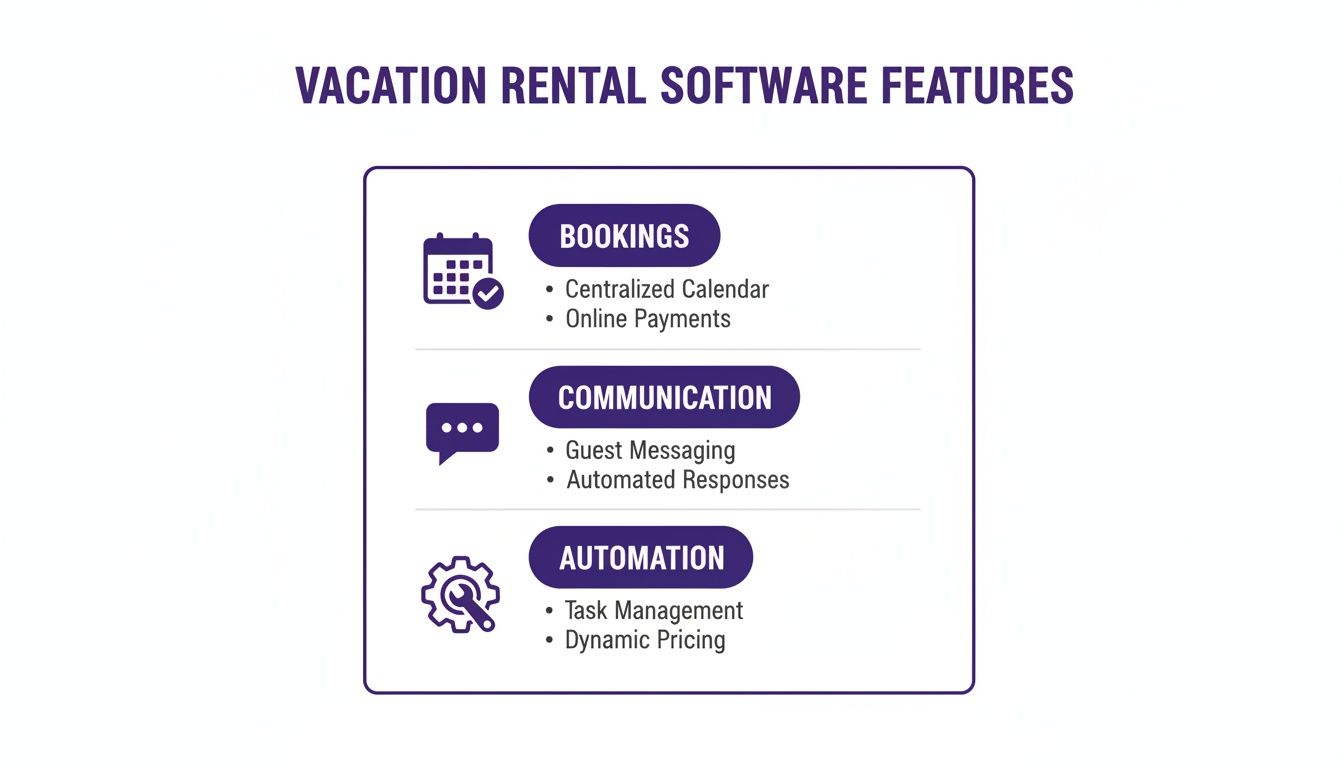
Ultimately, these core pillars—bookings, communication, and automation—are what give you back your time and help your business run like a well-oiled machine.
Our Takeaway: We’ve learned that the "best" direct booking site isn’t just about looking pretty. It’s about how easily it integrates with your payment processor, how well it’s set up for SEO, and whether it gives you true control over your brand.
For example, Hostaway's website builder is known for its simplicity and strong out-of-the-box features. In contrast, OwnerRez provides immense customization for those willing to dive into the settings, making it a fantastic choice for hosts with very specific branding needs. Guesty sits somewhere in the middle, offering polished templates that are easy to get up and running quickly.
Operational And Team Management
As you grow, managing cleaners, maintenance staff, and co-hosts becomes a huge operational challenge. The right software gives you the tools to schedule tasks, track progress, and communicate clearly with your entire team.
This is an area where the platforms show some distinct differences. Guesty for Pros, for instance, has extensive features for managing large teams, including granular user permissions and detailed task assignments. This makes it a strong contender for professional property management companies.
OwnerRez also offers powerful operational tools, including deep integrations with maintenance and housekeeping software. Its system is highly functional, designed for hosts who need to manage complex workflows across multiple properties. Hostaway provides a balanced approach, with intuitive task management that’s easy for small teams to adopt and use effectively without a steep learning curve.
Scalability And Pricing Models
Finally, think about how each platform will support your business as it grows. Scalability isn't just about handling more properties; it's also about how the pricing structure and feature sets align with where you want to be in a few years.
The vacation rental software market is incredibly dynamic. Cloud-based solutions now dominate over 65% of the market, offering the flexibility that both solo hosts and large managers need to scale. You can read more about the vacation rental software market dynamics to understand where the industry is heading.
Here’s a general breakdown of their pricing philosophies:
Guesty typically uses a percentage-of-booking model. This can be cost-effective when you're starting out but can get expensive as your revenue grows. This model aligns their success with yours but requires careful financial planning.
Hostaway often uses a flat-fee subscription model. This gives you predictable monthly costs, which we've found incredibly helpful for budgeting, especially when managing properties with fluctuating occupancy.
OwnerRez is famous for its à la carte pricing. You pay for the core system and then add on specific modules—like property management or QuickBooks integration—as you need them. This approach is fantastic for hosts who want to pay only for what they use, but it can get complex to manage.
Feature Deep Dive Software Comparison
To help you visualize how these platforms compare on the ground, we've broken down their key features side-by-side. Think of this as your cheat sheet for matching features to your specific hosting needs, whether you're just starting out or managing dozens of properties.
Feature Category | Guesty | Hostaway | OwnerRez | Our Takeaway |
|---|---|---|---|---|
Channel Management | Excellent. Deep integrations with all major channels and a robust, enterprise-grade sync. Built for complexity. | Top-Tier. Considered one of the best and most reliable in the industry. Great for hosts who prioritize stability. | Rock-Solid. Known for its powerful API connections that rarely fail. A workhorse for performance-focused hosts. | Hostaway and OwnerRez are neck-and-neck on reliability. Guesty is best for massive, multi-channel inventories. |
Automation | Highly advanced. Complex, trigger-based workflows for messaging, tasks, and reviews. Best for power users. | Flexible & User-Friendly. Intuitive rule-based automation that's powerful but easier to set up than Guesty. | Powerful & Functional. Less slick on the front-end but offers deep, reliable automation for core tasks. | Guesty is for the pro PM. Hostaway strikes the perfect balance for most scaling hosts. OwnerRez is for the host who values function over form. |
Direct Booking Site | Polished templates. Easy to set up and professional-looking, but with less customization. | Strong all-rounder. Good balance of ease-of-use and customization with solid built-in features. | Highly Customizable. Offers immense control for tech-savvy hosts but requires more setup. | Hostaway is the easiest to get a great site live. OwnerRez is for brand-focused hosts who want total control. |
Team Management | Extensive. Granular user permissions, task assignments, and reporting designed for large teams. | Intuitive. Easy-to-use task management and user roles perfect for small to medium-sized teams. | Very Capable. Strong features for owner reporting, maintenance, and housekeeping coordination. | Guesty is the clear winner for large, professional PM companies. Hostaway and OwnerRez are excellent for smaller, growing teams. |
Pricing Model | Percentage of Booking | Flat Monthly Fee | À La Carte (Pay-per-feature) | OwnerRez offers the most control over costs. Hostaway provides predictability. Guesty's model scales with your revenue. |
In the end, choosing the best vacation rental software is about finding the one that feels like a natural extension of your business. By comparing these platforms based on your specific needs, you can find a partner that not only solves today's challenges but also helps you achieve your long-term vision.
Finding the Right Software for Your Hosting Style
Picking the best vacation rental software isn't about grabbing the one with the longest feature list. It’s about finding a tool that fits your specific operation like a glove. The right software for a solo host managing a single cabin is almost never the best choice for a company juggling 50 urban condos.
From our own experience managing a four-bedroom house in D.C. to overseeing beach properties in the Riviera Maya, we've learned this lesson firsthand. Your day-to-day headaches and long-term goals should be your guide. This section breaks down our recommendations for different types of hosts, helping you find a platform that solves today's problems and grows with you tomorrow.
For The Solo Superhost With 1-3 Properties
If you're a solo host, time is your most precious commodity. You're the CEO of guest communication, cleaning coordination, and listing management, probably on top of a day job. Your main goal is to automate your workflow without getting lost in overly complicated software.
You need a tool that feels like a virtual assistant—intuitive, reliable, and ready to handle the repetitive tasks that eat up your day.
What Solo Hosts Really Need:
Effortless Automation: Automated messages for booking confirmations, check-in instructions, and checkout reminders are an absolute must.
Rock-Solid Channel Management: Even with just a couple of properties on Airbnb and Vrbo, a dependable channel manager is your best defense against the dreaded double booking.
Simple Direct Booking Site: A straightforward, template-based website builder lets you capture direct bookings and build your brand without needing a computer science degree.
A Great Mobile App: You’re always on the go, so a clean, functional mobile app is critical for running your business from anywhere.
Based on these needs, a platform like Hostaway often hits the sweet spot. Its automation rules are powerful yet surprisingly easy to configure, and its channel manager is one of the most trusted in the game. It gives you the core tools to win back your time without an intimidating learning curve.
For The Scaling Investor With 4-15 Properties
Once you cross the three-property mark, the game changes. Your focus shifts from just saving time to actively optimizing your portfolio and squeezing every last drop of revenue out of it. As a scaling investor, you live and die by the data—ROI, efficiency, and performance metrics are your new best friends.
Your software needs to do more than just automate; it needs to be a powerhouse of analytics and financial reporting that helps you make smart, data-driven moves.
What Scaling Investors Really Need:
Advanced Reporting & Analytics: You need deep dives into occupancy rates, revenue per available night (RevPAN), and booking sources to see what’s actually working.
Dynamic Pricing Integrations: Seamless connections to tools like PriceLabs or Wheelhouse are non-negotiable for automatically optimizing rates and maximizing your income.
Customizable Direct Booking Engine: You need more control over your direct booking site to nail your branding and execute specific marketing strategies.
Scalable Pricing: You need a pricing model that doesn’t punish you for growing. Predictable costs are essential for mapping out your finances.
For this kind of host, OwnerRez is a true standout. Its interface might feel a bit utilitarian, but don't let that fool you—the backend is an absolute beast. It offers some of the most robust reporting features on the market and has an à la carte pricing model that lets you pay only for what you use. That level of granular control is perfect for an investor focused on optimizing every dial.
For The Professional Property Manager With 15+ Properties
As a professional property manager, you're not just a host; you're running a full-blown business. You’re managing properties, owners, a team of cleaners, maintenance staff, and complex financials. Your software needs to be the central command center for a high level of operational complexity.
Here, things like team management, owner reporting, and enterprise-grade automation aren't just nice-to-haves—they're mission-critical.
What Professional Managers Really Need:
Robust Team Management: Features for assigning tasks, setting specific user permissions, and tracking team performance are vital for keeping operations coordinated.
Comprehensive Owner Portal: You need a clean, dedicated portal where property owners can get transparent access to booking calendars, financial statements, and performance dashboards.
Advanced Automation Workflows: The ability to build complex, multi-step automation rules for everything from guest messaging to maintenance tickets is a must.
An Extensive Integration Marketplace: Your software has to play nice with a huge array of third-party tools, including accounting software, smart home devices, and specialized marketing platforms.
In this league, a platform like Guesty is built to perform. It was designed from the ground up for larger portfolios, offering deep features for team collaboration, detailed owner accounting, and some of the most advanced automation you can get. It's a comprehensive solution built to handle the intricate demands of a professional vacation rental operation.
Weaving a Digital Guidebook into Your Tech Stack
While your property management software is the engine running your business in the background, a dedicated digital guidebook is what perfects the guest experience. It’s a critical layer that many hosts forget when looking for the best vacation rental software.
Think of it this way: your PMS manages the booking, but the guidebook manages the stay. A platform like SmoothStay isn't here to replace your management software. It makes it better by taking over all the guest-facing communication and information, creating a seamless, five-star journey from the moment they check in.
Bridging the Gap Between Management and Hospitality
The real magic happens when you automate hospitality without making it feel robotic. A great digital guidebook is like a 24/7 virtual concierge for your guests, answering their questions before they even have to ask.
In our own properties—from our house in D.C. to our condos in Tulum and Playa del Carmen—a smart guidebook completely changed the game for us. We saw a huge drop in those late-night texts about the Wi-Fi password or how to work the coffee maker.
We’ve found that a well-designed digital guidebook can cut down on repetitive guest questions by up to 80%. That’s a massive amount of time you get back to focus on growing your business, not just managing it.
This frees you up to deliver real hospitality, focusing on the thoughtful touches that earn glowing reviews instead of just answering the same things over and over again.
The Power of Guest-First Features
Modern digital guidebooks are so much more than a PDF of house rules. They're interactive tools designed to make your guests' stay effortless and even delightful. The goal is to give them all the information they need in one beautiful, easy-to-use place.
When you're comparing options, look for features that make a real difference:
Customizable Branding: Your guidebook should feel like it belongs to your property. The ability to add your logo, brand colors, and a custom URL helps build a professional image and encourages repeat, direct bookings down the road.
Simple QR Code Access: Guests should be able to get what they need the second they walk in the door by scanning a QR code. No apps to download, no clunky logins—just instant access to everything.
AI-Powered Assistance: An integrated AI chatbot can handle common questions in a heartbeat, giving guests quick answers about anything from local restaurant hours to where to find extra towels.
To take it a step further, you can integrate specialized tools like AI-powered guest support solutions right alongside your digital guidebook. These additions create a fully responsive, supportive environment for your guests. For a closer look at the benefits, you can learn more about crafting the perfect electronic guidebook in our detailed article.
Ultimately, adding a digital guidebook is about elevating the entire guest journey. It closes the gap between efficient backend management and a truly memorable, personal stay—and that’s the secret to earning five-star reviews and guests who come back year after year.
A Practical Checklist for Switching Software
Making a software switch can feel like open-heart surgery for your business. It’s a big deal, but with a clear plan, what seems like a massive project becomes a series of manageable steps. We've been through our own migrations, and trust us, a little bit of planning upfront prevents a world of chaos later. This checklist breaks down the process into a straightforward, actionable game plan.
A solid plan is all about minimizing disruption. It keeps things running smoothly for you, your team, and most importantly, your guests.
Phase 1: Prepare for the Move
Before you even think about logging into your new software, you need to get your house in order. This first phase is all about auditing your current operation and getting your data squeaky clean. A clean start is a good start.
Audit Your Current Processes: Map out everything. How do you handle a new inquiry? What's the exact protocol for scheduling cleaners after a checkout? Documenting your current workflows helps you replicate—and improve—them in the new system.
Export and Clean Your Data: Pull every piece of essential data from your old system. We're talking guest info, booking history, and all future reservations. This is the perfect opportunity to clean it up. Get rid of duplicate entries, fix those annoying typos, and standardize your formatting before you import a single line.
Set a Go-Live Date: Pick a target date for the official switch. Try to aim for your slow season, if you have one. This gives everyone a firm deadline to work towards and keeps the team aligned.
Phase 2: Set Up and Test Everything
With clean data and a clear plan in hand, it’s time to start building out your new system. The absolute key here is to test every single thing in a controlled environment before you flip the switch.
The biggest mistake hosts make is rushing the setup. Take the time to test every automation and connection. A few hours of testing now can save you days of headaches later on. This is what worked for us.
Configure Your Settings: Go through the setup process methodically. Connect your OTA channels, build out your direct booking site, and get your payment processors configured.
Import Your Data: Carefully import your cleaned-up data into the new platform. Then, double-check that all future bookings, guest details, and property information transferred over correctly. Don’t just assume it worked.
Build and Test Automations: Recreate your automated messages, cleaning tasks, and other key workflows. Once they're built, run several test bookings to make sure every trigger fires exactly as you expect. Seriously, don't skip this step.
Phase 3: Go Live and Communicate
Once you’re confident that everything works as it should, you’re ready for the final step. This phase is about making the official changeover and keeping everyone in the loop. Clear communication prevents confusion for your team, any property owners you work with, and your guests.
Finally, don't forget to train your team. A powerful new tool is completely useless if nobody knows how to use it right. For some great tips on creating clear instructions for your staff, check out our guide on how to create an SOP.
Your Questions, Answered
Jumping into the world of vacation rental software can bring up a lot of questions. We’ve been there. Here are some straightforward answers to the most common questions we hear from fellow hosts, designed to help you make the right call.
How Much Should I Budget for Vacation Rental Software?
There’s no single price tag, since the cost really depends on what you need. Most platforms work on one of three models: a flat monthly fee per property, a cut of your booking revenue, or tiered subscriptions that unlock more features as you pay more.
For a solo host, budgeting around $30–$70 per month is a realistic place to start. But instead of getting hung up on the sticker price, think about the return on your investment. If the software saves you five hours a month and helps you land just one extra booking, it’s already paid for itself.
Do I Need a Channel Manager if I’m Only on Airbnb?
I get this question a lot. While a channel manager is famous for preventing double bookings across multiple sites, it's still a massive advantage for a host who is only on one platform. Think of it this way: the best vacation rental software isn't just a channel manager; it's a complete toolkit for growth.
Even if you're only on Airbnb today, the software gives you a direct booking website, automated messaging, and streamlined cleaning management. You're essentially future-proofing your business. When you're ready to expand to Vrbo or your own site, that foundation is already in place, making the transition seamless.
Can This Software Really Help Me Get More Direct Bookings?
Absolutely. In fact, this is one of the biggest long-term wins. The best software gives you the tools to build your own brand, cutting down your dependence on OTAs and their hefty commission fees.
Features like a built-in website builder, integrated payment processing, and even basic SEO tools let you create a professional online presence. By driving traffic to your own site, you take back control of the guest relationship, boost your profit margins, and build a more resilient, independent business.
At SmoothStay, we believe the best tools empower hosts to create unforgettable guest experiences. Because we're hosts too, we built our platform with guest-first features, customizable guidebooks, and fair pricing to solve the real challenges we all face. Our AI-powered tools are designed to help you deliver top-notch hospitality effortlessly. Start your free 14-day trial today and see the difference.