A Host’s Guide to Airbnb Property Management Services
Considering Airbnb property management services? Discover the costs, benefits, and how to choose the right partner to scale your short-term rental business.
Disclosure: Some links in this article are affiliate links. If you make a purchase, we may earn a commission at no extra cost to you. This helps support our content.
If you've ever felt like your short-term rental is turning into a second full-time job, you're not alone. When we first started, managing our own home in Washington, D.C. felt manageable. But when we expanded to properties in the Riviera Maya, the day-to-day work became a real grind. This is exactly where professional Airbnb property management services come into play—they’re designed to take the operational weight off your shoulders.
A management service acts as your partner on the ground, making sure your property runs smoothly. It’s not a solution just for big-time investors with a huge portfolio. It’s a smart move for any host who wants to scale their business without burning out.
Your Guide to Airbnb Property Management
At its core, an Airbnb property management service is a company or individual who handles the day-to-day operations of your rental. Think of them as a co-pilot for your hosting business. They free you up to focus on the big picture instead of getting bogged down in guest messages and cleaning schedules. This can mean handing over every single detail or just a few key tasks you'd rather not do yourself.
The Two Core Management Models
When you start looking for help, you'll find that services generally fall into two buckets. Figuring out the difference is the first step to deciding what kind of support you actually need.
Full-Service Management: This is the all-inclusive, hands-off option. The company handles everything from marketing your listing and setting dynamic prices to coordinating cleaners, fielding maintenance calls, and offering 24/7 guest support. You pay a percentage of your booking revenue, and they run the entire show.
À La Carte Services: This flexible model lets you pick and choose. Maybe you love chatting with guests but can’t stand coordinating turnovers. You could hire a company just for cleaning and maintenance, or maybe only for pricing optimization. It’s a pay-per-service approach that lets you fill specific gaps in your hosting workflow.
To make this clearer, here's a quick comparison to help you understand the two main approaches.
Full-Service vs A La Carte Management at a Glance
Service Area | Full-Service Management (All-Inclusive) | A La Carte Services (Pay-Per-Use) |
|---|---|---|
Pricing Model | Percentage of booking revenue (e.g., 20-30%) | Flat fee per service (e.g., $150 per cleaning) |
Marketing & Listing | Included; handles photos, description, and channel management | Typically an add-on service; you manage the listing |
Guest Communication | Included; 24/7 support from booking to checkout | Often an add-on or handled by the host |
Cleaning & Turnovers | Included; schedules and manages cleaners | Core offering; pay per turnover |
Maintenance | Included; coordinates all repairs and upkeep | Pay per call-out or per hour for repairs |
Dynamic Pricing | Included; uses software to optimize rates | Usually an add-on service for a monthly fee |
Best For | Hosts who want a completely passive investment | Hands-on hosts who need help with specific tasks |
Ultimately, the right choice depends on your goals and how involved you want to be.
From our experience, we’ve found that the right partnership doesn’t just save you time—it often makes you more money. A great manager can boost your occupancy and nightly rates enough to more than cover their fees, turning a hands-on headache into a truly passive investment.
Whether you go all-in or just get help where you need it, professionalizing your operations is the key to improving the guest experience and reclaiming your most valuable asset: your time.
The Seven Pillars of Professional Airbnb Management
So, what are you actually paying for when you hire an Airbnb property management service? It’s a lot more than just someone to hand over the keys. A great manager runs your property like a small business, focusing on seven core areas that drive revenue, keep guests happy, and protect your investment.
Think of these as the seven pillars holding up a successful short-term rental. If you neglect one, the whole structure can start to feel a bit shaky. In our experience, mastering all seven is what separates an average host from a top-tier Superhost.
1. Listing Optimization and Marketing
Your Airbnb listing is your digital storefront. A professional manager doesn’t just throw together a quick description; they craft a compelling marketing asset designed to convert lookers into bookers. This means professional photography, SEO-friendly titles that grab attention, and a description that sells the experience, not just the space.
They also make sure your property is listed across multiple platforms like VRBO or Booking.com, which massively expands your reach and helps keep that calendar full. It’s all about making sure the right guests find your property, no matter where they’re searching.
2. Around-the-Clock Guest Communication
Guests expect answers, and they expect them now—whether they’re asking for the Wi-Fi password at 10 PM or inquiring about a booking at 6 AM. A manager provides 24/7 coverage, handling everything from the first message to the post-stay review. This kind of responsiveness is a huge factor in Airbnb’s search algorithm and is absolutely critical for earning those coveted five-star reviews.
This is also where smart automation can be a game-changer. A savvy manager might use a tool like SmoothStay's AI-powered guidebook to instantly answer common questions, which frees them up to handle more complex guest needs. We dive deeper into these strategies in our guide to property management workflow automation.
3. Turnover and Cleaning Coordination
The switch between one guest checking out and the next checking in is a high-stakes logistical dance. A manager coordinates this entire whirlwind, scheduling professional cleaners, restocking essentials like coffee and toiletries, and running inspections to check for any damage. They make sure your property is perfectly reset for every single arrival.
4. Proactive Maintenance and Repairs
A leaky faucet or a broken AC unit can torpedo a guest's stay and lead to a damaging review. A professional manager handles these things proactively. They have a go-to network of trusted local vendors—plumbers, electricians, handymen—ready to jump on problems quickly, often before a guest even realizes something is wrong.
This means you’re not the one getting a panicked call about a broken appliance while you're trying to have dinner. The manager is your first line of defense, keeping your property in top shape.
5. Dynamic Pricing Strategy
Leaving your nightly rate the same all year is one of the biggest mistakes a host can make. A skilled manager uses dynamic pricing software to adjust your rates daily based on seasonality, local events, holidays, and what your competitors are doing. This data-driven approach ensures you’re not leaving money on the table during peak season or sitting empty during the slow months.
The diagram below shows the two main ways management services are structured—Full-Service and À La Carte—which often dictates how things like pricing are handled.
As you can see, a full-service plan typically bundles all seven pillars into one package, whereas an à la carte approach lets you pick and choose the support you need most.
6. Seamless Guest Check-Ins
A smooth arrival sets the tone for the entire stay. Managers create a flawless check-in process, whether it’s through smart locks with unique codes, a secure lockbox, or an in-person greeting. They provide crystal-clear, step-by-step instructions so guests can get into the property without any friction or confusion.
7. Local Compliance and Regulations
Navigating the web of short-term rental laws can feel like a full-time job. A good manager stays on top of local regulations, making sure your property is fully compliant with permits, safety standards, and tax requirements. This protects you from hefty fines and legal headaches, giving you some much-needed peace of mind.
These seven pillars all work together to create a seamless, professional operation. A great manager doesn’t just tick off tasks; they weave these functions into a system that boosts your revenue and gives you back your time.
What's This Going to Cost? A Breakdown of Property Management Fees
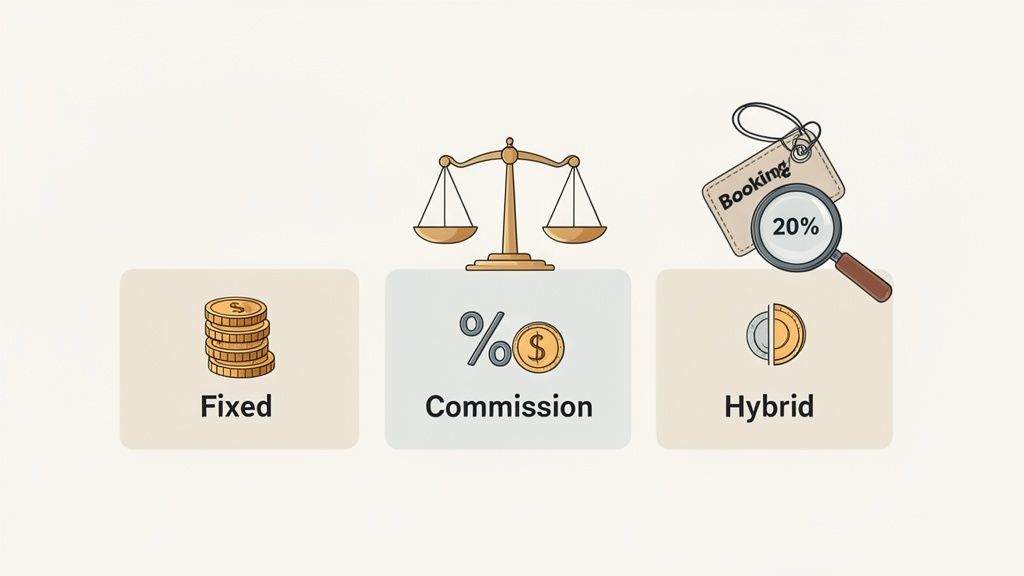
Alright, let's get straight to the question every host asks first: what’s this all going to cost me? When we first started looking for help, the different fee structures felt a bit overwhelming. But once you break them down, they generally fall into three simple categories.
The trick is finding a model that feels like a true partnership—one that aligns with your property's performance and your own financial goals.
The Commission-Based Model
This is the one you’ll see most often, and for good reason. The manager charges a percentage of the total booking revenue, which typically lands somewhere between 15% and 30%. Where you fall in that range depends on your market, the type of property you have, and how much work you’re handing over.
So, if your property brings in $4,000 in a month and the management fee is 20%, your manager takes home $800.
The upside: This model puts you and your manager on the same team. They’re directly motivated to maximize your revenue because when you make more, they make more. It also means you pay less during a slow month.
The downside: In peak season, that percentage can feel like a big chunk of change. You just need to be sure your manager is truly earning it with smart pricing and top-notch guest service.
The Fixed-Rate Model
Less common in the vacation rental world, some companies charge a flat monthly fee no matter what your property earns. This gives you predictable expenses, which is great for budgeting if your income is pretty steady year-round.
But because vacation rental income can swing wildly with the seasons, this model isn't always the best fit. It’s more suited for markets that have stable, year-round demand.
The Hybrid Model
Just like it sounds, the hybrid model is a mix of both. A manager might charge a lower base commission—say, 10-15%—and then add on fees for specific services. These à la carte items could be anything from coordinating a major repair to handling a deep clean.
In our experience managing properties, we've found that a great manager often pays for themselves. The increase in revenue from professional dynamic pricing and higher occupancy can easily cover—and even exceed—their commission.
Don't think of the fee as just a cost. It's an investment in expertise and, just as importantly, your time. A property that runs like a well-oiled machine earns better reviews, which drives more bookings. It's a positive feedback loop.
Watch Out for Hidden Costs
No matter which model you're considering, always read the fine print. Some proposals from Airbnb property management services look great on the surface but are loaded with hidden costs that can catch you by surprise.
Make sure you ask about these potential add-ons:
Onboarding Fees: A one-time charge to get your listing set up, which might cover things like professional photos, listing creation, and initial inspections.
Maintenance Markups: It's pretty standard for managers to add a percentage on top of vendor invoices for coordinating repairs, usually around 10-15%.
Restocking Fees: Charges for replenishing all those guest supplies like toiletries, coffee, and paper towels.
Termination Fees: A penalty you'll have to pay for ending your contract early.
Getting clear on these details from the start saves a lot of headaches later and builds a transparent partnership. For a deeper dive, check out our guide on the average property management cost per month. Understanding the total cost helps you accurately calculate your potential return and pick the right partner for your rental.
How to Measure Your Return on Investment
Bringing on an Airbnb property manager isn't just about handing over the keys to save time; it's a serious business move. So, how do you actually know if that investment is paying off? You have to look past the top-line revenue and dig into the numbers that reveal whether your manager is truly growing your business.
Think of it like this: your property is a small business, and you need to track its performance just like any other venture. The right partner should be actively improving your key metrics, not just keeping things afloat. Let's walk through the simple, practical ways to measure your ROI.
Tracking the Core Financial Metrics
First things first, you need to get comfortable with a few key performance indicators (KPIs) that are the bread and butter of the short-term rental world. Any good manager should be able to rattle these off without breaking a sweat.
Occupancy Rate: This one’s straightforward. It’s the percentage of nights your property was booked out of all the nights it was available. A high occupancy rate is a clear sign that your manager’s marketing and pricing game is strong.
Average Daily Rate (ADR): This tells you the average price your property booked for on any given night. You find it by dividing your total booking revenue by the number of nights booked. ADR shows you if your manager is smartly capitalizing on high-demand periods instead of just filling rooms cheaply.
Revenue Per Available Room (RevPAR): This is the gold standard because it blends both occupancy and ADR into one powerful number. To calculate your RevPAR, just multiply your ADR by your Occupancy Rate. It gives you the clearest, most honest picture of how effectively your property is generating cash.
These three metrics tell a complete story together. A manager might brag about a 95% occupancy rate, but if the ADR is rock-bottom, your actual earnings will suffer. A healthy RevPAR proves they’ve found that sweet spot—keeping the calendar full while still charging what your property is worth.
Beyond the Bank Statement: Guest Satisfaction
While the financial KPIs are critical, they only tell half the story. The real engine of long-term success in the short-term rental game is guest satisfaction. Happy guests leave five-star reviews, which skyrockets your listing in Airbnb’s search results and attracts even more bookings.
A great manager's impact is visible not just on your bank statement, but in your five-star reviews. These reviews are the social proof that drives future bookings and allows you to command higher nightly rates.
Your review score is a direct reflection of the guest experience your manager delivers. Consistent five-star ratings mean they’re nailing everything from communication and cleanliness to creating that welcoming vibe that makes people want to come back. That professional touch makes all the difference.
For instance, properties in well-supported, Airbnb-friendly buildings not only get significantly more views and leads but also achieve an average guest rating of 4.82 out of 5 stars, according to a recent company report. You can see more on how a professional setup impacts ratings in this report on Airbnb-friendly real estate.
A manager who consistently delivers exceptional experiences is building a sustainable business for you. If you want to dive deeper into the data side of things, check out our guide on how to use short-term rental analytics to really grow your business.
Red Flags to Watch For When Choosing a Management Partner
Choosing the wrong property manager can turn your investment into a bigger headache than hosting solo. We’ve learned some tough lessons over the years, and a few tell-tale signs now make us walk away from a potential partnership immediately. Think of this as your practical checklist for spotting trouble before you sign on the dotted line.
A polished website and a friendly sales pitch don’t always tell the whole story. The real test is how a company operates behind the scenes, and those initial conversations often reveal everything you need to know.
Vague Contracts and Hidden Fees
The management agreement should be crystal clear, not a maze of confusing legal jargon. If a potential partner can't give you a straightforward answer about every single line item in their contract, that’s a major red flag. A transparent partner will happily walk you through everything.
Pay close attention to these specific clauses:
Contract Length and Termination Policy: Be wary of long, unbreakable contracts. You should have a clear, fair exit path if the partnership isn't working out.
Owner Liability Clauses: Understand exactly what you are responsible for. A good contract protects both you and the manager.
Hidden Costs: Ask directly about onboarding fees, maintenance markups, and charges for restocking supplies. If they’re hesitant to provide a full fee schedule, it’s a sign that your monthly statements could be full of surprises.
A trustworthy partner wants you to understand the agreement completely. Ambiguity in a contract almost always benefits the person who wrote it, not the person signing it.
Poor Communication from the Start
How a company communicates during the sales process is a direct preview of how they'll communicate once they have your business. If they take days to respond to your initial inquiry or give you canned, unhelpful answers, imagine how they’ll treat a guest with an urgent issue at 2 AM.
Responsiveness is non-negotiable in this business. Slow replies can sink guest reviews and torpedo your listing's rank in Airbnb’s search results.
An Outdated or Non-Existent Tech Stack
In today's market, running a successful short-term rental without the right technology is like trying to navigate a new city without a map. A professional manager should be using modern tools to run their operation efficiently.
Ask them specifically about their tech stack:
Do they use dynamic pricing software to adjust your rates daily? Or do they just "set it and forget it"?
What Property Management System (PMS) do they use to prevent double bookings and automate messaging?
How do they coordinate cleaners? Do they use turnover software with checklists and photo verification?
A manager who relies on spreadsheets and a personal cell phone simply can't compete with one who uses dedicated software to optimize pricing, streamline turnovers, and provide seamless guest experiences. A lack of investment in technology is a clear sign of an operation that isn’t built to scale or perform at a high level.
Scaling Efficiently and Reducing Management Costs
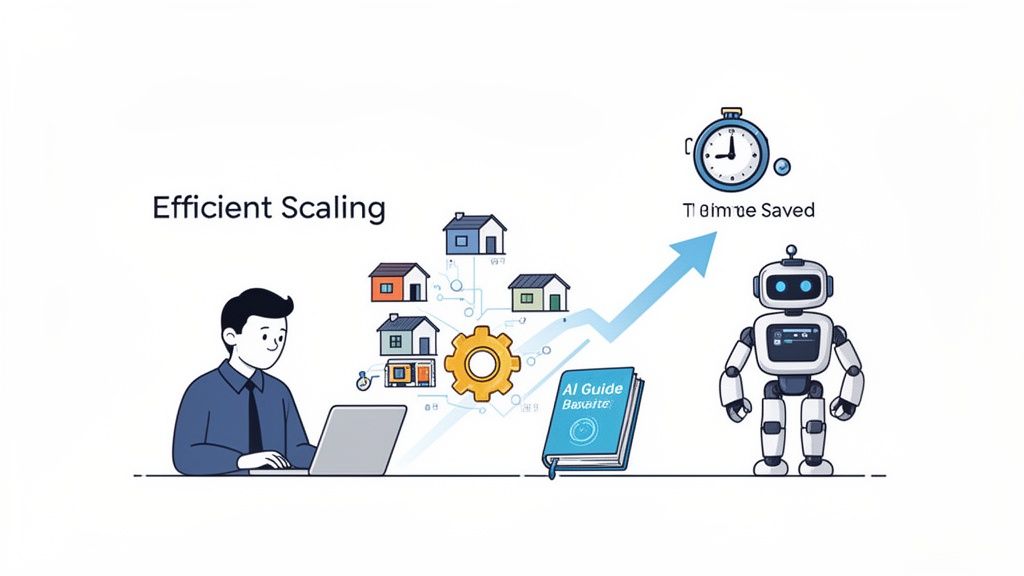
What if you want the polish of a professional operation without handing over 20-30% of your revenue? Not every host needs—or wants—to outsource their entire business. Sometimes, you just need a way to get the repetitive, time-consuming tasks off your plate.
This is where a hybrid, tech-first approach really shines. It's a smarter way to scale, blending your own hosting skills with targeted automation. You get to keep doing the parts you actually enjoy, like designing the space, while technology handles the grunt work.
We’ve found this to be an incredibly powerful strategy, especially when making the leap from one property to several. The goal isn't to work harder; it's to build a system that works for you.
Embracing Smart Automation
Let's be honest, the biggest time-sink in hosting is the endless stream of repetitive guest questions. "What's the Wi-Fi password?" "Where's the best place for tacos?" "How do I use the smart TV?" Answering the same things over and over is exhausting, whether it’s you or a paid manager doing the typing.
This is exactly where technology becomes your most valuable employee. By embracing smart automation, you can deliver a five-star experience without being chained to your phone 24/7.
A key part of scaling is finding ways to handle guest inquiries and interactions without your direct involvement. Exploring tools for automating customer service is a great first step. This frees you up to focus on growing your business, not just running it day-to-day.
The Power of an AI-Powered Guidebook
One of the most effective tools we've used is a digital guidebook powered by AI. Forget about clunky PDFs or a dusty binder that no one reads. A tool like SmoothStay acts as an interactive, on-demand concierge for your guests.
Here’s how it completely changes your workflow:
Automated Answers: An AI chatbot built right into the guidebook can instantly answer most common questions, dramatically cutting down your inbox traffic.
Centralized Information: All your property info—from check-in steps with photos to appliance tutorials and your curated local recommendations—lives in one easy-to-find place.
Customized Experience: You can create a beautiful, professional guidebook that matches your brand, making you look like a seasoned pro, even if you’re managing everything yourself.
By automating the routine, you free yourself to focus on the personal touches that create memorable stays and earn glowing reviews. Technology handles the predictable, so you can handle the exceptional.
By picking the right tools, you can build a scalable hosting business on your own terms. You get the professional results of a full-service agency while keeping more of your hard-earned revenue. It’s all about creating a system that gives you the freedom to grow without the burnout.
Your Questions About Property Management, Answered
Alright, let's wrap this up by tackling some of the big questions we hear all the time from hosts who are on the fence about hiring help. We'll pull from everything we’ve covered to give you straight, honest answers to help you make that final call with confidence.
What Percentage Do Most Airbnb Property Managers Charge?
The most common model you'll run into is a commission based on your booking revenue. You can generally expect this to land somewhere between 15% and 30%.
But that number isn't pulled out of thin air. The exact percentage really depends on a few things:
Scope of Services: Are you looking for a completely hands-off, full-service package? That'll be on the higher end. If you just need help with a few specific tasks, you might find à la carte options with different pricing.
Your Market: A bustling city center or a hot vacation destination will have different standard rates than a quiet, rural spot.
Property Type: Let's be real—a luxury villa with a pool and a hot tub demands a lot more attention than a small studio apartment. The fee will reflect that extra work.
Our advice? Always ask for a crystal-clear breakdown of what that percentage actually covers. You don't want any surprises showing up on your statement later.
Is Hiring a Property Manager for My Airbnb Worth It?
This is the million-dollar question, isn't it? Based on our experience, the answer is almost always "yes." It becomes worth it the moment the value you get back is greater than the fee you pay out. And that value isn't just about money—it's about your time, your sanity, and your peace of mind.
Think of it this way: a great manager can often boost your revenue through expert pricing and higher occupancy enough to completely cover their own fee. You might break even on cost, but you come out way ahead in reclaimed weekends and dramatically less stress.
At the end of the day, it's a strategic move for your business. If your goal is to grow your portfolio, create truly passive income, or just get your life back, then bringing in a professional is one of the smartest investments you can make.
Can I Use a Property Manager If I Live Far Away?
Absolutely. In fact, this is one of the top reasons hosts seek out Airbnb property management services in the first place. Trying to manage a rental remotely without any local support isn't just tough—it's a recipe for disaster.
A local manager is your essential "boots on the ground." They're the ones who can handle a guest emergency at 2 AM, oversee a plumbing repair, and make sure your property is sparkling clean for the next arrival. This kind of partnership makes owning a rental in another state, or even another country, not just possible, but profitable and genuinely stress-free.
Ready to streamline your hosting and give your guests a five-star experience without the endless questions? SmoothStay helps you create beautiful, AI-powered digital guidebooks that cut down on repetitive inquiries and boost your reviews. It's built by hosts, for hosts.